 Add to Chrome
 Add to Firefox
 Add to Edge
SSPO: Structure-Aware Similarity-Weighted Preference Optimization for Neural Combinatorial Optimization
Aug 12, 2026
Neural combinatorial optimization (NCO) relies on parallel solution sampling for training, yet existing methods fail to fully exploit the rich information latent in a co-sampled solution group. Preference-optimization methods anchor on the single best solution and discard fine-grained quality and structural signal from all other peers-a failure we term gradient signal polarization. Mean-based baselines instead weight peers uniformly, so structurally near-identical peers flood the baseline with redundant information and keep gradient variance high-a failure we term baseline redundancy. We propose SSPO (Structure-Aware Similarity-Weighted Preference Optimization), which scores all $B$ sampled solutions jointly through a dissimilarity-weighted leave-one-out baseline: structurally distinct peers receive higher weight, resolving both failures in a single mechanism. The baseline uses zero-parameter, problem-adaptive solution embeddings built from the encoder's existing node representations. Experiments on TSP, EFL, and JSP benchmarks show consistent gains over prior best-anchor and uniform-weight baselines. A direct comparison against uniform RLOO on TSP and EFL confirms that structure-aware weighting is the primary driver of improvement. The SSPO-trained EFL policy has been deployed in a production facility-location system at JD$\mathord{.}$com, confirming practical viability at scale.

Large Language Model for Operations Research Formulation Selection in Multi-Warehouse Inventory Allocation
Jul 28, 2026Multi-warehouse inventory allocation is typically formulated as a mixed-integer programming (MIP) problem, yet no single formulation consistently matches heterogeneous instance-level regimes induced by demand concentration, inventory imbalance, replenishment scale, service constraints, and forecast volatility. We study this issue as instance-wise operations research (OR) formulation selection, where each allocation instance is assigned to a solver-executable formulation from a candidate OR expert library. We propose a solver-guided large language model (LLM) framework for OR formulation selection, in which each OR expert corresponds to a MIP formulation encoding a distinct allocation priority. To train the selector, the framework first constructs balanced expert-conditioned supervised fine-tuning (SFT) records for schema learning, and then uses MIP solver evaluation on historical instances to convert solver-evaluated allocation-quality gaps into margin-weighted identity preference optimization (IPO) preferences and per-instance expert-score metadata for reward lookup during group relative policy optimization (GRPO) to assign rewards to sampled responses. Experiments on multi-warehouse inventory allocation instances from JD$\mathord{.}$com, one of China's largest e-retailers, demonstrate that GRPO substantially improves expert-selection accuracy relative to the SFT+IPO selector and, more importantly, produces higher realized allocation quality than both the preference-trained selector and the best fixed formulation. With GRPO, Hit Ratio@1 and Hit Ratio@2 increase from 21.45% to 50.42% and from 70.47% to 82.31%. The resulting selector achieves an allocation accuracy gain of 12.57 percentage points over the incumbent baseline, outperforming both the SFT+IPO selector and the best fixed OR expert, and reduces the gap to the ex-post oracle to 4.85 percentage points.
SPORD: A Simulation-Propose-then-OR-Dispose Approach for Supply Chain Planning
Jul 23, 2026For years, supply chain planning at e-commerce firms has operated as a collection of isolated projects. Each planning task from static network planning to dynamic warehouse assortment planning requires analysts to spend weeks building models from scratch, calibrating and persuading executives to act on outputs they cannot verify. Three barriers drive this: bespoke models proliferate because standardization is difficult (operational fragmentation); once unified, the combinatorial scale of millions of SKUs, thousands of nodes, and intricate routing logic exceeds what solvers can handle within a tight window (computational intractability); and a mathematically optimal solution still fails to be implemented if the executives do not trust it (implementation hurdle). To bridge this gap, we propose and implement the Simulation-Propose-then-OR-Dispose method, deployed as JD.com's NetSim platform. The central insight is decoupling: simulation proposes by generating and evaluating the full set of operationally valid candidate paths-absorbing all idiosyncratic business logic, while an integer program disposes by selecting the globally optimal subset. Computationally, matrix-vectorized CPU/GPU accelerated simulation achieves a 10-100 times speedup over serial methods, and a list scheduling algorithm reduces coupled-order processing from hours to minutes. Operationally, we establish a closed loop via an intelligent diagnosis engine. Since 2025, NetSim has optimized end to-end services for over 20,000 suppliers, the cross-regional fulfillment rate dropped from 6.1% to 4.9%, and the average monthly carbon reduction is approximately 5,745 tCO2e. SPORD moves simulation from monitoring to active planning. The transparent outputs turn skeptical executives into engaged collaborators, and the modular architecture ensures that the next planning requires just configuration, not reconstruction.
Solver-Verified Formulation Generation and Selection for Multi-Warehouse Inventory Allocation Using Large Language Models
Jun 28, 2026Balance-oriented multi-warehouse inventory allocation is a recurring decision problem in large-scale e-commerce supply chains, in which a fixed replenishment quantity is distributed across warehouses to balance post-allocation inventory coverage while accounting for demand forecasts and heterogeneous allocation constraints. In practice, allocation requirements are often scenario-dependent and expressed in semi-structured or natural-language form rather than as ready-to-solve operations research (OR) formulations. We propose an OR-guided Large Language Model (LLM) for Allocation (ORLA) that uses solver feedback to generate, verify, and select OR formulations. ORLA integrates automatic "Problem-Model-Code (PMC)" generation, learning-based formulation selection, and feasibility restoration. We develop three complementary mixed-integer programming formulation families based on deviation minimization, soft band compliance, and knapsack-inspired allocation, together with solver-ready mixed-integer linear programming reformulations, modular constraint extensions, and a penalty-based relaxation mechanism for infeasible cases. The LLM component generates candidate formulations and executable solver code from textual or semi-structured specifications, while the solver provides verification signals for executability, feasibility, and solution quality. To address instance heterogeneity, ORLA estimates the expected quality of candidate formulations, selects promising candidates, and combines their outputs through score-aware aggregation. Experimental results on 29 production evaluation batches from JD.com show that the best single OR formulation improves allocation accuracy by 3.4 percentage points over the incumbent approach, while the full ORLA framework achieves a 4.5 percentage-point overall improvement and improves allocation accuracy in 26 of the 29 evaluation batches.
ORPR: An OR-Guided Pretrain-then-Reinforce Learning Model for Inventory Management
Dec 22, 2025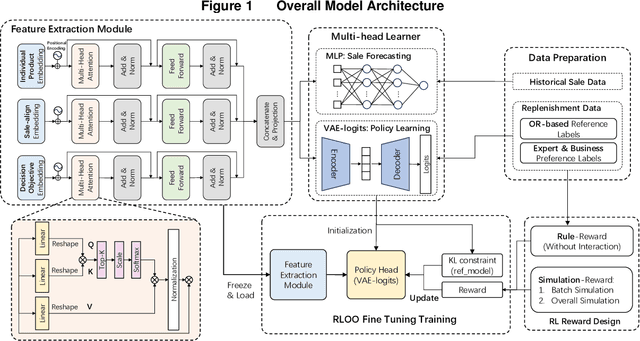
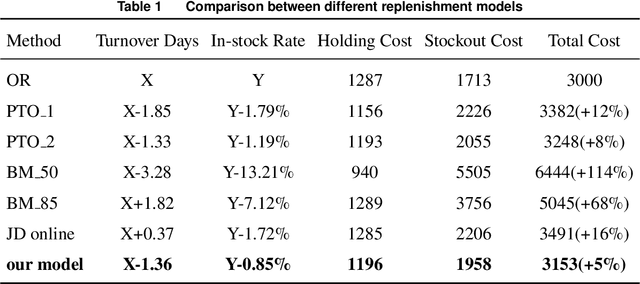
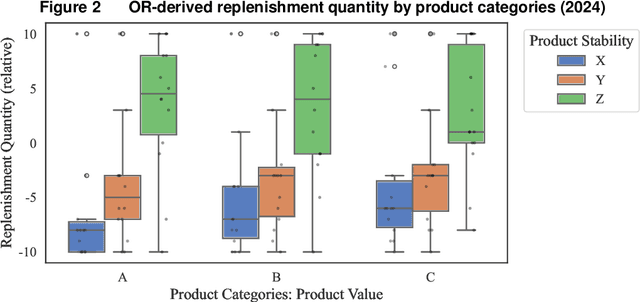
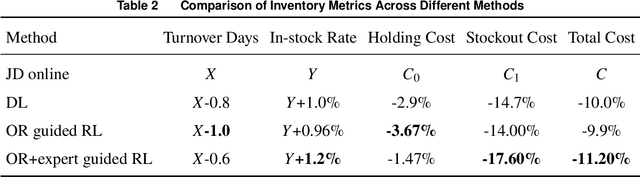
As the pursuit of synergy between Artificial Intelligence (AI) and Operations Research (OR) gains momentum in handling complex inventory systems, a critical challenge persists: how to effectively reconcile AI's adaptive perception with OR's structural rigor. To bridge this gap, we propose a novel OR-Guided "Pretrain-then-Reinforce" framework. To provide structured guidance, we propose a simulation-augmented OR model that generates high-quality reference decisions, implicitly capturing complex business constraints and managerial preferences. Leveraging these OR-derived decisions as foundational training labels, we design a domain-informed deep learning foundation model to establish foundational decision-making capabilities, followed by a reinforcement learning (RL) fine-tuning stage. Uniquely, we position RL as a deep alignment mechanism that enables the AI agent to internalize the optimality principles of OR, while simultaneously leveraging exploration for general policy refinement and allowing expert guidance for scenario-specific adaptation (e.g., promotional events). Validated through extensive numerical experiments and a field deployment at JD.com augmented by a Difference-in-Differences (DiD) analysis, our model significantly outperforms incumbent industrial practices, delivering real-world gains of a 5.27-day reduction in turnover and a 2.29% increase in in-stock rates, alongside a 29.95% decrease in holding costs. Contrary to the prevailing trend of brute-force model scaling, our study demonstrates that a lightweight, domain-informed model can deliver state-of-the-art performance and robust transferability when guided by structured OR logic. This approach offers a scalable and cost-effective paradigm for intelligent supply chain management, highlighting the value of deeply aligning AI with OR.
Leveraging LLM-Based Agents for Intelligent Supply Chain Planning
Sep 04, 2025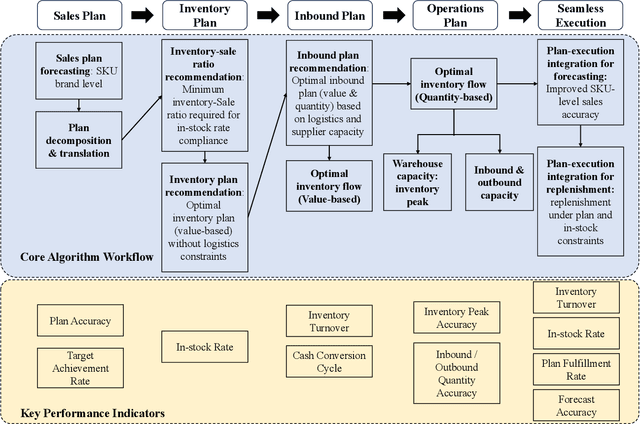
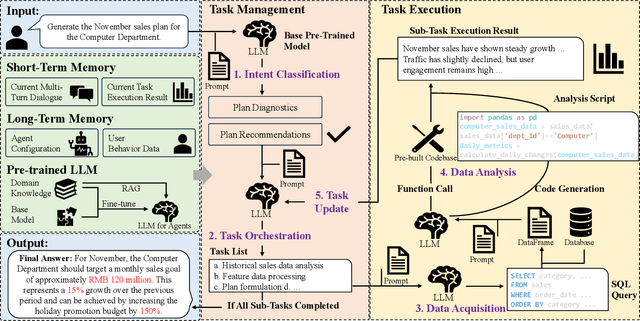
In supply chain management, planning is a critical concept. The movement of physical products across different categories, from suppliers to warehouse management, to sales, and logistics transporting them to customers, entails the involvement of many entities. It covers various aspects such as demand forecasting, inventory management, sales operations, and replenishment. How to collect relevant data from an e-commerce platform's perspective, formulate long-term plans, and dynamically adjust them based on environmental changes, while ensuring interpretability, efficiency, and reliability, is a practical and challenging problem. In recent years, the development of AI technologies, especially the rapid progress of large language models, has provided new tools to address real-world issues. In this work, we construct a Supply Chain Planning Agent (SCPA) framework that can understand domain knowledge, comprehend the operator's needs, decompose tasks, leverage or create new tools, and return evidence-based planning reports. We deploy this framework in JD.com's real-world scenario, demonstrating the feasibility of LLM-agent applications in the supply chain. It effectively reduced labor and improved accuracy, stock availability, and other key metrics.
TimeHF: Billion-Scale Time Series Models Guided by Human Feedback
Jan 27, 2025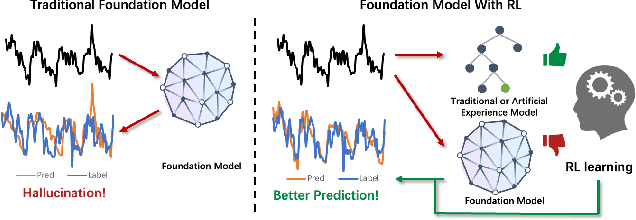
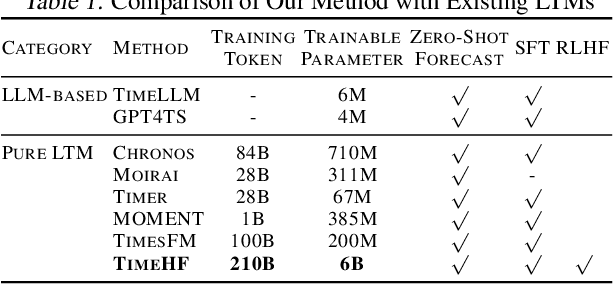

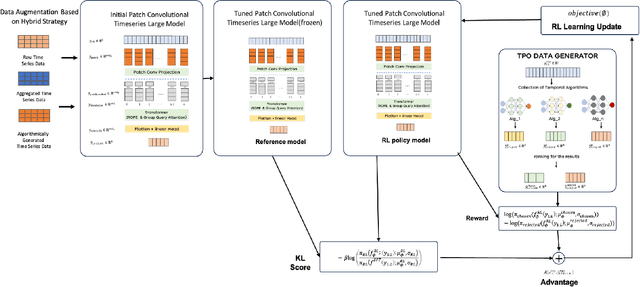
Time series neural networks perform exceptionally well in real-world applications but encounter challenges such as limited scalability, poor generalization, and suboptimal zero-shot performance. Inspired by large language models, there is interest in developing large time series models (LTM) to address these issues. However, current methods struggle with training complexity, adapting human feedback, and achieving high predictive accuracy. We introduce TimeHF, a novel pipeline for creating LTMs with 6 billion parameters, incorporating human feedback. We use patch convolutional embedding to capture long time series information and design a human feedback mechanism called time-series policy optimization. Deployed in JD.com's supply chain, TimeHF handles automated replenishment for over 20,000 products, improving prediction accuracy by 33.21% over existing methods. This work advances LTM technology and shows significant industrial benefits.
sTransformer: A Modular Approach for Extracting Inter-Sequential and Temporal Information for Time-Series Forecasting
Aug 19, 2024In recent years, numerous Transformer-based models have been applied to long-term time-series forecasting (LTSF) tasks. However, recent studies with linear models have questioned their effectiveness, demonstrating that simple linear layers can outperform sophisticated Transformer-based models. In this work, we review and categorize existing Transformer-based models into two main types: (1) modifications to the model structure and (2) modifications to the input data. The former offers scalability but falls short in capturing inter-sequential information, while the latter preprocesses time-series data but is challenging to use as a scalable module. We propose $\textbf{sTransformer}$, which introduces the Sequence and Temporal Convolutional Network (STCN) to fully capture both sequential and temporal information. Additionally, we introduce a Sequence-guided Mask Attention mechanism to capture global feature information. Our approach ensures the capture of inter-sequential information while maintaining module scalability. We compare our model with linear models and existing forecasting models on long-term time-series forecasting, achieving new state-of-the-art results. We also conducted experiments on other time-series tasks, achieving strong performance. These demonstrate that Transformer-based structures remain effective and our model can serve as a viable baseline for time-series tasks.
Improving Accuracy Without Losing Interpretability: A ML Approach for Time Series Forecasting
Dec 13, 2022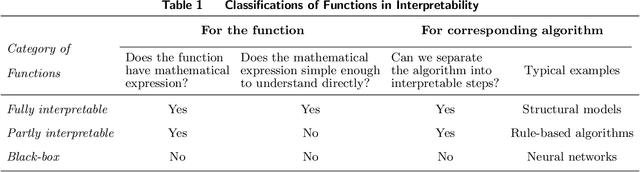

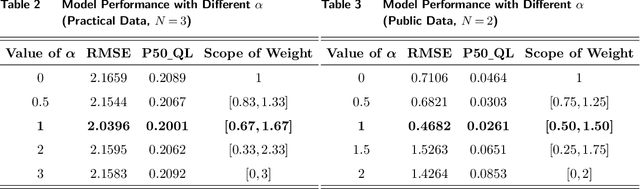

In time series forecasting, decomposition-based algorithms break aggregate data into meaningful components and are therefore appreciated for their particular advantages in interpretability. Recent algorithms often combine machine learning (hereafter ML) methodology with decomposition to improve prediction accuracy. However, incorporating ML is generally considered to sacrifice interpretability inevitably. In addition, existing hybrid algorithms usually rely on theoretical models with statistical assumptions and focus only on the accuracy of aggregate predictions, and thus suffer from accuracy problems, especially in component estimates. In response to the above issues, this research explores the possibility of improving accuracy without losing interpretability in time series forecasting. We first quantitatively define interpretability for data-driven forecasts and systematically review the existing forecasting algorithms from the perspective of interpretability. Accordingly, we propose the W-R algorithm, a hybrid algorithm that combines decomposition and ML from a novel perspective. Specifically, the W-R algorithm replaces the standard additive combination function with a weighted variant and uses ML to modify the estimates of all components simultaneously. We mathematically analyze the theoretical basis of the algorithm and validate its performance through extensive numerical experiments. In general, the W-R algorithm outperforms all decomposition-based and ML benchmarks. Based on P50_QL, the algorithm relatively improves by 8.76% in accuracy on the practical sales forecasts of JD.com and 77.99% on a public dataset of electricity loads. This research offers an innovative perspective to combine the statistical and ML algorithms, and JD.com has implemented the W-R algorithm to make accurate sales predictions and guide its marketing activities.