 Add to Chrome
 Add to Firefox
 Add to Edge
Solver-Verified Formulation Generation and Selection for Multi-Warehouse Inventory Allocation Using Large Language Models
Jun 28, 2026
Balance-oriented multi-warehouse inventory allocation is a recurring decision problem in large-scale e-commerce supply chains, in which a fixed replenishment quantity is distributed across warehouses to balance post-allocation inventory coverage while accounting for demand forecasts and heterogeneous allocation constraints. In practice, allocation requirements are often scenario-dependent and expressed in semi-structured or natural-language form rather than as ready-to-solve operations research (OR) formulations. We propose an OR-guided Large Language Model (LLM) for Allocation (ORLA) that uses solver feedback to generate, verify, and select OR formulations. ORLA integrates automatic "Problem-Model-Code (PMC)" generation, learning-based formulation selection, and feasibility restoration. We develop three complementary mixed-integer programming formulation families based on deviation minimization, soft band compliance, and knapsack-inspired allocation, together with solver-ready mixed-integer linear programming reformulations, modular constraint extensions, and a penalty-based relaxation mechanism for infeasible cases. The LLM component generates candidate formulations and executable solver code from textual or semi-structured specifications, while the solver provides verification signals for executability, feasibility, and solution quality. To address instance heterogeneity, ORLA estimates the expected quality of candidate formulations, selects promising candidates, and combines their outputs through score-aware aggregation. Experimental results on 29 production evaluation batches from JD.com show that the best single OR formulation improves allocation accuracy by 3.4 percentage points over the incumbent approach, while the full ORLA framework achieves a 4.5 percentage-point overall improvement and improves allocation accuracy in 26 of the 29 evaluation batches.

Leveraging LLM-Based Agents for Intelligent Supply Chain Planning
Sep 04, 2025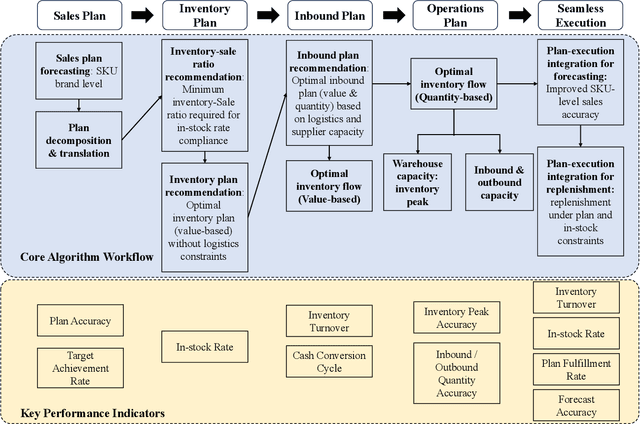
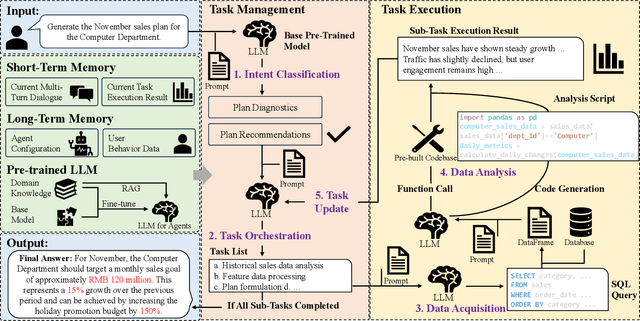
In supply chain management, planning is a critical concept. The movement of physical products across different categories, from suppliers to warehouse management, to sales, and logistics transporting them to customers, entails the involvement of many entities. It covers various aspects such as demand forecasting, inventory management, sales operations, and replenishment. How to collect relevant data from an e-commerce platform's perspective, formulate long-term plans, and dynamically adjust them based on environmental changes, while ensuring interpretability, efficiency, and reliability, is a practical and challenging problem. In recent years, the development of AI technologies, especially the rapid progress of large language models, has provided new tools to address real-world issues. In this work, we construct a Supply Chain Planning Agent (SCPA) framework that can understand domain knowledge, comprehend the operator's needs, decompose tasks, leverage or create new tools, and return evidence-based planning reports. We deploy this framework in JD.com's real-world scenario, demonstrating the feasibility of LLM-agent applications in the supply chain. It effectively reduced labor and improved accuracy, stock availability, and other key metrics.
PixelsDB: Serverless and Natural-Language-Aided Data Analytics with Flexible Service Levels and Prices
May 30, 2024Serverless query processing has become increasingly popular due to its advantages, including automated hardware and software management, high elasticity, and pay-as-you-go pricing. For users who are not system experts, serverless query processing greatly reduces the cost of owning a data analytic system. However, it is still a significant challenge for non-expert users to transform their complex and evolving data analytic needs into proper SQL queries and select a serverless query engine that delivers satisfactory performance and price for each type of query. This paper presents PixelsDB, an open-source data analytic system that allows users who lack system or SQL expertise to explore data efficiently. It allows users to generate and debug SQL queries using a natural language interface powered by fine-tuned language models. The queries are then executed by a serverless query engine that offers varying prices for different service levels on query urgency. The service levels are natively supported by dedicated architecture design and heterogeneous resource scheduling that can apply cost-efficient resources to process non-urgent queries. We envision that the combination of a serverless paradigm, a natural-language-aided interface, and flexible service levels and prices will substantially improve the user experience in data analysis.