 Add to Chrome
 Add to Firefox
 Add to Edge
Cognitive World Models for Process-Level Social Influence Evaluation
Jun 28, 2026
Social influence dialogue changes user behavior by altering internal cognitive states. The central evaluation question is whether the user's beliefs, desires, intentions, and emotions measurably change over the course of conversation, a process-oriented criterion that neither surface-level text metrics (BLEU/ROUGE) nor single-score LLM judgments can capture. We propose the \textbf{Cog}nitive \textbf{W}orld \textbf{M}odel \textbf{(CogWM)}, an LLM-based user model that reframes multi-turn dialogue evaluation from ``what did the user say'' to ``how did the user's internal cognitive state evolves.'' CogWM jointly predicts BDI/E cognitive states and user utterances and serves as both a user simulator and an evaluation platform, using a three-tier evaluation framework that covers turn-level fidelity, trajectory-level state dynamics, and task-level composite scoring. Trained via our \textbf{S}ummarize-\textbf{a}nd-\textbf{A}llocate \textbf{(SaA)} annotation pipeline on 150,454 user-turn samples across four social influence scenarios, CogWM achieves 77.6\% emotion accuracy (2.1$\times$ over GPT-5.5). In 3600 multi-agent discrimination trials, it distinguishes six commercial agents by their cognitive influence, with Llama-4-Scout ranking first (CTS +0.233). CogWM moves social influence dialogue evaluation from terminal judgment to process tracking. We have released our code\footnote{\scriptsize Code: https://github.com/lucianma05-create/CogWM} and models\footnote{Model: https://www.modelscope.cn/models/LucianMa/CogWM-14B}.

Think Thrice Before You Speak: Dual knowledge-enhanced Theory-of-Mind Reasoning for Persuasive Agents
May 21, 2026Persuasive dialogue requires reasoning about others' latent mental states, a capability known as Theory of Mind (ToM). However, due to reliance on simple prompting strategies and insufficient ToM knowledge, existing LLMs often fail to capture the intrinsic dependencies among mental states, leading to fragmented representations and unstable reasoning. To address these challenges, we introduce the ToM-based Persuasive Dialogue (ToM-PD) task, grounded in the Belief-Desire-Intention (BDI) framework, which explicitly models the sequential dependencies among mental states in multi-turn dialogues. To facilitate research on this task, we construct a large-scale annotated dataset, ToM-based Broad Persuasive Dialogues (ToM-BPD), capturing fine-grained mental states and corresponding persuasive strategies. We further propose Think Thrice Before You Speak (TTBYS), a knowledge-enhanced stepwise reasoning framework that leverages both explicit and implicit prior experiences to improve LLMs' inference of desires, beliefs, and persuasive strategies. Experimental results demonstrate that Qwen3-8B equipped with TTBYS outperforms GPT-5 by 1.20%, 22.80%, and 16.97% in predicting desires, beliefs, and persuasive strategies, respectively. Case studies further show that our approach enhances interpretability and consistency in reasoning.
A Benchmark and Multi-Agent System for Instruction-driven Cinematic Video Compilation
Apr 12, 2026The surging demand for adapting long-form cinematic content into short videos has motivated the need for versatile automatic video compilation systems. However, existing compilation methods are limited to predefined tasks, and the community lacks a comprehensive benchmark to evaluate the cinematic compilation. To address this, we introduce CineBench, the first benchmark for instruction-driven cinematic video compilation, featuring diverse user instructions and high-quality ground-truth compilations annotated by professional editors. To overcome contextual collapse and temporal fragmentation, we present CineAgents, a multi-agent system that reformulates cinematic video compilation into ``design-and-compose'' paradigm. CineAgents performs script reverse-engineering to construct a hierarchical narrative memory to provide multi-level context and employs an iterative narrative planning process that refines a creative blueprint into a final compiled script. Extensive experiments demonstrate that CineAgents significantly outperforms existing methods, generating compilations with superior narrative coherence and logical coherence.
AndroTMem: From Interaction Trajectories to Anchored Memory in Long-Horizon GUI Agents
Mar 19, 2026Long-horizon GUI agents are a key step toward real-world deployment, yet effective interaction memory under prevailing paradigms remains under-explored. Replaying full interaction sequences is redundant and amplifies noise, while summaries often erase dependency-critical information and traceability. We present AndroTMem, a diagnostic framework for anchored memory in long-horizon Android GUI agents. Its core benchmark, AndroTMem-Bench, comprises 1,069 tasks with 34,473 interaction steps (avg. 32.1 per task, max. 65). We evaluate agents with TCR (Task Complete Rate), focusing on tasks whose completion requires carrying forward critical intermediate state; AndroTMem-Bench is designed to enforce strong step-to-step causal dependencies, making sparse yet essential intermediate states decisive for downstream actions and centering interaction memory in evaluation. Across open- and closed-source GUI agents, we observe a consistent pattern: as interaction sequences grow longer, performance drops are driven mainly by within-task memory failures, not isolated perception errors or local action mistakes. Guided by this diagnosis, we propose Anchored State Memory (ASM), which represents interaction sequences as a compact set of causally linked intermediate-state anchors to enable subgoal-targeted retrieval and attribution-aware decision making. Across multiple settings and 12 evaluated GUI agents, ASM consistently outperforms full-sequence replay and summary-based baselines, improving TCR by 5%-30.16% and AMS by 4.93%-24.66%, indicating that anchored, structured memory effectively mitigates the interaction-memory bottleneck in long-horizon GUI tasks. The code, benchmark, and related resources are publicly available at [https://github.com/CVC2233/AndroTMem](https://github.com/CVC2233/AndroTMem).
Audio-sync Video Instance Editing with Granularity-Aware Mask Refiner
Dec 11, 2025
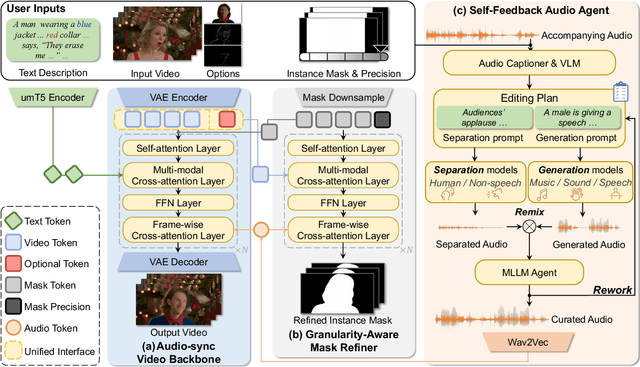
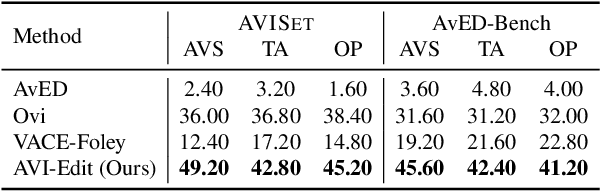

Recent advancements in video generation highlight that realistic audio-visual synchronization is crucial for engaging content creation. However, existing video editing methods largely overlook audio-visual synchronization and lack the fine-grained spatial and temporal controllability required for precise instance-level edits. In this paper, we propose AVI-Edit, a framework for audio-sync video instance editing. We propose a granularity-aware mask refiner that iteratively refines coarse user-provided masks into precise instance-level regions. We further design a self-feedback audio agent to curate high-quality audio guidance, providing fine-grained temporal control. To facilitate this task, we additionally construct a large-scale dataset with instance-centric correspondence and comprehensive annotations. Extensive experiments demonstrate that AVI-Edit outperforms state-of-the-art methods in visual quality, condition following, and audio-visual synchronization. Project page: https://hjzheng.net/projects/AVI-Edit/.
PanoWan: Lifting Diffusion Video Generation Models to 360° with Latitude/Longitude-aware Mechanisms
May 28, 2025Panoramic video generation enables immersive 360{\deg} content creation, valuable in applications that demand scene-consistent world exploration. However, existing panoramic video generation models struggle to leverage pre-trained generative priors from conventional text-to-video models for high-quality and diverse panoramic videos generation, due to limited dataset scale and the gap in spatial feature representations. In this paper, we introduce PanoWan to effectively lift pre-trained text-to-video models to the panoramic domain, equipped with minimal modules. PanoWan employs latitude-aware sampling to avoid latitudinal distortion, while its rotated semantic denoising and padded pixel-wise decoding ensure seamless transitions at longitude boundaries. To provide sufficient panoramic videos for learning these lifted representations, we contribute PanoVid, a high-quality panoramic video dataset with captions and diverse scenarios. Consequently, PanoWan achieves state-of-the-art performance in panoramic video generation and demonstrates robustness for zero-shot downstream tasks.
The Future of Cognitive Strategy-enhanced Persuasive Dialogue Agents: New Perspectives and Trends
Feb 07, 2024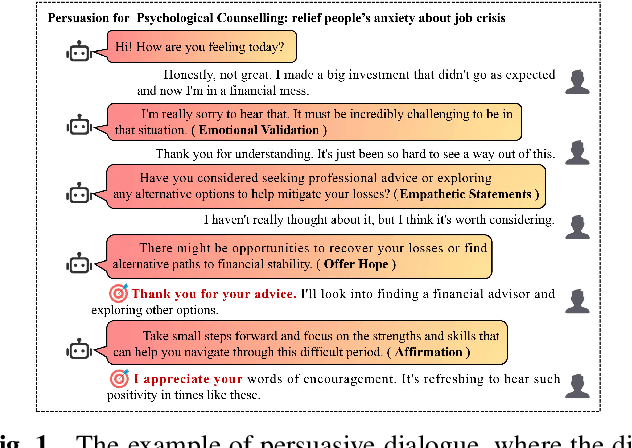
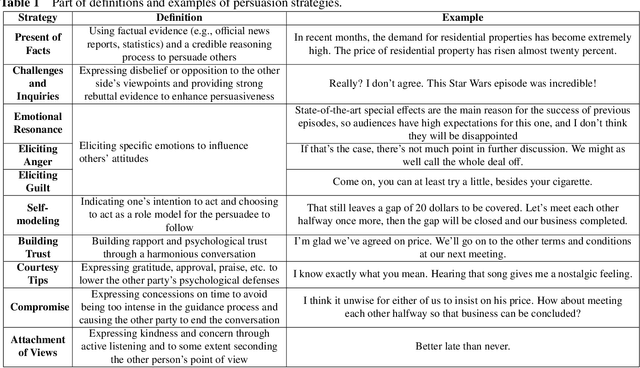
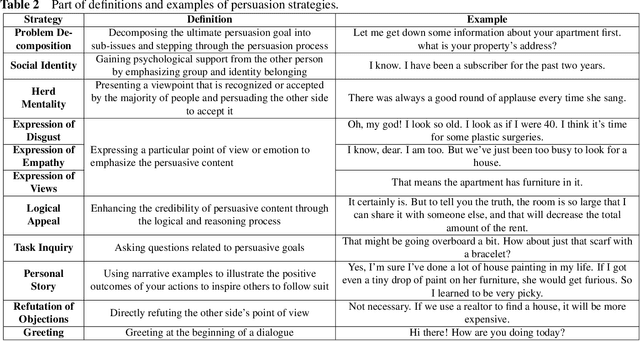
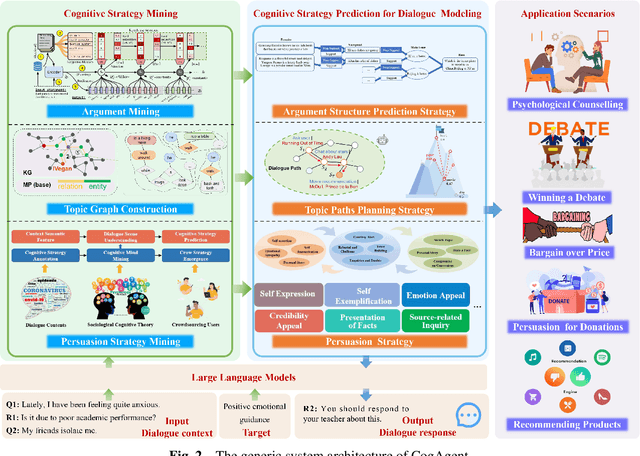
Persuasion, as one of the crucial abilities in human communication, has garnered extensive attention from researchers within the field of intelligent dialogue systems. We humans tend to persuade others to change their viewpoints, attitudes or behaviors through conversations in various scenarios (e.g., persuasion for social good, arguing in online platforms). Developing dialogue agents that can persuade others to accept certain standpoints is essential to achieving truly intelligent and anthropomorphic dialogue system. Benefiting from the substantial progress of Large Language Models (LLMs), dialogue agents have acquired an exceptional capability in context understanding and response generation. However, as a typical and complicated cognitive psychological system, persuasive dialogue agents also require knowledge from the domain of cognitive psychology to attain a level of human-like persuasion. Consequently, the cognitive strategy-enhanced persuasive dialogue agent (defined as CogAgent), which incorporates cognitive strategies to achieve persuasive targets through conversation, has become a predominant research paradigm. To depict the research trends of CogAgent, in this paper, we first present several fundamental cognitive psychology theories and give the formalized definition of three typical cognitive strategies, including the persuasion strategy, the topic path planning strategy, and the argument structure prediction strategy. Then we propose a new system architecture by incorporating the formalized definition to lay the foundation of CogAgent. Representative works are detailed and investigated according to the combined cognitive strategy, followed by the summary of authoritative benchmarks and evaluation metrics. Finally, we summarize our insights on open issues and future directions of CogAgent for upcoming researchers.