 Add to Chrome
 Add to Firefox
 Add to Edge
Every Packet Counts: Dispersing Information for Loss-Resilient Learned Image Compression
Aug 11, 2026
Learned image compression (LIC) has achieved impressive rate-distortion performance. However, existing methods remain highly vulnerable to packet loss, a common challenge in satellite and emergency communications. This vulnerability stems from non-uniform information distribution at the packetization stage and sequential decoding dependencies at the entropy coding stage. We propose an end-to-end loss-resilient image compression scheme that addresses both. Before packetization, we introduce an Inter-Channel Redistribution (ICR) mechanism to redistribute channel energy, preventing critical information concentrating in a small subset of channels. Then, an Interleaved Channel Grouping (ICG) strategy partitions latent channels in a strided manner to disperse information across packets, with each packet kept within constrained sizes. To limit cascading errors from lost packets, we adopt a two-layer dual-branch autoregressive structure to shorten the dependency chain. Extensive experiments demonstrate that our method consistently outperforms existing approaches in both reconstruction quality and stability. At 20% packet loss, it achieves an average PSNR gain of 1.84 dB over LossResilientLIC while reducing PSNR variance by an order of magnitude. Notably, trained under uniform random loss only, our model generalizes to bursty loss modeled by the Gilbert-Elliott channel, outperforming methods explicitly trained for such conditions.

SpeedyGS: Content-Aware 3D Gaussian Splatting Compression via Two-Stage Optimization
Jul 14, 2026Recent progress in compressing large-scale 3D Gaussian Splatting (3DGS) data has substantially reduced storage footprint, network transmission bandwidth, and memory traffic to GPU caches before rendering. Yet decoding with advanced 3DGS codecs still takes seconds, making them unsuitable for interactive applications. To systematically address this challenge, we propose SpeedyGS, a Content-Aware 3DGS Compressor that separately optimizes the structural formation and statistical coding. First, in structural formation, we jointly optimize adaptive quantization and pruning under a unified rate-distortion objective, where the rate term is replaced by a lightweight rate proxy that estimates entropy coding cost of the next stage, thereby efficiently regulating Gaussian density and precision to yield a compact scene representation. Then, in the statistical coding phase, Gaussian geometry is converted into sparse octree tokens and subsequently undergoes multi-stage coding, while Gaussian attributes are serialized into a 1D token stream for entropy coding via a complexity-controllable local autoregressive model. SpeedyGS achieves a favorable balance among optimization efficiency, compression performance, decoding latency, and rendering speed. Compared to vanilla 3DGS, SpeedyGS achieves up to 160$\times$ model size reduction with negligible quality degradation across common datasets. Compared to state-of-the-art compression methods, it also offers significantly faster decoding and accelerates optimization by 9$\times$ on consumer-grade hardware. To further reduce decoding overhead, the statistical coding stage also supports channel-wise, fixed-length coding for Gaussian as a simpler alternative, enabling SpeedyGS to better adapt to the underlying application and reduce decoding latency to nearly zero.
Mobile GUI Agent Privacy Personalization with Trajectory Induced Preference Optimization
Apr 13, 2026Mobile GUI agents powered by Multimodal Large Language Models (MLLMs) can execute complex tasks on mobile devices. Despite this progress, most existing systems still optimize task success or efficiency, neglecting users' privacy personalization. In this paper, we study the often-overlooked problem of agent personalization. We observe that personalization can induce systematic structural heterogeneity in execution trajectories. For example, privacy-first users often prefer protective actions, e.g., refusing permissions, logging out, and minimizing exposure, leading to logically different execution trajectories from utility-first users. Such variable-length and structurally different trajectories make standard preference optimization unstable and less informative. To address this issue, we propose Trajectory Induced Preference Optimization (TIPO), which uses preference-intensity weighting to emphasize key privacy-related steps and padding gating to suppress alignment noise. Results on our Privacy Preference Dataset show that TIPO improves persona alignment and distinction while preserving strong task executability, achieving 65.60% SR, 46.22 Compliance, and 66.67% PD, outperforming existing optimization methods across various GUI tasks. The code and dataset will be publicly released at https://github.com/Zhixin-L/TIPO.
AndroTMem: From Interaction Trajectories to Anchored Memory in Long-Horizon GUI Agents
Mar 19, 2026Long-horizon GUI agents are a key step toward real-world deployment, yet effective interaction memory under prevailing paradigms remains under-explored. Replaying full interaction sequences is redundant and amplifies noise, while summaries often erase dependency-critical information and traceability. We present AndroTMem, a diagnostic framework for anchored memory in long-horizon Android GUI agents. Its core benchmark, AndroTMem-Bench, comprises 1,069 tasks with 34,473 interaction steps (avg. 32.1 per task, max. 65). We evaluate agents with TCR (Task Complete Rate), focusing on tasks whose completion requires carrying forward critical intermediate state; AndroTMem-Bench is designed to enforce strong step-to-step causal dependencies, making sparse yet essential intermediate states decisive for downstream actions and centering interaction memory in evaluation. Across open- and closed-source GUI agents, we observe a consistent pattern: as interaction sequences grow longer, performance drops are driven mainly by within-task memory failures, not isolated perception errors or local action mistakes. Guided by this diagnosis, we propose Anchored State Memory (ASM), which represents interaction sequences as a compact set of causally linked intermediate-state anchors to enable subgoal-targeted retrieval and attribution-aware decision making. Across multiple settings and 12 evaluated GUI agents, ASM consistently outperforms full-sequence replay and summary-based baselines, improving TCR by 5%-30.16% and AMS by 4.93%-24.66%, indicating that anchored, structured memory effectively mitigates the interaction-memory bottleneck in long-horizon GUI tasks. The code, benchmark, and related resources are publicly available at [https://github.com/CVC2233/AndroTMem](https://github.com/CVC2233/AndroTMem).
Mind the Third Eye! Benchmarking Privacy Awareness in MLLM-powered Smartphone Agents
Aug 27, 2025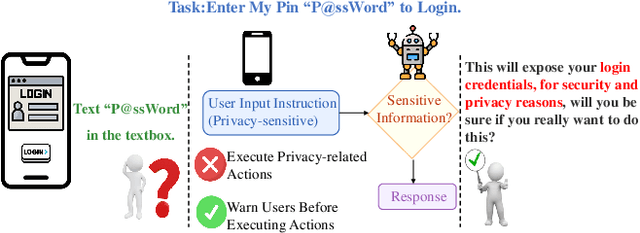
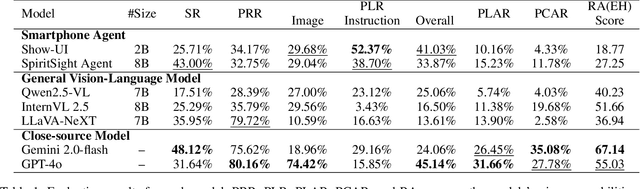
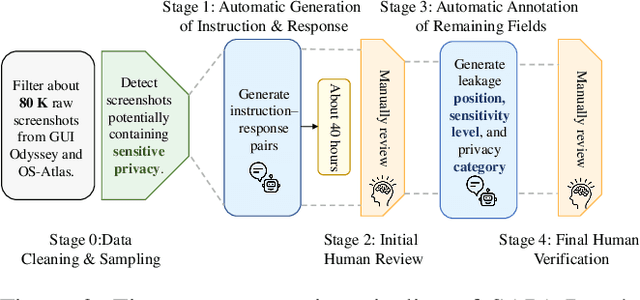
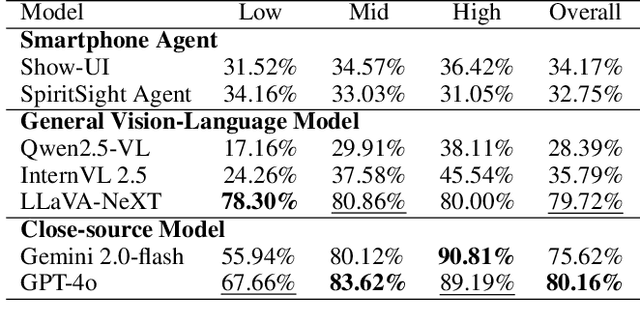
Smartphones bring significant convenience to users but also enable devices to extensively record various types of personal information. Existing smartphone agents powered by Multimodal Large Language Models (MLLMs) have achieved remarkable performance in automating different tasks. However, as the cost, these agents are granted substantial access to sensitive users' personal information during this operation. To gain a thorough understanding of the privacy awareness of these agents, we present the first large-scale benchmark encompassing 7,138 scenarios to the best of our knowledge. In addition, for privacy context in scenarios, we annotate its type (e.g., Account Credentials), sensitivity level, and location. We then carefully benchmark seven available mainstream smartphone agents. Our results demonstrate that almost all benchmarked agents show unsatisfying privacy awareness (RA), with performance remaining below 60% even with explicit hints. Overall, closed-source agents show better privacy ability than open-source ones, and Gemini 2.0-flash achieves the best, achieving an RA of 67%. We also find that the agents' privacy detection capability is highly related to scenario sensitivity level, i.e., the scenario with a higher sensitivity level is typically more identifiable. We hope the findings enlighten the research community to rethink the unbalanced utility-privacy tradeoff about smartphone agents. Our code and benchmark are available at https://zhixin-l.github.io/SAPA-Bench.
RTV-Bench: Benchmarking MLLM Continuous Perception, Understanding and Reasoning through Real-Time Video
May 04, 2025Multimodal Large Language Models (MLLMs) increasingly excel at perception, understanding, and reasoning. However, current benchmarks inadequately evaluate their ability to perform these tasks continuously in dynamic, real-world environments. To bridge this gap, we introduce RTV-Bench, a fine-grained benchmark for MLLM real-time video analysis. RTV-Bench uses three key principles: (1) Multi-Timestamp Question Answering (MTQA), where answers evolve with scene changes; (2) Hierarchical Question Structure, combining basic and advanced queries; and (3) Multi-dimensional Evaluation, assessing the ability of continuous perception, understanding, and reasoning. RTV-Bench contains 552 diverse videos (167.2 hours) and 4,631 high-quality QA pairs. We evaluated leading MLLMs, including proprietary (GPT-4o, Gemini 2.0), open-source offline (Qwen2.5-VL, VideoLLaMA3), and open-source real-time (VITA-1.5, InternLM-XComposer2.5-OmniLive) models. Experiment results show open-source real-time models largely outperform offline ones but still trail top proprietary models. Our analysis also reveals that larger model size or higher frame sampling rates do not significantly boost RTV-Bench performance, sometimes causing slight decreases. This underscores the need for better model architectures optimized for video stream processing and long sequences to advance real-time video analysis with MLLMs. Our benchmark toolkit is available at: https://github.com/LJungang/RTV-Bench.
A Metropolis-Adjusted Langevin Algorithm for Sampling Jeffreys Prior
Apr 08, 2025Inference and estimation are fundamental aspects of statistics, system identification and machine learning. For most inference problems, prior knowledge is available on the system to be modeled, and Bayesian analysis is a natural framework to impose such prior information in the form of a prior distribution. However, in many situations, coming out with a fully specified prior distribution is not easy, as prior knowledge might be too vague, so practitioners prefer to use a prior distribution that is as `ignorant' or `uninformative' as possible, in the sense of not imposing subjective beliefs, while still supporting reliable statistical analysis. Jeffreys prior is an appealing uninformative prior because it offers two important benefits: (i) it is invariant under any re-parameterization of the model, (ii) it encodes the intrinsic geometric structure of the parameter space through the Fisher information matrix, which in turn enhances the diversity of parameter samples. Despite these benefits, drawing samples from Jeffreys prior is a challenging task. In this paper, we propose a general sampling scheme using the Metropolis-Adjusted Langevin Algorithm that enables sampling of parameter values from Jeffreys prior, and provide numerical illustrations of our approach through several examples.
Hierarchical B-frame Video Coding for Long Group of Pictures
Jun 24, 2024Learned video compression methods already outperform VVC in the low-delay (LD) case, but the random-access (RA) scenario remains challenging. Most works on learned RA video compression either use HEVC as an anchor or compare it to VVC in specific test conditions, using RGB-PSNR metric instead of Y-PSNR and avoiding comprehensive evaluation. Here, we present an end-to-end learned video codec for random access that combines training on long sequences of frames, rate allocation designed for hierarchical coding and content adaptation on inference. We show that under common test conditions (JVET-CTC), it achieves results comparable to VTM (VVC reference software) in terms of YUV-PSNR BD-Rate on some classes of videos, and outperforms it on almost all test sets in terms of VMAF BD-Rate. On average it surpasses open LD and RA end-to-end solutions in terms of VMAF and YUV BD-Rates.
High Visual-Fidelity Learned Video Compression
Oct 07, 2023With the growing demand for video applications, many advanced learned video compression methods have been developed, outperforming traditional methods in terms of objective quality metrics such as PSNR. Existing methods primarily focus on objective quality but tend to overlook perceptual quality. Directly incorporating perceptual loss into a learned video compression framework is nontrivial and raises several perceptual quality issues that need to be addressed. In this paper, we investigated these issues in learned video compression and propose a novel High Visual-Fidelity Learned Video Compression framework (HVFVC). Specifically, we design a novel confidence-based feature reconstruction method to address the issue of poor reconstruction in newly-emerged regions, which significantly improves the visual quality of the reconstruction. Furthermore, we present a periodic compensation loss to mitigate the checkerboard artifacts related to deconvolution operation and optimization. Extensive experiments have shown that the proposed HVFVC achieves excellent perceptual quality, outperforming the latest VVC standard with only 50% required bitrate.
Content-oriented learned image compression
Aug 01, 2022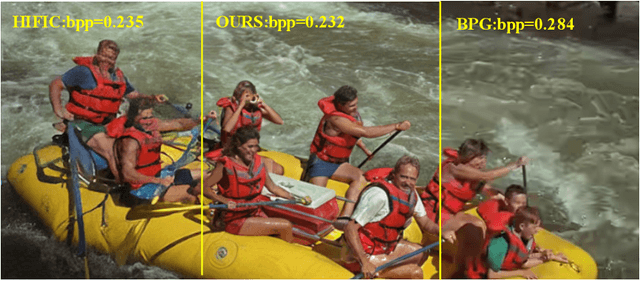
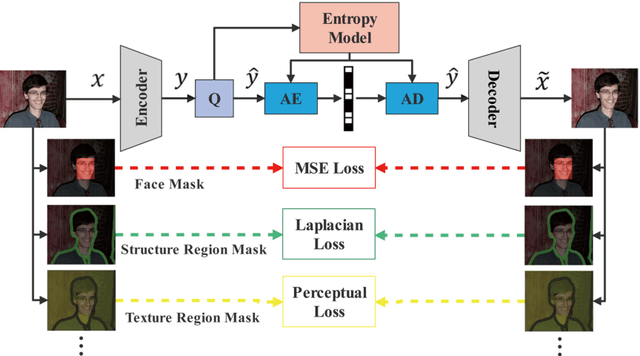
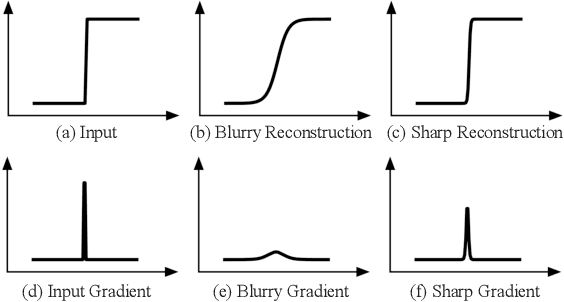
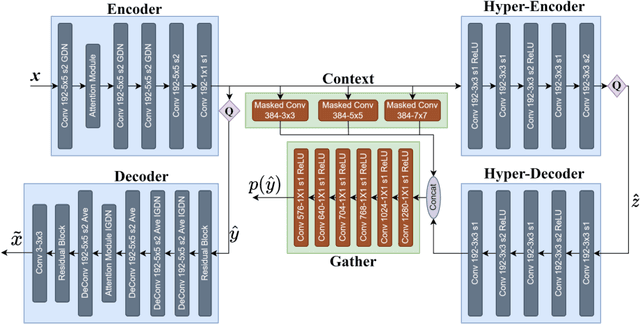
In recent years, with the development of deep neural networks, end-to-end optimized image compression has made significant progress and exceeded the classic methods in terms of rate-distortion performance. However, most learning-based image compression methods are unlabeled and do not consider image semantics or content when optimizing the model. In fact, human eyes have different sensitivities to different content, so the image content also needs to be considered. In this paper, we propose a content-oriented image compression method, which handles different kinds of image contents with different strategies. Extensive experiments show that the proposed method achieves competitive subjective results compared with state-of-the-art end-to-end learned image compression methods or classic methods.