 Add to Chrome
 Add to Firefox
 Add to Edge
Cognitive World Models for Process-Level Social Influence Evaluation
Jun 28, 2026
Social influence dialogue changes user behavior by altering internal cognitive states. The central evaluation question is whether the user's beliefs, desires, intentions, and emotions measurably change over the course of conversation, a process-oriented criterion that neither surface-level text metrics (BLEU/ROUGE) nor single-score LLM judgments can capture. We propose the \textbf{Cog}nitive \textbf{W}orld \textbf{M}odel \textbf{(CogWM)}, an LLM-based user model that reframes multi-turn dialogue evaluation from ``what did the user say'' to ``how did the user's internal cognitive state evolves.'' CogWM jointly predicts BDI/E cognitive states and user utterances and serves as both a user simulator and an evaluation platform, using a three-tier evaluation framework that covers turn-level fidelity, trajectory-level state dynamics, and task-level composite scoring. Trained via our \textbf{S}ummarize-\textbf{a}nd-\textbf{A}llocate \textbf{(SaA)} annotation pipeline on 150,454 user-turn samples across four social influence scenarios, CogWM achieves 77.6\% emotion accuracy (2.1$\times$ over GPT-5.5). In 3600 multi-agent discrimination trials, it distinguishes six commercial agents by their cognitive influence, with Llama-4-Scout ranking first (CTS +0.233). CogWM moves social influence dialogue evaluation from terminal judgment to process tracking. We have released our code\footnote{\scriptsize Code: https://github.com/lucianma05-create/CogWM} and models\footnote{Model: https://www.modelscope.cn/models/LucianMa/CogWM-14B}.

Think Thrice Before You Speak: Dual knowledge-enhanced Theory-of-Mind Reasoning for Persuasive Agents
May 21, 2026Persuasive dialogue requires reasoning about others' latent mental states, a capability known as Theory of Mind (ToM). However, due to reliance on simple prompting strategies and insufficient ToM knowledge, existing LLMs often fail to capture the intrinsic dependencies among mental states, leading to fragmented representations and unstable reasoning. To address these challenges, we introduce the ToM-based Persuasive Dialogue (ToM-PD) task, grounded in the Belief-Desire-Intention (BDI) framework, which explicitly models the sequential dependencies among mental states in multi-turn dialogues. To facilitate research on this task, we construct a large-scale annotated dataset, ToM-based Broad Persuasive Dialogues (ToM-BPD), capturing fine-grained mental states and corresponding persuasive strategies. We further propose Think Thrice Before You Speak (TTBYS), a knowledge-enhanced stepwise reasoning framework that leverages both explicit and implicit prior experiences to improve LLMs' inference of desires, beliefs, and persuasive strategies. Experimental results demonstrate that Qwen3-8B equipped with TTBYS outperforms GPT-5 by 1.20%, 22.80%, and 16.97% in predicting desires, beliefs, and persuasive strategies, respectively. Case studies further show that our approach enhances interpretability and consistency in reasoning.
Bulk-Calibrated Credal Ambiguity Sets: Fast, Tractable Decision Making under Out-of-Sample Contamination
Jan 29, 2026Distributionally robust optimisation (DRO) minimises the worst-case expected loss over an ambiguity set that can capture distributional shifts in out-of-sample environments. While Huber (linear-vacuous) contamination is a classical minimal-assumption model for an $\varepsilon$-fraction of arbitrary perturbations, including it in an ambiguity set can make the worst-case risk infinite and the DRO objective vacuous unless one imposes strong boundedness or support assumptions. We address these challenges by introducing bulk-calibrated credal ambiguity sets: we learn a high-mass bulk set from data while considering contamination inside the bulk and bounding the remaining tail contribution separately. This leads to a closed-form, finite $\mathrm{mean}+\sup$ robust objective and tractable linear or second-order cone programs for common losses and bulk geometries. Through this framework, we highlight and exploit the equivalence between the imprecise probability (IP) notion of upper expectation and the worst-case risk, demonstrating how IP credal sets translate into DRO objectives with interpretable tolerance levels. Experiments on heavy-tailed inventory control, geographically shifted house-price regression, and demographically shifted text classification show competitive robustness-accuracy trade-offs and efficient optimisation times, using Bayesian, frequentist, or empirical reference distributions.
The Future of Cognitive Strategy-enhanced Persuasive Dialogue Agents: New Perspectives and Trends
Feb 07, 2024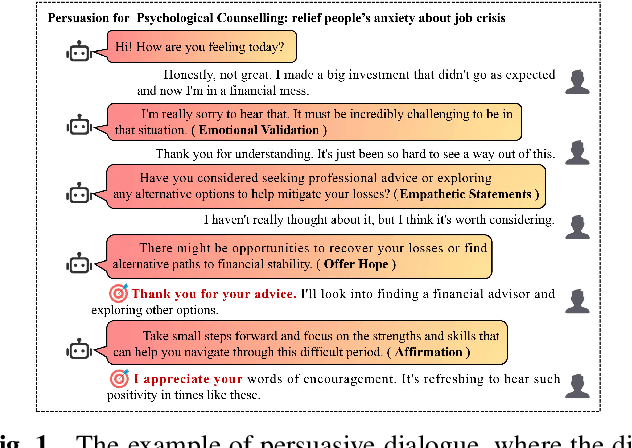
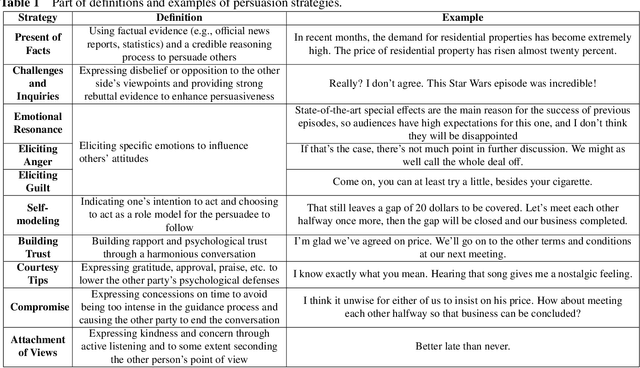
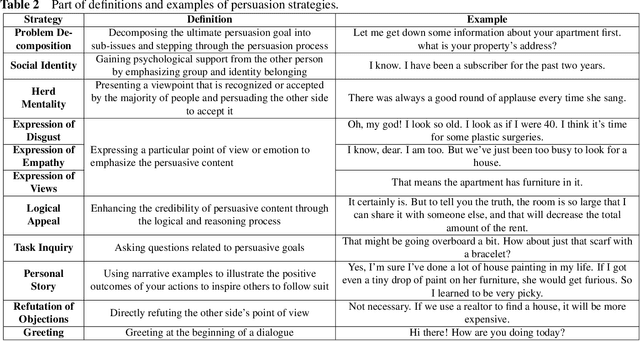
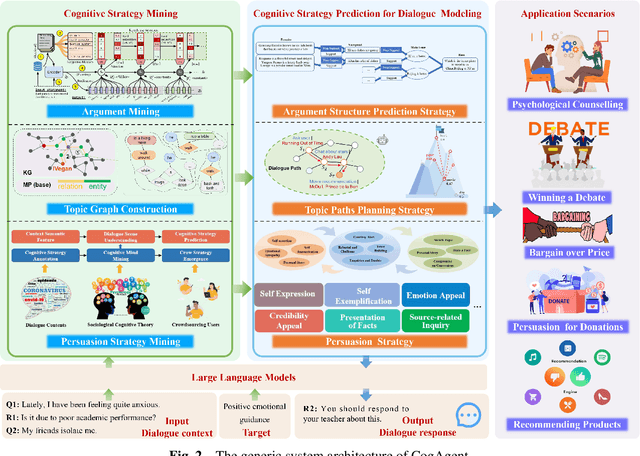
Persuasion, as one of the crucial abilities in human communication, has garnered extensive attention from researchers within the field of intelligent dialogue systems. We humans tend to persuade others to change their viewpoints, attitudes or behaviors through conversations in various scenarios (e.g., persuasion for social good, arguing in online platforms). Developing dialogue agents that can persuade others to accept certain standpoints is essential to achieving truly intelligent and anthropomorphic dialogue system. Benefiting from the substantial progress of Large Language Models (LLMs), dialogue agents have acquired an exceptional capability in context understanding and response generation. However, as a typical and complicated cognitive psychological system, persuasive dialogue agents also require knowledge from the domain of cognitive psychology to attain a level of human-like persuasion. Consequently, the cognitive strategy-enhanced persuasive dialogue agent (defined as CogAgent), which incorporates cognitive strategies to achieve persuasive targets through conversation, has become a predominant research paradigm. To depict the research trends of CogAgent, in this paper, we first present several fundamental cognitive psychology theories and give the formalized definition of three typical cognitive strategies, including the persuasion strategy, the topic path planning strategy, and the argument structure prediction strategy. Then we propose a new system architecture by incorporating the formalized definition to lay the foundation of CogAgent. Representative works are detailed and investigated according to the combined cognitive strategy, followed by the summary of authoritative benchmarks and evaluation metrics. Finally, we summarize our insights on open issues and future directions of CogAgent for upcoming researchers.