 Add to Chrome
 Add to Firefox
 Add to Edge
OmniCoT: A Benchmark for Global and Multi-Step Panoramic Reasoning
Jun 29, 2026
Multimodal Large Language Models (MLLMs) have demonstrated promising spatial reasoning capabilities, while these abilities remain underexplored in the emerging visual modality of panoramic imagery. The full 360°$\times$180° field of view of panoramas essentially supports complex global multi-step reasoning, which is also the fundamental advantage of panoramas in applications such as embodied intelligence. However, existing panoramic benchmarks largely focus on simplistic queries that rely on local cues or single-/few-step reasoning, thereby ignoring the fundamental advantage of panoramas and failing to fully exploit their potential. To address this gap, we introduce OmniCoT, a panoramic spatial reasoning suite designed to enable MLLMs to use global evidence and perform multi-step inference across viewpoints. It includes OmniCoT-B (6.7K data) for evaluation, which measures both answer accuracy and reasoning quality, OmniCoT-Real (1K data) as a manually annotated real-world subset to quantify the Sim-to-Real gap. For training, OmniCoT-T (14.3K data) is purpose-built with structured stepwise Chain-of-Thought annotations that explicitly link intermediate reasoning steps to panoramic evidence. Based on OmniCoT-T, we introduce OmniCoT-R1 and adopt a two-stage training strategy tailored to the geometrically complex panoramic space, where Supervised Fine-tuning (SFT) anchors reasoning to panoramic evidence (e.g., bearings, proximity) and GRPO penalizes geometrically incoherent paths to consolidate global 360° spatial consistency. Through OmniCoT, we aim to recalibrate the difficulty of panoramic spatial reasoning to better align with the intrinsic capabilities of panoramic imagery, thereby fostering meaningful progress in this research area.

Thinking Economically: A Hierarchical Framework for Adaptive-Complexity Reasoning in LLMs
May 31, 2026Chain-of-Thought (CoT) has significantly enhanced LLM reasoning, yet often incurs substantial computational overhead due to "overthinking": generating excessively long rationales without commensurate accuracy gains. Existing efficiency methods typically apply uniform compression, which overlooks a critical observation that reasoning complexity is heterogeneous at two distinct granularity: across different problems and within individual reasoning steps. This motivates our principle of Thinking Economically: intelligently allocating computational resources based on intrinsic task and step demands rather than pursuing uniform brevity. We propose Hierarchical Adaptive Budgeter (HAB), a training framework that operationalizes this principle through coarse-to-fine budgeting. At the inter-step level, HAB predicts the optimal reasoning depth for each problem. At the intra-step level, HAB learns step-specific token budgeting signals from PPL-derived step comparisons and an adaptive Pareto optimization objective that captures the local quality-efficiency trade-off, while a Fisher Information-based pruner further provides fine-grained training-time guidance, thereby encouraging the generator to internalize more economical reasoning patterns. Experiments on GSM8K and MATH500 show that HAB not only surpasses standard CoT in accuracy but also reduces token usage, achieving a stronger performance-efficiency trade-off than the compared baselines.
AndroTMem: From Interaction Trajectories to Anchored Memory in Long-Horizon GUI Agents
Mar 19, 2026Long-horizon GUI agents are a key step toward real-world deployment, yet effective interaction memory under prevailing paradigms remains under-explored. Replaying full interaction sequences is redundant and amplifies noise, while summaries often erase dependency-critical information and traceability. We present AndroTMem, a diagnostic framework for anchored memory in long-horizon Android GUI agents. Its core benchmark, AndroTMem-Bench, comprises 1,069 tasks with 34,473 interaction steps (avg. 32.1 per task, max. 65). We evaluate agents with TCR (Task Complete Rate), focusing on tasks whose completion requires carrying forward critical intermediate state; AndroTMem-Bench is designed to enforce strong step-to-step causal dependencies, making sparse yet essential intermediate states decisive for downstream actions and centering interaction memory in evaluation. Across open- and closed-source GUI agents, we observe a consistent pattern: as interaction sequences grow longer, performance drops are driven mainly by within-task memory failures, not isolated perception errors or local action mistakes. Guided by this diagnosis, we propose Anchored State Memory (ASM), which represents interaction sequences as a compact set of causally linked intermediate-state anchors to enable subgoal-targeted retrieval and attribution-aware decision making. Across multiple settings and 12 evaluated GUI agents, ASM consistently outperforms full-sequence replay and summary-based baselines, improving TCR by 5%-30.16% and AMS by 4.93%-24.66%, indicating that anchored, structured memory effectively mitigates the interaction-memory bottleneck in long-horizon GUI tasks. The code, benchmark, and related resources are publicly available at [https://github.com/CVC2233/AndroTMem](https://github.com/CVC2233/AndroTMem).
Temporal Gains, Spatial Costs: Revisiting Video Fine-Tuning in Multimodal Large Language Models
Mar 18, 2026Multimodal large language models (MLLMs) are typically trained in multiple stages, with video-based supervised fine-tuning (Video-SFT) serving as a key step for improving visual understanding. Yet its effect on the fine-grained evolution of visual capabilities, particularly the balance between spatial and temporal understanding, remains poorly understood. In this paper, we systematically study how Video-SFT reshapes visual capabilities in MLLMs. Across architectures, parameter scales, and frame sampling settings, we observe a consistent pattern: Video-SFT reliably improves video performance, but often yields limited gains or even degradation on static image benchmarks. We further show that this trade-off is closely tied to temporal budget: increasing the number of sampled frames generally improves video performance, but does not reliably improve static image performance. Motivated by this finding, we study an instruction-aware Hybrid-Frame strategy that adaptively allocates frame counts and partially mitigates the image-video trade-off. Our results indicate that Video-SFT is not a free lunch for MLLMs, and preserving spatial understanding remains a central challenge in joint image-video training.
Multimodal Spatial Reasoning in the Large Model Era: A Survey and Benchmarks
Oct 29, 2025Humans possess spatial reasoning abilities that enable them to understand spaces through multimodal observations, such as vision and sound. Large multimodal reasoning models extend these abilities by learning to perceive and reason, showing promising performance across diverse spatial tasks. However, systematic reviews and publicly available benchmarks for these models remain limited. In this survey, we provide a comprehensive review of multimodal spatial reasoning tasks with large models, categorizing recent progress in multimodal large language models (MLLMs) and introducing open benchmarks for evaluation. We begin by outlining general spatial reasoning, focusing on post-training techniques, explainability, and architecture. Beyond classical 2D tasks, we examine spatial relationship reasoning, scene and layout understanding, as well as visual question answering and grounding in 3D space. We also review advances in embodied AI, including vision-language navigation and action models. Additionally, we consider emerging modalities such as audio and egocentric video, which contribute to novel spatial understanding through new sensors. We believe this survey establishes a solid foundation and offers insights into the growing field of multimodal spatial reasoning. Updated information about this survey, codes and implementation of the open benchmarks can be found at https://github.com/zhengxuJosh/Awesome-Spatial-Reasoning.
PANORAMA: The Rise of Omnidirectional Vision in the Embodied AI Era
Sep 16, 2025Omnidirectional vision, using 360-degree vision to understand the environment, has become increasingly critical across domains like robotics, industrial inspection, and environmental monitoring. Compared to traditional pinhole vision, omnidirectional vision provides holistic environmental awareness, significantly enhancing the completeness of scene perception and the reliability of decision-making. However, foundational research in this area has historically lagged behind traditional pinhole vision. This talk presents an emerging trend in the embodied AI era: the rapid development of omnidirectional vision, driven by growing industrial demand and academic interest. We highlight recent breakthroughs in omnidirectional generation, omnidirectional perception, omnidirectional understanding, and related datasets. Drawing on insights from both academia and industry, we propose an ideal panoramic system architecture in the embodied AI era, PANORAMA, which consists of four key subsystems. Moreover, we offer in-depth opinions related to emerging trends and cross-community impacts at the intersection of panoramic vision and embodied AI, along with the future roadmap and open challenges. This overview synthesizes state-of-the-art advancements and outlines challenges and opportunities for future research in building robust, general-purpose omnidirectional AI systems in the embodied AI era.
Are Multimodal Large Language Models Ready for Omnidirectional Spatial Reasoning?
May 17, 2025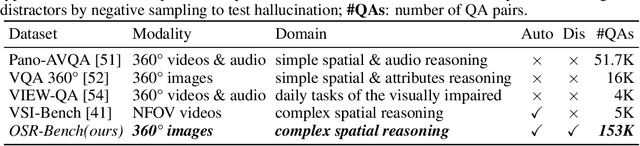
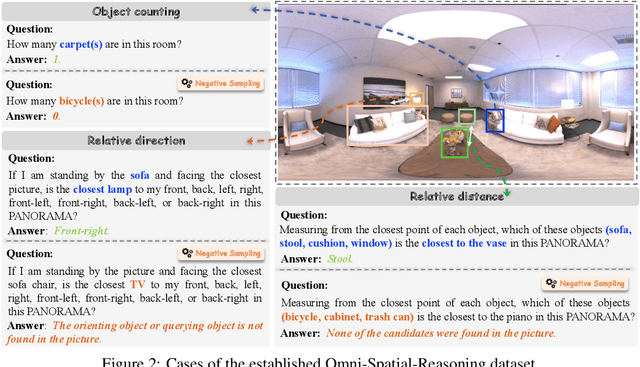
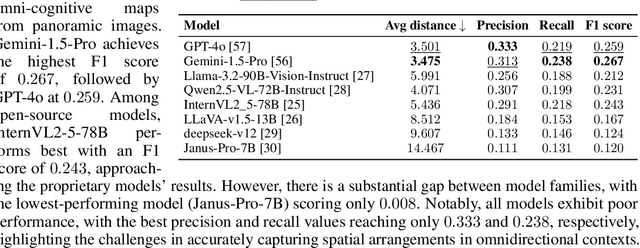
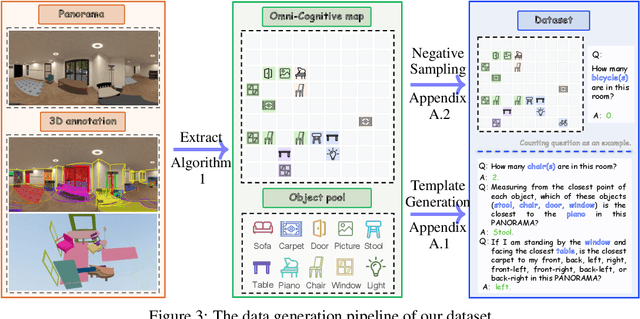
The 180x360 omnidirectional field of view captured by 360-degree cameras enables their use in a wide range of applications such as embodied AI and virtual reality. Although recent advances in multimodal large language models (MLLMs) have shown promise in visual-spatial reasoning, most studies focus on standard pinhole-view images, leaving omnidirectional perception largely unexplored. In this paper, we ask: Are MLLMs ready for omnidirectional spatial reasoning? To investigate this, we introduce OSR-Bench, the first benchmark specifically designed for this setting. OSR-Bench includes over 153,000 diverse question-answer pairs grounded in high-fidelity panoramic indoor scene maps. It covers key reasoning types including object counting, relative distance, and direction. We also propose a negative sampling strategy that inserts non-existent objects into prompts to evaluate hallucination and grounding robustness. For fine-grained analysis, we design a two-stage evaluation framework assessing both cognitive map generation and QA accuracy using rotation-invariant matching and a combination of rule-based and LLM-based metrics. We evaluate eight state-of-the-art MLLMs, including GPT-4o, Gemini 1.5 Pro, and leading open-source models under zero-shot settings. Results show that current models struggle with spatial reasoning in panoramic contexts, highlighting the need for more perceptually grounded MLLMs. OSR-Bench and code will be released at: https://huggingface.co/datasets/UUUserna/OSR-Bench