 Add to Chrome
 Add to Firefox
 Add to Edge
DreamX-Phi 1.0: Action-Conditioned Video World Model for Robotic Manipulation
Aug 13, 2026
We present \textbf{DreamX-Phi 1.0}, an action-conditioned video world model for robotic manipulation that, given an observed frame, a language instruction, and a prescribed action sequence comprising end-effector poses and gripper states, predicts the resulting future observations. Yet realism alone does not guarantee faithfulness: a convincing rollout can still move the wrong arm or lose the manipulated object. To ensure the prediction respects each arm's commanded path, we inject per-arm $\mathrm{SE}(3)$ transformations into attention via \textbf{PRoPE-style geometric encoding}, preserving arm identity and rigid-motion structure. Action control alone does not fully constrain scene geometry or the evolution of small manipulated objects. We therefore add a lightweight \textbf{depth branch} for scene-level geometry and use \textbf{SAM3 masks} with a frozen \textbf{V-JEPA teacher} to maintain object consistency throughout grasping. We further distill the multi-step generator into a few-step student via distribution-matching distillation for efficient deployment. At the time of writing, \model{} achieves first place on Track~1 and second place on Track~2 of the WorldArena~2.0 Challenge. Our model and code will be publicly available.

Robo-ValueRL: Reliable Value Estimation for Offline-to-Online Reinforcement Learning
Jul 10, 2026Offline-to-online reinforcement learning is promising for generalizable robotic manipulation, yet its full-stack complexity obscures reproduction and diagnosis. Within such systems, value estimation plays a central role in prioritizing heterogeneous data for policy improvement. Despite its importance, the central question remains underexplored: how value-function reliability shapes policy optimization in offline-to-online reinforcement learning. To answer this question, we propose Robo-ValueRL, a unified framework that enables reliable value estimation and systematically traces its downstream effects on policy pretraining and online improvement. Concretely, Robo-ValueRL learns a history-conditioned value estimator and evaluates its reliability through global-progress and local-preference metrics. These resulting value estimates are propagated into quality-conditioned consistency-policy pretraining and a residual adaptation module on online rollouts, providing a unified testbed for analyzing how value reliability shapes downstream policy performance. Across 240 hours of offline demonstrations and over 3,000 online rollout trajectories, our extensive experiments show that downstream performance is strongly associated with value reliability. Reliable value functions provide better action-quality estimates, allowing value-guided offline RL to scale more effectively than quality-agnostic behavior cloning, and stabilize online improvement by prioritizing high-quality rollout data. Integrating reliable value guidance through offline pretraining with online improvement, our system achieves 86% success on millimeter-level precise chip insertion and 84% on generalizable block disassembly. We hope these findings highlight the importance of value-guided data utilization for effective policy improvement from heterogeneous robotic experience.
DreamX-World 1.0: A General-Purpose Interactive World Model
Jun 15, 2026DreamX-World 1.0 is a general-purpose interactive text/image-to-video world model for controllable long-horizon generation. It supports camera navigation, revisits to previously observed regions, and promptable events across photorealistic, game-style, and stylized domains. Our data engine combines camera-accurate Unreal Engine rendering, action-rich gameplay recordings, and real-world videos with recovered camera geometry. For camera control, we introduce E-PRoPE, a lightweight variant of projective positional encoding that retains PRoPE's projective camera geometry while applying camera-aware attention to spatially reduced tokens. We convert a bidirectional video generator into a few-step autoregressive world model using causal forcing, DMD-style distillation, and long-rollout training. Training on self-generated long-horizon contexts exposes the model to its own generated history and reduces the style and color drift that accumulates across autoregressive chunks. Memory-Conditioned Scene Persistence retrieves earlier views through camera-geometry-based retrieval, while residual recycling makes the conditioning path less sensitive to imperfect memory latents. Event Instruction Tuning adds composable event control, and reinforcement learning alignment recovers camera control and visual quality after distillation. With mixed-precision DiT execution, residual reuse, 75\%-pruned VAE decoding, and asynchronous pipeline parallelism, DreamX-World 1.0 reaches up to 16\,FPS on eight RTX\,5090 GPUs. On our 5-second basic evaluation, DreamX-World 1.0 achieves a camera-control score of 73.75 and an overall score of 84.76, outperforming HY-WorldPlay 1.5 and LingBot-World in overall score, which achieve 80.79 and 80.45, respectively.
I$^2$-SDF: Intrinsic Indoor Scene Reconstruction and Editing via Raytracing in Neural SDFs
Mar 29, 2023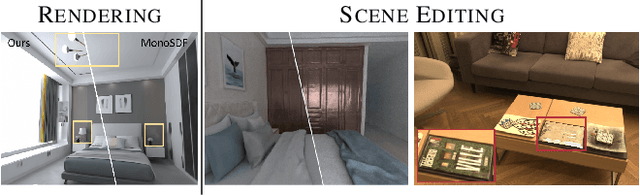
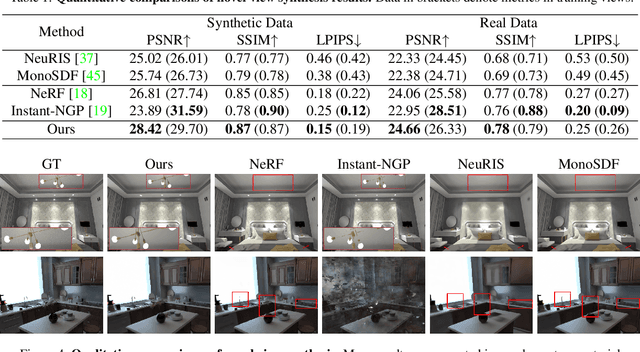
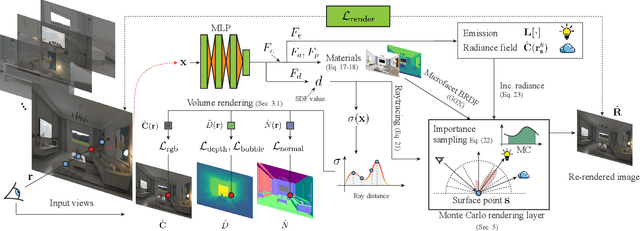
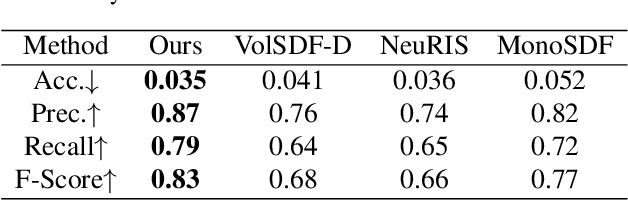
In this work, we present I$^2$-SDF, a new method for intrinsic indoor scene reconstruction and editing using differentiable Monte Carlo raytracing on neural signed distance fields (SDFs). Our holistic neural SDF-based framework jointly recovers the underlying shapes, incident radiance and materials from multi-view images. We introduce a novel bubble loss for fine-grained small objects and error-guided adaptive sampling scheme to largely improve the reconstruction quality on large-scale indoor scenes. Further, we propose to decompose the neural radiance field into spatially-varying material of the scene as a neural field through surface-based, differentiable Monte Carlo raytracing and emitter semantic segmentations, which enables physically based and photorealistic scene relighting and editing applications. Through a number of qualitative and quantitative experiments, we demonstrate the superior quality of our method on indoor scene reconstruction, novel view synthesis, and scene editing compared to state-of-the-art baselines.