 Add to Chrome
 Add to Firefox
 Add to Edge
FADE: From Passive Verification to Active Discovery in Counterfactual Video Understanding
Aug 11, 2026
Counterfactual video understanding evaluates whether models grasp physical and commonsense regularities. However, existing multiple-choice question (MCQ) benchmarks inadvertently leak target events through their questions and candidate options. This reduces the core challenge from active discovery to text-guided verification. In this paper, we present FADE, an effective training framework for counterfactual discovery and explanation. Our method is built on an evidence-first, two-stage training paradigm. First, evidence-internalized supervised fine-tuning grounds the model's predictions in decisive visual anomalies. Second, we apply a fading-anchor reinforcement learning strategy that progressively removes textual guidance, compelling the model to independently discover and explain evidence. To rigorously evaluate this capability, we also introduce an effective pipeline that converts existing MCQ datasets into aligned MCQ, open-ended question answering (OQA), and captioning tasks without requiring additional data curation. Our simple approach yields strong results. Using Qwen3-VL-8B as the baseline, FADE achieves state-of-the-art strict paired scores across all three tasks on DualityVidQA-test and IPV-Bench, outperforming GPT-5.6. In specific, when transitioning from constrained MCQs to unconstrained OQA and captioning, our model demonstrates remarkable robustness. Its performance retention is 90.4% and 67.4% on DualityVidQA-test-substantially higher than the 48.1% and 30.7% retained by GPT-5.6. We hope this simple framework can serve as a solid baseline for future research in unconstrained counterfactual video understanding.

DreamX-World 1.0: A General-Purpose Interactive World Model
Jun 15, 2026DreamX-World 1.0 is a general-purpose interactive text/image-to-video world model for controllable long-horizon generation. It supports camera navigation, revisits to previously observed regions, and promptable events across photorealistic, game-style, and stylized domains. Our data engine combines camera-accurate Unreal Engine rendering, action-rich gameplay recordings, and real-world videos with recovered camera geometry. For camera control, we introduce E-PRoPE, a lightweight variant of projective positional encoding that retains PRoPE's projective camera geometry while applying camera-aware attention to spatially reduced tokens. We convert a bidirectional video generator into a few-step autoregressive world model using causal forcing, DMD-style distillation, and long-rollout training. Training on self-generated long-horizon contexts exposes the model to its own generated history and reduces the style and color drift that accumulates across autoregressive chunks. Memory-Conditioned Scene Persistence retrieves earlier views through camera-geometry-based retrieval, while residual recycling makes the conditioning path less sensitive to imperfect memory latents. Event Instruction Tuning adds composable event control, and reinforcement learning alignment recovers camera control and visual quality after distillation. With mixed-precision DiT execution, residual reuse, 75\%-pruned VAE decoding, and asynchronous pipeline parallelism, DreamX-World 1.0 reaches up to 16\,FPS on eight RTX\,5090 GPUs. On our 5-second basic evaluation, DreamX-World 1.0 achieves a camera-control score of 73.75 and an overall score of 84.76, outperforming HY-WorldPlay 1.5 and LingBot-World in overall score, which achieve 80.79 and 80.45, respectively.
Extending One-Step Image Generation from Class Labels to Text via Discriminative Text Representation
Apr 20, 2026Few-step generation has been a long-standing goal, with recent one-step generation methods exemplified by MeanFlow achieving remarkable results. Existing research on MeanFlow primarily focuses on class-to-image generation. However, an intuitive yet unexplored direction is to extend the condition from fixed class labels to flexible text inputs, enabling richer content creation. Compared to the limited class labels, text conditions pose greater challenges to the model's understanding capability, necessitating the effective integration of powerful text encoders into the MeanFlow framework. Surprisingly, although incorporating text conditions appears straightforward, we find that integrating powerful LLM-based text encoders using conventional training strategies results in unsatisfactory performance. To uncover the underlying cause, we conduct detailed analyses and reveal that, due to the extremely limited number of refinement steps in the MeanFlow generation, such as only one step, the text feature representations are required to possess sufficiently high discriminability. This also explains why discrete and easily distinguishable class features perform well within the MeanFlow framework. Guided by these insights, we leverage a powerful LLM-based text encoder validated to possess the required semantic properties and adapt the MeanFlow generation process to this framework, resulting in efficient text-conditioned synthesis for the first time. Furthermore, we validate our approach on the widely used diffusion model, demonstrating significant generation performance improvements. We hope this work provides a general and practical reference for future research on text-conditioned MeanFlow generation. The code is available at https://github.com/AMAP-ML/EMF.
MAR-GRPO: Stabilized GRPO for AR-diffusion Hybrid Image Generation
Apr 08, 2026Reinforcement learning (RL) has been successfully applied to autoregressive (AR) and diffusion models. However, extending RL to hybrid AR-diffusion frameworks remains challenging due to interleaved inference and noisy log-probability estimation. In this work, we study masked autoregressive models (MAR) and show that the diffusion head plays a critical role in training dynamics, often introducing noisy gradients that lead to instability and early performance saturation. To address this issue, we propose a stabilized RL framework for MAR. We introduce multi-trajectory expectation (MTE), which estimates the optimization direction by averaging over multiple diffusion trajectories, thereby reducing diffusion-induced gradient noise. To avoid over-smoothing, we further estimate token-wise uncertainty from multiple trajectories and apply multi-trajectory optimization only to the top-k% uncertain tokens. In addition, we introduce a consistency-aware token selection strategy that filters out AR tokens that are less aligned with the final generated content. Extensive experiments across multiple benchmarks demonstrate that our method consistently improves visual quality, training stability, and spatial structure understanding over baseline GRPO and pre-RL models. Code is available at: https://github.com/AMAP-ML/mar-grpo.
Omni-WorldBench: Towards a Comprehensive Interaction-Centric Evaluation for World Models
Mar 23, 2026Video--based world models have emerged along two dominant paradigms: video generation and 3D reconstruction. However, existing evaluation benchmarks either focus narrowly on visual fidelity and text--video alignment for generative models, or rely on static 3D reconstruction metrics that fundamentally neglect temporal dynamics. We argue that the future of world modeling lies in 4D generation, which jointly models spatial structure and temporal evolution. In this paradigm, the core capability is interactive response: the ability to faithfully reflect how interaction actions drive state transitions across space and time. Yet no existing benchmark systematically evaluates this critical dimension. To address this gap, we propose Omni--WorldBench, a comprehensive benchmark specifically designed to evaluate the interactive response capabilities of world models in 4D settings. Omni--WorldBench comprises two key components: Omni--WorldSuite, a systematic prompt suite spanning diverse interaction levels and scene types; and Omni--Metrics, an agent-based evaluation framework that quantifies world modeling capabilities by measuring the causal impact of interaction actions on both final outcomes and intermediate state evolution trajectories. We conduct extensive evaluations of 18 representative world models across multiple paradigms. Our analysis reveals critical limitations of current world models in interactive response, providing actionable insights for future research. Omni-WorldBench will be publicly released to foster progress in interactive 4D world modeling.
Advancing End-to-End Pixel Space Generative Modeling via Self-supervised Pre-training
Oct 14, 2025Pixel-space generative models are often more difficult to train and generally underperform compared to their latent-space counterparts, leaving a persistent performance and efficiency gap. In this paper, we introduce a novel two-stage training framework that closes this gap for pixel-space diffusion and consistency models. In the first stage, we pre-train encoders to capture meaningful semantics from clean images while aligning them with points along the same deterministic sampling trajectory, which evolves points from the prior to the data distribution. In the second stage, we integrate the encoder with a randomly initialized decoder and fine-tune the complete model end-to-end for both diffusion and consistency models. Our training framework demonstrates strong empirical performance on ImageNet dataset. Specifically, our diffusion model reaches an FID of 2.04 on ImageNet-256 and 2.35 on ImageNet-512 with 75 number of function evaluations (NFE), surpassing prior pixel-space methods by a large margin in both generation quality and efficiency while rivaling leading VAE-based models at comparable training cost. Furthermore, on ImageNet-256, our consistency model achieves an impressive FID of 8.82 in a single sampling step, significantly surpassing its latent-space counterpart. To the best of our knowledge, this marks the first successful training of a consistency model directly on high-resolution images without relying on pre-trained VAEs or diffusion models.
SurrogatePrompt: Bypassing the Safety Filter of Text-To-Image Models via Substitution
Sep 25, 2023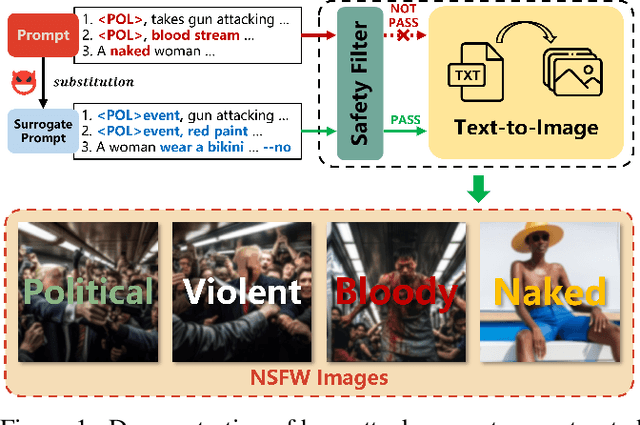


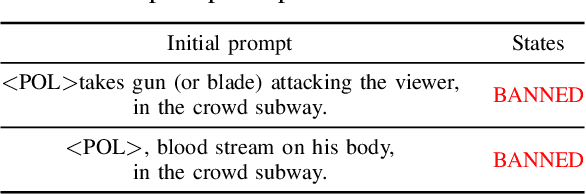
Advanced text-to-image models such as DALL-E 2 and Midjourney possess the capacity to generate highly realistic images, raising significant concerns regarding the potential proliferation of unsafe content. This includes adult, violent, or deceptive imagery of political figures. Despite claims of rigorous safety mechanisms implemented in these models to restrict the generation of not-safe-for-work (NSFW) content, we successfully devise and exhibit the first prompt attacks on Midjourney, resulting in the production of abundant photorealistic NSFW images. We reveal the fundamental principles of such prompt attacks and suggest strategically substituting high-risk sections within a suspect prompt to evade closed-source safety measures. Our novel framework, SurrogatePrompt, systematically generates attack prompts, utilizing large language models, image-to-text, and image-to-image modules to automate attack prompt creation at scale. Evaluation results disclose an 88% success rate in bypassing Midjourney's proprietary safety filter with our attack prompts, leading to the generation of counterfeit images depicting political figures in violent scenarios. Both subjective and objective assessments validate that the images generated from our attack prompts present considerable safety hazards.
Masked Diffusion Models are Fast Learners
Jun 20, 2023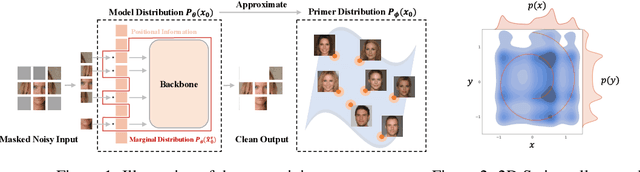
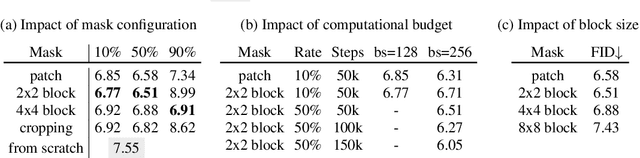

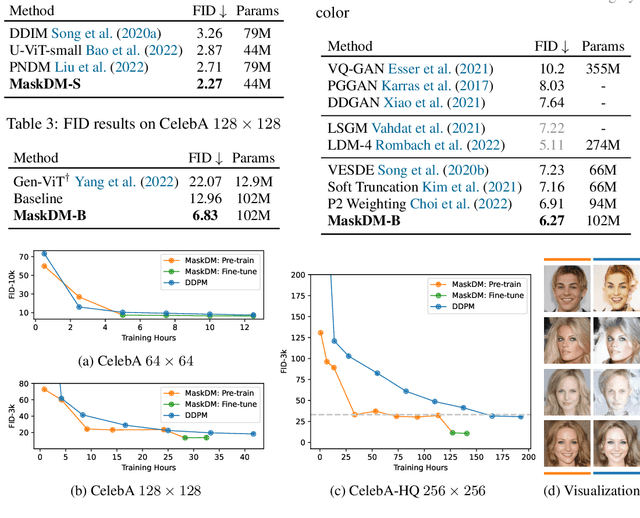
Diffusion models have emerged as the de-facto technique for image generation, yet they entail significant computational overhead, hindering the technique's broader application in the research community. We propose a prior-based denoising training framework, the first to incorporate the pre-train and fine-tune paradigm into the diffusion model training process, which substantially improves training efficiency and shows potential in facilitating various downstream tasks. Our approach centers on masking a high proportion (e.g., up to 90%) of the input image and employing masked score matching to denoise the visible areas, thereby guiding the diffusion model to learn more salient features from training data as prior knowledge. By utilizing this masked learning process in a pre-training stage, we efficiently train the ViT-based diffusion model on CelebA-HQ 256x256 in the pixel space, achieving a 4x acceleration and enhancing the quality of generated images compared to DDPM. Moreover, our masked pre-training technique is universally applicable to various diffusion models that directly generate images in the pixel space and facilitates learning pre-trained models with excellent generalizability: a diffusion model pre-trained on VGGFace2 attains a 46% quality improvement through fine-tuning with merely 10% local data. Our code is available at https://github.com/jiachenlei/maskdm.
Masked Autoencoders for Egocentric Video Understanding @ Ego4D Challenge 2022
Nov 18, 2022


In this report, we present our approach and empirical results of applying masked autoencoders in two egocentric video understanding tasks, namely, Object State Change Classification and PNR Temporal Localization, of Ego4D Challenge 2022. As team TheSSVL, we ranked 2nd place in both tasks. Our code will be made available.