 Add to Chrome
 Add to Firefox
 Add to Edge
A Composite Predictive-Generative Approach to Monaural Universal Speech Enhancement
May 30, 2025
It is promising to design a single model that can suppress various distortions and improve speech quality, i.e., universal speech enhancement (USE). Compared to supervised learning-based predictive methods, diffusion-based generative models have shown greater potential due to the generative capacities from degraded speech with severely damaged information. However, artifacts may be introduced in highly adverse conditions, and diffusion models often suffer from a heavy computational burden due to many steps for inference. In order to jointly leverage the superiority of prediction and generation and overcome the respective defects, in this work we propose a universal speech enhancement model called PGUSE by combining predictive and generative modeling. Our model consists of two branches: the predictive branch directly predicts clean samples from degraded signals, while the generative branch optimizes the denoising objective of diffusion models. We utilize the output fusion and truncated diffusion scheme to effectively integrate predictive and generative modeling, where the former directly combines results from both branches and the latter modifies the reverse diffusion process with initial estimates from the predictive branch. Extensive experiments on several datasets verify the superiority of the proposed model over state-of-the-art baselines, demonstrating the complementarity and benefits of combining predictive and generative modeling.

Light as Deception: GPT-driven Natural Relighting Against Vision-Language Pre-training Models
May 30, 2025While adversarial attacks on vision-and-language pretraining (VLP) models have been explored, generating natural adversarial samples crafted through realistic and semantically meaningful perturbations remains an open challenge. Existing methods, primarily designed for classification tasks, struggle when adapted to VLP models due to their restricted optimization spaces, leading to ineffective attacks or unnatural artifacts. To address this, we propose \textbf{LightD}, a novel framework that generates natural adversarial samples for VLP models via semantically guided relighting. Specifically, LightD leverages ChatGPT to propose context-aware initial lighting parameters and integrates a pretrained relighting model (IC-light) to enable diverse lighting adjustments. LightD expands the optimization space while ensuring perturbations align with scene semantics. Additionally, gradient-based optimization is applied to the reference lighting image to further enhance attack effectiveness while maintaining visual naturalness. The effectiveness and superiority of the proposed LightD have been demonstrated across various VLP models in tasks such as image captioning and visual question answering.
Generalizable Heuristic Generation Through Large Language Models with Meta-Optimization
May 27, 2025Heuristic design with large language models (LLMs) has emerged as a promising approach for tackling combinatorial optimization problems (COPs). However, existing approaches often rely on manually predefined evolutionary computation (EC) optimizers and single-task training schemes, which may constrain the exploration of diverse heuristic algorithms and hinder the generalization of the resulting heuristics. To address these issues, we propose Meta-Optimization of Heuristics (MoH), a novel framework that operates at the optimizer level, discovering effective optimizers through the principle of meta-learning. Specifically, MoH leverages LLMs to iteratively refine a meta-optimizer that autonomously constructs diverse optimizers through (self-)invocation, thereby eliminating the reliance on a predefined EC optimizer. These constructed optimizers subsequently evolve heuristics for downstream tasks, enabling broader heuristic exploration. Moreover, MoH employs a multi-task training scheme to promote its generalization capability. Experiments on classic COPs demonstrate that MoH constructs an effective and interpretable meta-optimizer, achieving state-of-the-art performance across various downstream tasks, particularly in cross-size settings.
A Unified Gradient-based Framework for Task-agnostic Continual Learning-Unlearning
May 21, 2025Recent advancements in deep models have highlighted the need for intelligent systems that combine continual learning (CL) for knowledge acquisition with machine unlearning (MU) for data removal, forming the Continual Learning-Unlearning (CLU) paradigm. While existing work treats CL and MU as separate processes, we reveal their intrinsic connection through a unified optimization framework based on Kullback-Leibler divergence minimization. This framework decomposes gradient updates for approximate CLU into four components: learning new knowledge, unlearning targeted data, preserving existing knowledge, and modulation via weight saliency. A critical challenge lies in balancing knowledge update and retention during sequential learning-unlearning cycles. To resolve this stability-plasticity dilemma, we introduce a remain-preserved manifold constraint to induce a remaining Hessian compensation for CLU iterations. A fast-slow weight adaptation mechanism is designed to efficiently approximate the second-order optimization direction, combined with adaptive weighting coefficients and a balanced weight saliency mask, proposing a unified implementation framework for gradient-based CLU. Furthermore, we pioneer task-agnostic CLU scenarios that support fine-grained unlearning at the cross-task category and random sample levels beyond the traditional task-aware setups. Experiments demonstrate that the proposed UG-CLU framework effectively coordinates incremental learning, precise unlearning, and knowledge stability across multiple datasets and model architectures, providing a theoretical foundation and methodological support for dynamic, compliant intelligent systems.
SubGCache: Accelerating Graph-based RAG with Subgraph-level KV Cache
May 19, 2025Graph-based retrieval-augmented generation (RAG) enables large language models (LLMs) to incorporate structured knowledge via graph retrieval as contextual input, enhancing more accurate and context-aware reasoning. We observe that for different queries, it could retrieve similar subgraphs as prompts, and thus we propose SubGCache, which aims to reduce inference latency by reusing computation across queries with similar structural prompts (i.e., subgraphs). Specifically, SubGCache clusters queries based on subgraph embeddings, constructs a representative subgraph for each cluster, and pre-computes the key-value (KV) cache of the representative subgraph. For each query with its retrieved subgraph within a cluster, it reuses the pre-computed KV cache of the representative subgraph of the cluster without computing the KV tensors again for saving computation. Experiments on two new datasets across multiple LLM backbones and graph-based RAG frameworks demonstrate that SubGCache consistently reduces inference latency with comparable and even improved generation quality, achieving up to 6.68$\times$ reduction in time-to-first-token (TTFT).
RealMath: A Continuous Benchmark for Evaluating Language Models on Research-Level Mathematics
May 18, 2025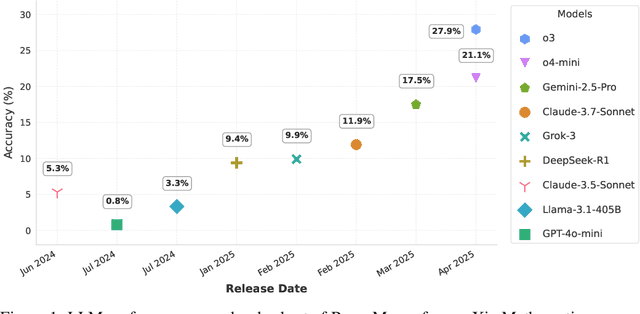
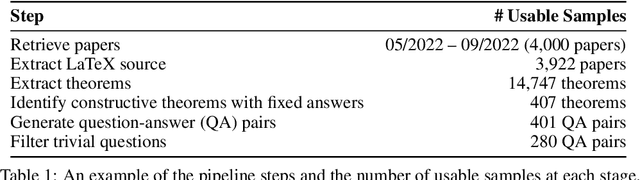

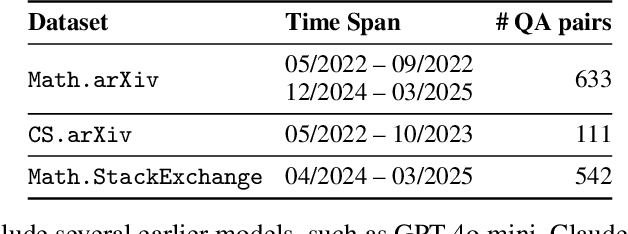
Existing benchmarks for evaluating mathematical reasoning in large language models (LLMs) rely primarily on competition problems, formal proofs, or artificially challenging questions -- failing to capture the nature of mathematics encountered in actual research environments. We introduce RealMath, a novel benchmark derived directly from research papers and mathematical forums that assesses LLMs' abilities on authentic mathematical tasks. Our approach addresses three critical challenges: sourcing diverse research-level content, enabling reliable automated evaluation through verifiable statements, and designing a continually refreshable dataset to mitigate contamination risks. Experimental results across multiple LLMs reveal surprising capabilities in handling research mathematics compared to competition problems, suggesting current models may already serve as valuable assistants for working mathematicians despite limitations on highly challenging problems. The code and dataset for RealMath are publicly available.
Table-R1: Region-based Reinforcement Learning for Table Understanding
May 18, 2025Tables present unique challenges for language models due to their structured row-column interactions, necessitating specialized approaches for effective comprehension. While large language models (LLMs) have demonstrated potential in table reasoning through prompting and techniques like chain-of-thought (CoT) and program-of-thought (PoT), optimizing their performance for table question answering remains underexplored. In this paper, we introduce region-based Table-R1, a novel reinforcement learning approach that enhances LLM table understanding by integrating region evidence into reasoning steps. Our method employs Region-Enhanced Supervised Fine-Tuning (RE-SFT) to guide models in identifying relevant table regions before generating answers, incorporating textual, symbolic, and program-based reasoning. Additionally, Table-Aware Group Relative Policy Optimization (TARPO) introduces a mixed reward system to dynamically balance region accuracy and answer correctness, with decaying region rewards and consistency penalties to align reasoning steps. Experiments show that Table-R1 achieves an average performance improvement of 14.36 points across multiple base models on three benchmark datasets, even outperforming baseline models with ten times the parameters, while TARPO reduces response token consumption by 67.5% compared to GRPO, significantly advancing LLM capabilities in efficient tabular reasoning.
Fair-PP: A Synthetic Dataset for Aligning LLM with Personalized Preferences of Social Equity
May 17, 2025Human preference plays a crucial role in the refinement of large language models (LLMs). However, collecting human preference feedback is costly and most existing datasets neglect the correlation between personalization and preferences. To address this issue, we introduce Fair-PP, a synthetic dataset of personalized preferences targeting social equity, derived from real-world social survey data, which includes 28 social groups, 98 equity topics, and 5 personal preference dimensions. Leveraging GPT-4o-mini, we engage in role-playing based on seven representative persona portrayals guided by existing social survey data, yielding a total of 238,623 preference records. Through Fair-PP, we also contribute (i) An automated framework for generating preference data, along with a more fine-grained dataset of personalized preferences; (ii) analysis of the positioning of the existing mainstream LLMs across five major global regions within the personalized preference space; and (iii) a sample reweighting method for personalized preference alignment, enabling alignment with a target persona while maximizing the divergence from other personas. Empirical experiments show our method outperforms the baselines.
BMMDetect: A Multimodal Deep Learning Framework for Comprehensive Biomedical Misconduct Detection
May 09, 2025
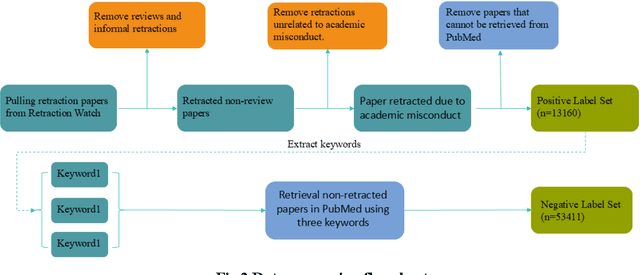
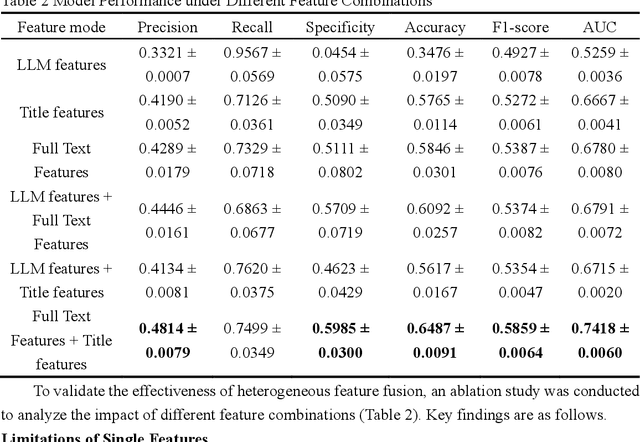
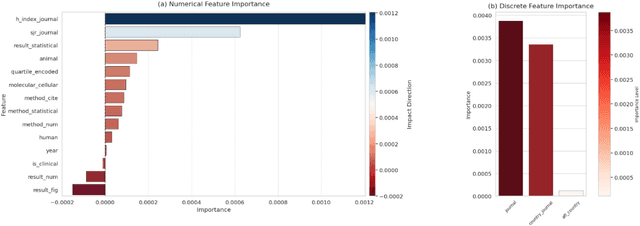
Academic misconduct detection in biomedical research remains challenging due to algorithmic narrowness in existing methods and fragmented analytical pipelines. We present BMMDetect, a multimodal deep learning framework that integrates journal metadata (SJR, institutional data), semantic embeddings (PubMedBERT), and GPT-4o-mined textual attributes (methodological statistics, data anomalies) for holistic manuscript evaluation. Key innovations include: (1) multimodal fusion of domain-specific features to reduce detection bias; (2) quantitative evaluation of feature importance, identifying journal authority metrics (e.g., SJR-index) and textual anomalies (e.g., statistical outliers) as dominant predictors; and (3) the BioMCD dataset, a large-scale benchmark with 13,160 retracted articles and 53,411 controls. BMMDetect achieves 74.33% AUC, outperforming single-modality baselines by 8.6%, and demonstrates transferability across biomedical subfields. This work advances scalable, interpretable tools for safeguarding research integrity.
Clustering with Communication: A Variational Framework for Single Cell Representation Learning
May 08, 2025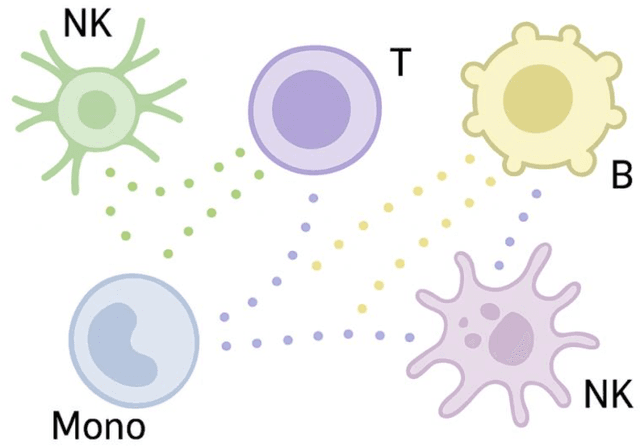
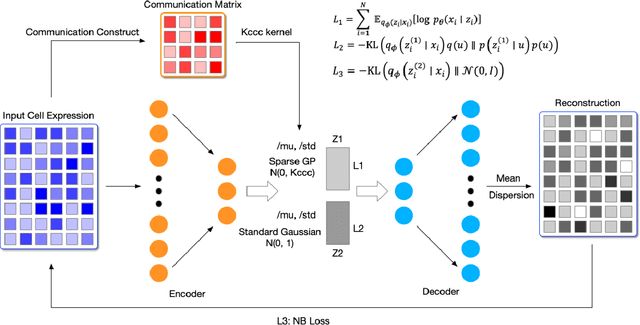
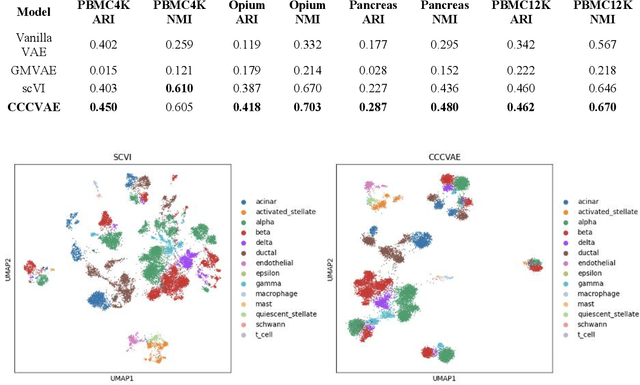
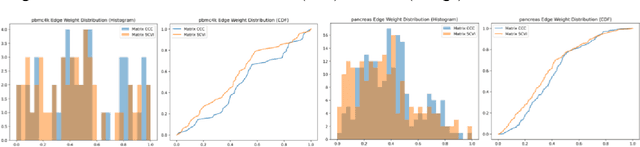
Single-cell RNA sequencing (scRNA-seq) has revealed complex cellular heterogeneity, but recent studies emphasize that understanding biological function also requires modeling cell-cell communication (CCC), the signaling interactions mediated by ligand-receptor pairs that coordinate cellular behavior. Tools like CellChat have demonstrated that CCC plays a critical role in processes such as cell differentiation, tissue regeneration, and immune response, and that transcriptomic data inherently encodes rich information about intercellular signaling. We propose CCCVAE, a novel variational autoencoder framework that incorporates CCC signals into single-cell representation learning. By leveraging a communication-aware kernel derived from ligand-receptor interactions and a sparse Gaussian process, CCCVAE encodes biologically informed priors into the latent space. Unlike conventional VAEs that treat each cell independently, CCCVAE encourages latent embeddings to reflect both transcriptional similarity and intercellular signaling context. Empirical results across four scRNA-seq datasets show that CCCVAE improves clustering performance, achieving higher evaluation scores than standard VAE baselines. This work demonstrates the value of embedding biological priors into deep generative models for unsupervised single-cell analysis.