 Add to Chrome
 Add to Firefox
 Add to Edge
What the Reranker Sees: Multi-Aspect Page Annotation for Long-Document Multimodal Question Answering
Aug 14, 2026
Long-document visual question answering (VQA) over documents of tens to hundreds of pages mixing text, tables, charts, and figures typically follows retrieve-then-read pipelines. In our setting, the bottleneck shifts from retrieval recall to reranker-side evidence selection: on MMLongBench-Doc, BGE-M3 reaches Recall@20 = 0.86 but only F1@5 = 0.254, and even the visual retriever ColPali reaches only F1@5 = 0.332; a text-only rerank LLM seeing only raw snippets misses table, chart, and layout evidence even when the upstream retriever encoded images. We propose Trident, with two complementary components: Trident-R, a retriever-agnostic LLM reranker that converts each candidate into an LLM-readable semantic record, including a visual caption, section path, entity tags, multi-axis concept hits, and a text snippet, then performs a single adaptive-K rerank call; and Trident-S, a generation-side module that prompts the VLM under topical, entity, and structural lenses before synthesis. On two long-document datasets, the annotation+rerank protocol substantially improves retrieval F1 across five heterogeneous pools, with every reranked pool exceeding the strongest adaptive-K baseline PageIndex. An LLM rerank without the annotation barely changes first-hit ranking, indicating the lift comes from the structured annotation. Trident-S targets open-ended synthesis questions by design, adding up to 6.6 points in generation accuracy on these questions. The best Trident configuration is the strongest downstream QA pipeline in our evaluation, with rankings consistent across two LLM judges (kappa = 0.913).

MatrAIx: Simulating the World with 8.3 Billion Persona Agents
Aug 04, 2026Human evaluation of AI systems and digital products is costly, slow, and difficult to scale. Offline evaluations are more scalable but often abstract away human diversity and interactive behavior. We therefore introduce MatrAIx, a population-scale simulated-user evaluation infrastructure for testing AI systems and digital products with heterogeneous users. MatrAIx has three core components: First, Persona 8B contains 8.3 billion persona records represented by 1,290 categorical dimensions. Records are either sampled from a dependency graph that preserves correlated attributes or derived from human-authored profiles. We release a quality-filtered coreset of approximately 1 million personas, comprising 599,847 human-grounded and 400,000 synthetic records. Second, the MatrAIx Playground provides four environments in which diverse users evaluate and interact with digital products: Survey, AI Chatbot, Web, and App. Third, MatrAIx provides 1,010 application tasks spanning more than 25 domains, including Commerce, Software, Finance, and Healthcare. We conducted 18,189 evaluation trials across eight representative tasks. Persona agents were powered by three LLMs: Claude Opus 4.8, GPT 5.5, and Claude Haiku 4.5. The resulting feedback captures how decisions and preferences vary across persona backgrounds, including hesitation after a price increase, willingness to continue after an AI assistant fails, and latency tolerance. We conducted two main validation studies: First, a 400-trial controlled study evaluated persona adherence across ten behavioral attributes and all four environments. The declared behavior was expressed or correctly suppressed in 366 trials (91.5%). Second, human and LLM judges evaluated the extraction quality of human-grounded personas. Overall, MatrAIx provides an end-to-end infrastructure for evaluating AI systems and digital products with diverse simulated human users.
Agents' Last Exam
Jun 03, 2026Recent AI systems have achieved strong results on a wide range of benchmarks, yet these gains have not translated into economically meaningful deployment across many professional domains. We argue that this gap is largely an evaluation problem: widely used benchmarks lack sustained performance measurement on real and economically valuable workflows. This paper introduces Agents' Last Exam (ALE), a benchmark designed to evaluate AI agents on long-horizon, economically valuable, real-world tasks with verifiable outcomes. Developed in collaboration with 250+ industry experts, ALE covers non-physical industries defined with reference to O*NET / SOC 2018 (the U.S. federal occupational taxonomy). It is organized around a task taxonomy with 55 subfields grouped into 13 industry clusters covering 1K+ tasks. Current results show that the hardest tier remains far from saturated: across mainstream harness and backbone configurations, the average full pass rate is 2.6%. ALE is designed as a living benchmark: its task pool grows continuously as new workflows and industries are onboarded. More broadly, ALE is intended not merely as another leaderboard, but as an instrument for closing the gap between benchmark success and GDP-relevant impact.
A Simple Plug-in for Improving Eviction-Based KV Cache Compression
May 22, 2026KV cache growth is a major bottleneck for long-context inference in large language models. Existing methods are often dominated by binary eviction or representation approximation, which may underutilize tokens that are not critical for exact retention but are still reconstructable. We present VECTOR, a plug-and-play augmentation for eviction-based pipelines that introduces three-way token routing: retention, approximation, and eviction. VECTOR combines an importance signal from the base scorer with a reconstructability signal from an offline-calibrated regression-based value estimation. By leveraging reconstructability, VECTOR recovers useful value information that would otherwise be irreversibly lost under binary eviction, while preserving key vectors for attention routing stability. Experimental results show that VECTOR improves quality-memory trade-offs under medium-to-high compression, with especially clear gains in stricter budget regimes.
Crafting Reversible SFT Behaviors in Large Language Models
May 07, 2026Supervised fine-tuning (SFT) induces new behaviors in large language models, yet imposes no structural constraint on how these behaviors are distributed within the model. Existing behavior interpretation methods, such as circuit attribution approaches, identify sparse subnetworks correlated with SFT-induced behaviors post-hoc. However, such correlations do not imply *causal necessity*, limiting the ability to selectively control SFT-induced behaviors at inference time. We pursue an alternative by asking: can an SFT-induced behavior be deliberately compressed into a sparse, mechanistically necessary subnetwork, termed a *carrier*, while remaining controllable at inference time without weight modification? We propose (a) **Loss-Constrained Dual Descent (LCDD)**, which constructs such carriers by jointly optimizing routing masks and model weights under an explicit utility budget, and (b) **SFT-Eraser**, a soft prompt optimized via activation matching on extracted carrier channels, to reverse the SFT-induced behavior. Across safety, fixed-response, and style behaviors on multiple model families, LCDD yields sparse carriers that preserve target behaviors while enabling strong reversion when triggered by SFT-Eraser. Ablations further establish that the sparse structure is the key precondition for reversal: the same trigger optimization fails on standard SFT models, confirming that structure rather than trigger design is the operative factor. These results provide direct evidence that the learned carriers are causally necessary for the behaviors, pointing to a new direction for systematically localizing and selectively suppressing SFT-induced behaviors in deployed models.
TRAJECT-Bench:A Trajectory-Aware Benchmark for Evaluating Agentic Tool Use
Oct 06, 2025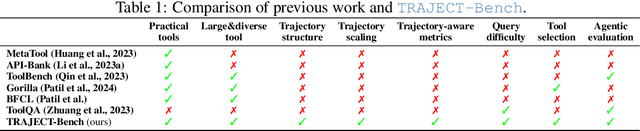
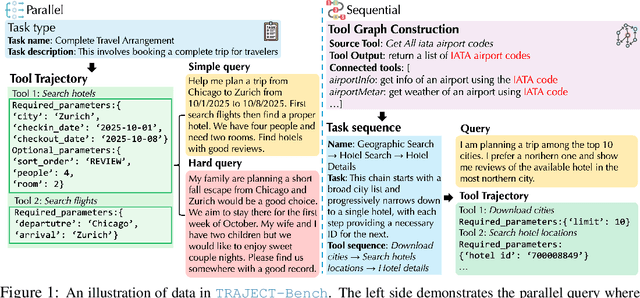
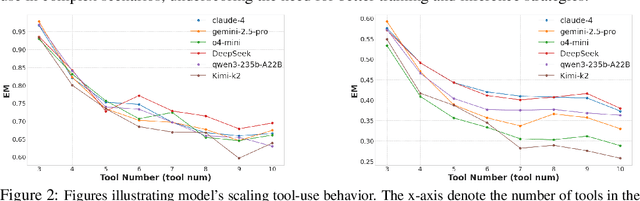
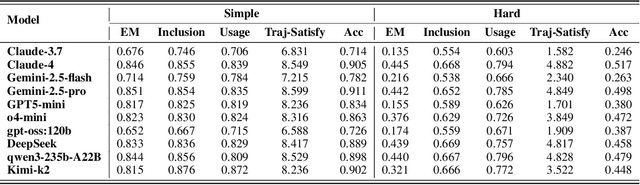
Large language model (LLM)-based agents increasingly rely on tool use to complete real-world tasks. While existing works evaluate the LLMs' tool use capability, they largely focus on the final answers yet overlook the detailed tool usage trajectory, i.e., whether tools are selected, parameterized, and ordered correctly. We introduce TRAJECT-Bench, a trajectory-aware benchmark to comprehensively evaluate LLMs' tool use capability through diverse tasks with fine-grained evaluation metrics. TRAJECT-Bench pairs high-fidelity, executable tools across practical domains with tasks grounded in production-style APIs, and synthesizes trajectories that vary in breadth (parallel calls) and depth (interdependent chains). Besides final accuracy, TRAJECT-Bench also reports trajectory-level diagnostics, including tool selection and argument correctness, and dependency/order satisfaction. Analyses reveal failure modes such as similar tool confusion and parameter-blind selection, and scaling behavior with tool diversity and trajectory length where the bottleneck of transiting from short to mid-length trajectories is revealed, offering actionable guidance for LLMs' tool use.
Retrieval-Augmented Generation with Graphs (GraphRAG)
Jan 08, 2025



Retrieval-augmented generation (RAG) is a powerful technique that enhances downstream task execution by retrieving additional information, such as knowledge, skills, and tools from external sources. Graph, by its intrinsic "nodes connected by edges" nature, encodes massive heterogeneous and relational information, making it a golden resource for RAG in tremendous real-world applications. As a result, we have recently witnessed increasing attention on equipping RAG with Graph, i.e., GraphRAG. However, unlike conventional RAG, where the retriever, generator, and external data sources can be uniformly designed in the neural-embedding space, the uniqueness of graph-structured data, such as diverse-formatted and domain-specific relational knowledge, poses unique and significant challenges when designing GraphRAG for different domains. Given the broad applicability, the associated design challenges, and the recent surge in GraphRAG, a systematic and up-to-date survey of its key concepts and techniques is urgently desired. Following this motivation, we present a comprehensive and up-to-date survey on GraphRAG. Our survey first proposes a holistic GraphRAG framework by defining its key components, including query processor, retriever, organizer, generator, and data source. Furthermore, recognizing that graphs in different domains exhibit distinct relational patterns and require dedicated designs, we review GraphRAG techniques uniquely tailored to each domain. Finally, we discuss research challenges and brainstorm directions to inspire cross-disciplinary opportunities. Our survey repository is publicly maintained at https://github.com/Graph-RAG/GraphRAG/.
Polaris: A Safety-focused LLM Constellation Architecture for Healthcare
Mar 20, 2024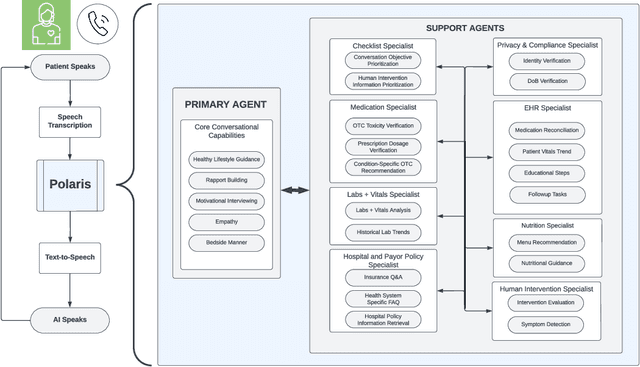
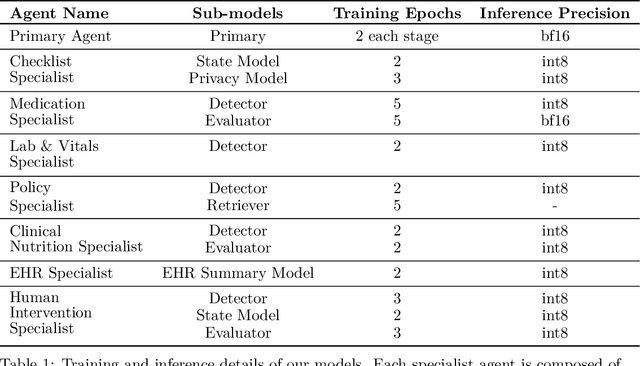
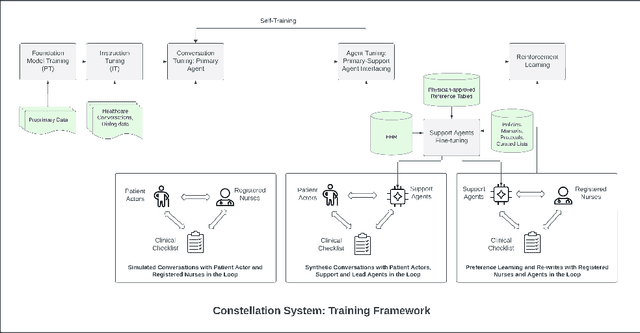
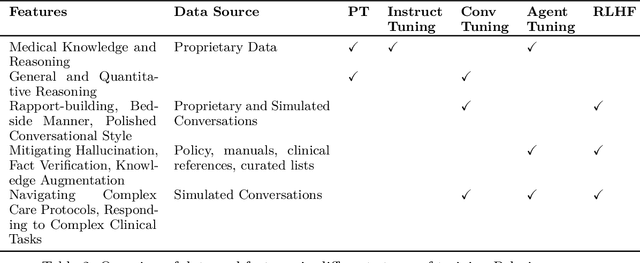
We develop Polaris, the first safety-focused LLM constellation for real-time patient-AI healthcare conversations. Unlike prior LLM works in healthcare focusing on tasks like question answering, our work specifically focuses on long multi-turn voice conversations. Our one-trillion parameter constellation system is composed of several multibillion parameter LLMs as co-operative agents: a stateful primary agent that focuses on driving an engaging conversation and several specialist support agents focused on healthcare tasks performed by nurses to increase safety and reduce hallucinations. We develop a sophisticated training protocol for iterative co-training of the agents that optimize for diverse objectives. We train our models on proprietary data, clinical care plans, healthcare regulatory documents, medical manuals, and other medical reasoning documents. We align our models to speak like medical professionals, using organic healthcare conversations and simulated ones between patient actors and experienced nurses. This allows our system to express unique capabilities such as rapport building, trust building, empathy and bedside manner. Finally, we present the first comprehensive clinician evaluation of an LLM system for healthcare. We recruited over 1100 U.S. licensed nurses and over 130 U.S. licensed physicians to perform end-to-end conversational evaluations of our system by posing as patients and rating the system on several measures. We demonstrate Polaris performs on par with human nurses on aggregate across dimensions such as medical safety, clinical readiness, conversational quality, and bedside manner. Additionally, we conduct a challenging task-based evaluation of the individual specialist support agents, where we demonstrate our LLM agents significantly outperform a much larger general-purpose LLM (GPT-4) as well as from its own medium-size class (LLaMA-2 70B).
Copyright Protection in Generative AI: A Technical Perspective
Feb 04, 2024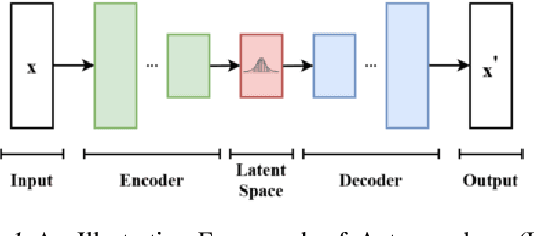
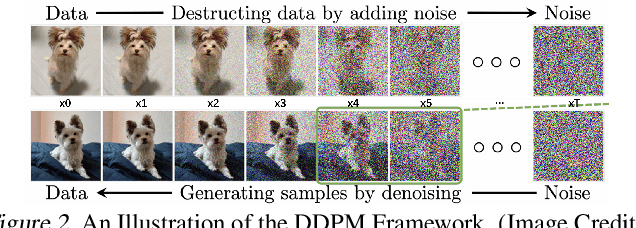
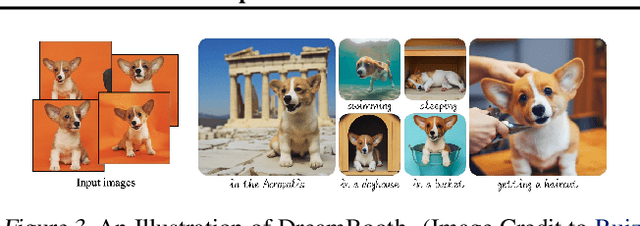

Generative AI has witnessed rapid advancement in recent years, expanding their capabilities to create synthesized content such as text, images, audio, and code. The high fidelity and authenticity of contents generated by these Deep Generative Models (DGMs) have sparked significant copyright concerns. There have been various legal debates on how to effectively safeguard copyrights in DGMs. This work delves into this issue by providing a comprehensive overview of copyright protection from a technical perspective. We examine from two distinct viewpoints: the copyrights pertaining to the source data held by the data owners and those of the generative models maintained by the model builders. For data copyright, we delve into methods data owners can protect their content and DGMs can be utilized without infringing upon these rights. For model copyright, our discussion extends to strategies for preventing model theft and identifying outputs generated by specific models. Finally, we highlight the limitations of existing techniques and identify areas that remain unexplored. Furthermore, we discuss prospective directions for the future of copyright protection, underscoring its importance for the sustainable and ethical development of Generative AI.
Single-Cell Multimodal Prediction via Transformers
Mar 01, 2023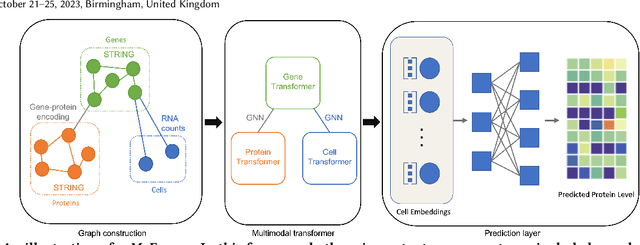
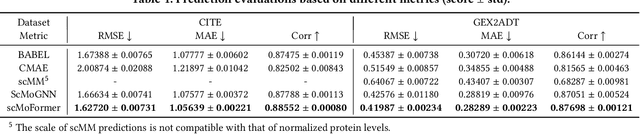
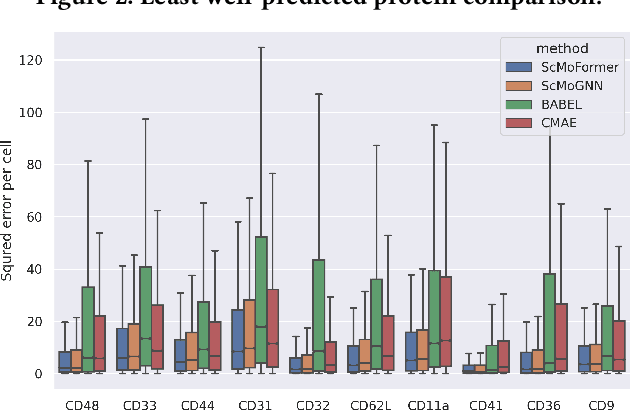
The recent development of multimodal single-cell technology has made the possibility of acquiring multiple omics data from individual cells, thereby enabling a deeper understanding of cellular states and dynamics. Nevertheless, the proliferation of multimodal single-cell data also introduces tremendous challenges in modeling the complex interactions among different modalities. The recently advanced methods focus on constructing static interaction graphs and applying graph neural networks (GNNs) to learn from multimodal data. However, such static graphs can be suboptimal as they do not take advantage of the downstream task information; meanwhile GNNs also have some inherent limitations when deeply stacking GNN layers. To tackle these issues, in this work, we investigate how to leverage transformers for multimodal single-cell data in an end-to-end manner while exploiting downstream task information. In particular, we propose a scMoFormer framework which can readily incorporate external domain knowledge and model the interactions within each modality and cross modalities. Extensive experiments demonstrate that scMoFormer achieves superior performance on various benchmark datasets. Note that scMoFormer won a Kaggle silver medal with the rank of $24\ /\ 1221$ (Top 2%) without ensemble in a NeurIPS 2022 competition. Our implementation is publicly available at Github.