 Add to Chrome
 Add to Firefox
 Add to Edge
Flux-Guard: Facial Identity Protection using diffusion models
Jun 16, 2026
The widespread deployment of face recognition (FR) systems exposes personal images shared on social media and public platforms to identity linkage and privacy risks. Existing adversarial privacy protection methods can degrade unauthorized FR performance but are not compatible with generative face editing. Artificial intelligence-driven face editing tools are gaining popularity, which has significantly increased user demand for personalized portrait generation and social sharing. However, current editing methods often preserve identity features, making the edited images still susceptible to tracking by malicious FR systems. Thus, this paper proposes Flux-Guard, a privacy-preserving face editing framework based on adversarial attacks, which integrates face editing and privacy protection within a unified generative process. Specifically, we design a flow trajectory control method to align semantic manipulations with the generative process and introduce latent-space adversarial optimization with an adaptive perceptual-loss-driven weighting strategy, dynamically adjusting adversarial strength to maximize attack effectiveness while preserving visual quality. Extensive experiments demonstrate that Flux-Guard supports face editing while significantly improving attack success rates against cross-domain face recognition models on the CelebA-HQ and LADN datasets. Furthermore, evaluation results for commercial APIs have confirmed its effectiveness in real-world applications. The code is released at https://github.com/JLMWang/Flux-Guard.

Learning from Human Driving: A Human-in-the-Loop Online Behavior Cloning Framework for Autonomous Driving
Jun 06, 2026With the evolution of large foundation models (LFMs), data-driven autonomous driving has made significant strides. However, existing paradigms still face severe challenges in complex interaction and long-tail scenarios due to distribution shift and causal confusion. These limitations often result in a lack of human-level decision-making flexibility and safety in extreme conditions. To overcome this limitation, this paper proposes a Human-in-the-Loop Online Behavior Cloning frame work (HiL-OBC) for autonomous driving, which aims to deeply integrate the cross-modal perceptual capabilities of LFMs with the high-level driving intelligence of human experts. Specifically, HiL-OBC deployment is executed through three critical phases: policy initialization with human intervention, latent behavioral modeling with Bayesian policy adaptation, and online deploy ment and updates. Furthermore, we design a Multi-modal Online Behavior Cloning (MOBC) model, which optimizes the base driving policy online through a lightweight network architecture, a takeover trigger mechanism, and a multi-variant loss function, thereby enhancing the system's decision-making robustness in complex environments. We evaluated the HiL-OBC on the LangAuto-Human CARLA benchmark. Experimental results demonstrate that the driving policies optimized via the human-in-the-loop mechanism achieve substantial performance gains: the DS of StructNav, LFG, and LMDrive increased by 47.25%, 31.59%, and 32.12%, respectively, with a simultaneous of various experimental settings and key components highlights the advantages of human-in-the-loop learning in improving decision-making robustness and overall driving performance.
The Essence of Balance for Self-Improving Agents in Vision-and-Language Navigation
Apr 21, 2026In vision-and-language navigation (VLN), self-improvement from policy-induced experience, using only standard VLN action supervision, critically depends on balancing behavioral diversity and learning stability, which governs whether the agent can extract a reliable learning signal for improvement. Increasing behavioral diversity is necessary to expose alternative action hypotheses but can destabilize policy-induced learning signals, whereas overly conservative stability constraints suppress exploration and induce early commitment, making reliable self-improvement difficult. To address this challenge, we propose Stability-Diversity Balance (SDB), a plug-and-play mechanism for balanced self-improvement in VLN. SDB expands each decision step into multiple latent behavioral hypotheses by applying controlled shifts in the instruction-conditioned hidden states, and then performs reliability-aware soft evaluation and aggregation to retain diverse yet instruction-consistent alternatives during learning. An explicit regularizer further constrains hypothesis interactions, preventing excessive drift or premature collapse of hypothesis diversity and stabilizing self-improvement without discarding training signals. Experiments on R2R, SOON, and REVERIE show consistent improvements; for example, on REVERIE val-unseen, SDB improves SPL from 33.73 to 35.93 and OSR from 51.07 to 54.25.
Instruction-as-State: Environment-Guided and State-Conditioned Semantic Understanding for Embodied Navigation
Apr 20, 2026Vision-and-Language Navigation requires agents to follow natural-language instructions in visually changing environments. A central challenge is the dynamic entanglement between language and observations: the meaning of instruction shifts as the agent's field of view and spatial context evolve. However, many existing models encode the instruction as a static global representation, limiting their ability to adapt instruction meaning to the current visual context. We therefore model instruction understanding as an Instruction-as-State variable: a decision-relevant, token-level instruction state that evolves step by step conditioned on the agent's perceptual state, where the perceptual state denotes the observation-grounded navigation context at each step. To realize this principle, we introduce State-Entangled Environment-Guided Instruction Understanding (S-EGIU), a coarse-to-fine framework for state-conditioned segment activation and token-level semantic refinement. At the coarse level, S-EGIU activates the instruction segment whose semantics align with the current observation. At the fine level, it refines the activated segment through observation-guided token grounding and contextual modeling, sharpening its internal semantics under the current observation. Together, these stages maintain an instruction state that is continuously updated according to the agent's perceptual state during navigation. S-EGIU delivers strong performance on several key metrics, including a +2.68% SPL gain on REVERIE Test Unseen, and demonstrates consistent efficiency gains across multiple VLN benchmarks, underscoring the value of dynamic instruction--perception entanglement.
Dual-Anchoring: Addressing State Drift in Vision-Language Navigation
Apr 19, 2026Vision-Language Navigation(VLN) requires an agent to navigate through 3D environments by following natural language instructions. While recent Video Large Language Models(Video-LLMs) have largely advanced VLN, they remain highly susceptible to State Drift in long scenarios. In these cases, the agent's internal state drifts away from the true task execution state, leading to aimless wandering and failure to execute essential maneuvers in the instruction. We attribute this failure to two distinct cognitive deficits: Progress Drift, where the agent fails to distinguish completed sub-goals from remaining ones, and Memory Drift, where the agent's history representations degrade, making it lose track of visited landmarks. In this paper, we propose a Dual-Anchoring Framework that explicitly anchors the instruction progress and history representations. First, to address progress drift, we introduce Instruction Progress Anchoring, which supervises the agent to generate structured text tokens that delineate completed versus remaining sub-goals. Second, to mitigate memory drift, we propose Memory Landmark Anchoring, which utilizes a Landmark-Centric World Model to retrospectively predict object-centric embeddings extracted by the Segment Anything Model, compelling the agent to explicitly verify past observations and preserve distinct representations of visited landmarks. Facilitating this framework, we curate two extensive datasets: 3.6 million samples with explicit progress descriptions, and 937k grounded landmark data for retrospective verification. Extensive experiments in both simulation and real-world environments demonstrate the superiority of our method, achieving a 15.2% improvement in Success Rate and a remarkable 24.7% gain on long-horizon trajectories. To facilitate further research, we will release our code, data generation pipelines, and the collected datasets.
DICE: Disentangling Artist Style from Content via Contrastive Subspace Decomposition in Diffusion Models
Feb 08, 2026The recent proliferation of diffusion models has made style mimicry effortless, enabling users to imitate unique artistic styles without authorization. In deployed platforms, this raises copyright and intellectual-property risks and calls for reliable protection. However, existing countermeasures either require costly weight editing as new styles emerge or rely on an explicitly specified editing style, limiting their practicality for deployment-side safety. To address this challenge, we propose DICE (Disentanglement of artist Style from Content via Contrastive Subspace Decomposition), a training-free framework for on-the-fly artist style erasure. Unlike style editing that require an explicitly specified replacement style, DICE performs style purification, removing the artist's characteristics while preserving the user-intended content. Our core insight is that a model cannot truly comprehend the artist style from a single text or image alone. Consequently, we abandon the traditional paradigm of identifying style from isolated samples. Instead, we construct contrastive triplets to compel the model to distinguish between style and non-style features in the latent space. By formalizing this disentanglement process as a solvable generalized eigenvalue problem, we achieve precise identification of the style subspace. Furthermore, we introduce an Adaptive Attention Decoupling Editing strategy dynamically assesses the style concentration of each token and performs differential suppression and content enhancement on the QKV vectors. Extensive experiments demonstrate that DICE achieves a superior balance between the thoroughness of style erasure and the preservation of content integrity. DICE introduces an additional overhead of only 3 seconds to disentangle style, providing a practical and efficient technique for curbing style mimicry.
VLA-Adapter: An Effective Paradigm for Tiny-Scale Vision-Language-Action Model
Sep 11, 2025Vision-Language-Action (VLA) models typically bridge the gap between perceptual and action spaces by pre-training a large-scale Vision-Language Model (VLM) on robotic data. While this approach greatly enhances performance, it also incurs significant training costs. In this paper, we investigate how to effectively bridge vision-language (VL) representations to action (A). We introduce VLA-Adapter, a novel paradigm designed to reduce the reliance of VLA models on large-scale VLMs and extensive pre-training. To this end, we first systematically analyze the effectiveness of various VL conditions and present key findings on which conditions are essential for bridging perception and action spaces. Based on these insights, we propose a lightweight Policy module with Bridge Attention, which autonomously injects the optimal condition into the action space. In this way, our method achieves high performance using only a 0.5B-parameter backbone, without any robotic data pre-training. Extensive experiments on both simulated and real-world robotic benchmarks demonstrate that VLA-Adapter not only achieves state-of-the-art level performance, but also offers the fast inference speed reported to date. Furthermore, thanks to the proposed advanced bridging paradigm, VLA-Adapter enables the training of a powerful VLA model in just 8 hours on a single consumer-grade GPU, greatly lowering the barrier to deploying the VLA model. Project page: https://vla-adapter.github.io/.
Toward Copyright Integrity and Verifiability via Multi-Bit Watermarking for Intelligent Transportation Systems
Feb 08, 2025Intelligent transportation systems (ITS) use advanced technologies such as artificial intelligence to significantly improve traffic flow management efficiency, and promote the intelligent development of the transportation industry. However, if the data in ITS is attacked, such as tampering or forgery, it will endanger public safety and cause social losses. Therefore, this paper proposes a watermarking that can verify the integrity of copyright in response to the needs of ITS, termed ITSmark. ITSmark focuses on functions such as extracting watermarks, verifying permission, and tracing tampered locations. The scheme uses the copyright information to build the multi-bit space and divides this space into multiple segments. These segments will be assigned to tokens. Thus, the next token is determined by its segment which contains the copyright. In this way, the obtained data contains the custom watermark. To ensure the authorization, key parameters are encrypted during copyright embedding to obtain cipher data. Only by possessing the correct cipher data and private key, can the user entirely extract the watermark. Experiments show that ITSmark surpasses baseline performances in data quality, extraction accuracy, and unforgeability. It also shows unique capabilities of permission verification and tampered location tracing, which ensures the security of extraction and the reliability of copyright verification. Furthermore, ITSmark can also customize the watermark embedding position and proportion according to user needs, making embedding more flexible.
* 11 figures, 10 tables. Accepted for publication in IEEE Transactions on Intelligent Transportation Systems (accepted versions, not the IEEE-published versions). \copyright 2025 IEEE. All rights reserved, including rights for text and data mining, and training of artificial intelligence and similar technologies. Personal use is permitted, but republication/redistribution requires IEEE permission
U-GIFT: Uncertainty-Guided Firewall for Toxic Speech in Few-Shot Scenario
Jan 01, 2025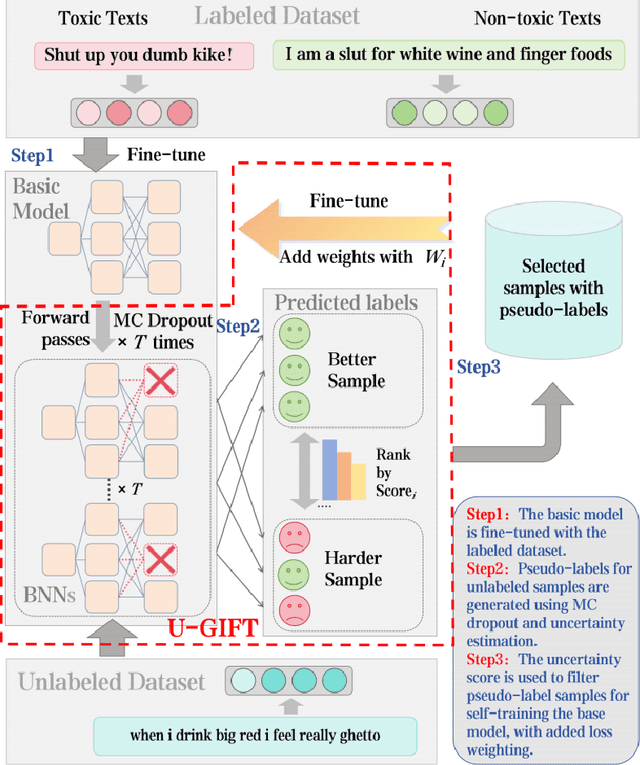
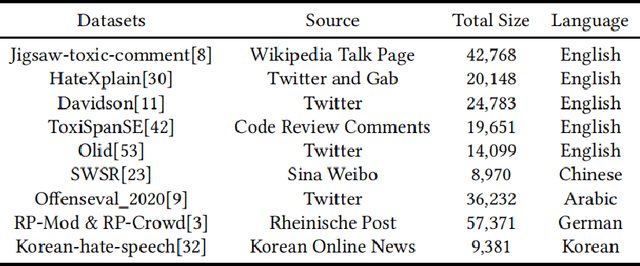
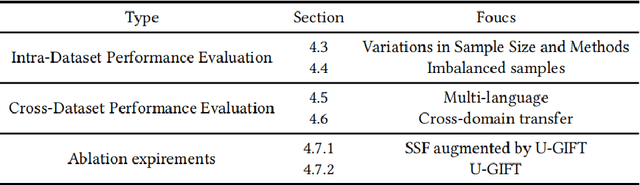
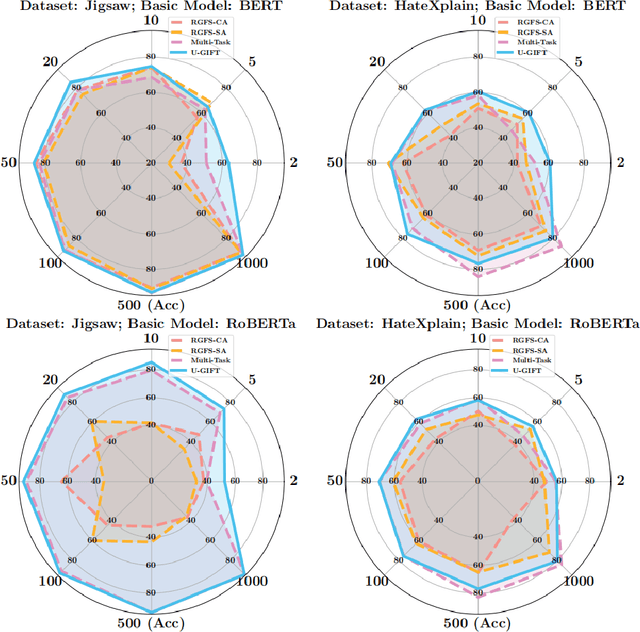
With the widespread use of social media, user-generated content has surged on online platforms. When such content includes hateful, abusive, offensive, or cyberbullying behavior, it is classified as toxic speech, posing a significant threat to the online ecosystem's integrity and safety. While manual content moderation is still prevalent, the overwhelming volume of content and the psychological strain on human moderators underscore the need for automated toxic speech detection. Previously proposed detection methods often rely on large annotated datasets; however, acquiring such datasets is both costly and challenging in practice. To address this issue, we propose an uncertainty-guided firewall for toxic speech in few-shot scenarios, U-GIFT, that utilizes self-training to enhance detection performance even when labeled data is limited. Specifically, U-GIFT combines active learning with Bayesian Neural Networks (BNNs) to automatically identify high-quality samples from unlabeled data, prioritizing the selection of pseudo-labels with higher confidence for training based on uncertainty estimates derived from model predictions. Extensive experiments demonstrate that U-GIFT significantly outperforms competitive baselines in few-shot detection scenarios. In the 5-shot setting, it achieves a 14.92\% performance improvement over the basic model. Importantly, U-GIFT is user-friendly and adaptable to various pre-trained language models (PLMs). It also exhibits robust performance in scenarios with sample imbalance and cross-domain settings, while showcasing strong generalization across various language applications. We believe that U-GIFT provides an efficient solution for few-shot toxic speech detection, offering substantial support for automated content moderation in cyberspace, thereby acting as a firewall to promote advancements in cybersecurity.
State-of-the-art Advances of Deep-learning Linguistic Steganalysis Research
Sep 03, 2024With the evolution of generative linguistic steganography techniques, conventional steganalysis falls short in robustly quantifying the alterations induced by steganography, thereby complicating detection. Consequently, the research paradigm has pivoted towards deep-learning-based linguistic steganalysis. This study offers a comprehensive review of existing contributions and evaluates prevailing developmental trajectories. Specifically, we first provided a formalized exposition of the general formulas for linguistic steganalysis, while comparing the differences between this field and the domain of text classification. Subsequently, we classified the existing work into two levels based on vector space mapping and feature extraction models, thereby comparing the research motivations, model advantages, and other details. A comparative analysis of the experiments is conducted to assess the performances. Finally, the challenges faced by this field are discussed, and several directions for future development and key issues that urgently need to be addressed are proposed.