 Add to Chrome
 Add to Firefox
 Add to Edge
Joint On-and-Off Policy Learning for Vision-and-Language Navigation
Jul 15, 2026
Vision-and-Language Navigation (VLN) necessitates an embodied agent to navigate in the physical world by adhering to natural language instructions. Recent advancements in Vision-Language Models (VLM) have propelled the development of VLM-based VLN methods with two predominant paradigms: (1) imitation learning (IL) on expert demonstrations, followed by the Dataset Aggregation (DAgger) algorithm to bolster error recovery capabilities; (2) reinforcement learning (RL) driven by verifiable rewards to enhance reasoning and exploration. A notable gap is the absence of integration between these two distinct paradigms. This paper introduces JOP-VLN, a novel VLN framework that synergistically combines off-policy imitation learning and on-policy exploration within a three-stage training pipeline. Initially, IL is employed on expert demonstrations to acquire basic navigation skills. Subsequently, the DAgger algorithm is utilized to generate heuristic exploration trajectories, which are then used for imitation learning to improve error recovery capabilities. Finally, a joint on-and-off policy learning framework is implemented, featuring high-entropy trajectory sampling to enhance RL training efficiency and an error-correction-prioritized trajectory sorting strategy for effective error correction. Extensive experiments demonstrate the efficacy of JOP-VLN, achieving success rates of 69.9% and 68.0% on the VLN-CE R2R and RxR benchmarks, respectively, setting a new state-of-the-art on R2R. Project page: https://qingrongh.github.io/JOP-VLN.

DataLadder: A Simulation-Enabled Interconversion Toolchain for the Embodied Data Pyramid
Jun 15, 2026Generalist robot policies require trustworthy evaluation and robot-usable training data, but both are difficult to scale with physical robots alone. Real-robot trials and demonstrations remain the most faithful source of deployment signals, yet they are slow, costly, and hard to reproduce. We present DataLadder, a simulation-enabled interconversion toolchain for human-robot aligned model evaluation and data generation, denoted as Robot $\rightleftharpoons$ Simulation $\rightleftharpoons$ Human. On the one hand, the Robot $\rightarrow$ Simulation $\rightarrow$ Human pathway supports human-robot aligned model evaluation by reconstructing real-robot tabletop organization tasks as calibrated digital twins for scalable evaluation, while using human embodied feedback to inspect and refine the naturalness of simulated motions. On the other hand, the Human $\rightarrow$ Simulation $\rightarrow$ Robot pathway supports human-robot aligned data generation: it lifts ego-centric human demonstrations into simulation, checks them under robot physical constraints, and converts them into robot-centered trajectories, annotations, and visual observations. Together, these pathways use the JoySim simulator as both a scalable evaluation layer and a physical consistency filter for robot data generation. We further package the core reconstruction, simulation, rendering, and realism-augmentation modules as cloud services on JD Cloud, turning the system into reusable infrastructure for robot data generation and model evaluation.
JoyAI-RA 0.1: A Foundation Model for Robotic Autonomy
Apr 22, 2026Robotic autonomy in open-world environments is fundamentally limited by insufficient data diversity and poor cross-embodiment generalization. Existing robotic datasets are often limited in scale and task coverage, while relatively large differences across robot embodiments impede effective behavior knowledge transfer. To address these challenges, we propose JoyAI-RA, a vision-language-action (VLA) embodied foundation model tailored for generalizable robotic manipulation. JoyAI-RA presents a multi-source multi-level pretraining framework that integrates web data, large-scale egocentric human manipulation videos, simulation-generated trajectories, and real-robot data. Through training on heterogeneous multi-source data with explicit action-space unification, JoyAI-RA effectively bridges embodiment gaps, particularly between human manipulation and robotic control, thereby enhancing cross-embodiment behavior learning. JoyAI-RA outperforms state-of-the-art methods in both simulation and real-world benchmarks, especially on diverse tasks with generalization demands.
Dual-Anchoring: Addressing State Drift in Vision-Language Navigation
Apr 19, 2026Vision-Language Navigation(VLN) requires an agent to navigate through 3D environments by following natural language instructions. While recent Video Large Language Models(Video-LLMs) have largely advanced VLN, they remain highly susceptible to State Drift in long scenarios. In these cases, the agent's internal state drifts away from the true task execution state, leading to aimless wandering and failure to execute essential maneuvers in the instruction. We attribute this failure to two distinct cognitive deficits: Progress Drift, where the agent fails to distinguish completed sub-goals from remaining ones, and Memory Drift, where the agent's history representations degrade, making it lose track of visited landmarks. In this paper, we propose a Dual-Anchoring Framework that explicitly anchors the instruction progress and history representations. First, to address progress drift, we introduce Instruction Progress Anchoring, which supervises the agent to generate structured text tokens that delineate completed versus remaining sub-goals. Second, to mitigate memory drift, we propose Memory Landmark Anchoring, which utilizes a Landmark-Centric World Model to retrospectively predict object-centric embeddings extracted by the Segment Anything Model, compelling the agent to explicitly verify past observations and preserve distinct representations of visited landmarks. Facilitating this framework, we curate two extensive datasets: 3.6 million samples with explicit progress descriptions, and 937k grounded landmark data for retrospective verification. Extensive experiments in both simulation and real-world environments demonstrate the superiority of our method, achieving a 15.2% improvement in Success Rate and a remarkable 24.7% gain on long-horizon trajectories. To facilitate further research, we will release our code, data generation pipelines, and the collected datasets.
Think-Program-reCtify: 3D Situated Reasoning with Large Language Models
Apr 23, 2024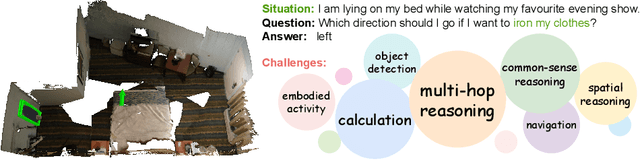
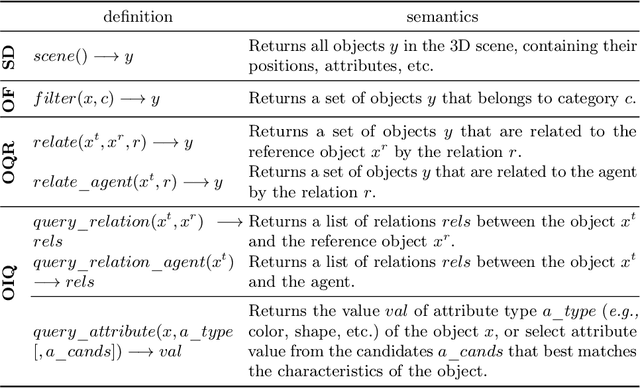
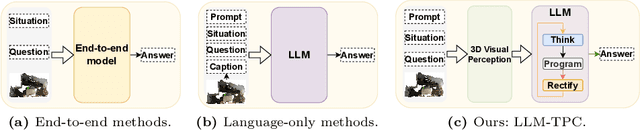
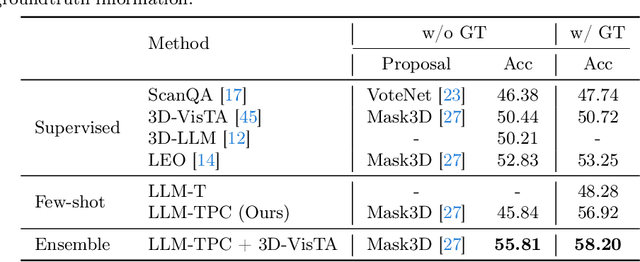
This work addresses the 3D situated reasoning task which aims to answer questions given egocentric observations in a 3D environment. The task remains challenging as it requires comprehensive 3D perception and complex reasoning skills. End-to-end models trained on supervised data for 3D situated reasoning suffer from data scarcity and generalization ability. Inspired by the recent success of leveraging large language models (LLMs) for visual reasoning, we propose LLM-TPC, a novel framework that leverages the planning, tool usage, and reflection capabilities of LLMs through a ThinkProgram-reCtify loop. The Think phase first decomposes the compositional question into a sequence of steps, and then the Program phase grounds each step to a piece of code and calls carefully designed 3D visual perception modules. Finally, the Rectify phase adjusts the plan and code if the program fails to execute. Experiments and analysis on the SQA3D benchmark demonstrate the effectiveness, interpretability and robustness of our method. Our code is publicly available at https://qingrongh.github.io/LLM-TPC/.