 Add to Chrome
 Add to Firefox
 Add to Edge
Diagnosing as Cardiologists Do: ECG Agents with Doctor-Grounded Priors for Clinical Reasoning Across Diseases and Populations
Aug 10, 2026
Cardiologists interpret electrocardiograms by localizing waveform components, measuring rhythm and interval patterns, and translating these structured observations into diagnostic evidence. Whether this expert reading process can serve as an effective prior for ECG agents remains unclear. To address this question, we introduce LuminaECG, a clinically structured ECG reasoning framework that reformulates ECG interpretation as measurement-grounded visual reading. ECG signals are rendered on standard electrocardiographic grid paper to preserve the spatial and scale cues used in clinical reading. P-wave, QRS-complex, and T-wave boundaries are explicitly delineated, and color-coded segmentation decomposes the waveform into discrete visual measurement primitives. A general 2B vision-language backbone is then trained with low-rank supervised fine-tuning to associate these primitives with diagnostic reasoning, without architectural modification. Across open, proprietary, and ECG-specialist zero-shot baselines, LuminaECG improves both waveform measurement and diagnostic recovery. It reaches a clinically meaningful reader tier on the CODE-test benchmark, transfers across geographically diverse ECG datasets without retraining, and generates reports whose structure contains an emergent prognostic signal. These findings suggest that effective ECG agents require not only larger models, but supervision that preserves the alignment between measurable waveform evidence and clinical knowledge.

Reversible Unlearnable Examples: Towards the Copyright Protection in Deep Learning Era
Aug 06, 2026Significant advancements in deep learning have been made possible by the utilization of large datasets, underscoring the critical importance of copyright protection. Adding meticulously designed perturbations to examples, making them unlearnable has become a crucial approach for safeguarding data copyright. Existing methods for creating unlearnable examples overlook the risk of data leakage, which can threaten data ownership. Thus, copyright protection in deep learning faces two main threats: illegal model training and malicious data leakage. We investigate that these two threats cannot be solved by straightforwardly combining existing availability attacks and watermarking techniques as their negative interaction effects. Therefore, in this paper, we propose a novel copyright protection mechanism for the aforementioned security concerns. Considering that the prevention of unauthorized model training requires powerful generalizability of unlearnable perturbations, we generate perturbations to induce the model to learn uncorrelated features of input images. It works by minimizing the mutual information of the input and output of the model. On the other hand, to eliminate the side impact of unlearnable perturbations on the watermark extraction, we design a dual extraction strategy by using two distinct watermark extractors. Extensive experiments on the image datasets {ImageNet, CIFAR10, and Pets} show that our proposed method could provide comprehensive copyright protection to images. The code is available at {https://github.com/Yeah21/ReversibleUnlearnableExamples}.
Knowledge-Guided Cross-Modal Fusion for Adult-to-Pediatric ECG Transfer via Label-Conditioned Contrastive Alignment
Jul 17, 2026Adult and pediatric electrocardiogram (ECG) interpretation relies on age-sensitive criteria, and models pretrained mainly on adult ECGs often transfer poorly to pediatric populations when pediatric labels are scarce. Existing multimodal ECG--text methods typically align waveforms and text at the global sample level, entangling evidence from co-occurring diagnoses and limiting transfer under this gap. We propose Pediatric-Adult ECG Alignment via Cross-modal Enhancement (PEACE), a knowledge-guided framework pretrained on the largely adult MIMIC-IV ECG corpus. PEACE describes each diagnosis along rhythm, morphology, and ST--T axes and, per recording, composes only positive-label descriptors into three axis tokens and a fused embedding. A label query network (LQN) uses diagnostic labels as queries to cross-attend over ECG tokens and axis tokens, while label set aware bidirectional contrastive learning (LSBC) aligns pooled ECG features with the fused embedding when recordings share diagnoses. Curriculum adaptive fusion (CAF) gates alignment strength according to smoothed classification loss and training progress, limiting disruption during early optimization. The knowledge branch is used only for training supervision; inference uses ECG signals alone. On ZZU-pECG, PEACE reaches macro average AUCs of 59.39%, 81.74%, and 91.56% under zero-shot, 50-shot, and full fine-tuning, with the clearest gains over foundation and knowledge-pretraining baselines under limited supervision; versus domain adaptation initializations, zero-shot improves substantially while 50-shot AUC is comparable to DANN. After fine-tuning on PTB-XL, PEACE reaches 96.90% macro average AUC over nine harmonized labels. Ablations confirm that label-conditioned knowledge alignment, rather than global text fusion, is the key driver of pediatric transfer gains.
MECO: A Multimodal Dataset for Emotion and Cognitive Understanding in Older Adults
Apr 03, 2026While affective computing has advanced considerably, multimodal emotion prediction in aging populations remains underexplored, largely due to the scarcity of dedicated datasets. Existing multimodal benchmarks predominantly target young, cognitively healthy subjects, neglecting the influence of cognitive decline on emotional expression and physiological responses. To bridge this gap, we present MECO, a Multimodal dataset for Emotion and Cognitive understanding in Older adults. MECO includes 42 participants and provides approximately 38 hours of multimodal signals, yielding 30,592 synchronized samples. To maximize ecological validity, data collection followed standardized protocols within community-based settings. The modalities cover video, audio, electroencephalography (EEG), and electrocardiography (ECG). In addition, the dataset offers comprehensive annotations of emotional and cognitive states, including self-assessed valence, arousal, six basic emotions, and Mini-Mental State Examination cognitive scores. We further establish baseline benchmarks for both emotion and cognitive prediction. MECO serves as a foundational resource for multimodal modeling of affect and cognition in aging populations, facilitating downstream applications such as personalized emotion recognition and early detection of mild cognitive impairment (MCI) in real-world settings. The complete dataset and supplementary materials are available at https://maitrechen.github.io/meco-page/.
Cross-Linguistic Persona-Driven Data Synthesis for Robust Multimodal Cognitive Decline Detection
Feb 08, 2026Speech-based digital biomarkers represent a scalable, non-invasive frontier for the early identification of Mild Cognitive Impairment (MCI). However, the development of robust diagnostic models remains impeded by acute clinical data scarcity and a lack of interpretable reasoning. Current solutions frequently struggle with cross-lingual generalization and fail to provide the transparent rationales essential for clinical trust. To address these barriers, we introduce SynCog, a novel framework integrating controllable zero-shot multimodal data synthesis with Chain-of-Thought (CoT) deduction fine-tuning. Specifically, SynCog simulates diverse virtual subjects with varying cognitive profiles to effectively alleviate clinical data scarcity. This generative paradigm enables the rapid, zero-shot expansion of clinical corpora across diverse languages, effectively bypassing data bottlenecks in low-resource settings and bolstering the diagnostic performance of Multimodal Large Language Models (MLLMs). Leveraging this synthesized dataset, we fine-tune a foundational multimodal backbone using a CoT deduction strategy, empowering the model to explicitly articulate diagnostic thought processes rather than relying on black-box predictions. Extensive experiments on the ADReSS and ADReSSo benchmarks demonstrate that augmenting limited clinical data with synthetic phenotypes yields competitive diagnostic performance, achieving Macro-F1 scores of 80.67% and 78.46%, respectively, outperforming current baseline models. Furthermore, evaluation on an independent real-world Mandarin cohort (CIR-E) demonstrates robust cross-linguistic generalization, attaining a Macro-F1 of 48.71%. These findings constitute a critical step toward providing clinically trustworthy and linguistically inclusive cognitive assessment tools for global healthcare.
Structure Disruption: Subverting Malicious Diffusion-Based Inpainting via Self-Attention Query Perturbation
May 26, 2025The rapid advancement of diffusion models has enhanced their image inpainting and editing capabilities but also introduced significant societal risks. Adversaries can exploit user images from social media to generate misleading or harmful content. While adversarial perturbations can disrupt inpainting, global perturbation-based methods fail in mask-guided editing tasks due to spatial constraints. To address these challenges, we propose Structure Disruption Attack (SDA), a powerful protection framework for safeguarding sensitive image regions against inpainting-based editing. Building upon the contour-focused nature of self-attention mechanisms of diffusion models, SDA optimizes perturbations by disrupting queries in self-attention during the initial denoising step to destroy the contour generation process. This targeted interference directly disrupts the structural generation capability of diffusion models, effectively preventing them from producing coherent images. We validate our motivation through visualization techniques and extensive experiments on public datasets, demonstrating that SDA achieves state-of-the-art (SOTA) protection performance while maintaining strong robustness.
OnSiteVRU: A High-Resolution Trajectory Dataset for High-Density Vulnerable Road Users
Mar 30, 2025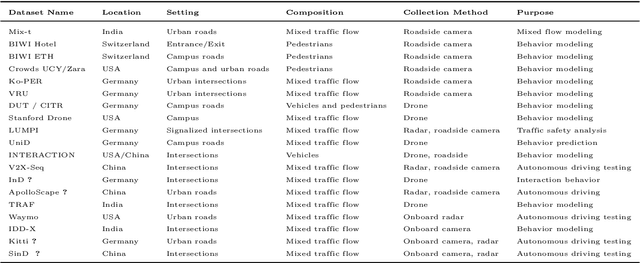
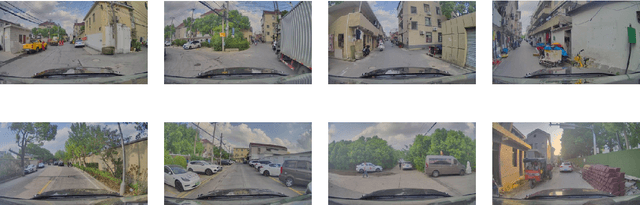
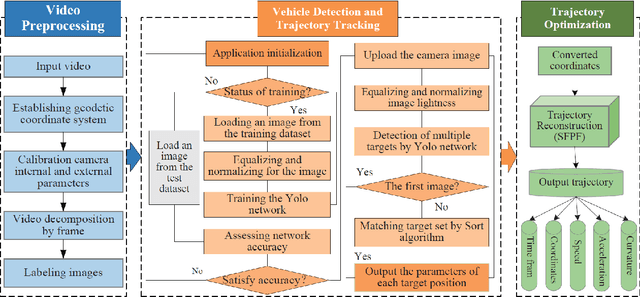
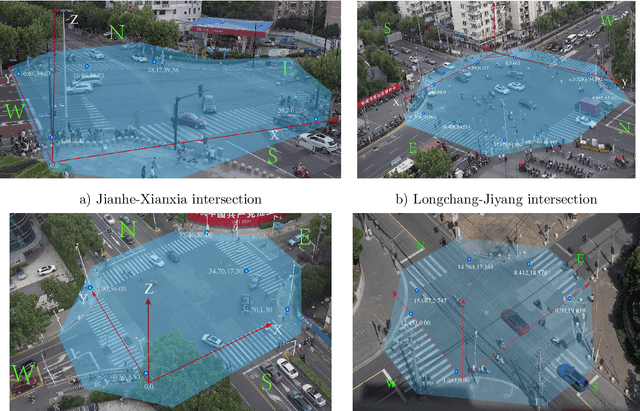
With the acceleration of urbanization and the growth of transportation demands, the safety of vulnerable road users (VRUs, such as pedestrians and cyclists) in mixed traffic flows has become increasingly prominent, necessitating high-precision and diverse trajectory data to support the development and optimization of autonomous driving systems. However, existing datasets fall short in capturing the diversity and dynamics of VRU behaviors, making it difficult to meet the research demands of complex traffic environments. To address this gap, this study developed the OnSiteVRU datasets, which cover a variety of scenarios, including intersections, road segments, and urban villages. These datasets provide trajectory data for motor vehicles, electric bicycles, and human-powered bicycles, totaling approximately 17,429 trajectories with a precision of 0.04 seconds. The datasets integrate both aerial-view natural driving data and onboard real-time dynamic detection data, along with environmental information such as traffic signals, obstacles, and real-time maps, enabling a comprehensive reconstruction of interaction events. The results demonstrate that VRU\_Data outperforms traditional datasets in terms of VRU density and scene coverage, offering a more comprehensive representation of VRU behavioral characteristics. This provides critical support for traffic flow modeling, trajectory prediction, and autonomous driving virtual testing. The dataset is publicly available for download at: https://www.kaggle.com/datasets/zcyan2/mixed-traffic-trajectory-dataset-in-from-shanghai.
AdaSin: Enhancing Hard Sample Metrics with Dual Adaptive Penalty for Face Recognition
Mar 05, 2025In recent years, the emergence of deep convolutional neural networks has positioned face recognition as a prominent research focus in computer vision. Traditional loss functions, such as margin-based, hard-sample mining-based, and hybrid approaches, have achieved notable performance improvements, with some leveraging curriculum learning to optimize training. However, these methods often fall short in effectively quantifying the difficulty of hard samples. To address this, we propose Adaptive Sine (AdaSin) loss function, which introduces the sine of the angle between a sample's embedding feature and its ground-truth class center as a novel difficulty metric. This metric enables precise and effective penalization of hard samples. By incorporating curriculum learning, the model dynamically adjusts classification boundaries across different training stages. Unlike previous adaptive-margin loss functions, AdaSin introduce a dual adaptive penalty, applied to both the positive and negative cosine similarities of hard samples. This design imposes stronger constraints, enhancing intra-class compactness and inter-class separability. The combination of the dual adaptive penalty and curriculum learning is guided by a well-designed difficulty metric. It enables the model to focus more effectively on hard samples in later training stages, and lead to the extraction of highly discriminative face features. Extensive experiments across eight benchmarks demonstrate that AdaSin achieves superior accuracy compared to other state-of-the-art methods.
RVAFM: Re-parameterizing Vertical Attention Fusion Module for Handwritten Paragraph Text Recognition
Mar 05, 2025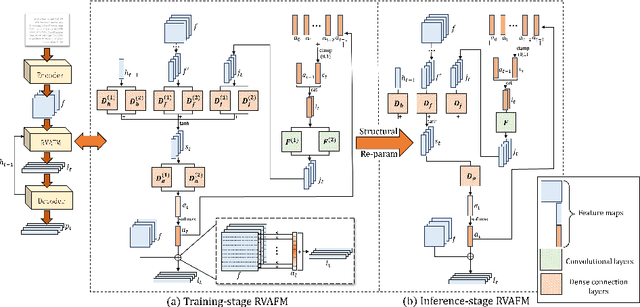
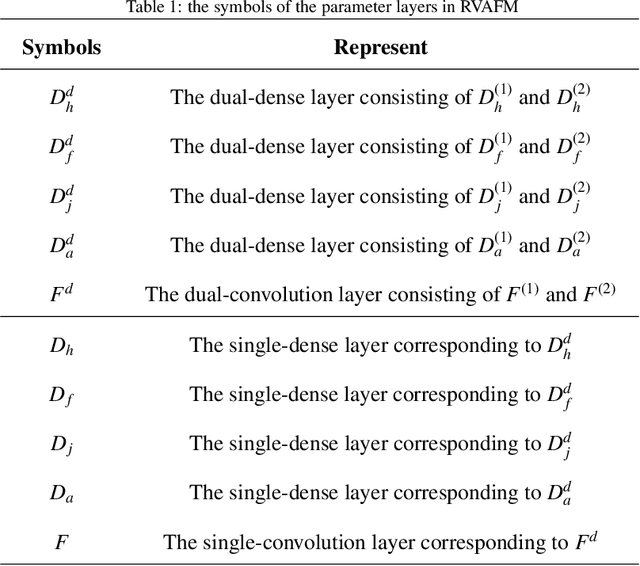
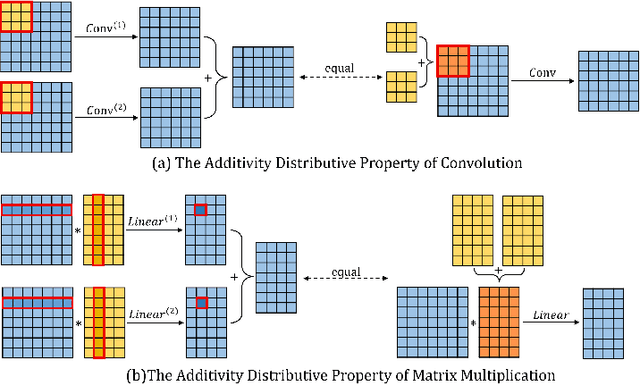
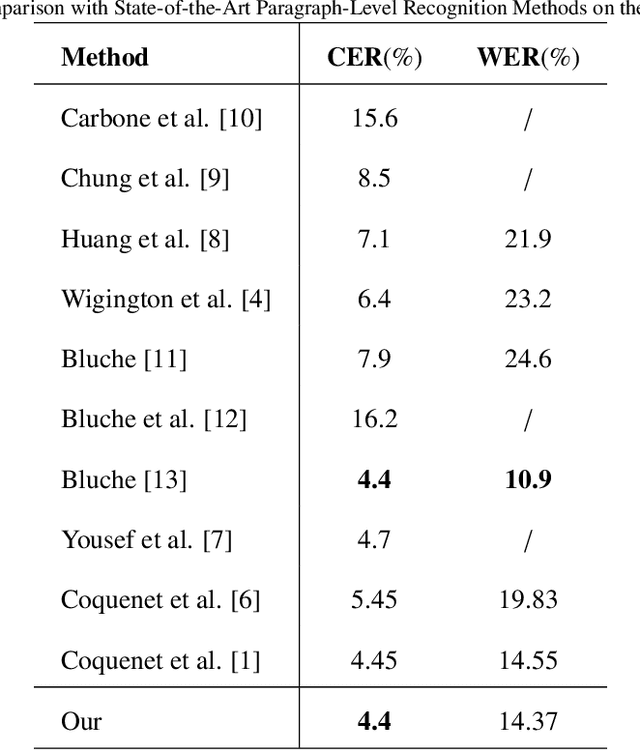
Handwritten Paragraph Text Recognition (HPTR) is a challenging task in Computer Vision, requiring the transformation of a paragraph text image, rich in handwritten text, into text encoding sequences. One of the most advanced models for this task is Vertical Attention Network (VAN), which utilizes a Vertical Attention Module (VAM) to implicitly segment paragraph text images into text lines, thereby reducing the difficulty of the recognition task. However, from a network structure perspective, VAM is a single-branch module, which is less effective in learning compared to multi-branch modules. In this paper, we propose a new module, named Re-parameterizing Vertical Attention Fusion Module (RVAFM), which incorporates structural re-parameterization techniques. RVAFM decouples the structure of the module during training and inference stages. During training, it uses a multi-branch structure for more effective learning, and during inference, it uses a single-branch structure for faster processing. The features learned by the multi-branch structure are fused into the single-branch structure through a special fusion method named Re-parameterization Fusion (RF) without any loss of information. As a result, we achieve a Character Error Rate (CER) of 4.44% and a Word Error Rate (WER) of 14.37% on the IAM paragraph-level test set. Additionally, the inference speed is slightly faster than VAN.
Feedback Design with VQ-VAE for Robust Precoding in Multi-User FDD Systems
Aug 08, 2024
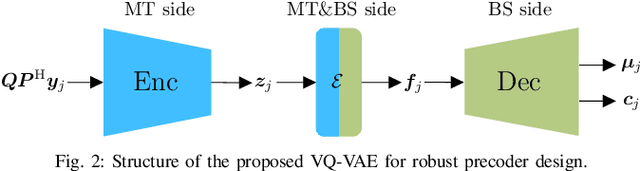
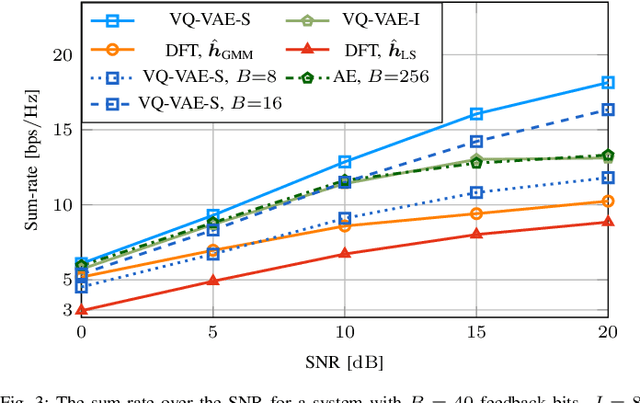
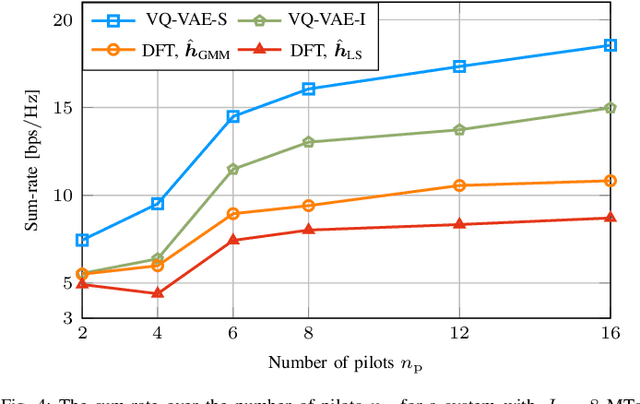
In this letter, we propose a vector quantized-variational autoencoder (VQ-VAE)-based feedback scheme for robust precoder design in multi-user frequency division duplex (FDD) systems. We demonstrate how the VQ-VAE can be tailored to specific propagation environments, focusing on systems with low pilot overhead, which is crucial in massive multiple-input multiple-output (MIMO). Extensive simulations with real-world measurement data show that our proposed feedback scheme outperforms state-of-the-art autoencoder (AE)-based compression schemes and conventional Discrete Fourier transform (DFT) codebook-based schemes. These improvements enable the deployment of systems with fewer feedback bits or pilots.