 Add to Chrome
 Add to Firefox
 Add to Edge
SM$^3$: Self-Supervised Multi-task Modeling with Multi-view 2D Images for Articulated Objects
Jan 17, 2024

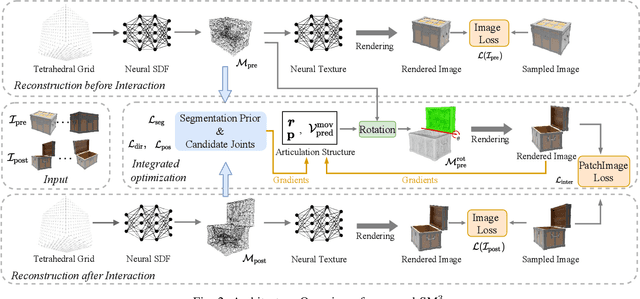
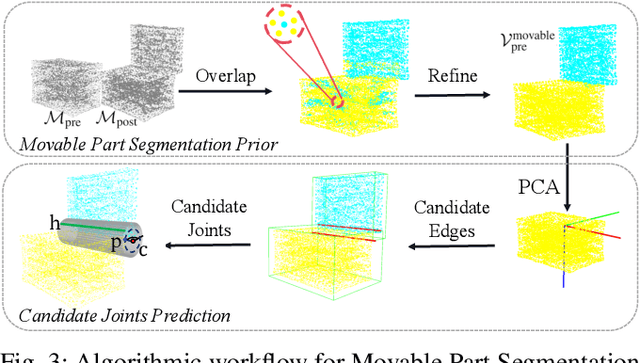
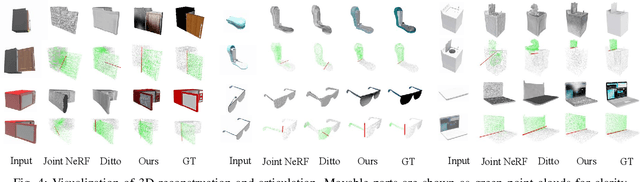
Reconstructing real-world objects and estimating their movable joint structures are pivotal technologies within the field of robotics. Previous research has predominantly focused on supervised approaches, relying on extensively annotated datasets to model articulated objects within limited categories. However, this approach falls short of effectively addressing the diversity present in the real world. To tackle this issue, we propose a self-supervised interaction perception method, referred to as SM$^3$, which leverages multi-view RGB images captured before and after interaction to model articulated objects, identify the movable parts, and infer the parameters of their rotating joints. By constructing 3D geometries and textures from the captured 2D images, SM$^3$ achieves integrated optimization of movable part and joint parameters during the reconstruction process, obviating the need for annotations. Furthermore, we introduce the MMArt dataset, an extension of PartNet-Mobility, encompassing multi-view and multi-modal data of articulated objects spanning diverse categories. Evaluations demonstrate that SM$^3$ surpasses existing benchmarks across various categories and objects, while its adaptability in real-world scenarios has been thoroughly validated.

Visual Robotic Manipulation with Depth-Aware Pretraining
Jan 17, 2024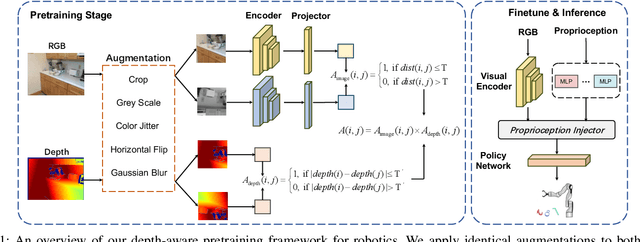
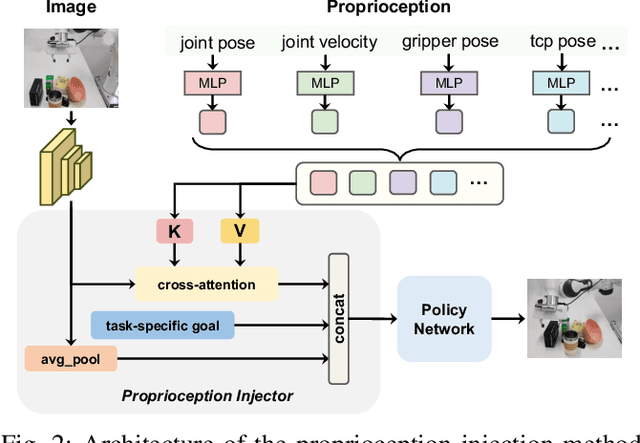
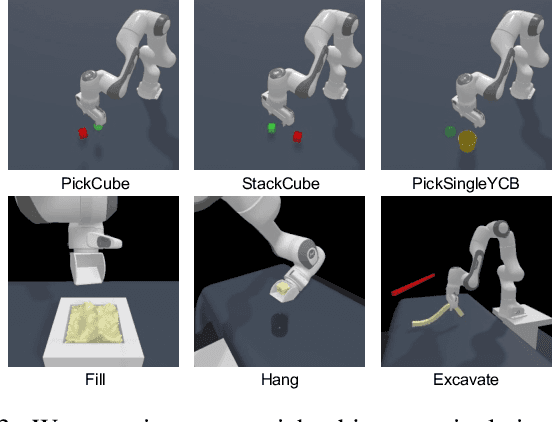
Recent work on visual representation learning has shown to be efficient for robotic manipulation tasks. However, most existing works pretrained the visual backbone solely on 2D images or egocentric videos, ignoring the fact that robots learn to act in 3D space, which is hard to learn from 2D observation. In this paper, we examine the effectiveness of pretraining for vision backbone with public-available large-scale 3D data to improve manipulation policy learning. Our method, namely Depth-aware Pretraining for Robotics (DPR), enables an RGB-only backbone to learn 3D scene representations from self-supervised contrastive learning, where depth information serves as auxiliary knowledge. No 3D information is necessary during manipulation policy learning and inference, making our model enjoy both efficiency and effectiveness in 3D space manipulation. Furthermore, we introduce a new way to inject robots' proprioception into the policy networks that makes the manipulation model robust and generalizable. We demonstrate in experiments that our proposed framework improves performance on unseen objects and visual environments for various robotics tasks on both simulated and real robots.
SWBT: Similarity Weighted Behavior Transformer with the Imperfect Demonstration for Robotic Manipulation
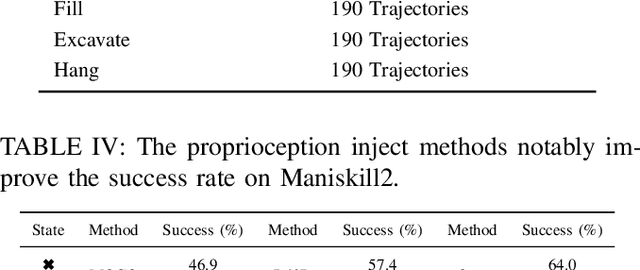
Jan 17, 2024Imitation learning (IL), aiming to learn optimal control policies from expert demonstrations, has been an effective method for robot manipulation tasks. However, previous IL methods either only use expensive expert demonstrations and omit imperfect demonstrations or rely on interacting with the environment and learning from online experiences. In the context of robotic manipulation, we aim to conquer the above two challenges and propose a novel framework named Similarity Weighted Behavior Transformer (SWBT). SWBT effectively learn from both expert and imperfect demonstrations without interaction with environments. We reveal that the easy-to-get imperfect demonstrations, such as forward and inverse dynamics, significantly enhance the network by learning fruitful information. To the best of our knowledge, we are the first to attempt to integrate imperfect demonstrations into the offline imitation learning setting for robot manipulation tasks. Extensive experiments on the ManiSkill2 benchmark built on the high-fidelity Sapien simulator and real-world robotic manipulation tasks demonstrated that the proposed method can extract better features and improve the success rates for all tasks. Our code will be released upon acceptance of the paper.
LLaVA-Phi: Efficient Multi-Modal Assistant with Small Language Model
Jan 15, 2024In this paper, we introduce LLaVA-$\phi$ (LLaVA-Phi), an efficient multi-modal assistant that harnesses the power of the recently advanced small language model, Phi-2, to facilitate multi-modal dialogues. LLaVA-Phi marks a notable advancement in the realm of compact multi-modal models. It demonstrates that even smaller language models, with as few as 2.7B parameters, can effectively engage in intricate dialogues that integrate both textual and visual elements, provided they are trained with high-quality corpora. Our model delivers commendable performance on publicly available benchmarks that encompass visual comprehension, reasoning, and knowledge-based perception. Beyond its remarkable performance in multi-modal dialogue tasks, our model opens new avenues for applications in time-sensitive environments and systems that require real-time interaction, such as embodied agents. It highlights the potential of smaller language models to achieve sophisticated levels of understanding and interaction, while maintaining greater resource efficiency.The project is available at {https://github.com/zhuyiche/llava-phi}.
Object-Centric Instruction Augmentation for Robotic Manipulation
Jan 05, 2024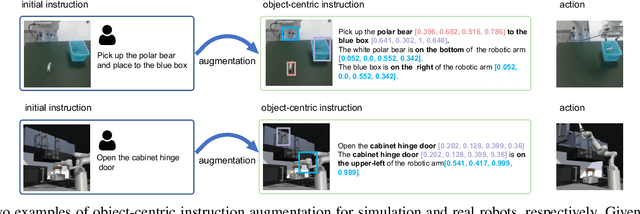
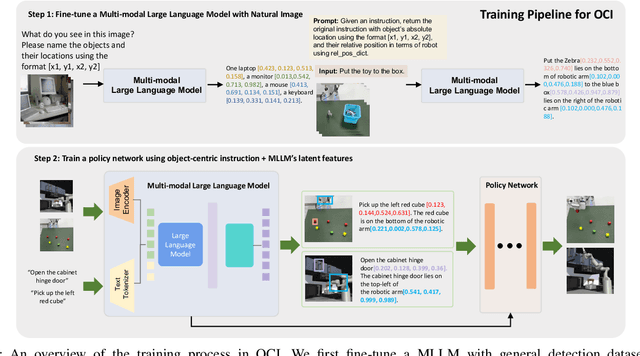
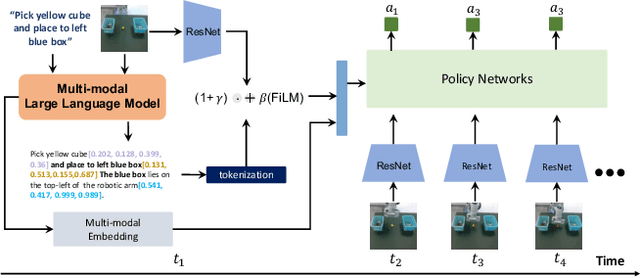
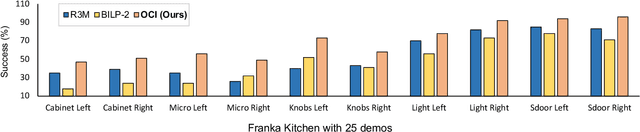
Humans interpret scenes by recognizing both the identities and positions of objects in their observations. For a robot to perform tasks such as \enquote{pick and place}, understanding both what the objects are and where they are located is crucial. While the former has been extensively discussed in the literature that uses the large language model to enrich the text descriptions, the latter remains underexplored. In this work, we introduce the \textit{Object-Centric Instruction Augmentation (OCI)} framework to augment highly semantic and information-dense language instruction with position cues. We utilize a Multi-modal Large Language Model (MLLM) to weave knowledge of object locations into natural language instruction, thus aiding the policy network in mastering actions for versatile manipulation. Additionally, we present a feature reuse mechanism to integrate the vision-language features from off-the-shelf pre-trained MLLM into policy networks. Through a series of simulated and real-world robotic tasks, we demonstrate that robotic manipulator imitation policies trained with our enhanced instructions outperform those relying solely on traditional language instructions.
Cross-Modal Reasoning with Event Correlation for Video Question Answering
Dec 20, 2023Video Question Answering (VideoQA) is a very attractive and challenging research direction aiming to understand complex semantics of heterogeneous data from two domains, i.e., the spatio-temporal video content and the word sequence in question. Although various attention mechanisms have been utilized to manage contextualized representations by modeling intra- and inter-modal relationships of the two modalities, one limitation of the predominant VideoQA methods is the lack of reasoning with event correlation, that is, sensing and analyzing relationships among abundant and informative events contained in the video. In this paper, we introduce the dense caption modality as a new auxiliary and distill event-correlated information from it to infer the correct answer. To this end, we propose a novel end-to-end trainable model, Event-Correlated Graph Neural Networks (EC-GNNs), to perform cross-modal reasoning over information from the three modalities (i.e., caption, video, and question). Besides the exploitation of a brand new modality, we employ cross-modal reasoning modules for explicitly modeling inter-modal relationships and aggregating relevant information across different modalities, and we propose a question-guided self-adaptive multi-modal fusion module to collect the question-oriented and event-correlated evidence through multi-step reasoning. We evaluate our model on two widely-used benchmark datasets and conduct an ablation study to justify the effectiveness of each proposed component.
Multi-Clue Reasoning with Memory Augmentation for Knowledge-based Visual Question Answering
Dec 20, 2023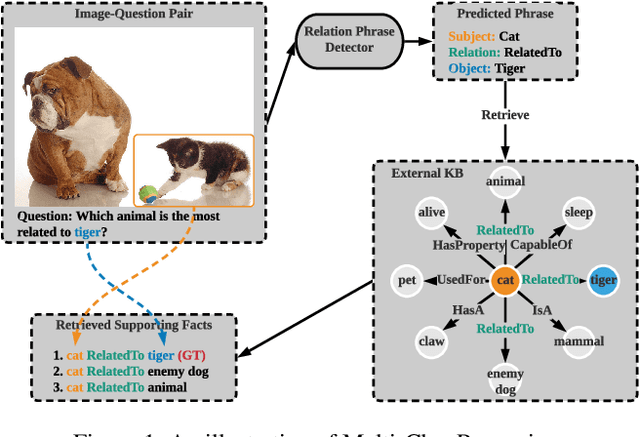
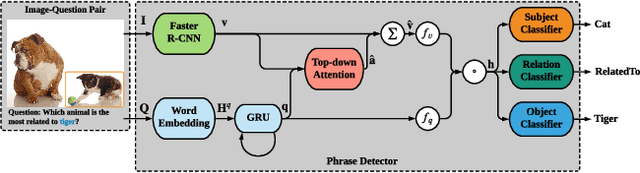
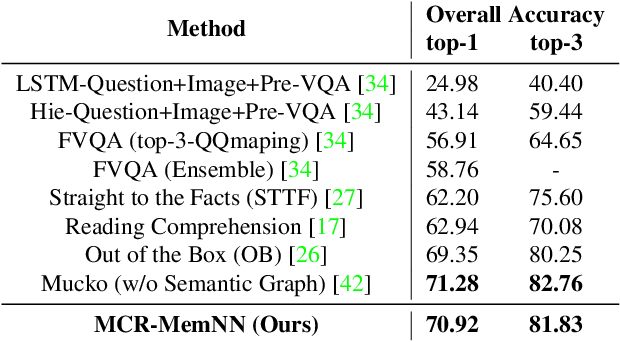
Visual Question Answering (VQA) has emerged as one of the most challenging tasks in artificial intelligence due to its multi-modal nature. However, most existing VQA methods are incapable of handling Knowledge-based Visual Question Answering (KB-VQA), which requires external knowledge beyond visible contents to answer questions about a given image. To address this issue, we propose a novel framework that endows the model with capabilities of answering more general questions, and achieves a better exploitation of external knowledge through generating Multiple Clues for Reasoning with Memory Neural Networks (MCR-MemNN). Specifically, a well-defined detector is adopted to predict image-question related relation phrases, each of which delivers two complementary clues to retrieve the supporting facts from external knowledge base (KB), which are further encoded into a continuous embedding space using a content-addressable memory. Afterwards, mutual interactions between visual-semantic representation and the supporting facts stored in memory are captured to distill the most relevant information in three modalities (i.e., image, question, and KB). Finally, the optimal answer is predicted by choosing the supporting fact with the highest score. We conduct extensive experiments on two widely-used benchmarks. The experimental results well justify the effectiveness of MCR-MemNN, as well as its superiority over other KB-VQA methods.
Exploring Gradient Explosion in Generative Adversarial Imitation Learning: A Probabilistic Perspective
Dec 18, 2023Generative Adversarial Imitation Learning (GAIL) stands as a cornerstone approach in imitation learning. This paper investigates the gradient explosion in two types of GAIL: GAIL with deterministic policy (DE-GAIL) and GAIL with stochastic policy (ST-GAIL). We begin with the observation that the training can be highly unstable for DE-GAIL at the beginning of the training phase and end up divergence. Conversely, the ST-GAIL training trajectory remains consistent, reliably converging. To shed light on these disparities, we provide an explanation from a theoretical perspective. By establishing a probabilistic lower bound for GAIL, we demonstrate that gradient explosion is an inevitable outcome for DE-GAIL due to occasionally large expert-imitator policy disparity, whereas ST-GAIL does not have the issue with it. To substantiate our assertion, we illustrate how modifications in the reward function can mitigate the gradient explosion challenge. Finally, we propose CREDO, a simple yet effective strategy that clips the reward function during the training phase, allowing the GAIL to enjoy high data efficiency and stable trainability.
Universal Deoxidation of Semiconductor Substrates Assisted by Machine-Learning and Real-Time-Feedback-Control
Dec 04, 2023Thin film deposition is an essential step in the semiconductor process. During preparation or loading, the substrate is exposed to the air unavoidably, which has motivated studies of the process control to remove the surface oxide before thin film deposition. Optimizing the deoxidation process in molecular beam epitaxy (MBE) for a random substrate is a multidimensional challenge and sometimes controversial. Due to variations in semiconductor materials and growth processes, the determination of substrate deoxidation temperature is highly dependent on the grower's expertise; the same substrate may yield inconsistent results when evaluated by different growers. Here, we employ a machine learning (ML) hybrid convolution and vision transformer (CNN-ViT) model. This model utilizes reflection high-energy electron diffraction (RHEED) video as input to determine the deoxidation status of the substrate as output, enabling automated substrate deoxidation under a controlled architecture. This also extends to the successful application of deoxidation processes on other substrates. Furthermore, we showcase the potential of models trained on data from a single MBE equipment to achieve high-accuracy deployment on other equipment. In contrast to traditional methods, our approach holds exceptional practical value. It standardizes deoxidation temperatures across various equipment and substrate materials, advancing the standardization research process in semiconductor preparation, a significant milestone in thin film growth technology. The concepts and methods demonstrated in this work are anticipated to revolutionize semiconductor manufacturing in optoelectronics and microelectronics industries by applying them to diverse material growth processes.
PDB-Struct: A Comprehensive Benchmark for Structure-based Protein Design
Nov 30, 2023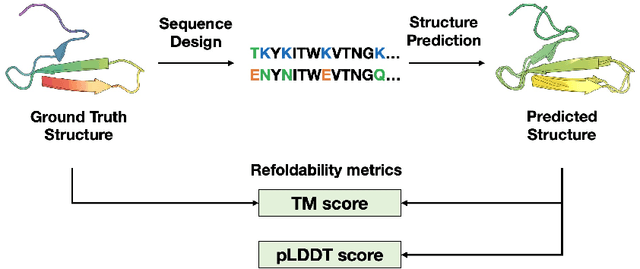
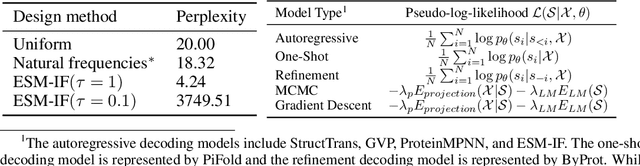
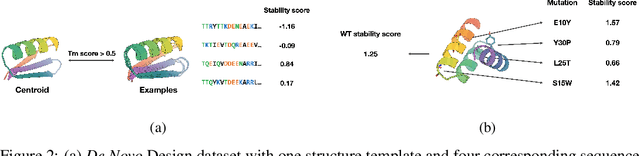

Structure-based protein design has attracted increasing interest, with numerous methods being introduced in recent years. However, a universally accepted method for evaluation has not been established, since the wet-lab validation can be overly time-consuming for the development of new algorithms, and the $\textit{in silico}$ validation with recovery and perplexity metrics is efficient but may not precisely reflect true foldability. To address this gap, we introduce two novel metrics: refoldability-based metric, which leverages high-accuracy protein structure prediction models as a proxy for wet lab experiments, and stability-based metric, which assesses whether models can assign high likelihoods to experimentally stable proteins. We curate datasets from high-quality CATH protein data, high-throughput $\textit{de novo}$ designed proteins, and mega-scale experimental mutagenesis experiments, and in doing so, present the $\textbf{PDB-Struct}$ benchmark that evaluates both recent and previously uncompared protein design methods. Experimental results indicate that ByProt, ProteinMPNN, and ESM-IF perform exceptionally well on our benchmark, while ESM-Design and AF-Design fall short on the refoldability metric. We also show that while some methods exhibit high sequence recovery, they do not perform as well on our new benchmark. Our proposed benchmark paves the way for a fair and comprehensive evaluation of protein design methods in the future. Code is available at https://github.com/WANG-CR/PDB-Struct.