 Add to Chrome
 Add to Firefox
 Add to Edge
A Gradient Perspective on RLVR Stability and Winner Advantage Policy Optimization
Jun 15, 2026
Reinforcement learning with verifiable rewards (RLVR) improves language-model reasoning, but GRPO-style optimization remains prone to collapse. We analyse this instability through token-level gradient dynamics, deriving a taxonomy that predicts how updates affect next-token probabilities and entropy. The taxonomy shows that stability depends jointly on the advantage sign and token distribution under the current policy. Motivated by this finding, we propose Winner Advantage Policy Optimization (WAPO), a simple online clipped policy-gradient objective that updates only on positive-advantage completions. Across mathematical reasoning and multi-hop QA benchmarks, WAPO improves training stability and matches or outperforms baselines across multiple model families. Full code can be found at https://github.com/layer6ai-labs/wapo.

Agentic Monte Carlo: Simulating Reinforcement Learning for Black-Box Agents
Jun 03, 2026LLM agents operate in two distinct regimes: open-weight agents amenable to reinforcement learning (RL) and black-box agents whose behaviour must be controlled purely at test time. Although black-box agents are often backed by state-of-the-art proprietary LLMs, API-only access precludes parameter-level optimization, rendering most RL methods inapplicable. To address this limitation, we turn to a known equivalence between RL and Bayesian inference. We propose Agentic Monte Carlo (AMC) to directly sample from the optimal policy of a black-box agent rather than training it through RL. The optimal policy is a posterior over trajectories whose prior we define as the fixed black-box LLM agent. We employ Sequential Monte Carlo to sample from this posterior by learning a value function to steer the agent while leaving the underlying black-box model unchanged. We validate AMC on three diverse environments from the AgentGym benchmark, demonstrating significant improvements over prompting baselines and even outperforming Group Relative Policy Optimization (GRPO) as we scale the test-time compute of our method. AMC demonstrates the feasibility of performing principled RL-style optimization of black-box LLM agents. Code is available at https://github.com/layer6ai-labs/Agentic-Monte-Carlo
Chartographer: Counterfactual Chart Generation for Evaluating Vision-Language Models
May 26, 2026Chart question-answering (QA) benchmarks aim to pose questions that require visual reasoning to correctly answer, but models can often reach solutions through shortcuts or prior familiarity with a chart based on their own background knowledge. To strictly evaluate visual reasoning, we propose counterfactual charts where the chart-question task remains fixed, but underlying chart and the corresponding answer are varied. We introduce Chartographer, a framework to reverse engineer charts into executable code, validate reconstruction fidelity, generate seed-controlled counterfactual variants, and derive new answers from executable QA logic. We apply this framework to existing chart QA datasets and evaluate proprietary and open-source vision-language models (VLMs), measuring variation sensitivity and generalizability. Counterfactual charts reveal failures hidden by single-chart performance: VLMs often fail to generalize after answering the original chart correctly. We find failures are most prevalent when updated charts require novel visual reasoning pathways.
RankJudge: A Multi-Turn LLM-as-a-Judge Synthetic Benchmark Generator
May 20, 2026As interactive LLM-based applications are created and refined, model developers need to evaluate the quality of generated text along many possible axes. For simpler systems, human evaluation may be practical, but in complicated systems like conversational chatbots, the amount of generated text can overwhelm human annotation resources. Model developers have begun to rely heavily on auto-evaluation, where LLMs are also used to judge generation quality. However, existing LLM-as-a-judge benchmarks largely focus on simple Q\&A tasks that do not match the complexity of multi-turn conversations. We introduce RankJudge, a benchmark generator for evaluating LLM-as-a-judge on multi-turn conversations grounded in reference documents. RankJudge creates pairs of conversations where one conversation has a single flaw injected into one turn. This construction allows paired conversations to be labeled unambiguously as better or worse, and precisely isolates failure categories to individual turns, enabling a strict joint correctness criterion for judging. We implement RankJudge across the domains of machine learning, biomedicine, and finance, evaluate 21 frontier LLM judges, and rank those judges via the Bradley-Terry model. Our formulation also allows ranking each conversation pair with difficulty ratings, which we use to dynamically curate the evaluation slice to reduce label noise, as confirmed via human annotation. We find that judge rankings are stable under partial observability, coarser correctness criteria, and an alternative random-walk rating algorithm.
Causal Foundation Models with Continuous Treatments
May 14, 2026Causal inference, estimating causal effects from observational data, is a fundamental tool in many disciplines. Of particular importance across a variety of domains is the continuous treatment setting, where the variable of intervention has a continuous range. This setting is far less explored and represents a substantial shift from the binary treatment setting, with models needing to represent effects across a continuum of treatment values. In this paper, we present the first causal foundation model for the continuous treatment setting. Our model meta-learns the ability to predict causal effects across a wide variety of unseen tasks without additional training or fine-tuning. First, we design a novel prior over data-generating processes with continuous treatment variables in order to generate a rich causal training corpus. We then train a transformer to reconstruct individual treatment-response curves given only observational data, leveraging in-context learning to amortize expensive Bayesian posterior inference. Our model achieves state-of-the-art performance on individual treatment-response curve reconstruction tasks compared to causal models which are trained specifically for those tasks.
On the Burden of Achieving Fairness in Conformal Prediction
May 14, 2026Conformal prediction is often calibrated with a single pooled threshold, but this can hide cross-group heterogeneity in score distributions and distort group-wise coverage. We study this phenomenon through the population score distributions underlying split conformal calibration. First, we derive a conservation law and lower bound showing that pooled calibration incurs irreducible group-wise coverage distortion at a scale set by cross-group quantile heterogeneity. Second, we demonstrate that the two leading fairness definitions for conformal prediction, Equalized Coverage and Equalized Set Size, are fundamentally in tension. Third, we quantify the cost of moving between policies which treat groups separately or pool them. Experiments on synthetic and real data confirm the same bidirectional trade-off after finite-sample calibration. Our results show that, for the policy families studied here, calibration choice does not remove cross-group heterogeneity; it determines whether the resulting distortion appears in the coverage or size dimension, providing a principled lens for analyzing fairness-oriented calibration choices in practice.
Beyond Procedure: Substantive Fairness in Conformal Prediction
Feb 18, 2026Conformal prediction (CP) offers distribution-free uncertainty quantification for machine learning models, yet its interplay with fairness in downstream decision-making remains underexplored. Moving beyond CP as a standalone operation (procedural fairness), we analyze the holistic decision-making pipeline to evaluate substantive fairness-the equity of downstream outcomes. Theoretically, we derive an upper bound that decomposes prediction-set size disparity into interpretable components, clarifying how label-clustered CP helps control method-driven contributions to unfairness. To facilitate scalable empirical analysis, we introduce an LLM-in-the-loop evaluator that approximates human assessment of substantive fairness across diverse modalities. Our experiments reveal that label-clustered CP variants consistently deliver superior substantive fairness. Finally, we empirically show that equalized set sizes, rather than coverage, strongly correlate with improved substantive fairness, enabling practitioners to design more fair CP systems. Our code is available at https://github.com/layer6ai-labs/llm-in-the-loop-conformal-fairness.
Response Quality Assessment for Retrieval-Augmented Generation via Conditional Conformal Factuality
Jun 26, 2025Existing research on Retrieval-Augmented Generation (RAG) primarily focuses on improving overall question-answering accuracy, often overlooking the quality of sub-claims within generated responses. Recent methods that attempt to improve RAG trustworthiness, such as through auto-evaluation metrics, lack probabilistic guarantees or require ground truth answers. To address these limitations, we propose Conformal-RAG, a novel framework inspired by recent applications of conformal prediction (CP) on large language models (LLMs). Conformal-RAG leverages CP and internal information from the RAG mechanism to offer statistical guarantees on response quality. It ensures group-conditional coverage spanning multiple sub-domains without requiring manual labelling of conformal sets, making it suitable for complex RAG applications. Compared to existing RAG auto-evaluation methods, Conformal-RAG offers statistical guarantees on the quality of refined sub-claims, ensuring response reliability without the need for ground truth answers. Additionally, our experiments demonstrate that by leveraging information from the RAG system, Conformal-RAG retains up to 60\% more high-quality sub-claims from the response compared to direct applications of CP to LLMs, while maintaining the same reliability guarantee.
Textual Bayes: Quantifying Uncertainty in LLM-Based Systems
Jun 11, 2025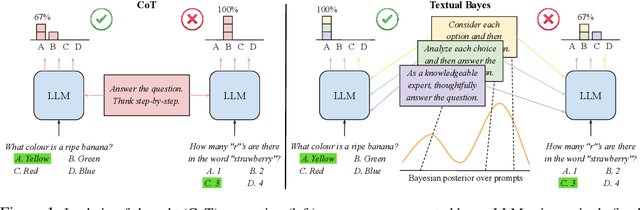
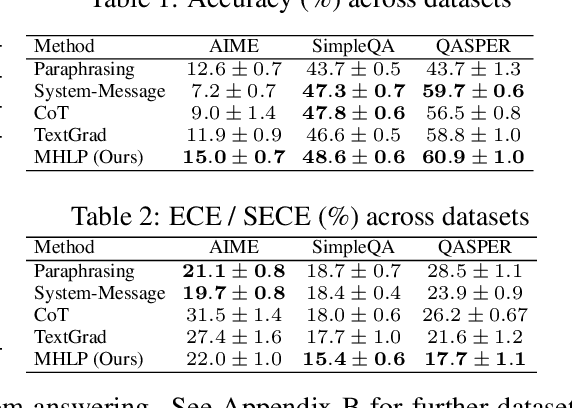
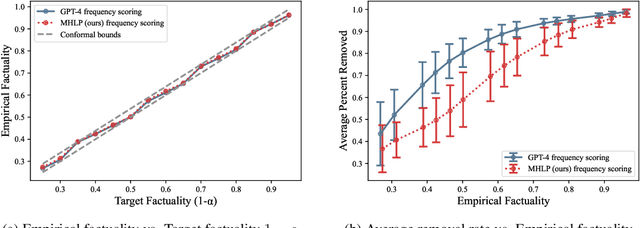
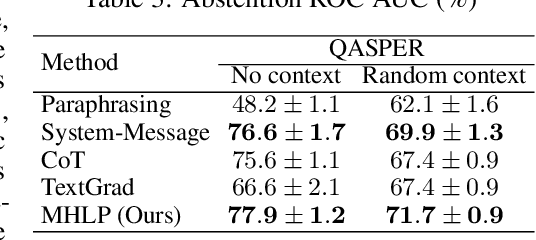
Although large language models (LLMs) are becoming increasingly capable of solving challenging real-world tasks, accurately quantifying their uncertainty remains a critical open problem, which limits their applicability in high-stakes domains. This challenge is further compounded by the closed-source, black-box nature of many state-of-the-art LLMs. Moreover, LLM-based systems can be highly sensitive to the prompts that bind them together, which often require significant manual tuning (i.e., prompt engineering). In this work, we address these challenges by viewing LLM-based systems through a Bayesian lens. We interpret prompts as textual parameters in a statistical model, allowing us to use a small training dataset to perform Bayesian inference over these prompts. This novel perspective enables principled uncertainty quantification over both the model's textual parameters and its downstream predictions, while also incorporating prior beliefs about these parameters expressed in free-form text. To perform Bayesian inference, a difficult problem even for well-studied data modalities, we introduce Metropolis-Hastings through LLM Proposals (MHLP), a novel Markov chain Monte Carlo (MCMC) algorithm that combines prompt optimization techniques with standard MCMC methods. MHLP is a turnkey modification to existing LLM pipelines, including those that rely exclusively on closed-source models. Empirically, we demonstrate that our method yields improvements in both predictive accuracy and uncertainty quantification (UQ) on a range of LLM benchmarks and UQ tasks. More broadly, our work demonstrates a viable path for incorporating methods from the rich Bayesian literature into the era of LLMs, paving the way for more reliable and calibrated LLM-based systems.
CausalPFN: Amortized Causal Effect Estimation via In-Context Learning
Jun 09, 2025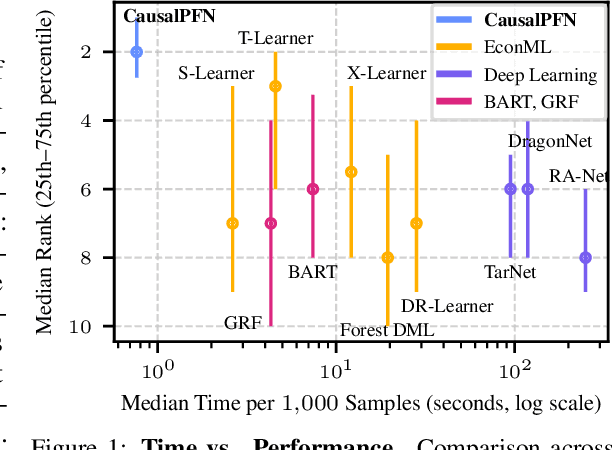

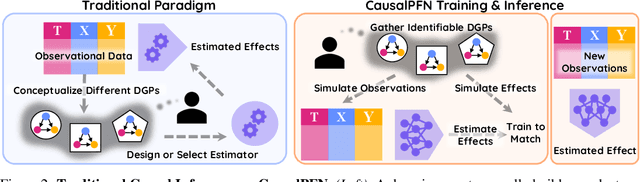
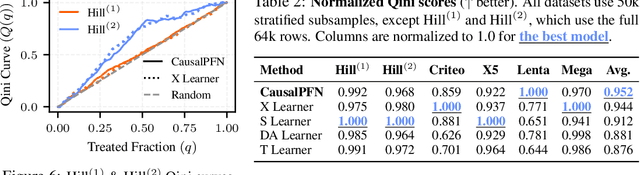
Causal effect estimation from observational data is fundamental across various applications. However, selecting an appropriate estimator from dozens of specialized methods demands substantial manual effort and domain expertise. We present CausalPFN, a single transformer that amortizes this workflow: trained once on a large library of simulated data-generating processes that satisfy ignorability, it infers causal effects for new observational datasets out-of-the-box. CausalPFN combines ideas from Bayesian causal inference with the large-scale training protocol of prior-fitted networks (PFNs), learning to map raw observations directly to causal effects without any task-specific adjustment. Our approach achieves superior average performance on heterogeneous and average treatment effect estimation benchmarks (IHDP, Lalonde, ACIC). Moreover, it shows competitive performance for real-world policy making on uplift modeling tasks. CausalPFN provides calibrated uncertainty estimates to support reliable decision-making based on Bayesian principles. This ready-to-use model does not require any further training or tuning and takes a step toward automated causal inference (https://github.com/vdblm/CausalPFN).