 Add to Chrome
 Add to Firefox
 Add to Edge
TabDPT-Turbo: Efficient In-Context Learning for Tabular Prediction
Aug 02, 2026
Tabular foundation models, driven by in-context learning, have rapidly grown in quality and popularity. However, recent approaches with either cell-based architectures or retrieval have sacrificed efficiency for raw performance, restricting their utility in situations where compute is limited or inference speed is crucial. We adopt an alternate approach, sticking with row-based attention while incorporating long context pre-training to eliminate the need for retrieval. By combining this with architectural improvements and SSL pre-training on a newly-sourced, larger corpus of real data results, we present TabDPT-Turbo, a model that provides comparable default performance to TabDPT v1.1 on TabArena-Lite, CC18, and CTR23, at orders of magnitude faster. In our experiments, TabDPT-Turbo is the fastest model overall among leading foundation models. We have released the new model as TabDPT v1.2 at https://github.com/layer6ai-labs/TabDPT-inference.

A Gradient Perspective on RLVR Stability and Winner Advantage Policy Optimization
Jun 15, 2026Reinforcement learning with verifiable rewards (RLVR) improves language-model reasoning, but GRPO-style optimization remains prone to collapse. We analyse this instability through token-level gradient dynamics, deriving a taxonomy that predicts how updates affect next-token probabilities and entropy. The taxonomy shows that stability depends jointly on the advantage sign and token distribution under the current policy. Motivated by this finding, we propose Winner Advantage Policy Optimization (WAPO), a simple online clipped policy-gradient objective that updates only on positive-advantage completions. Across mathematical reasoning and multi-hop QA benchmarks, WAPO improves training stability and matches or outperforms baselines across multiple model families. Full code can be found at https://github.com/layer6ai-labs/wapo.
RankJudge: A Multi-Turn LLM-as-a-Judge Synthetic Benchmark Generator
May 20, 2026As interactive LLM-based applications are created and refined, model developers need to evaluate the quality of generated text along many possible axes. For simpler systems, human evaluation may be practical, but in complicated systems like conversational chatbots, the amount of generated text can overwhelm human annotation resources. Model developers have begun to rely heavily on auto-evaluation, where LLMs are also used to judge generation quality. However, existing LLM-as-a-judge benchmarks largely focus on simple Q\&A tasks that do not match the complexity of multi-turn conversations. We introduce RankJudge, a benchmark generator for evaluating LLM-as-a-judge on multi-turn conversations grounded in reference documents. RankJudge creates pairs of conversations where one conversation has a single flaw injected into one turn. This construction allows paired conversations to be labeled unambiguously as better or worse, and precisely isolates failure categories to individual turns, enabling a strict joint correctness criterion for judging. We implement RankJudge across the domains of machine learning, biomedicine, and finance, evaluate 21 frontier LLM judges, and rank those judges via the Bradley-Terry model. Our formulation also allows ranking each conversation pair with difficulty ratings, which we use to dynamically curate the evaluation slice to reduce label noise, as confirmed via human annotation. We find that judge rankings are stable under partial observability, coarser correctness criteria, and an alternative random-walk rating algorithm.
On Convolutions, Intrinsic Dimension, and Diffusion Models
Jun 25, 2025The manifold hypothesis asserts that data of interest in high-dimensional ambient spaces, such as image data, lies on unknown low-dimensional submanifolds. Diffusion models (DMs) -- which operate by convolving data with progressively larger amounts of Gaussian noise and then learning to revert this process -- have risen to prominence as the most performant generative models, and are known to be able to learn distributions with low-dimensional support. For a given datum in one of these submanifolds, we should thus intuitively expect DMs to have implicitly learned its corresponding local intrinsic dimension (LID), i.e. the dimension of the submanifold it belongs to. Kamkari et al. (2024b) recently showed that this is indeed the case by linking this LID to the rate of change of the log marginal densities of the DM with respect to the amount of added noise, resulting in an LID estimator known as FLIPD. LID estimators such as FLIPD have a plethora of uses, among others they quantify the complexity of a given datum, and can be used to detect outliers, adversarial examples and AI-generated text. FLIPD achieves state-of-the-art performance at LID estimation, yet its theoretical underpinnings are incomplete since Kamkari et al. (2024b) only proved its correctness under the highly unrealistic assumption of affine submanifolds. In this work we bridge this gap by formally proving the correctness of FLIPD under realistic assumptions. Additionally, we show that an analogous result holds when Gaussian convolutions are replaced with uniform ones, and discuss the relevance of this result.
Textual Bayes: Quantifying Uncertainty in LLM-Based Systems
Jun 11, 2025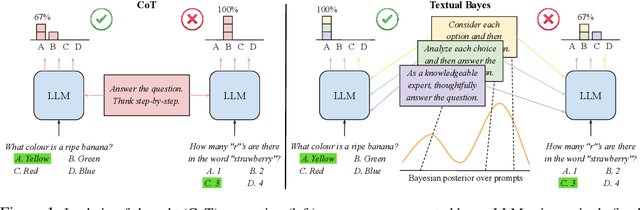
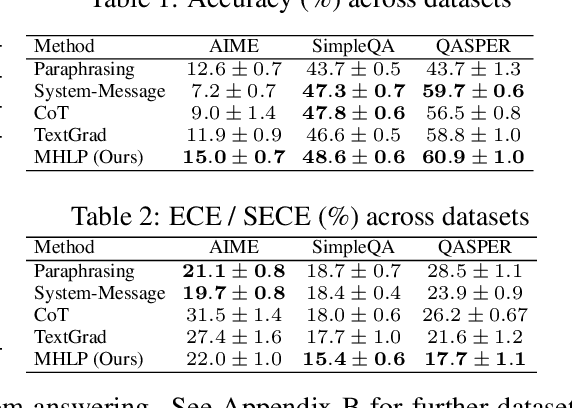
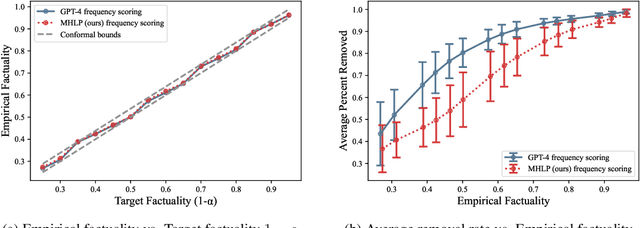
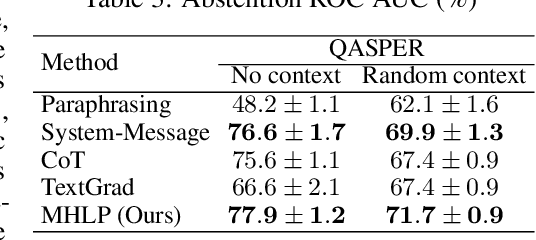
Although large language models (LLMs) are becoming increasingly capable of solving challenging real-world tasks, accurately quantifying their uncertainty remains a critical open problem, which limits their applicability in high-stakes domains. This challenge is further compounded by the closed-source, black-box nature of many state-of-the-art LLMs. Moreover, LLM-based systems can be highly sensitive to the prompts that bind them together, which often require significant manual tuning (i.e., prompt engineering). In this work, we address these challenges by viewing LLM-based systems through a Bayesian lens. We interpret prompts as textual parameters in a statistical model, allowing us to use a small training dataset to perform Bayesian inference over these prompts. This novel perspective enables principled uncertainty quantification over both the model's textual parameters and its downstream predictions, while also incorporating prior beliefs about these parameters expressed in free-form text. To perform Bayesian inference, a difficult problem even for well-studied data modalities, we introduce Metropolis-Hastings through LLM Proposals (MHLP), a novel Markov chain Monte Carlo (MCMC) algorithm that combines prompt optimization techniques with standard MCMC methods. MHLP is a turnkey modification to existing LLM pipelines, including those that rely exclusively on closed-source models. Empirically, we demonstrate that our method yields improvements in both predictive accuracy and uncertainty quantification (UQ) on a range of LLM benchmarks and UQ tasks. More broadly, our work demonstrates a viable path for incorporating methods from the rich Bayesian literature into the era of LLMs, paving the way for more reliable and calibrated LLM-based systems.
Inconsistencies In Consistency Models: Better ODE Solving Does Not Imply Better Samples
Nov 13, 2024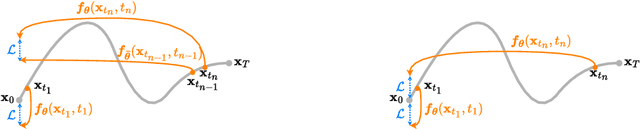
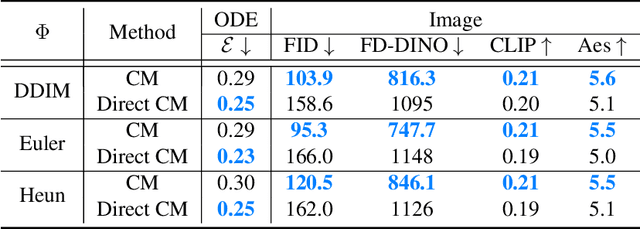
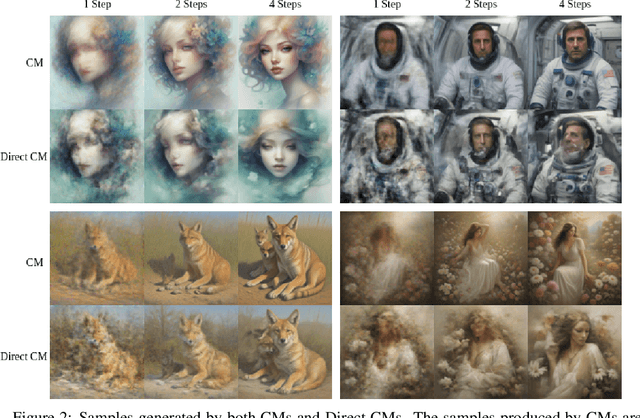
Although diffusion models can generate remarkably high-quality samples, they are intrinsically bottlenecked by their expensive iterative sampling procedure. Consistency models (CMs) have recently emerged as a promising diffusion model distillation method, reducing the cost of sampling by generating high-fidelity samples in just a few iterations. Consistency model distillation aims to solve the probability flow ordinary differential equation (ODE) defined by an existing diffusion model. CMs are not directly trained to minimize error against an ODE solver, rather they use a more computationally tractable objective. As a way to study how effectively CMs solve the probability flow ODE, and the effect that any induced error has on the quality of generated samples, we introduce Direct CMs, which \textit{directly} minimize this error. Intriguingly, we find that Direct CMs reduce the ODE solving error compared to CMs but also result in significantly worse sample quality, calling into question why exactly CMs work well in the first place. Full code is available at: https://github.com/layer6ai-labs/direct-cms.
A Geometric Framework for Understanding Memorization in Generative Models
Oct 31, 2024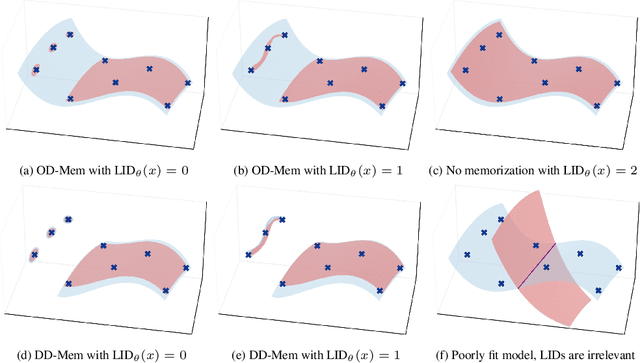


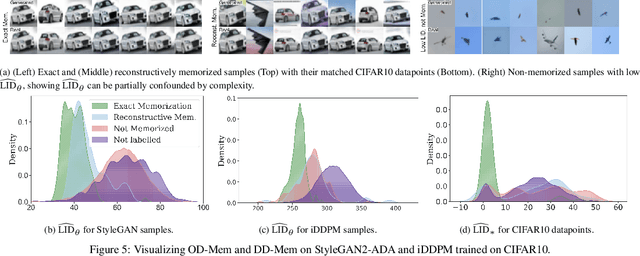
As deep generative models have progressed, recent work has shown them to be capable of memorizing and reproducing training datapoints when deployed. These findings call into question the usability of generative models, especially in light of the legal and privacy risks brought about by memorization. To better understand this phenomenon, we propose the manifold memorization hypothesis (MMH), a geometric framework which leverages the manifold hypothesis into a clear language in which to reason about memorization. We propose to analyze memorization in terms of the relationship between the dimensionalities of $(i)$ the ground truth data manifold and $(ii)$ the manifold learned by the model. This framework provides a formal standard for "how memorized" a datapoint is and systematically categorizes memorized data into two types: memorization driven by overfitting and memorization driven by the underlying data distribution. By analyzing prior work in the context of the MMH, we explain and unify assorted observations in the literature. We empirically validate the MMH using synthetic data and image datasets up to the scale of Stable Diffusion, developing new tools for detecting and preventing generation of memorized samples in the process.
TabDPT: Scaling Tabular Foundation Models
Oct 23, 2024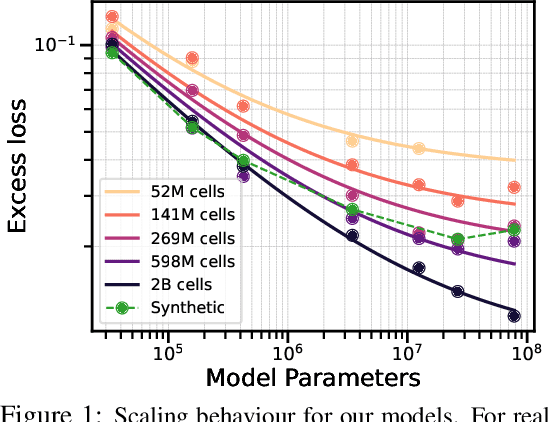
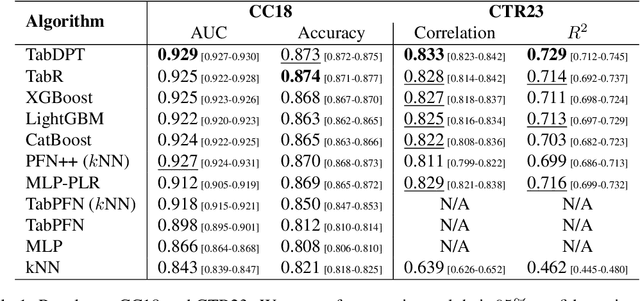
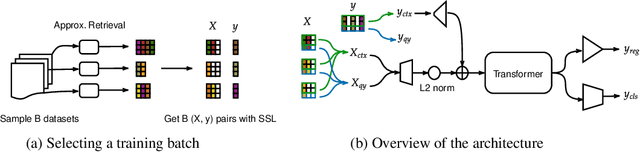
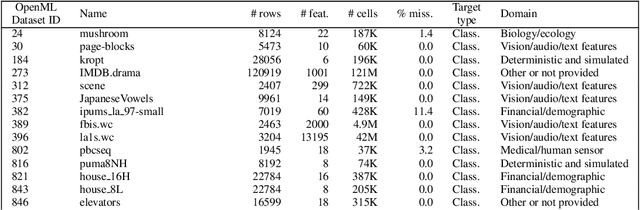
The challenges faced by neural networks on tabular data are well-documented and have hampered the progress of tabular foundation models. Techniques leveraging in-context learning (ICL) have shown promise here, allowing for dynamic adaptation to unseen data. ICL can provide predictions for entirely new datasets without further training or hyperparameter tuning, therefore providing very fast inference when encountering a novel task. However, scaling ICL for tabular data remains an issue: approaches based on large language models cannot efficiently process numeric tables, and tabular-specific techniques have not been able to effectively harness the power of real data to improve performance and generalization. We are able to overcome these challenges by training tabular-specific ICL-based architectures on real data with self-supervised learning and retrieval, combining the best of both worlds. Our resulting model -- the Tabular Discriminative Pre-trained Transformer (TabDPT) -- achieves state-of-the-art performance on the CC18 (classification) and CTR23 (regression) benchmarks with no task-specific fine-tuning, demonstrating the adapatability and speed of ICL once the model is pre-trained. TabDPT also demonstrates strong scaling as both model size and amount of available data increase, pointing towards future improvements simply through the curation of larger tabular pre-training datasets and training larger models.
MSc-SQL: Multi-Sample Critiquing Small Language Models For Text-To-SQL Translation
Oct 16, 2024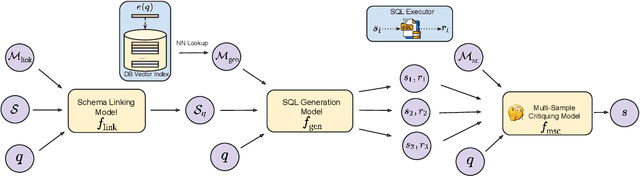
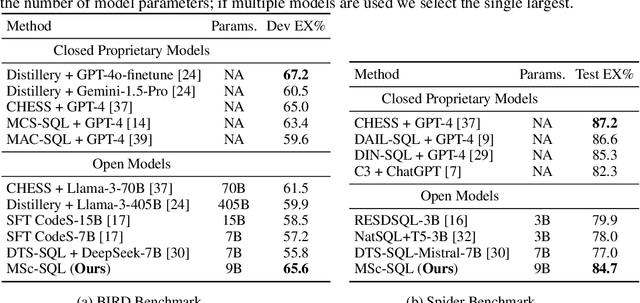
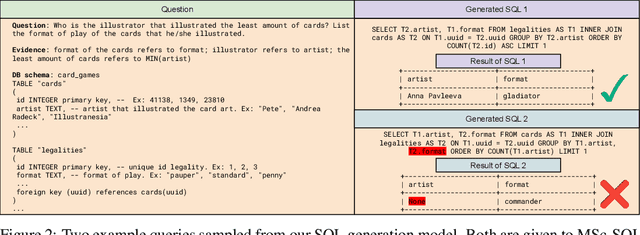
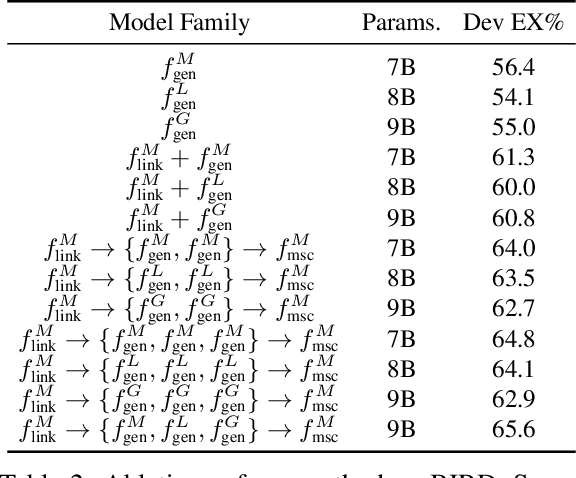
Text-to-SQL generation enables non-experts to interact with databases via natural language. Recent advances rely on large closed-source models like GPT-4 that present challenges in accessibility, privacy, and latency. To address these issues, we focus on developing small, efficient, and open-source text-to-SQL models. We demonstrate the benefits of sampling multiple candidate SQL generations and propose our method, MSc-SQL, to critique them using associated metadata. Our sample critiquing model evaluates multiple outputs simultaneously, achieving state-of-the-art performance compared to other open-source models while remaining competitive with larger models at a much lower cost. Full code can be found at github.com/layer6ai-labs/msc-sql.
Retrieval & Fine-Tuning for In-Context Tabular Models
Jun 07, 2024Tabular data is a pervasive modality spanning a wide range of domains, and the inherent diversity poses a considerable challenge for deep learning. Recent advancements using transformer-based in-context learning have shown promise on smaller and less complex datasets, but have struggled to scale to larger and more complex ones. To address this limitation, we propose a combination of retrieval and fine-tuning: we can adapt the transformer to a local subset of the data by collecting nearest neighbours, and then perform task-specific fine-tuning with this retrieved set of neighbours in context. Using TabPFN as the base model -- currently the best tabular in-context learner -- and applying our retrieval and fine-tuning scheme on top results in what we call a locally-calibrated PFN, or LoCalPFN. We conduct extensive evaluation on 95 datasets curated by TabZilla from OpenML, upon which we establish a new state-of-the-art with LoCalPFN -- even with respect to tuned tree-based models. Notably, we show a significant boost in performance compared to the base in-context model, demonstrating the efficacy of our approach and advancing the frontier of deep learning in tabular data.