 Add to Chrome
 Add to Firefox
 Add to Edge
Understanding the Surprising Generalization Properties of Tabular Foundation Models
Aug 18, 2026
Tabular Foundation Models (TFMs) increasingly rely on in-context learning, where a model receives labelled examples at inference time and predicts labels for new inputs without updating its weights. Existing TFMs are typically trained on either massive synthetic corpora or very large collections of real datasets. In contrast, we show that surprisingly strong transfer can emerge from self-supervised pre-training on just a single real table. In this setting, we also find that tables tend to be either broadly useful or broadly poor regardless of downstream prediction task, and that the strongest predictor of usefulness is the number of features rather than the number of instances. This leads to a task-centric interpretation of tabular pre-training: the number and the quality of tasks are essential for the pre-training of TFMs. We show that the same task-centric perspective can help corpus design at scale: fine-grained column-level pre-processing consistently improves downstream performance, while no improvements are observed when we filter or deduplicate at the dataset level. Finally, we offer a new perspective for how TFMs generalize: we believe that tabular in-context generalization is largely retrieval-based, and good models are those that learn to identify relevant examples in the provided context and aggregate them well. The mechanics of TFMs have been relatively understudied; our task-centric, retrieval-based perspective offers a new framework to guide future model and corpus design.

Training Fair Tabular Foundation Models
Aug 14, 2026Tabular Foundation Models (TFMs) have emerged as leading methods for tabular predictive tasks, leveraging in-context learning to predict on new data without task-specific training. Despite the increased use of TFMs in high-stakes decision-making, their fairness properties remain largely unexplored. In this work, we incorporate fairness constraints directly into TFM training, enabling fair predictions in a single forward pass. Our approach addresses two key challenges: limited access to sensitive attributes in training data, and the incompatibility of existing fairness techniques with the in-context learning paradigm. We propose FairTFM, a scalable training strategy based on synthetic fairness tasks and a fairness-aware architecture using a gradient reversal layer, which encourages the model to learn representations invariant to sensitive attributes. Experiments on 132 fairness tasks show consistent improvements in fairness while maintaining competitive accuracy.
TabDPT-Turbo: Efficient In-Context Learning for Tabular Prediction
Aug 02, 2026Tabular foundation models, driven by in-context learning, have rapidly grown in quality and popularity. However, recent approaches with either cell-based architectures or retrieval have sacrificed efficiency for raw performance, restricting their utility in situations where compute is limited or inference speed is crucial. We adopt an alternate approach, sticking with row-based attention while incorporating long context pre-training to eliminate the need for retrieval. By combining this with architectural improvements and SSL pre-training on a newly-sourced, larger corpus of real data results, we present TabDPT-Turbo, a model that provides comparable default performance to TabDPT v1.1 on TabArena-Lite, CC18, and CTR23, at orders of magnitude faster. In our experiments, TabDPT-Turbo is the fastest model overall among leading foundation models. We have released the new model as TabDPT v1.2 at https://github.com/layer6ai-labs/TabDPT-inference.
Agentic Monte Carlo: Simulating Reinforcement Learning for Black-Box Agents
Jun 03, 2026LLM agents operate in two distinct regimes: open-weight agents amenable to reinforcement learning (RL) and black-box agents whose behaviour must be controlled purely at test time. Although black-box agents are often backed by state-of-the-art proprietary LLMs, API-only access precludes parameter-level optimization, rendering most RL methods inapplicable. To address this limitation, we turn to a known equivalence between RL and Bayesian inference. We propose Agentic Monte Carlo (AMC) to directly sample from the optimal policy of a black-box agent rather than training it through RL. The optimal policy is a posterior over trajectories whose prior we define as the fixed black-box LLM agent. We employ Sequential Monte Carlo to sample from this posterior by learning a value function to steer the agent while leaving the underlying black-box model unchanged. We validate AMC on three diverse environments from the AgentGym benchmark, demonstrating significant improvements over prompting baselines and even outperforming Group Relative Policy Optimization (GRPO) as we scale the test-time compute of our method. AMC demonstrates the feasibility of performing principled RL-style optimization of black-box LLM agents. Code is available at https://github.com/layer6ai-labs/Agentic-Monte-Carlo
Generalization Can Emerge in Tabular Foundation Models From a Single Table
Nov 12, 2025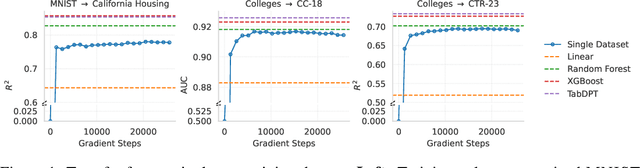
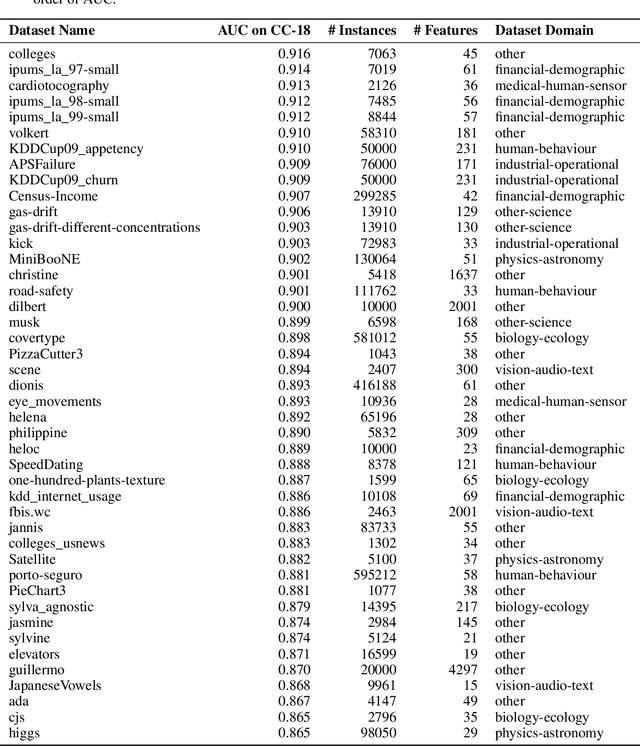
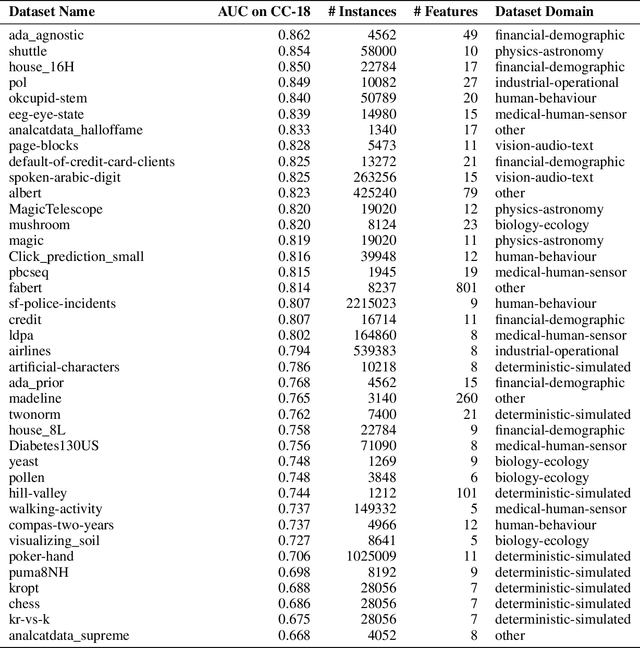
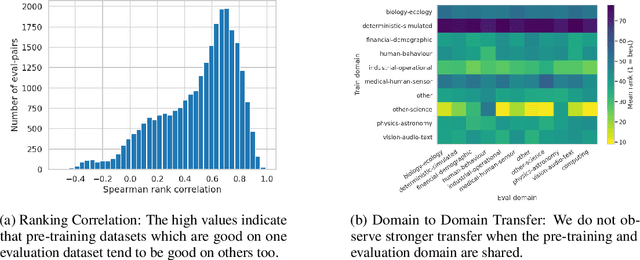
Deep tabular modelling increasingly relies on in-context learning where, during inference, a model receives a set of $(x,y)$ pairs as context and predicts labels for new inputs without weight updates. We challenge the prevailing view that broad generalization here requires pre-training on large synthetic corpora (e.g., TabPFN priors) or a large collection of real data (e.g., TabDPT training datasets), discovering that a relatively small amount of data suffices for generalization. We find that simple self-supervised pre-training on just a \emph{single} real table can produce surprisingly strong transfer across heterogeneous benchmarks. By systematically pre-training and evaluating on many diverse datasets, we analyze what aspects of the data are most important for building a Tabular Foundation Model (TFM) generalizing across domains. We then connect this to the pre-training procedure shared by most TFMs and show that the number and quality of \emph{tasks} one can construct from a dataset is key to downstream performance.
CaloChallenge 2022: A Community Challenge for Fast Calorimeter Simulation
Oct 28, 2024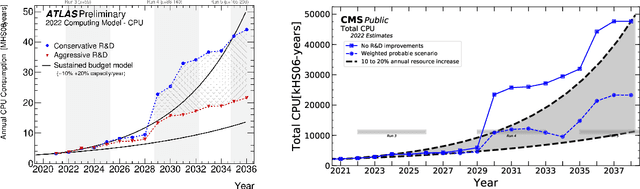
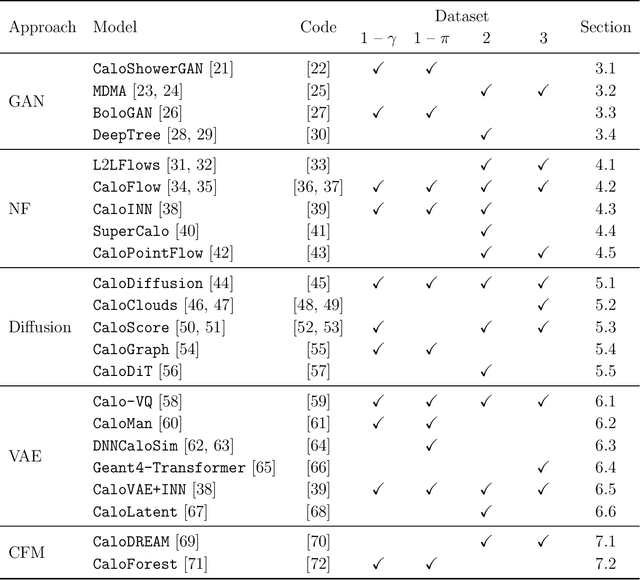
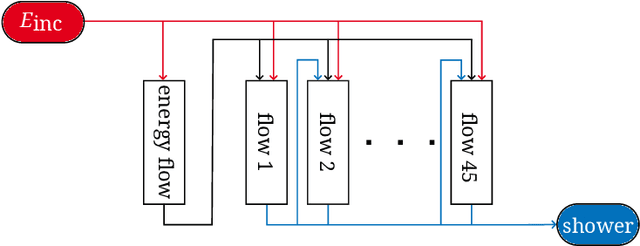
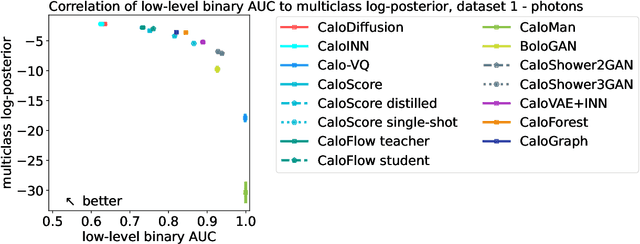
We present the results of the "Fast Calorimeter Simulation Challenge 2022" - the CaloChallenge. We study state-of-the-art generative models on four calorimeter shower datasets of increasing dimensionality, ranging from a few hundred voxels to a few tens of thousand voxels. The 31 individual submissions span a wide range of current popular generative architectures, including Variational AutoEncoders (VAEs), Generative Adversarial Networks (GANs), Normalizing Flows, Diffusion models, and models based on Conditional Flow Matching. We compare all submissions in terms of quality of generated calorimeter showers, as well as shower generation time and model size. To assess the quality we use a broad range of different metrics including differences in 1-dimensional histograms of observables, KPD/FPD scores, AUCs of binary classifiers, and the log-posterior of a multiclass classifier. The results of the CaloChallenge provide the most complete and comprehensive survey of cutting-edge approaches to calorimeter fast simulation to date. In addition, our work provides a uniquely detailed perspective on the important problem of how to evaluate generative models. As such, the results presented here should be applicable for other domains that use generative AI and require fast and faithful generation of samples in a large phase space.
TabDPT: Scaling Tabular Foundation Models
Oct 23, 2024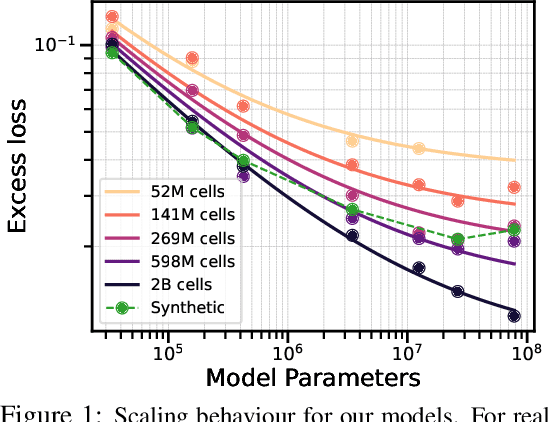
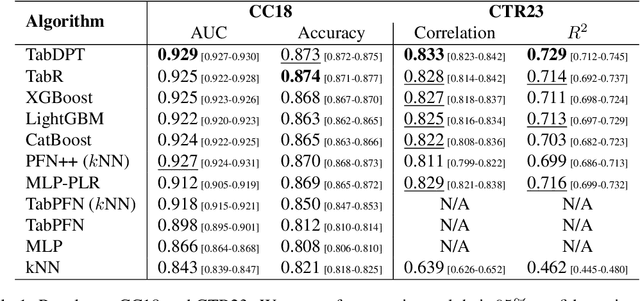
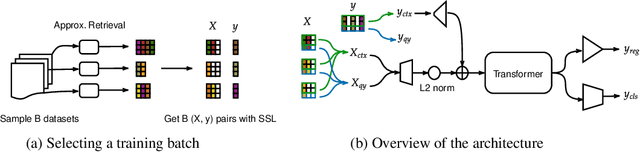
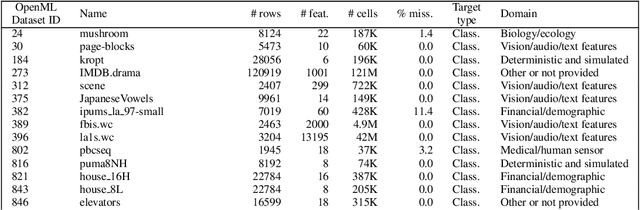
The challenges faced by neural networks on tabular data are well-documented and have hampered the progress of tabular foundation models. Techniques leveraging in-context learning (ICL) have shown promise here, allowing for dynamic adaptation to unseen data. ICL can provide predictions for entirely new datasets without further training or hyperparameter tuning, therefore providing very fast inference when encountering a novel task. However, scaling ICL for tabular data remains an issue: approaches based on large language models cannot efficiently process numeric tables, and tabular-specific techniques have not been able to effectively harness the power of real data to improve performance and generalization. We are able to overcome these challenges by training tabular-specific ICL-based architectures on real data with self-supervised learning and retrieval, combining the best of both worlds. Our resulting model -- the Tabular Discriminative Pre-trained Transformer (TabDPT) -- achieves state-of-the-art performance on the CC18 (classification) and CTR23 (regression) benchmarks with no task-specific fine-tuning, demonstrating the adapatability and speed of ICL once the model is pre-trained. TabDPT also demonstrates strong scaling as both model size and amount of available data increase, pointing towards future improvements simply through the curation of larger tabular pre-training datasets and training larger models.
Deep Generative Models through the Lens of the Manifold Hypothesis: A Survey and New Connections
Apr 03, 2024



In recent years there has been increased interest in understanding the interplay between deep generative models (DGMs) and the manifold hypothesis. Research in this area focuses on understanding the reasons why commonly-used DGMs succeed or fail at learning distributions supported on unknown low-dimensional manifolds, as well as developing new models explicitly designed to account for manifold-supported data. This manifold lens provides both clarity as to why some DGMs (e.g. diffusion models and some generative adversarial networks) empirically surpass others (e.g. likelihood-based models such as variational autoencoders, normalizing flows, or energy-based models) at sample generation, and guidance for devising more performant DGMs. We carry out the first survey of DGMs viewed through this lens, making two novel contributions along the way. First, we formally establish that numerical instability of high-dimensional likelihoods is unavoidable when modelling low-dimensional data. We then show that DGMs on learned representations of autoencoders can be interpreted as approximately minimizing Wasserstein distance: this result, which applies to latent diffusion models, helps justify their outstanding empirical results. The manifold lens provides a rich perspective from which to understand DGMs, which we aim to make more accessible and widespread.
A Geometric Explanation of the Likelihood OOD Detection Paradox
Mar 27, 2024


Likelihood-based deep generative models (DGMs) commonly exhibit a puzzling behaviour: when trained on a relatively complex dataset, they assign higher likelihood values to out-of-distribution (OOD) data from simpler sources. Adding to the mystery, OOD samples are never generated by these DGMs despite having higher likelihoods. This two-pronged paradox has yet to be conclusively explained, making likelihood-based OOD detection unreliable. Our primary observation is that high-likelihood regions will not be generated if they contain minimal probability mass. We demonstrate how this seeming contradiction of large densities yet low probability mass can occur around data confined to low-dimensional manifolds. We also show that this scenario can be identified through local intrinsic dimension (LID) estimation, and propose a method for OOD detection which pairs the likelihoods and LID estimates obtained from a pre-trained DGM. Our method can be applied to normalizing flows and score-based diffusion models, and obtains results which match or surpass state-of-the-art OOD detection benchmarks using the same DGM backbones. Our code is available at https://github.com/layer6ai-labs/dgm_ood_detection.
Exposing flaws of generative model evaluation metrics and their unfair treatment of diffusion models
Jun 07, 2023


We systematically study a wide variety of image-based generative models spanning semantically-diverse datasets to understand and improve the feature extractors and metrics used to evaluate them. Using best practices in psychophysics, we measure human perception of image realism for generated samples by conducting the largest experiment evaluating generative models to date, and find that no existing metric strongly correlates with human evaluations. Comparing to 16 modern metrics for evaluating the overall performance, fidelity, diversity, and memorization of generative models, we find that the state-of-the-art perceptual realism of diffusion models as judged by humans is not reflected in commonly reported metrics such as FID. This discrepancy is not explained by diversity in generated samples, though one cause is over-reliance on Inception-V3. We address these flaws through a study of alternative self-supervised feature extractors, find that the semantic information encoded by individual networks strongly depends on their training procedure, and show that DINOv2-ViT-L/14 allows for much richer evaluation of generative models. Next, we investigate data memorization, and find that generative models do memorize training examples on simple, smaller datasets like CIFAR10, but not necessarily on more complex datasets like ImageNet. However, our experiments show that current metrics do not properly detect memorization; none in the literature is able to separate memorization from other phenomena such as underfitting or mode shrinkage. To facilitate further development of generative models and their evaluation we release all generated image datasets, human evaluation data, and a modular library to compute 16 common metrics for 8 different encoders at https://github.com/layer6ai-labs/dgm-eval.