 Add to Chrome
 Add to Firefox
 Add to Edge
A Gradient Perspective on RLVR Stability and Winner Advantage Policy Optimization
Jun 15, 2026
Reinforcement learning with verifiable rewards (RLVR) improves language-model reasoning, but GRPO-style optimization remains prone to collapse. We analyse this instability through token-level gradient dynamics, deriving a taxonomy that predicts how updates affect next-token probabilities and entropy. The taxonomy shows that stability depends jointly on the advantage sign and token distribution under the current policy. Motivated by this finding, we propose Winner Advantage Policy Optimization (WAPO), a simple online clipped policy-gradient objective that updates only on positive-advantage completions. Across mathematical reasoning and multi-hop QA benchmarks, WAPO improves training stability and matches or outperforms baselines across multiple model families. Full code can be found at https://github.com/layer6ai-labs/wapo.

MSc-SQL: Multi-Sample Critiquing Small Language Models For Text-To-SQL Translation
Oct 16, 2024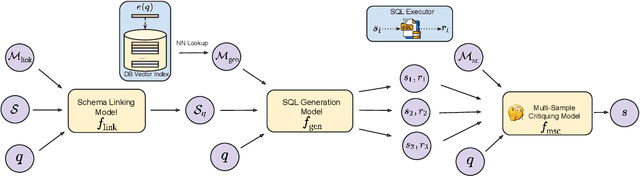
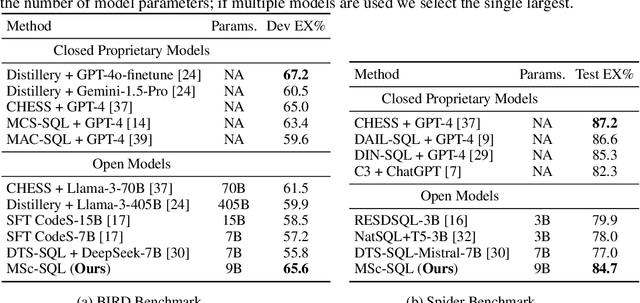
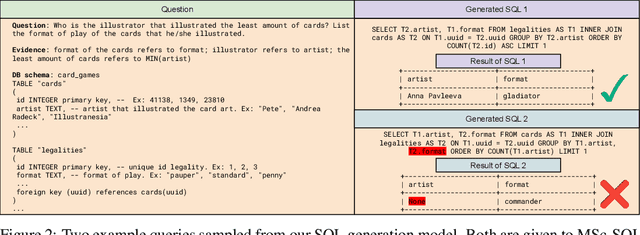
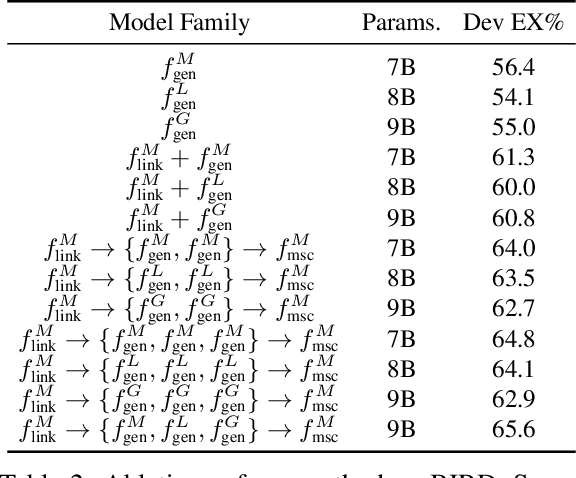
Text-to-SQL generation enables non-experts to interact with databases via natural language. Recent advances rely on large closed-source models like GPT-4 that present challenges in accessibility, privacy, and latency. To address these issues, we focus on developing small, efficient, and open-source text-to-SQL models. We demonstrate the benefits of sampling multiple candidate SQL generations and propose our method, MSc-SQL, to critique them using associated metadata. Our sample critiquing model evaluates multiple outputs simultaneously, achieving state-of-the-art performance compared to other open-source models while remaining competitive with larger models at a much lower cost. Full code can be found at github.com/layer6ai-labs/msc-sql.