 Add to Chrome
 Add to Firefox
 Add to Edge
DecoupleGS: Interactive 3D Gaussian Splatting for End-to-End Autonomous Driving Testing
Aug 03, 2026
End-to-end (E2E) autonomous driving algorithms require rigorous closed-loop validation in simulation environments offering high visual fidelity, strong interactivity, and real-time performance. Existing approaches, from game engines to static neural rendering, inherently trade off these requirements and struggle with the dynamic scene composition essential for E2E testing. To bridge this gap, we propose a novel decoupled 3D Gaussian Splatting (3DGS) framework tailored for large-scale E2E evaluation. We fundamentally decompose scenes into a high-fidelity static background and manipulable dynamic agents using an object-centric canonical representation. To resolve resulting representational conflicts, we introduce three targeted modules: (1) asset compression via perceptual pruning and vector quantization for real-time traffic rendering; (2) map-guided geometric registration leveraging semantic topology to strictly align trajectories; and (3) proxy-based relighting transferring ambient illumination for seamless photometric integration. Extensive experiments demonstrate that DecoupleGS achieves a balanced fidelity-efficiency trade-off, improves metric and photometric consistency, and provides a practical closed-loop sensor simulation platform for E2E autonomous driving evaluation.

From Attacks to Curricula: Learnability-Guided Adversarial Training for Safe Autonomous Driving
Jun 12, 2026Closed-loop adversarial training improves autonomous driving safety by exposing policies to rare safety-critical scenarios. Standard pipelines first generate adversarial scenarios and then sample them for policy optimization. However, most existing frameworks remain attack-oriented: collision-driven generators often synthesize unsolvable extreme situations, which can degrade learning, while heuristic samplers ignore the evolving capability of the driving policy, causing sample inefficiency and delayed convergence. We propose AlignADV, a learnability-guided closed-loop adversarial training framework that converts adversarial scenarios into resolvable and capability-aligned curricula. First, we reformulate adversarial scenario generation as a preference alignment problem and employ direct preference optimization to guide the generator toward critical yet resolvable scenarios. Second, we introduce behavioral fingerprints to capture the intrinsic characteristics of the evolving policy and construct a multi-modal capability prediction model that estimates policy performance without expensive closed-loop simulations. By combining resolvability-aligned scenarios with capability predictions, AlignADV develops a dynamic curriculum sampling mechanism that prioritizes scenarios targeting the current policy's vulnerabilities. Experiments on the Waymo Open Motion Dataset demonstrate that AlignADV improves convergence efficiency and final performance, reducing training steps by up to 40.6 percent compared with baseline methods while lowering collision rate and improving route completion under both normal and adversarial traffic conditions. These results highlight a shift from attack-oriented scenario generation to learnability-guided policy improvement, offering a principled direction for safer and more efficient autonomous driving training. Project page: https://meiyuewen.github.io/AlignADV/.
CollabBench: Benchmarking and Unleashing Collaborative Ability of LLMs with Diverse Players via Proactive Engagement
Jun 04, 2026While LLM-based agents excel at individual tasks, effective collaboration with realistic human partners remains challenging. Most of the existing conversation-level collaborative studies lack grounded interaction and behavioral execution, motivating the need for cooperative game environments that enable contextualized and immersive collaboration. To this end, this paper proposes CollabBench, a benchmark for evaluating and training collaborative agents in cooperative games. CollabBench features a Diverse Player Profile Simulation pipeline to model varied players behaviors, and a Collaborative Agentic Training paradigm that unifies reasoning, communication, and action via agentic rollouts, optimized with a hybrid reward balancing task efficiency and affective adaptation. We further extend classic environments to CWAH-MultiPlayer and Cook-MultiPlayer for systematic evaluation under diverse personalities. Experiments with efficiency and affective metrics show that our trained models outperform base models, achieving 19.5% higher efficiency and 24.4% improved affective performance. Further analysis reveals key collaborative limitations of existing models and offers insights for future collaborative training.
LGEST: Dynamic Spatial-Spectral Expert Routing for Hyperspectral Image Classification
Mar 25, 2026Deep learning methods, including Convolutional Neural Networks, Transformers and Mamba, have achieved remarkable success in hyperspectral image (HSI) classification. Nevertheless, existing methods exhibit inflexible integration of local-global representations, inadequate handling of spectral-spatial scale disparities across heterogeneous bands, and susceptibility to the Hughes phenomenon under high-dimensional sample heterogeneity. To address these challenges, we propose Local-Global Expert Spatial-Spectral Transformer (LGEST), a novel framework that synergistically combines three key innovations. The LGEST first employs a Deep Spatial-Spectral Autoencoder (DSAE) to generate compact yet discriminative embeddings through hierarchical nonlinear compression, preserving 3D neighborhood coherence while mitigating information loss in high-dimensional spaces. Secondly, a Cross-Interactive Mixed Expert Feature Pyramid (CIEM-FPN) leverages cross-attention mechanisms and residual mixture-of-experts layers to dynamically fuse multi-scale features, adaptively weighting spectral discriminability and spatial saliency through learnable gating functions. Finally, a Local-Global Expert System (LGES) processes decomposed features via sparsely activated expert pairs: convolutional sub-experts capture fine-grained textures, while transformer sub-experts model long-range contextual dependencies, with a routing controller dynamically selecting experts based on real-time feature saliency. Extensive experiments on four benchmark datasets demonstrate that LGEST consistently outperforms state-of-the-art methods.
V2X-REALM: Vision-Language Model-Based Robust End-to-End Cooperative Autonomous Driving with Adaptive Long-Tail Modeling
Jun 26, 2025Ensuring robust planning and decision-making under rare, diverse, and visually degraded long-tail scenarios remains a fundamental challenge for autonomous driving in urban environments. This issue becomes more critical in cooperative settings, where vehicles and infrastructure jointly perceive and reason across complex environments. To address this challenge, we propose V2X-REALM, a vision-language model (VLM)-based framework with adaptive multimodal learning for robust cooperative autonomous driving under long-tail scenarios. V2X-REALM introduces three core innovations: (i) a prompt-driven long-tail scenario generation and evaluation pipeline that leverages foundation models to synthesize realistic long-tail conditions such as snow and fog across vehicle- and infrastructure-side views, enriching training diversity efficiently; (ii) a gated multi-scenario adaptive attention module that modulates the visual stream using scenario priors to recalibrate ambiguous or corrupted features; and (iii) a multi-task scenario-aware contrastive learning objective that improves multimodal alignment and promotes cross-scenario feature separability. Extensive experiments demonstrate that V2X-REALM significantly outperforms existing baselines in robustness, semantic reasoning, safety, and planning accuracy under complex, challenging driving conditions, advancing the scalability of end-to-end cooperative autonomous driving.
Towards Robust Multi-UAV Collaboration: MARL with Noise-Resilient Communication and Attention Mechanisms
Mar 04, 2025Efficient path planning for unmanned aerial vehicles (UAVs) is crucial in remote sensing and information collection. As task scales expand, the cooperative deployment of multiple UAVs significantly improves information collection efficiency. However, collaborative communication and decision-making for multiple UAVs remain major challenges in path planning, especially in noisy environments. To efficiently accomplish complex information collection tasks in 3D space and address robust communication issues, we propose a multi-agent reinforcement learning (MARL) framework for UAV path planning based on the Counterfactual Multi-Agent Policy Gradients (COMA) algorithm. The framework incorporates attention mechanism-based UAV communication protocol and training-deployment system, significantly improving communication robustness and individual decision-making capabilities in noisy conditions. Experiments conducted on both synthetic and real-world datasets demonstrate that our method outperforms existing algorithms in terms of path planning efficiency and robustness, especially in noisy environments, achieving a 78\% improvement in entropy reduction.
Online Adaptive Platoon Control for Connected and Automated Vehicles via Physics Enhanced Residual Learning
Dec 30, 2024This paper introduces a physics enhanced residual learning (PERL) framework for connected and automated vehicle (CAV) platoon control, addressing the dynamics and unpredictability inherent to platoon systems. The framework first develops a physics-based controller to model vehicle dynamics, using driving speed as input to optimize safety and efficiency. Then the residual controller, based on neural network (NN) learning, enriches the prior knowledge of the physical model and corrects residuals caused by vehicle dynamics. By integrating the physical model with data-driven online learning, the PERL framework retains the interpretability and transparency of physics-based models and enhances the adaptability and precision of data-driven learning, achieving significant improvements in computational efficiency and control accuracy in dynamic scenarios. Simulation and robot car platform tests demonstrate that PERL significantly outperforms pure physical and learning models, reducing average cumulative absolute position and speed errors by up to 58.5% and 40.1% (physical model) and 58.4% and 47.7% (NN model). The reduced-scale robot car platform tests further validate the adaptive PERL framework's superior accuracy and rapid convergence under dynamic disturbances, reducing position and speed cumulative errors by 72.73% and 99.05% (physical model) and 64.71% and 72.58% (NN model). PERL enhances platoon control performance through online parameter updates when external disturbances are detected. Results demonstrate the advanced framework's exceptional accuracy and rapid convergence capabilities, proving its effectiveness in maintaining platoon stability under diverse conditions.
FollowGen: A Scaled Noise Conditional Diffusion Model for Car-Following Trajectory Prediction
Nov 23, 2024


Vehicle trajectory prediction is crucial for advancing autonomous driving and advanced driver assistance systems (ADAS). Although deep learning-based approaches - especially those utilizing transformer-based and generative models - have markedly improved prediction accuracy by capturing complex, non-linear patterns in vehicle dynamics and traffic interactions, they frequently overlook detailed car-following behaviors and the inter-vehicle interactions critical for real-world driving applications, particularly in fully autonomous or mixed traffic scenarios. To address the issue, this study introduces a scaled noise conditional diffusion model for car-following trajectory prediction, which integrates detailed inter-vehicular interactions and car-following dynamics into a generative framework, improving both the accuracy and plausibility of predicted trajectories. The model utilizes a novel pipeline to capture historical vehicle dynamics by scaling noise with encoded historical features within the diffusion process. Particularly, it employs a cross-attention-based transformer architecture to model intricate inter-vehicle dependencies, effectively guiding the denoising process and enhancing prediction accuracy. Experimental results on diverse real-world driving scenarios demonstrate the state-of-the-art performance and robustness of the proposed method.
Hypergraph-based Motion Generation with Multi-modal Interaction Relational Reasoning
Sep 18, 2024The intricate nature of real-world driving environments, characterized by dynamic and diverse interactions among multiple vehicles and their possible future states, presents considerable challenges in accurately predicting the motion states of vehicles and handling the uncertainty inherent in the predictions. Addressing these challenges requires comprehensive modeling and reasoning to capture the implicit relations among vehicles and the corresponding diverse behaviors. This research introduces an integrated framework for autonomous vehicles (AVs) motion prediction to address these complexities, utilizing a novel Relational Hypergraph Interaction-informed Neural mOtion generator (RHINO). RHINO leverages hypergraph-based relational reasoning by integrating a multi-scale hypergraph neural network to model group-wise interactions among multiple vehicles and their multi-modal driving behaviors, thereby enhancing motion prediction accuracy and reliability. Experimental validation using real-world datasets demonstrates the superior performance of this framework in improving predictive accuracy and fostering socially aware automated driving in dynamic traffic scenarios.
V2X-VLM: End-to-End V2X Cooperative Autonomous Driving Through Large Vision-Language Models
Aug 17, 2024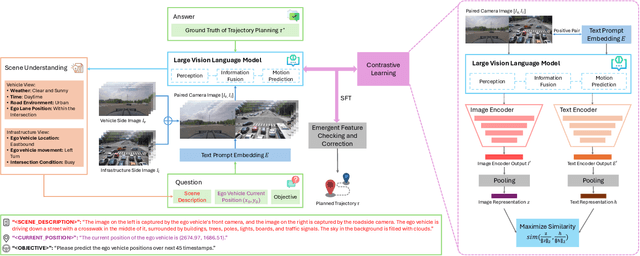
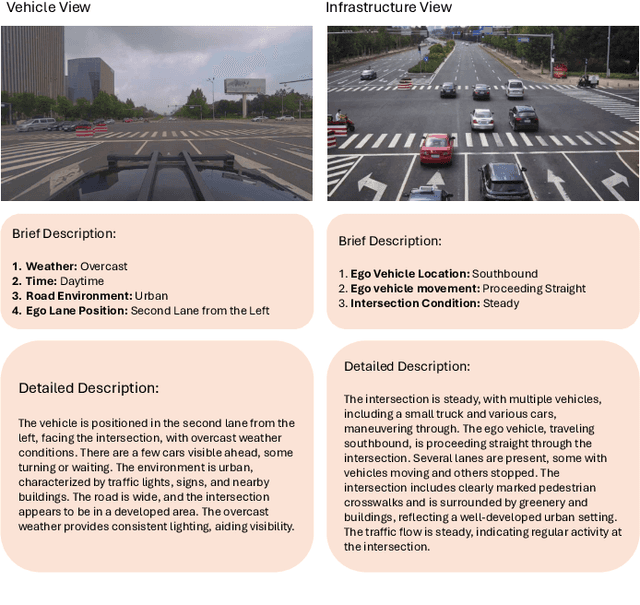
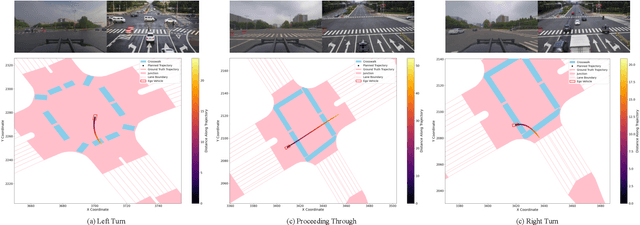
Advancements in autonomous driving have increasingly focused on end-to-end (E2E) systems that manage the full spectrum of driving tasks, from environmental perception to vehicle navigation and control. This paper introduces V2X-VLM, an innovative E2E vehicle-infrastructure cooperative autonomous driving (VICAD) framework with large vision-language models (VLMs). V2X-VLM is designed to enhance situational awareness, decision-making, and ultimate trajectory planning by integrating data from vehicle-mounted cameras, infrastructure sensors, and textual information. The strength of the comprehensive multimodel data fusion of the VLM enables precise and safe E2E trajectory planning in complex and dynamic driving scenarios. Validation on the DAIR-V2X dataset demonstrates that V2X-VLM outperforms existing state-of-the-art methods in cooperative autonomous driving.