 Add to Chrome
 Add to Firefox
 Add to Edge
DFADD: The Diffusion and Flow-Matching Based Audio Deepfake Dataset
Sep 13, 2024


Mainstream zero-shot TTS production systems like Voicebox and Seed-TTS achieve human parity speech by leveraging Flow-matching and Diffusion models, respectively. Unfortunately, human-level audio synthesis leads to identity misuse and information security issues. Currently, many antispoofing models have been developed against deepfake audio. However, the efficacy of current state-of-the-art anti-spoofing models in countering audio synthesized by diffusion and flowmatching based TTS systems remains unknown. In this paper, we proposed the Diffusion and Flow-matching based Audio Deepfake (DFADD) dataset. The DFADD dataset collected the deepfake audio based on advanced diffusion and flowmatching TTS models. Additionally, we reveal that current anti-spoofing models lack sufficient robustness against highly human-like audio generated by diffusion and flow-matching TTS systems. The proposed DFADD dataset addresses this gap and provides a valuable resource for developing more resilient anti-spoofing models.

SpeechPrompt: Prompting Speech Language Models for Speech Processing Tasks
Aug 23, 2024


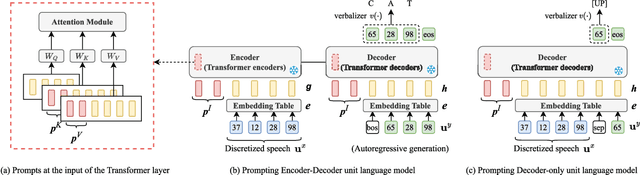
Prompting has become a practical method for utilizing pre-trained language models (LMs). This approach offers several advantages. It allows an LM to adapt to new tasks with minimal training and parameter updates, thus achieving efficiency in both storage and computation. Additionally, prompting modifies only the LM's inputs and harnesses the generative capabilities of language models to address various downstream tasks in a unified manner. This significantly reduces the need for human labor in designing task-specific models. These advantages become even more evident as the number of tasks served by the LM scales up. Motivated by the strengths of prompting, we are the first to explore the potential of prompting speech LMs in the domain of speech processing. Recently, there has been a growing interest in converting speech into discrete units for language modeling. Our pioneer research demonstrates that these quantized speech units are highly versatile within our unified prompting framework. Not only can they serve as class labels, but they also contain rich phonetic information that can be re-synthesized back into speech signals for speech generation tasks. Specifically, we reformulate speech processing tasks into speech-to-unit generation tasks. As a result, we can seamlessly integrate tasks such as speech classification, sequence generation, and speech generation within a single, unified prompting framework. The experiment results show that the prompting method can achieve competitive performance compared to the strong fine-tuning method based on self-supervised learning models with a similar number of trainable parameters. The prompting method also shows promising results in the few-shot setting. Moreover, with the advanced speech LMs coming into the stage, the proposed prompting framework attains great potential.
* Published in IEEE/ACM Transactions on Audio, Speech, and Language Processing (TASLP)
EMO-Codec: An In-Depth Look at Emotion Preservation capacity of Legacy and Neural Codec Models With Subjective and Objective Evaluations
Jul 30, 2024

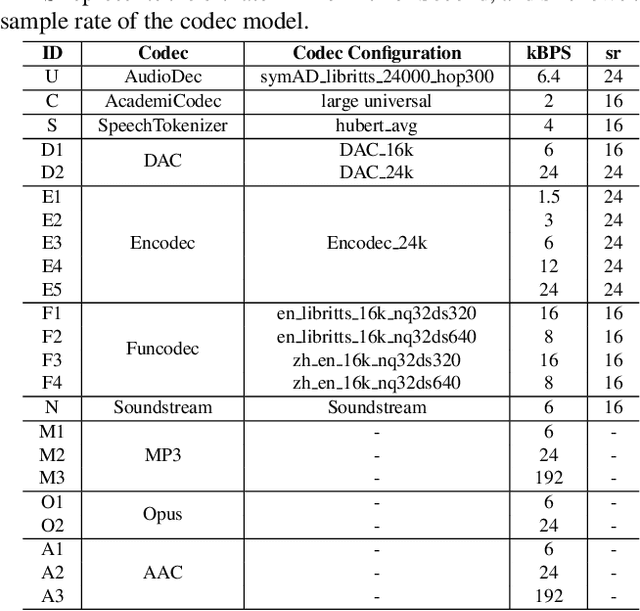

The neural codec model reduces speech data transmission delay and serves as the foundational tokenizer for speech language models (speech LMs). Preserving emotional information in codecs is crucial for effective communication and context understanding. However, there is a lack of studies on emotion loss in existing codecs. This paper evaluates neural and legacy codecs using subjective and objective methods on emotion datasets like IEMOCAP. Our study identifies which codecs best preserve emotional information under various bitrate scenarios. We found that training codec models with both English and Chinese data had limited success in retaining emotional information in Chinese. Additionally, resynthesizing speech through these codecs degrades the performance of speech emotion recognition (SER), particularly for emotions like sadness, depression, fear, and disgust. Human listening tests confirmed these findings. This work guides future speech technology developments to ensure new codecs maintain the integrity of emotional information in speech.
EMO-Codec: A Depth Look at Emotion Preservation Capacity of Legacy and Neural Codec Models With Subjective and Objective Evaluations
Jul 24, 2024The neural codec model reduces speech data transmission delay and serves as the foundational tokenizer for speech language models (speech LMs). Preserving emotional information in codecs is crucial for effective communication and context understanding. However, there is a lack of studies on emotion loss in existing codecs. This paper evaluates neural and legacy codecs using subjective and objective methods on emotion datasets like IEMOCAP. Our study identifies which codecs best preserve emotional information under various bitrate scenarios. We found that training codec models with both English and Chinese data had limited success in retaining emotional information in Chinese. Additionally, resynthesizing speech through these codecs degrades the performance of speech emotion recognition (SER), particularly for emotions like sadness, depression, fear, and disgust. Human listening tests confirmed these findings. This work guides future speech technology developments to ensure new codecs maintain the integrity of emotional information in speech.
Laugh Now Cry Later: Controlling Time-Varying Emotional States of Flow-Matching-Based Zero-Shot Text-to-Speech
Jul 17, 2024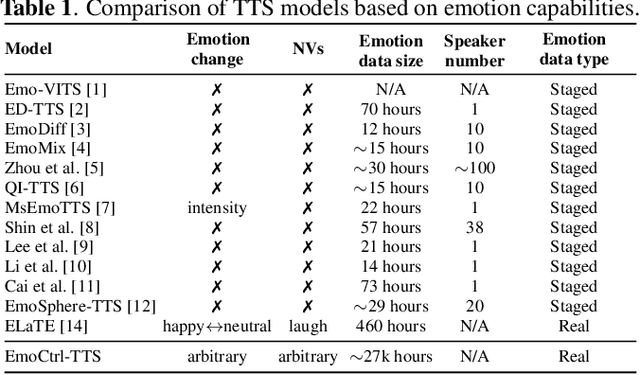


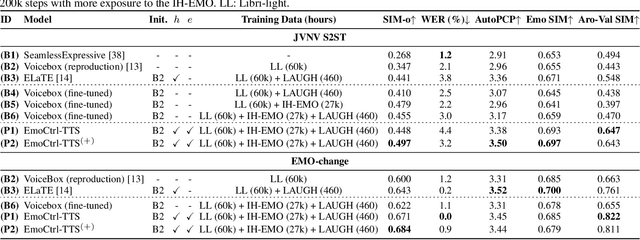
People change their tones of voice, often accompanied by nonverbal vocalizations (NVs) such as laughter and cries, to convey rich emotions. However, most text-to-speech (TTS) systems lack the capability to generate speech with rich emotions, including NVs. This paper introduces EmoCtrl-TTS, an emotion-controllable zero-shot TTS that can generate highly emotional speech with NVs for any speaker. EmoCtrl-TTS leverages arousal and valence values, as well as laughter embeddings, to condition the flow-matching-based zero-shot TTS. To achieve high-quality emotional speech generation, EmoCtrl-TTS is trained using more than 27,000 hours of expressive data curated based on pseudo-labeling. Comprehensive evaluations demonstrate that EmoCtrl-TTS excels in mimicking the emotions of audio prompts in speech-to-speech translation scenarios. We also show that EmoCtrl-TTS can capture emotion changes, express strong emotions, and generate various NVs in zero-shot TTS. See https://aka.ms/emoctrl-tts for demo samples.
CodecFake: Enhancing Anti-Spoofing Models Against Deepfake Audios from Codec-Based Speech Synthesis Systems
Jun 11, 2024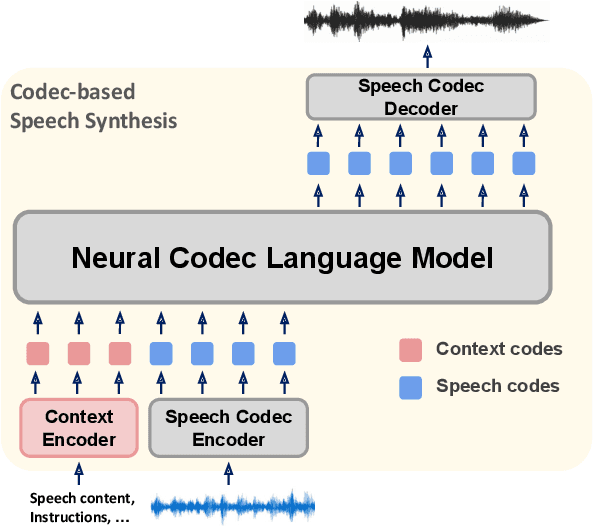
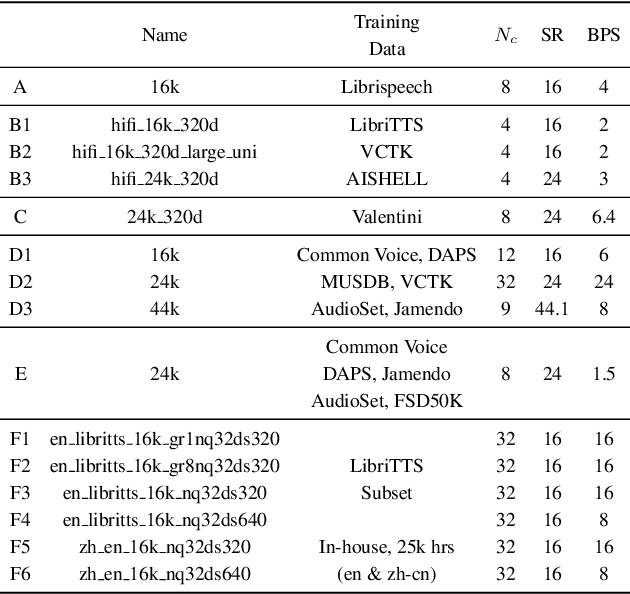
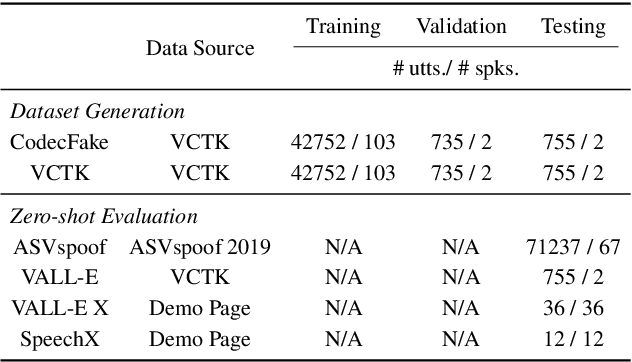
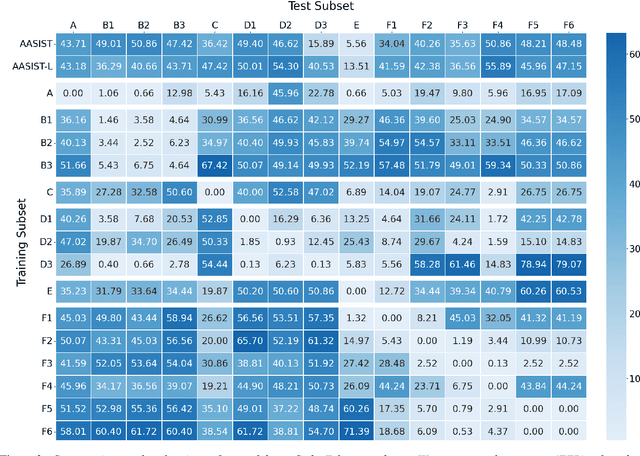
Current state-of-the-art (SOTA) codec-based audio synthesis systems can mimic anyone's voice with just a 3-second sample from that specific unseen speaker. Unfortunately, malicious attackers may exploit these technologies, causing misuse and security issues. Anti-spoofing models have been developed to detect fake speech. However, the open question of whether current SOTA anti-spoofing models can effectively counter deepfake audios from codec-based speech synthesis systems remains unanswered. In this paper, we curate an extensive collection of contemporary SOTA codec models, employing them to re-create synthesized speech. This endeavor leads to the creation of CodecFake, the first codec-based deepfake audio dataset. Additionally, we verify that anti-spoofing models trained on commonly used datasets cannot detect synthesized speech from current codec-based speech generation systems. The proposed CodecFake dataset empowers these models to counter this challenge effectively.
Neural Codec-based Adversarial Sample Detection for Speaker Verification
Jun 07, 2024Automatic Speaker Verification (ASV), increasingly used in security-critical applications, faces vulnerabilities from rising adversarial attacks, with few effective defenses available. In this paper, we propose a neural codec-based adversarial sample detection method for ASV. The approach leverages the codec's ability to discard redundant perturbations and retain essential information. Specifically, we distinguish between genuine and adversarial samples by comparing ASV score differences between original and re-synthesized audio (by codec models). This comprehensive study explores all open-source neural codecs and their variant models for experiments. The Descript-audio-codec model stands out by delivering the highest detection rate among 15 neural codecs and surpassing seven prior state-of-the-art (SOTA) detection methods. Note that, our single-model method even outperforms a SOTA ensemble method by a large margin.
Emo-bias: A Large Scale Evaluation of Social Bias on Speech Emotion Recognition
Jun 07, 2024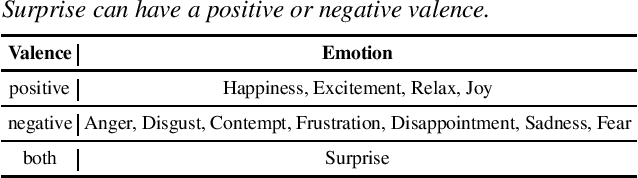
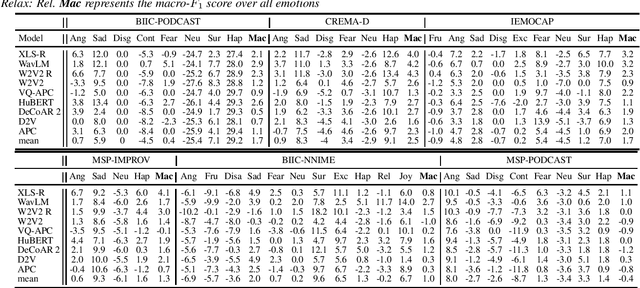
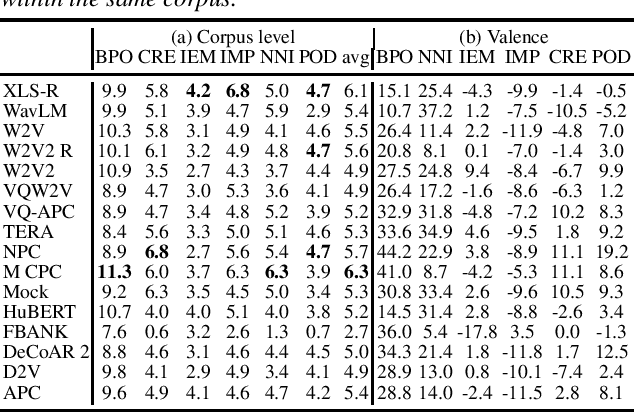
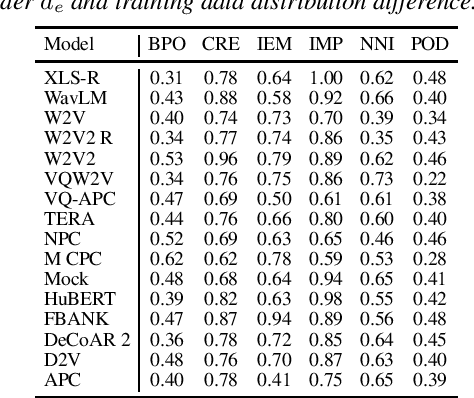
The rapid growth of Speech Emotion Recognition (SER) has diverse global applications, from improving human-computer interactions to aiding mental health diagnostics. However, SER models might contain social bias toward gender, leading to unfair outcomes. This study analyzes gender bias in SER models trained with Self-Supervised Learning (SSL) at scale, exploring factors influencing it. SSL-based SER models are chosen for their cutting-edge performance. Our research pioneering research gender bias in SER from both upstream model and data perspectives. Our findings reveal that females exhibit slightly higher overall SER performance than males. Modified CPC and XLS-R, two well-known SSL models, notably exhibit significant bias. Moreover, models trained with Mandarin datasets display a pronounced bias toward valence. Lastly, we find that gender-wise emotion distribution differences in training data significantly affect gender bias, while upstream model representation has a limited impact.
Singing Voice Graph Modeling for SingFake Detection
Jun 05, 2024Detecting singing voice deepfakes, or SingFake, involves determining the authenticity and copyright of a singing voice. Existing models for speech deepfake detection have struggled to adapt to unseen attacks in this unique singing voice domain of human vocalization. To bridge the gap, we present a groundbreaking SingGraph model. The model synergizes the capabilities of the MERT acoustic music understanding model for pitch and rhythm analysis with the wav2vec2.0 model for linguistic analysis of lyrics. Additionally, we advocate for using RawBoost and beat matching techniques grounded in music domain knowledge for singing voice augmentation, thereby enhancing SingFake detection performance. Our proposed method achieves new state-of-the-art (SOTA) results within the SingFake dataset, surpassing the previous SOTA model across three distinct scenarios: it improves EER relatively for seen singers by 13.2%, for unseen singers by 24.3%, and unseen singers using different codecs by 37.1%.
A Large-Scale Evaluation of Speech Foundation Models
Apr 15, 2024The foundation model paradigm leverages a shared foundation model to achieve state-of-the-art (SOTA) performance for various tasks, requiring minimal downstream-specific modeling and data annotation. This approach has proven crucial in the field of Natural Language Processing (NLP). However, the speech processing community lacks a similar setup to explore the paradigm systematically. In this work, we establish the Speech processing Universal PERformance Benchmark (SUPERB) to study the effectiveness of the paradigm for speech. We propose a unified multi-tasking framework to address speech processing tasks in SUPERB using a frozen foundation model followed by task-specialized, lightweight prediction heads. Combining our results with community submissions, we verify that the foundation model paradigm is promising for speech, and our multi-tasking framework is simple yet effective, as the best-performing foundation model shows competitive generalizability across most SUPERB tasks. For reproducibility and extensibility, we have developed a long-term maintained platform that enables deterministic benchmarking, allows for result sharing via an online leaderboard, and promotes collaboration through a community-driven benchmark database to support new development cycles. Finally, we conduct a series of analyses to offer an in-depth understanding of SUPERB and speech foundation models, including information flows across tasks inside the models, the correctness of the weighted-sum benchmarking protocol and the statistical significance and robustness of the benchmark.