 Add to Chrome
 Add to Firefox
 Add to Edge
Vox-Fusion++: Voxel-based Neural Implicit Dense Tracking and Mapping with Multi-maps
Mar 19, 2024
In this paper, we introduce Vox-Fusion++, a multi-maps-based robust dense tracking and mapping system that seamlessly fuses neural implicit representations with traditional volumetric fusion techniques. Building upon the concept of implicit mapping and positioning systems, our approach extends its applicability to real-world scenarios. Our system employs a voxel-based neural implicit surface representation, enabling efficient encoding and optimization of the scene within each voxel. To handle diverse environments without prior knowledge, we incorporate an octree-based structure for scene division and dynamic expansion. To achieve real-time performance, we propose a high-performance multi-process framework. This ensures the system's suitability for applications with stringent time constraints. Additionally, we adopt the idea of multi-maps to handle large-scale scenes, and leverage loop detection and hierarchical pose optimization strategies to reduce long-term pose drift and remove duplicate geometry. Through comprehensive evaluations, we demonstrate that our method outperforms previous methods in terms of reconstruction quality and accuracy across various scenarios. We also show that our Vox-Fusion++ can be used in augmented reality and collaborative mapping applications. Our source code will be publicly available at \url{https://github.com/zju3dv/Vox-Fusion_Plus_Plus}

Peeking Behind the Curtains of Residual Learning
Feb 13, 2024The utilization of residual learning has become widespread in deep and scalable neural nets. However, the fundamental principles that contribute to the success of residual learning remain elusive, thus hindering effective training of plain nets with depth scalability. In this paper, we peek behind the curtains of residual learning by uncovering the "dissipating inputs" phenomenon that leads to convergence failure in plain neural nets: the input is gradually compromised through plain layers due to non-linearities, resulting in challenges of learning feature representations. We theoretically demonstrate how plain neural nets degenerate the input to random noise and emphasize the significance of a residual connection that maintains a better lower bound of surviving neurons as a solution. With our theoretical discoveries, we propose "The Plain Neural Net Hypothesis" (PNNH) that identifies the internal path across non-linear layers as the most critical part in residual learning, and establishes a paradigm to support the training of deep plain neural nets devoid of residual connections. We thoroughly evaluate PNNH-enabled CNN architectures and Transformers on popular vision benchmarks, showing on-par accuracy, up to 0.3% higher training throughput, and 2x better parameter efficiency compared to ResNets and vision Transformers.
Adversarial Estimation of Topological Dimension with Harmonic Score Maps
Dec 11, 2023Quantification of the number of variables needed to locally explain complex data is often the first step to better understanding it. Existing techniques from intrinsic dimension estimation leverage statistical models to glean this information from samples within a neighborhood. However, existing methods often rely on well-picked hyperparameters and ample data as manifold dimension and curvature increases. Leveraging insight into the fixed point of the score matching objective as the score map is regularized by its Dirichlet energy, we show that it is possible to retrieve the topological dimension of the manifold learned by the score map. We then introduce a novel method to measure the learned manifold's topological dimension (i.e., local intrinsic dimension) using adversarial attacks, thereby generating useful interpretations of the learned manifold.
SD-NAE: Generating Natural Adversarial Examples with Stable Diffusion
Nov 21, 2023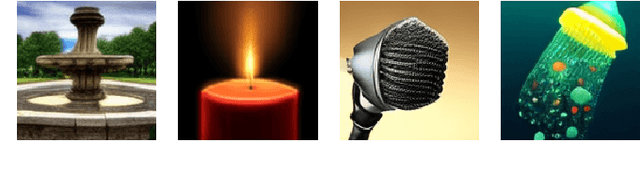
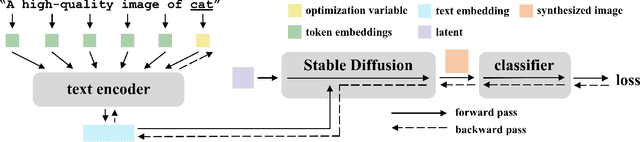
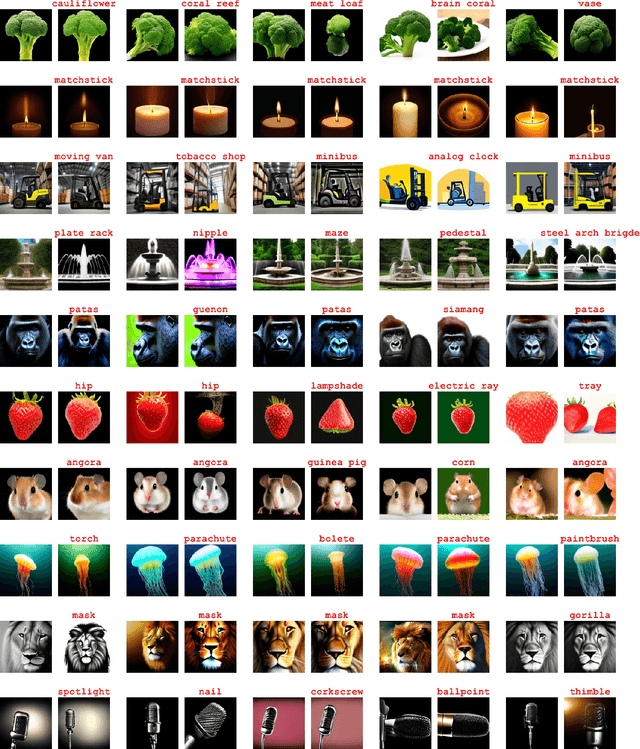
Robustly evaluating deep learning image classifiers is challenging due to some limitations of standard datasets. Natural Adversarial Examples (NAEs), arising naturally from the environment and capable of deceiving classifiers, are instrumental in identifying vulnerabilities in trained models. Existing works collect such NAEs by filtering from a huge set of real images, a process that is passive and lacks control. In this work, we propose to actively synthesize NAEs with the state-of-the-art Stable Diffusion. Specifically, our method formulates a controlled optimization process, where we perturb the token embedding that corresponds to a specified class to synthesize NAEs. The generation is guided by the gradient of loss from the target classifier so that the created image closely mimics the ground-truth class yet fools the classifier. Named SD-NAE (Stable Diffusion for Natural Adversarial Examples), our innovative method is effective in producing valid and useful NAEs, which is demonstrated through a meticulously designed experiment. Our work thereby provides a valuable method for obtaining challenging evaluation data, which in turn can potentially advance the development of more robust deep learning models. Code is available at https://github.com/linyueqian/SD-NAE.
DistDNAS: Search Efficient Feature Interactions within 2 Hours
Nov 01, 2023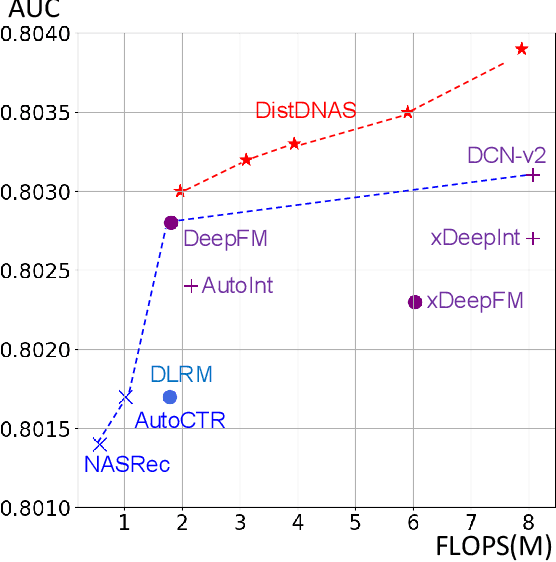
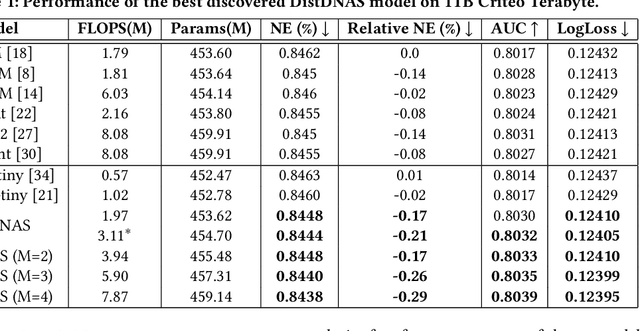
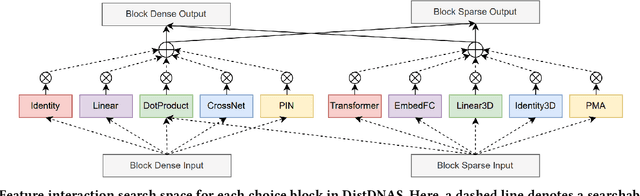
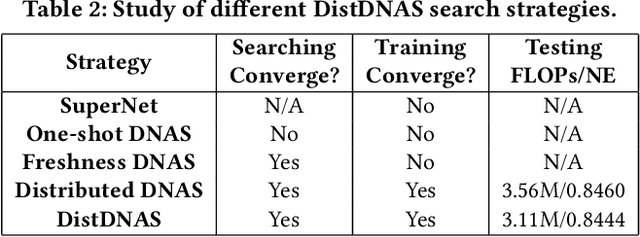
Search efficiency and serving efficiency are two major axes in building feature interactions and expediting the model development process in recommender systems. On large-scale benchmarks, searching for the optimal feature interaction design requires extensive cost due to the sequential workflow on the large volume of data. In addition, fusing interactions of various sources, orders, and mathematical operations introduces potential conflicts and additional redundancy toward recommender models, leading to sub-optimal trade-offs in performance and serving cost. In this paper, we present DistDNAS as a neat solution to brew swift and efficient feature interaction design. DistDNAS proposes a supernet to incorporate interaction modules of varying orders and types as a search space. To optimize search efficiency, DistDNAS distributes the search and aggregates the choice of optimal interaction modules on varying data dates, achieving over 25x speed-up and reducing search cost from 2 days to 2 hours. To optimize serving efficiency, DistDNAS introduces a differentiable cost-aware loss to penalize the selection of redundant interaction modules, enhancing the efficiency of discovered feature interactions in serving. We extensively evaluate the best models crafted by DistDNAS on a 1TB Criteo Terabyte dataset. Experimental evaluations demonstrate 0.001 AUC improvement and 60% FLOPs saving over current state-of-the-art CTR models.
Farthest Greedy Path Sampling for Two-shot Recommender Search
Oct 31, 2023Weight-sharing Neural Architecture Search (WS-NAS) provides an efficient mechanism for developing end-to-end deep recommender models. However, in complex search spaces, distinguishing between superior and inferior architectures (or paths) is challenging. This challenge is compounded by the limited coverage of the supernet and the co-adaptation of subnet weights, which restricts the exploration and exploitation capabilities inherent to weight-sharing mechanisms. To address these challenges, we introduce Farthest Greedy Path Sampling (FGPS), a new path sampling strategy that balances path quality and diversity. FGPS enhances path diversity to facilitate more comprehensive supernet exploration, while emphasizing path quality to ensure the effective identification and utilization of promising architectures. By incorporating FGPS into a Two-shot NAS (TS-NAS) framework, we derive high-performance architectures. Evaluations on three Click-Through Rate (CTR) prediction benchmarks demonstrate that our approach consistently achieves superior results, outperforming both manually designed and most NAS-based models.
Zero-Shot Emotion Transfer For Cross-Lingual Speech Synthesis
Oct 06, 2023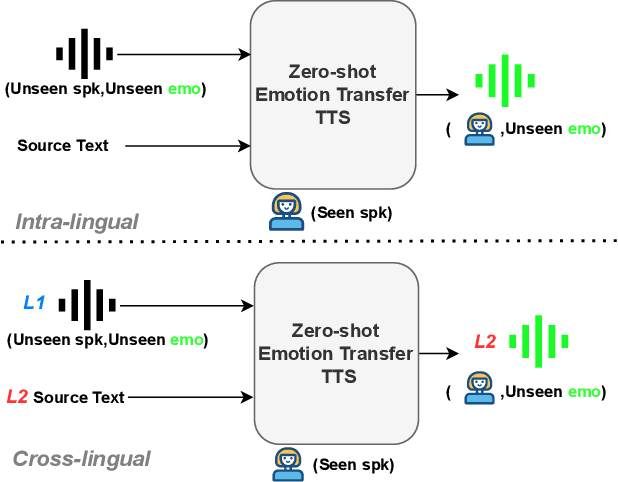
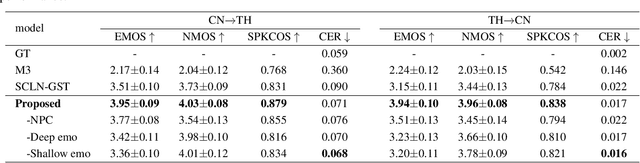
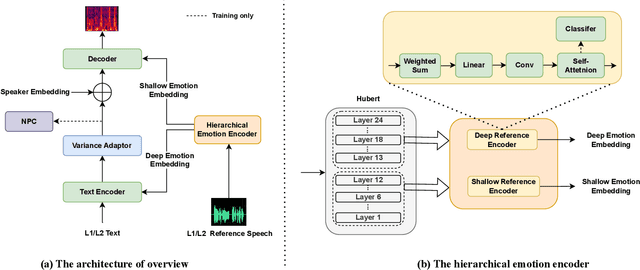

Zero-shot emotion transfer in cross-lingual speech synthesis aims to transfer emotion from an arbitrary speech reference in the source language to the synthetic speech in the target language. Building such a system faces challenges of unnatural foreign accents and difficulty in modeling the shared emotional expressions of different languages. Building on the DelightfulTTS neural architecture, this paper addresses these challenges by introducing specifically-designed modules to model the language-specific prosody features and language-shared emotional expressions separately. Specifically, the language-specific speech prosody is learned by a non-autoregressive predictive coding (NPC) module to improve the naturalness of the synthetic cross-lingual speech. The shared emotional expression between different languages is extracted from a pre-trained self-supervised model HuBERT with strong generalization capabilities. We further use hierarchical emotion modeling to capture more comprehensive emotions across different languages. Experimental results demonstrate the proposed framework's effectiveness in synthesizing bi-lingual emotional speech for the monolingual target speaker without emotional training data.
Depth Completion with Multiple Balanced Bases and Confidence for Dense Monocular SLAM
Sep 20, 2023Dense SLAM based on monocular cameras does indeed have immense application value in the field of AR/VR, especially when it is performed on a mobile device. In this paper, we propose a novel method that integrates a light-weight depth completion network into a sparse SLAM system using a multi-basis depth representation, so that dense mapping can be performed online even on a mobile phone. Specifically, we present a specifically optimized multi-basis depth completion network, called BBC-Net, tailored to the characteristics of traditional sparse SLAM systems. BBC-Net can predict multiple balanced bases and a confidence map from a monocular image with sparse points generated by off-the-shelf keypoint-based SLAM systems. The final depth is a linear combination of predicted depth bases that can be optimized by tuning the corresponding weights. To seamlessly incorporate the weights into traditional SLAM optimization and ensure efficiency and robustness, we design a set of depth weight factors, which makes our network a versatile plug-in module, facilitating easy integration into various existing sparse SLAM systems and significantly enhancing global depth consistency through bundle adjustment. To verify the portability of our method, we integrate BBC-Net into two representative SLAM systems. The experimental results on various datasets show that the proposed method achieves better performance in monocular dense mapping than the state-of-the-art methods. We provide an online demo running on a mobile phone, which verifies the efficiency and mapping quality of the proposed method in real-world scenarios.
Stable and Causal Inference for Discriminative Self-supervised Deep Visual Representations
Aug 16, 2023
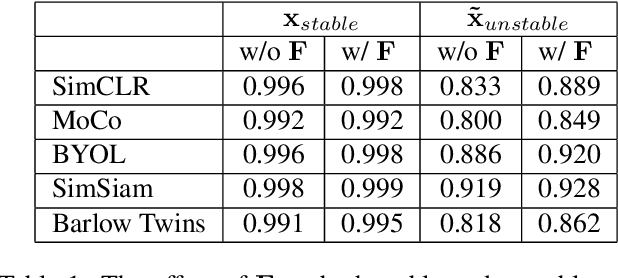
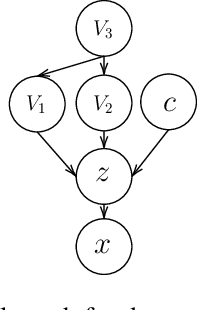

In recent years, discriminative self-supervised methods have made significant strides in advancing various visual tasks. The central idea of learning a data encoder that is robust to data distortions/augmentations is straightforward yet highly effective. Although many studies have demonstrated the empirical success of various learning methods, the resulting learned representations can exhibit instability and hinder downstream performance. In this study, we analyze discriminative self-supervised methods from a causal perspective to explain these unstable behaviors and propose solutions to overcome them. Our approach draws inspiration from prior works that empirically demonstrate the ability of discriminative self-supervised methods to demix ground truth causal sources to some extent. Unlike previous work on causality-empowered representation learning, we do not apply our solutions during the training process but rather during the inference process to improve time efficiency. Through experiments on both controlled image datasets and realistic image datasets, we show that our proposed solutions, which involve tempering a linear transformation with controlled synthetic data, are effective in addressing these issues.
OpenOOD v1.5: Enhanced Benchmark for Out-of-Distribution Detection
Jun 17, 2023Out-of-Distribution (OOD) detection is critical for the reliable operation of open-world intelligent systems. Despite the emergence of an increasing number of OOD detection methods, the evaluation inconsistencies present challenges for tracking the progress in this field. OpenOOD v1 initiated the unification of the OOD detection evaluation but faced limitations in scalability and usability. In response, this paper presents OpenOOD v1.5, a significant improvement from its predecessor that ensures accurate, standardized, and user-friendly evaluation of OOD detection methodologies. Notably, OpenOOD v1.5 extends its evaluation capabilities to large-scale datasets such as ImageNet, investigates full-spectrum OOD detection which is important yet underexplored, and introduces new features including an online leaderboard and an easy-to-use evaluator. This work also contributes in-depth analysis and insights derived from comprehensive experimental results, thereby enriching the knowledge pool of OOD detection methodologies. With these enhancements, OpenOOD v1.5 aims to drive advancements and offer a more robust and comprehensive evaluation benchmark for OOD detection research.