 Add to Chrome
 Add to Firefox
 Add to Edge
Compressed-Domain-Aware Online Video Super-Resolution
Mar 08, 2026
In bandwidth-limited online video streaming, videos are usually downsampled and compressed. Although recent online video super-resolution (online VSR) approaches achieve promising results, they are still compute-intensive and fall short of real-time processing at higher resolutions, due to complex motion estimation for alignment and redundant processing of consecutive frames. To address these issues, we propose a compressed-domain-aware network (CDA-VSR) for online VSR, which utilizes compressed-domain information, including motion vectors, residual maps, and frame types to balance quality and efficiency. Specifically, we propose a motion-vector-guided deformable alignment module that uses motion vectors for coarse warping and learns only local residual offsets for fine-tuned adjustments, thereby maintaining accuracy while reducing computation. Then, we utilize a residual map gated fusion module to derive spatial weights from residual maps, suppressing mismatched regions and emphasizing reliable details. Further, we design a frame-type-aware reconstruction module for adaptive compute allocation across frame types, balancing accuracy and efficiency. On the REDS4 dataset, our CDA-VSR surpasses the state-of-the-art method TMP, with a maximum PSNR improvement of 0.13 dB while delivering more than double the inference speed. The code will be released at https://github.com/sspBIT/CDA-VSR.

Joint Optimization of STAR-RIS Assisted UAV Communication Systems
Sep 08, 2022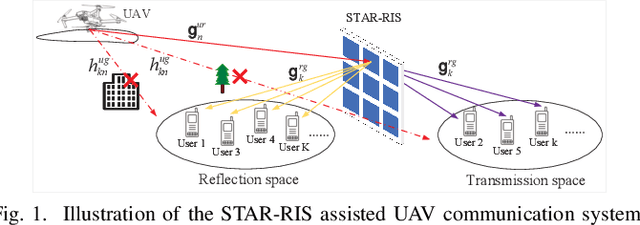
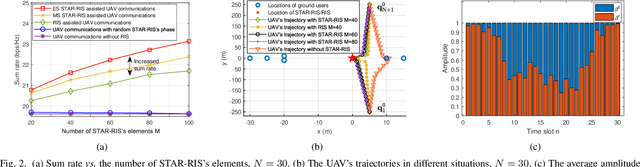
In this letter, we study the simultaneously transmitting and reflecting reconfigurable intelligent surface (STAR-RIS) assisted unmanned aerial vehicle (UAV) communications. Our goal is to maximize the sum rate of all users by jointly optimizing the STAR-RIS's beamforming vectors, the UAV's trajectory and power allocation. We decompose the formulated non-convex problem into three subproblems and solve them alternately to obtain the solution. Simulations show that: 1) the STAR-RIS achieves a higher sum rate than traditional RIS; 2) to exploit the benefits of STAR-RIS, the UAV's trajectory is closer to STAR-RIS than that of RIS; 3) the energy splitting for reflection and transmission highly depends on the real-time trajectory of UAV.
* 5 pages, 4 figures