 Add to Chrome
 Add to Firefox
 Add to Edge
PathCover: A Fast Convex Decomposition along a Path via Randomized Iterative Space Partitioning (RISP) on Point Clouds
Aug 06, 2026
Autonomous robot navigation requires the rapid generation of obstacle-free regions for trajectory planning. However, existing corridor generators struggle to meet real-time, sensor-rate computational constraints. To resolve this bottleneck, we introduce PathCover, a framework driven by RISP; a novel randomized algorithm that constructs convex polytopes directly from raw point cloud data in expected linear time under a mild probabilistic elimination condition. PathCover generates sequences of overlapping, obstacle-free polytopes that safely constrain downstream MPC and trajectory optimization. We mathematically guarantee that the algorithm terminates in finite steps while ensuring continuous progress along any obstacle-free reference path. Extensive benchmarks on synthetic and real-world LiDAR datasets demonstrate an order-of-magnitude speedup over state-of-the-art methods while maintaining comparable corridor volumes. The complete pipeline is validated via high-fidelity quadrotor simulations and physical deployment on a quadrupedal robot navigating constrained environments using live LiDAR perception.

Robust Multimodal Dynamic Object Segmentation
Jul 20, 2026Dynamic object segmentation plays a critical role in many visual applications such as static scene reconstruction from dynamic videos. However, existing optical flow-based methods fail to ensure consistent static/dynamic segmentation along object boundaries, while 3D reconstruction-based approaches are highly sensitive to reconstruction errors. To address these limitations, we present a dynamic object segmentation framework that can generate both precise and complete dynamic masks by integrating multimodal cues including 2D point tracks, 3D reconstruction, and semantic information. We design a network combining Transformer architectures with feature clustering aggregation modules to perform static/dynamic classification of multimodal feature trajectories. It enables the model to adaptively determine which type of feature should dominate based on the characteristics of each scene, while also mitigating the impact of feature degradation. Additionally, we introduce a novel point-query-based SAM post-processing method capable of handling multiple objects within a single mask. Extensive experiments demonstrate that our approach achieves state-of-the-art performance in both dynamic object segmentation and static scene reconstruction tasks.
Online Learning of Robust Legged Odometry with Minimal Exteroceptive Supervision
Jun 19, 2026Robust locomotion and navigation for legged robots relies heavily on dependable odometry. Traditional multi-sensor fusion for such state estimation requires meticulous sensor calibration and platform-specific kinematic modeling, which complicates deployment. Industrially packaged exteroceptive sensors can provide accurate motion tracking but remain vulnerable to perceptually degraded conditions. We thus develop a plug-and-play, robust legged odometry system that eliminates the need for explicit exteroceptive-to-proprioceptive calibration or system kinematic modeling. Our approach leverages established exteroceptive motion pipelines as a continuous supervisory signal to train an online learned velocity neural network directly from proprioceptive data. An Invariant EKF (InEKF) is then used to fuse the learned proprioceptive or exteroceptive velocity (if any) and IMU data. When exteroception fails due to environmental degradation, the system seamlessly falls back to using the learned proprioceptive model, yielding a resilient legged odometry that readily adapts to new hardware. We demonstrate the platform-agnostic, easily deployable nature of our approach on different quadruped platforms, showcasing promising results in maintaining robust motion estimation across challenging scenarios.
Proprioceptive-only State Estimation for Legged Robots with Set-Coverage Measurements of Learned Dynamics
Mar 18, 2026Proprioceptive-only state estimation is attractive for legged robots since it is computationally cheaper and is unaffected by perceptually degraded conditions. The history of joint-level measurements contains rich information that can be used to infer the dynamics of the system and subsequently produce navigational measurements. Recent approaches produce these estimates with learned measurement models and fuse with IMU data, under a Gaussian noise assumption. However, this assumption can easily break down with limited training data and render the estimates inconsistent and potentially divergent. In this work, we propose a proprioceptive-only state estimation framework for legged robots that characterizes the measurement noise using set-coverage statements that do not assume any distribution. We develop a practical and computationally inexpensive method to use these set-coverage measurements with a Gaussian filter in a systematic way. We validate the approach in both simulation and two real-world quadrupedal datasets. Comparison with the Gaussian baselines shows that our proposed method remains consistent and is not prone to drift under real noise scenarios.
Consistent and Efficient MSCKF-based LiDAR-Inertial Odometry with Inferred Cluster-to-Plane Constraints for UAVs
Mar 13, 2026Robust and accurate navigation is critical for Unmanned Aerial Vehicles (UAVs) especially for those with stringent Size, Weight, and Power (SWaP) constraints. However, most state-of-the-art (SOTA) LiDAR-Inertial Odometry (LIO) systems still suffer from estimation inconsistency and computational bottlenecks when deployed on such platforms. To address these issues, this paper proposes a consistent and efficient tightly-coupled LIO framework tailored for UAVs. Within the efficient Multi-State Constraint Kalman Filter (MSCKF) framework, we build coplanar constraints inferred from planar features observed across a sliding window. By applying null-space projection to sliding-window coplanar constraints, we eliminate the direct dependency on feature parameters in the state vector, thereby mitigating overconfidence and improving consistency. More importantly, to further boost the efficiency, we introduce a parallel voxel-based data association and a novel compact cluster-to-plane measurement model. This compact measurement model losslessly reduces observation dimensionality and significantly accelerating the update process. Extensive evaluations demonstrate that our method outperforms most state-of-the-art (SOTA) approaches by providing a superior balance of consistency and efficiency. It exhibits improved robustness in degenerate scenarios, achieves the lowest memory usage via its map-free nature, and runs in real-time on resource-constrained embedded platforms (e.g., NVIDIA Jetson TX2).
Learning Neural Observer-Predictor Models for Limb-level Sampling-based Locomotion Planning
Oct 26, 2025Accurate full-body motion prediction is essential for the safe, autonomous navigation of legged robots, enabling critical capabilities like limb-level collision checking in cluttered environments. Simplified kinematic models often fail to capture the complex, closed-loop dynamics of the robot and its low-level controller, limiting their predictions to simple planar motion. To address this, we present a learning-based observer-predictor framework that accurately predicts this motion. Our method features a neural observer with provable UUB guarantees that provides a reliable latent state estimate from a history of proprioceptive measurements. This stable estimate initializes a computationally efficient predictor, designed for the rapid, parallel evaluation of thousands of potential trajectories required by modern sampling-based planners. We validated the system by integrating our neural predictor into an MPPI-based planner on a Vision 60 quadruped. Hardware experiments successfully demonstrated effective, limb-aware motion planning in a challenging, narrow passage and over small objects, highlighting our system's ability to provide a robust foundation for high-performance, collision-aware planning on dynamic robotic platforms.
Learning IMU Bias with Diffusion Model
May 17, 2025Motion sensing and tracking with IMU data is essential for spatial intelligence, which however is challenging due to the presence of time-varying stochastic bias. IMU bias is affected by various factors such as temperature and vibration, making it highly complex and difficult to model analytically. Recent data-driven approaches using deep learning have shown promise in predicting bias from IMU readings. However, these methods often treat the task as a regression problem, overlooking the stochatic nature of bias. In contrast, we model bias, conditioned on IMU readings, as a probabilistic distribution and design a conditional diffusion model to approximate this distribution. Through this approach, we achieve improved performance and make predictions that align more closely with the known behavior of bias.
Large-Scale Gaussian Splatting SLAM
May 15, 2025The recently developed Neural Radiance Fields (NeRF) and 3D Gaussian Splatting (3DGS) have shown encouraging and impressive results for visual SLAM. However, most representative methods require RGBD sensors and are only available for indoor environments. The robustness of reconstruction in large-scale outdoor scenarios remains unexplored. This paper introduces a large-scale 3DGS-based visual SLAM with stereo cameras, termed LSG-SLAM. The proposed LSG-SLAM employs a multi-modality strategy to estimate prior poses under large view changes. In tracking, we introduce feature-alignment warping constraints to alleviate the adverse effects of appearance similarity in rendering losses. For the scalability of large-scale scenarios, we introduce continuous Gaussian Splatting submaps to tackle unbounded scenes with limited memory. Loops are detected between GS submaps by place recognition and the relative pose between looped keyframes is optimized utilizing rendering and feature warping losses. After the global optimization of camera poses and Gaussian points, a structure refinement module enhances the reconstruction quality. With extensive evaluations on the EuRoc and KITTI datasets, LSG-SLAM achieves superior performance over existing Neural, 3DGS-based, and even traditional approaches. Project page: https://lsg-slam.github.io.
Online Language Splatting
Mar 12, 2025To enable AI agents to interact seamlessly with both humans and 3D environments, they must not only perceive the 3D world accurately but also align human language with 3D spatial representations. While prior work has made significant progress by integrating language features into geometrically detailed 3D scene representations using 3D Gaussian Splatting (GS), these approaches rely on computationally intensive offline preprocessing of language features for each input image, limiting adaptability to new environments. In this work, we introduce Online Language Splatting, the first framework to achieve online, near real-time, open-vocabulary language mapping within a 3DGS-SLAM system without requiring pre-generated language features. The key challenge lies in efficiently fusing high-dimensional language features into 3D representations while balancing the computation speed, memory usage, rendering quality and open-vocabulary capability. To this end, we innovatively design: (1) a high-resolution CLIP embedding module capable of generating detailed language feature maps in 18ms per frame, (2) a two-stage online auto-encoder that compresses 768-dimensional CLIP features to 15 dimensions while preserving open-vocabulary capabilities, and (3) a color-language disentangled optimization approach to improve rendering quality. Experimental results show that our online method not only surpasses the state-of-the-art offline methods in accuracy but also achieves more than 40x efficiency boost, demonstrating the potential for dynamic and interactive AI applications.
Robust 4D Radar-aided Inertial Navigation for Aerial Vehicles
Feb 21, 2025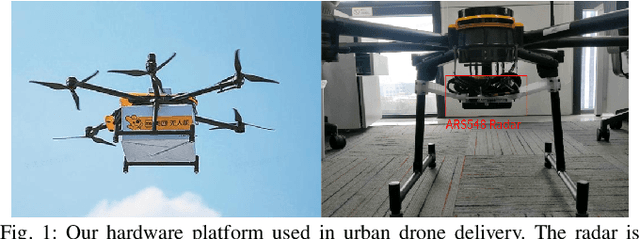
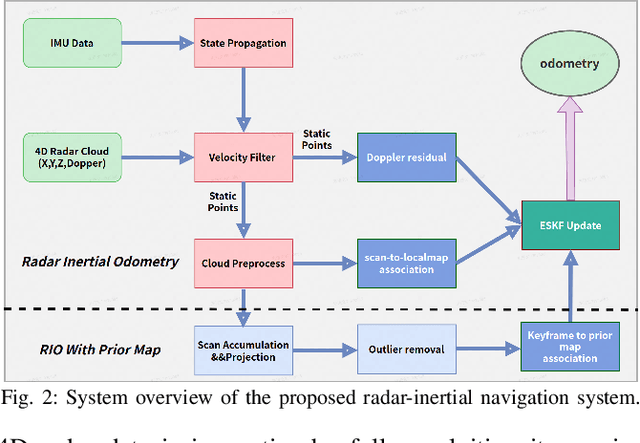
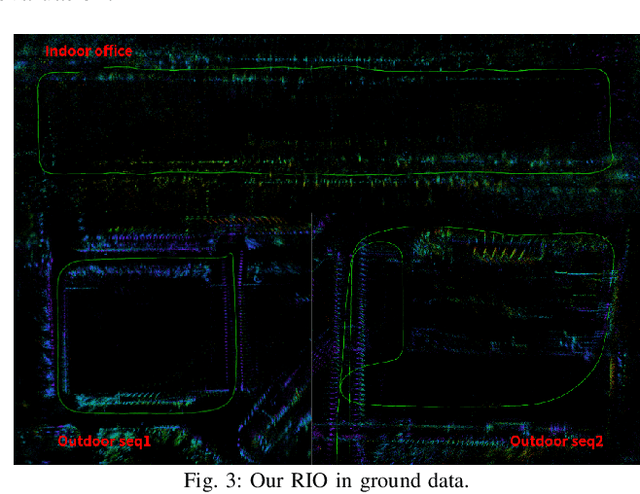
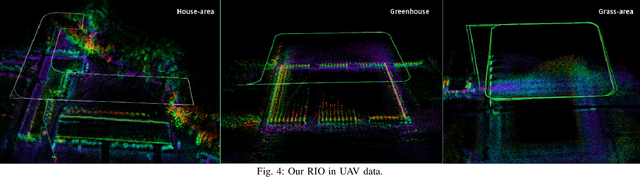
While LiDAR and cameras are becoming ubiquitous for unmanned aerial vehicles (UAVs) but can be ineffective in challenging environments, 4D millimeter-wave (MMW) radars that can provide robust 3D ranging and Doppler velocity measurements are less exploited for aerial navigation. In this paper, we develop an efficient and robust error-state Kalman filter (ESKF)-based radar-inertial navigation for UAVs. The key idea of the proposed approach is the point-to-distribution radar scan matching to provide motion constraints with proper uncertainty qualification, which are used to update the navigation states in a tightly coupled manner, along with the Doppler velocity measurements. Moreover, we propose a robust keyframe-based matching scheme against the prior map (if available) to bound the accumulated navigation errors and thus provide a radar-based global localization solution with high accuracy. Extensive real-world experimental validations have demonstrated that the proposed radar-aided inertial navigation outperforms state-of-the-art methods in both accuracy and robustness.