 Add to Chrome
 Add to Firefox
 Add to Edge
Consistent and Efficient MSCKF-based LiDAR-Inertial Odometry with Inferred Cluster-to-Plane Constraints for UAVs
Mar 13, 2026
Robust and accurate navigation is critical for Unmanned Aerial Vehicles (UAVs) especially for those with stringent Size, Weight, and Power (SWaP) constraints. However, most state-of-the-art (SOTA) LiDAR-Inertial Odometry (LIO) systems still suffer from estimation inconsistency and computational bottlenecks when deployed on such platforms. To address these issues, this paper proposes a consistent and efficient tightly-coupled LIO framework tailored for UAVs. Within the efficient Multi-State Constraint Kalman Filter (MSCKF) framework, we build coplanar constraints inferred from planar features observed across a sliding window. By applying null-space projection to sliding-window coplanar constraints, we eliminate the direct dependency on feature parameters in the state vector, thereby mitigating overconfidence and improving consistency. More importantly, to further boost the efficiency, we introduce a parallel voxel-based data association and a novel compact cluster-to-plane measurement model. This compact measurement model losslessly reduces observation dimensionality and significantly accelerating the update process. Extensive evaluations demonstrate that our method outperforms most state-of-the-art (SOTA) approaches by providing a superior balance of consistency and efficiency. It exhibits improved robustness in degenerate scenarios, achieves the lowest memory usage via its map-free nature, and runs in real-time on resource-constrained embedded platforms (e.g., NVIDIA Jetson TX2).

Robust 4D Radar-aided Inertial Navigation for Aerial Vehicles
Feb 21, 2025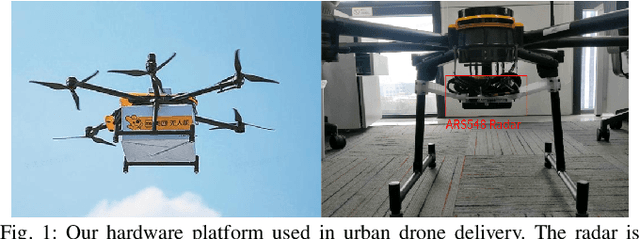
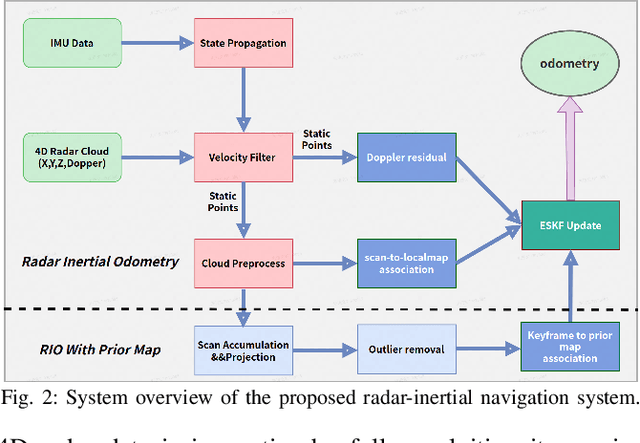
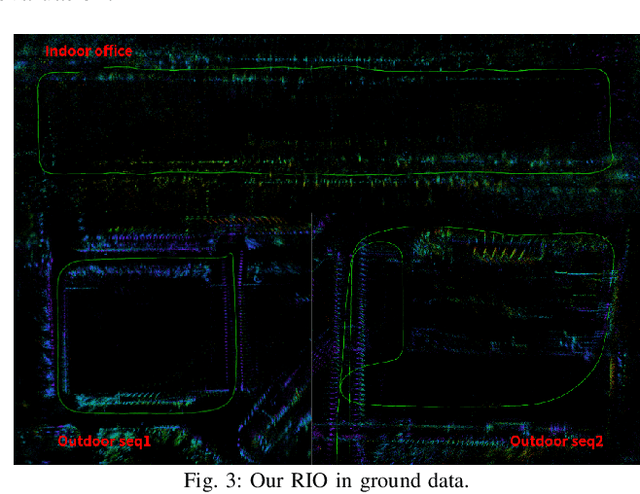
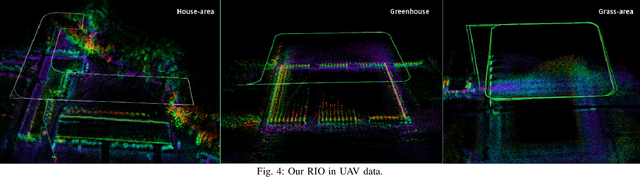
While LiDAR and cameras are becoming ubiquitous for unmanned aerial vehicles (UAVs) but can be ineffective in challenging environments, 4D millimeter-wave (MMW) radars that can provide robust 3D ranging and Doppler velocity measurements are less exploited for aerial navigation. In this paper, we develop an efficient and robust error-state Kalman filter (ESKF)-based radar-inertial navigation for UAVs. The key idea of the proposed approach is the point-to-distribution radar scan matching to provide motion constraints with proper uncertainty qualification, which are used to update the navigation states in a tightly coupled manner, along with the Doppler velocity measurements. Moreover, we propose a robust keyframe-based matching scheme against the prior map (if available) to bound the accumulated navigation errors and thus provide a radar-based global localization solution with high accuracy. Extensive real-world experimental validations have demonstrated that the proposed radar-aided inertial navigation outperforms state-of-the-art methods in both accuracy and robustness.