 Add to Chrome
 Add to Firefox
 Add to Edge
Liquid Fusion of Heterogeneous Representations Towards General Salient Object Detection
Jun 25, 2026
General Salient Object Detection (SOD) aims to identify and segment visually interesting objects from uni-modality or multi-modality scenes, recently advanced by cutting-edge State Space Models (SSMs). However, a critical limitation of current approaches is their neglect of the inherent spectral biases exhibited by different neural network paradigms. By digging to the dataset-level spectral analysis of Convolutional Neural Networks (CNNs) and SSMs, their semantic representations are inherently complementary based on their complementary frequency preferences. Inspired by this, we harmonize heterogeneous representations from SSMs and CNNs to bridge their spectral biases for general salient object detection. To this end, inspired by the dynamic information propagation of Liquid Neural Networks (LNNs), we introduce a liquid fusion to dynamically integrates features from two backbones, including VMamba and ConvNeXt, referred to Liquid Fusion Network (LFNet). Concretely, by treating the continuous VMamba features and ConvNeXt features as evolving states and exogenous stimulus, respectively, LFNet employs a dynamic gating mechanism for content-aware feature aggregation. Crucially, this state-stimulus paradigm enables to scale to multi-modal cues, resulting in flexibility in general SOD. Besides, a Saliency-Guided Upsampling (SGU) operator to propagate the features to the shallow layer, which leverages a spectral-spatial co-design to suppress upsampling artifacts while preserving semantics. Extensive experiments across five diverse tasks (RGB, RGB-D, RGB-T, VSOD, and VDT) demonstrate that LFNet achieves state-of-the-art performance, offering a superior trade-off between detection accuracy and model efficiency. Code has been released at https://github.com/cke520/LFNet.

EgoPhys: Learning Generalizable Physics Models of Deformable Objects from Egocentric Video
Jun 15, 2026Humans naturally understand object physics through everyday interactions, but faithfully predicting complex deformable dynamics, such as elastic materials and fabrics, remains a major challenge for computer vision and robotics. We present EgoPhys, a framework that constructs deformable physical digital twins from egocentric RGB-only video using generalizable priors. EgoPhys overcomes the limitations of existing methods to enable controllable deformable digital twin generation from egocentric videos by distilling per-object inverse-physics solutions into a compact codebook, enabling prediction of dense spring stiffness fields for unseen objects without per-spring test-time optimization. Trained with generalizable priors from diverse egocentric interactions, EgoPhys outperforms baselines in reconstruction, future prediction, and zero-shot generalization. To support training and evaluation, we curate an egocentric interaction dataset covering diverse deformable objects, scenes, and manipulation styles. We deploy EgoPhys on a real xArm6 robot, demonstrating that a digital twin initialized from a single egocentric human play video can serve as an internal world representation to aid in deformable-object planning, highlighting egocentric RGB observations as a scalable path toward real-to-sim pipelines.
Cross-Hand Latent Representation for Vision-Language-Action Models
Mar 10, 2026Dexterous manipulation is essential for real-world robot autonomy, mirroring the central role of human hand coordination in daily activity. Humans rely on rich multimodal perception--vision, sound, and language-guided intent--to perform dexterous actions, motivating vision-based, language-conditioned manipulation systems for robots. However, training reliable vision-language-action (VLA) models for dexterous manipulation requires large-scale demonstrations across many robotic hands. In addition, as new dexterous embodiments appear rapidly, collecting data for each becomes costly and impractical, creating a need for scalable cross-embodiment learning. We introduce XL-VLA, a vision-language-action framework integrated with a unified latent action space shared across diverse dexterous hands. This embodiment-invariant latent space is directly pluggable into standard VLA architectures, enabling seamless cross-embodiment training and efficient reuse of both existing and newly collected data. Experimental results demonstrate that XL-VLA consistently outperforms baseline VLA models operating in raw joint spaces, establishing it as an effective solution for scalable cross-embodiment dexterous manipulation.
From Power to Precision: Learning Fine-grained Dexterity for Multi-fingered Robotic Hands
Nov 17, 2025

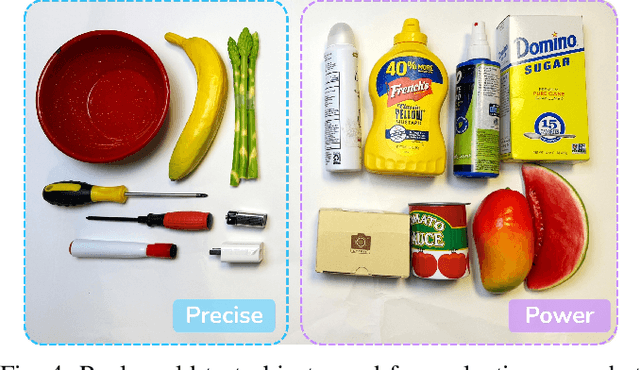
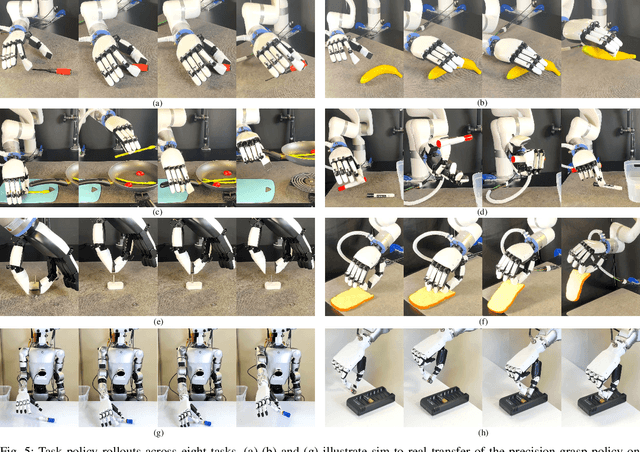
Human grasps can be roughly categorized into two types: power grasps and precision grasps. Precision grasping enables tool use and is believed to have influenced human evolution. Today's multi-fingered robotic hands are effective in power grasps, but for tasks requiring precision, parallel grippers are still more widely adopted. This contrast highlights a key limitation in current robotic hand design: the difficulty of achieving both stable power grasps and precise, fine-grained manipulation within a single, versatile system. In this work, we bridge this gap by jointly optimizing the control and hardware design of a multi-fingered dexterous hand, enabling both power and precision manipulation. Rather than redesigning the entire hand, we introduce a lightweight fingertip geometry modification, represent it as a contact plane, and jointly optimize its parameters along with the corresponding control. Our control strategy dynamically switches between power and precision manipulation and simplifies precision control into parallel thumb-index motions, which proves robust for sim-to-real transfer. On the design side, we leverage large-scale simulation to optimize the fingertip geometry using a differentiable neural-physics surrogate model. We validate our approach through extensive experiments in both sim-to-real and real-to-real settings. Our method achieves an 82.5% zero-shot success rate on unseen objects in sim-to-real precision grasping, and a 93.3% success rate in challenging real-world tasks involving bread pinching. These results demonstrate that our co-design framework can significantly enhance the fine-grained manipulation ability of multi-fingered hands without reducing their ability for power grasps. Our project page is at https://jianglongye.com/power-to-precision
GSWorld: Closed-Loop Photo-Realistic Simulation Suite for Robotic Manipulation
Oct 23, 2025This paper presents GSWorld, a robust, photo-realistic simulator for robotics manipulation that combines 3D Gaussian Splatting with physics engines. Our framework advocates "closing the loop" of developing manipulation policies with reproducible evaluation of policies learned from real-robot data and sim2real policy training without using real robots. To enable photo-realistic rendering of diverse scenes, we propose a new asset format, which we term GSDF (Gaussian Scene Description File), that infuses Gaussian-on-Mesh representation with robot URDF and other objects. With a streamlined reconstruction pipeline, we curate a database of GSDF that contains 3 robot embodiments for single-arm and bimanual manipulation, as well as more than 40 objects. Combining GSDF with physics engines, we demonstrate several immediate interesting applications: (1) learning zero-shot sim2real pixel-to-action manipulation policy with photo-realistic rendering, (2) automated high-quality DAgger data collection for adapting policies to deployment environments, (3) reproducible benchmarking of real-robot manipulation policies in simulation, (4) simulation data collection by virtual teleoperation, and (5) zero-shot sim2real visual reinforcement learning. Website: https://3dgsworld.github.io/.
Robots Pre-train Robots: Manipulation-Centric Robotic Representation from Large-Scale Robot Dataset
Oct 29, 2024The pre-training of visual representations has enhanced the efficiency of robot learning. Due to the lack of large-scale in-domain robotic datasets, prior works utilize in-the-wild human videos to pre-train robotic visual representation. Despite their promising results, representations from human videos are inevitably subject to distribution shifts and lack the dynamics information crucial for task completion. We first evaluate various pre-trained representations in terms of their correlation to the downstream robotic manipulation tasks (i.e., manipulation centricity). Interestingly, we find that the "manipulation centricity" is a strong indicator of success rates when applied to downstream tasks. Drawing from these findings, we propose Manipulation Centric Representation (MCR), a foundation representation learning framework capturing both visual features and the dynamics information such as actions and proprioceptions of manipulation tasks to improve manipulation centricity. Specifically, we pre-train a visual encoder on the DROID robotic dataset and leverage motion-relevant data such as robot proprioceptive states and actions. We introduce a novel contrastive loss that aligns visual observations with the robot's proprioceptive state-action dynamics, combined with a behavior cloning (BC)-like actor loss to predict actions during pre-training, along with a time contrastive loss. Empirical results across 4 simulation domains with 20 tasks verify that MCR outperforms the strongest baseline method by 14.8%. Moreover, MCR boosts the performance of data-efficient learning with a UR5e arm on 3 real-world tasks by 76.9%. Project website: https://robots-pretrain-robots.github.io/.
Make-An-Agent: A Generalizable Policy Network Generator with Behavior-Prompted Diffusion
Jul 15, 2024Can we generate a control policy for an agent using just one demonstration of desired behaviors as a prompt, as effortlessly as creating an image from a textual description? In this paper, we present Make-An-Agent, a novel policy parameter generator that leverages the power of conditional diffusion models for behavior-to-policy generation. Guided by behavior embeddings that encode trajectory information, our policy generator synthesizes latent parameter representations, which can then be decoded into policy networks. Trained on policy network checkpoints and their corresponding trajectories, our generation model demonstrates remarkable versatility and scalability on multiple tasks and has a strong generalization ability on unseen tasks to output well-performed policies with only few-shot demonstrations as inputs. We showcase its efficacy and efficiency on various domains and tasks, including varying objectives, behaviors, and even across different robot manipulators. Beyond simulation, we directly deploy policies generated by Make-An-Agent onto real-world robots on locomotion tasks.
RoboDuet: A Framework Affording Mobile-Manipulation and Cross-Embodiment
Mar 27, 2024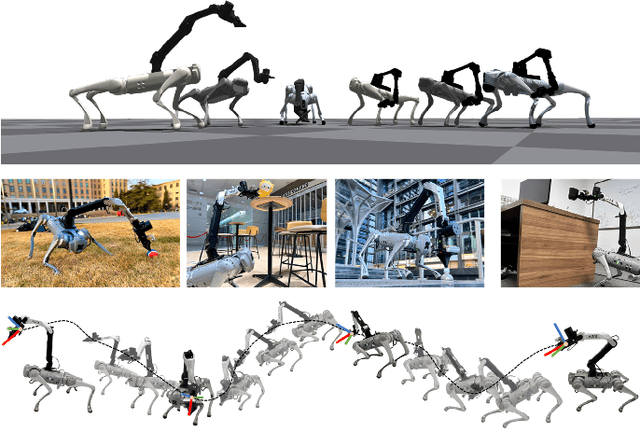
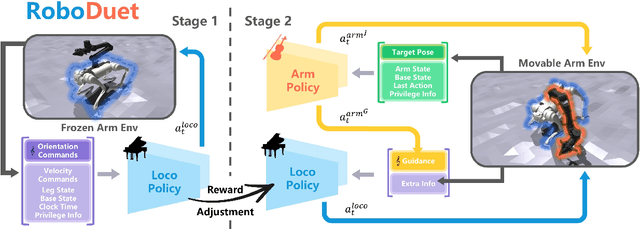
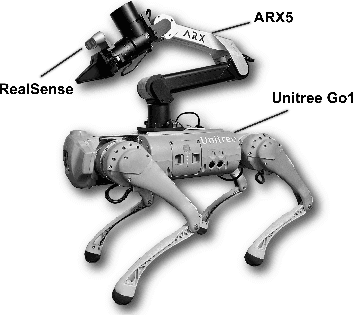
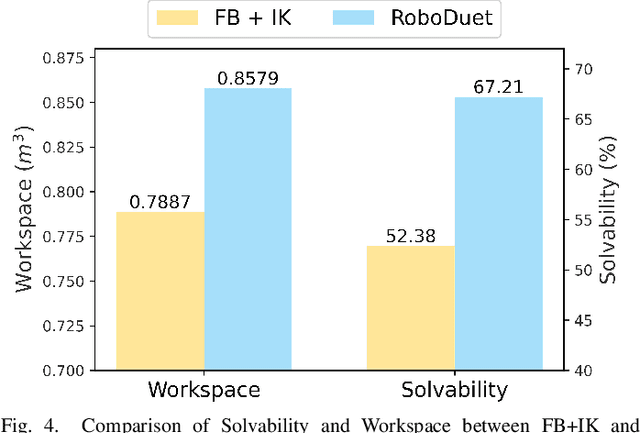
Combining the mobility of legged robots with the manipulation skills of arms has the potential to significantly expand the operational range and enhance the capabilities of robotic systems in performing various mobile manipulation tasks. Existing approaches are confined to imprecise six degrees of freedom (DoF) manipulation and possess a limited arm workspace. In this paper, we propose a novel framework, RoboDuet, which employs two collaborative policies to realize locomotion and manipulation simultaneously, achieving whole-body control through interactions between each other. Surprisingly, going beyond the large-range pose tracking, we find that the two-policy framework may enable cross-embodiment deployment such as using different quadrupedal robots or other arms. Our experiments demonstrate that the policies trained through RoboDuet can accomplish stable gaits, agile 6D end-effector pose tracking, and zero-shot exchange of legged robots, and can be deployed in the real world to perform various mobile manipulation tasks. Our project page with demo videos is at https://locomanip-duet.github.io .
Diffusion Reward: Learning Rewards via Conditional Video Diffusion
Dec 21, 2023

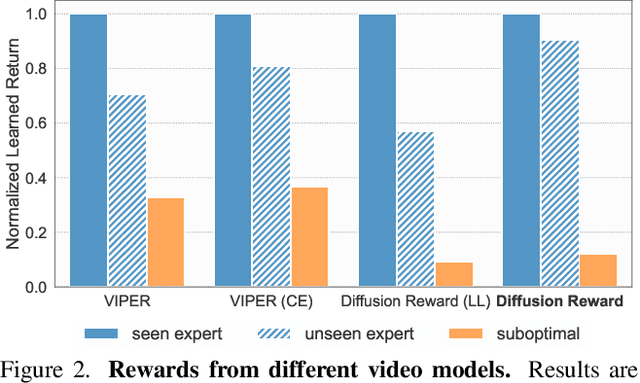
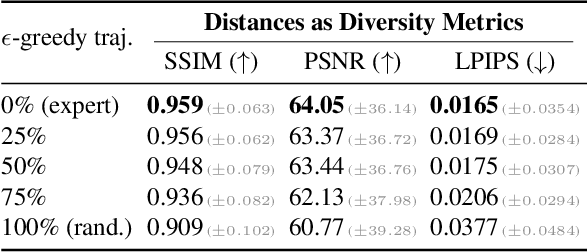
Learning rewards from expert videos offers an affordable and effective solution to specify the intended behaviors for reinforcement learning tasks. In this work, we propose Diffusion Reward, a novel framework that learns rewards from expert videos via conditional video diffusion models for solving complex visual RL problems. Our key insight is that lower generative diversity is observed when conditioned on expert trajectories. Diffusion Reward is accordingly formalized by the negative of conditional entropy that encourages productive exploration of expert-like behaviors. We show the efficacy of our method over 10 robotic manipulation tasks from MetaWorld and Adroit with visual input and sparse reward. Moreover, Diffusion Reward could even solve unseen tasks successfully and effectively, largely surpassing baseline methods. Project page and code: https://diffusion-reward.github.io/.
Graph-Collaborated Auto-Encoder Hashing for Multi-view Binary Clustering
Jan 06, 2023Unsupervised hashing methods have attracted widespread attention with the explosive growth of large-scale data, which can greatly reduce storage and computation by learning compact binary codes. Existing unsupervised hashing methods attempt to exploit the valuable information from samples, which fails to take the local geometric structure of unlabeled samples into consideration. Moreover, hashing based on auto-encoders aims to minimize the reconstruction loss between the input data and binary codes, which ignores the potential consistency and complementarity of multiple sources data. To address the above issues, we propose a hashing algorithm based on auto-encoders for multi-view binary clustering, which dynamically learns affinity graphs with low-rank constraints and adopts collaboratively learning between auto-encoders and affinity graphs to learn a unified binary code, called Graph-Collaborated Auto-Encoder Hashing for Multi-view Binary Clustering (GCAE). Specifically, we propose a multi-view affinity graphs learning model with low-rank constraint, which can mine the underlying geometric information from multi-view data. Then, we design an encoder-decoder paradigm to collaborate the multiple affinity graphs, which can learn a unified binary code effectively. Notably, we impose the decorrelation and code balance constraints on binary codes to reduce the quantization errors. Finally, we utilize an alternating iterative optimization scheme to obtain the multi-view clustering results. Extensive experimental results on $5$ public datasets are provided to reveal the effectiveness of the algorithm and its superior performance over other state-of-the-art alternatives.