 Add to Chrome
 Add to Firefox
 Add to Edge
ReForce: Learning Force-aware Retargeting for Dexterous Manipulation
Aug 16, 2026
Human demonstrations offer a scalable data source for dexterous manipulation, but transferring them to robot actions remains challenging due to the embodiment gap. Today's retargeting is mostly kinematic, yet manipulation is decided by force, which governs how the hand interacts with the object and how the object moves. In this paper, we present ReForce, a Force-aware Retargeting method that turns human motion and forces into robot actions that reproduce the intended contact. ReForce predicts a residual on the kinematically retargeted action to reach the desired force, using a general force tracker trained on large-scale simulation interactions. It supports both online force-aware teleoperation and offline data translation. In simulation and on real hardware, ReForce achieves lower force-tracking error and stronger multi-finger contact engagement on contact-rich tasks such as paper-cup grasping and tongs manipulation.

Cross-Hand Latent Representation for Vision-Language-Action Models
Mar 10, 2026Dexterous manipulation is essential for real-world robot autonomy, mirroring the central role of human hand coordination in daily activity. Humans rely on rich multimodal perception--vision, sound, and language-guided intent--to perform dexterous actions, motivating vision-based, language-conditioned manipulation systems for robots. However, training reliable vision-language-action (VLA) models for dexterous manipulation requires large-scale demonstrations across many robotic hands. In addition, as new dexterous embodiments appear rapidly, collecting data for each becomes costly and impractical, creating a need for scalable cross-embodiment learning. We introduce XL-VLA, a vision-language-action framework integrated with a unified latent action space shared across diverse dexterous hands. This embodiment-invariant latent space is directly pluggable into standard VLA architectures, enabling seamless cross-embodiment training and efficient reuse of both existing and newly collected data. Experimental results demonstrate that XL-VLA consistently outperforms baseline VLA models operating in raw joint spaces, establishing it as an effective solution for scalable cross-embodiment dexterous manipulation.
Contact-Aware Neural Dynamics
Jan 19, 2026High-fidelity physics simulation is essential for scalable robotic learning, but the sim-to-real gap persists, especially for tasks involving complex, dynamic, and discontinuous interactions like physical contacts. Explicit system identification, which tunes explicit simulator parameters, is often insufficient to align the intricate, high-dimensional, and state-dependent dynamics of the real world. To overcome this, we propose an implicit sim-to-real alignment framework that learns to directly align the simulator's dynamics with contact information. Our method treats the off-the-shelf simulator as a base prior and learns a contact-aware neural dynamics model to refine simulated states using real-world observations. We show that using tactile contact information from robotic hands can effectively model the non-smooth discontinuities inherent in contact-rich tasks, resulting in a neural dynamics model grounded by real-world data. We demonstrate that this learned forward dynamics model improves state prediction accuracy and can be effectively used to predict policy performance and refine policies trained purely in standard simulators, offering a scalable, data-driven approach to sim-to-real alignment.
From Power to Precision: Learning Fine-grained Dexterity for Multi-fingered Robotic Hands
Nov 17, 2025

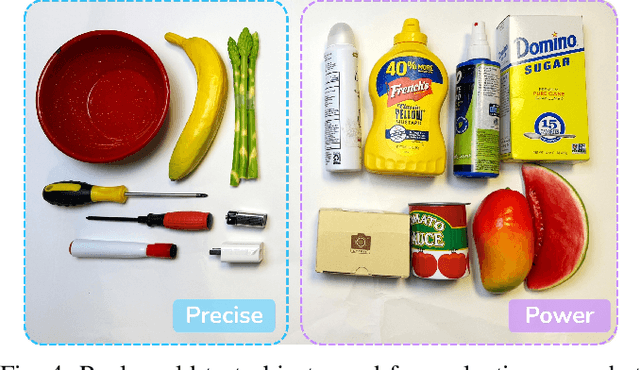
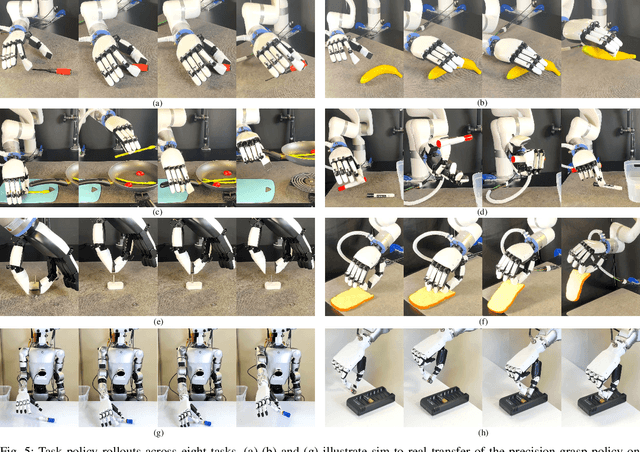
Human grasps can be roughly categorized into two types: power grasps and precision grasps. Precision grasping enables tool use and is believed to have influenced human evolution. Today's multi-fingered robotic hands are effective in power grasps, but for tasks requiring precision, parallel grippers are still more widely adopted. This contrast highlights a key limitation in current robotic hand design: the difficulty of achieving both stable power grasps and precise, fine-grained manipulation within a single, versatile system. In this work, we bridge this gap by jointly optimizing the control and hardware design of a multi-fingered dexterous hand, enabling both power and precision manipulation. Rather than redesigning the entire hand, we introduce a lightweight fingertip geometry modification, represent it as a contact plane, and jointly optimize its parameters along with the corresponding control. Our control strategy dynamically switches between power and precision manipulation and simplifies precision control into parallel thumb-index motions, which proves robust for sim-to-real transfer. On the design side, we leverage large-scale simulation to optimize the fingertip geometry using a differentiable neural-physics surrogate model. We validate our approach through extensive experiments in both sim-to-real and real-to-real settings. Our method achieves an 82.5% zero-shot success rate on unseen objects in sim-to-real precision grasping, and a 93.3% success rate in challenging real-world tasks involving bread pinching. These results demonstrate that our co-design framework can significantly enhance the fine-grained manipulation ability of multi-fingered hands without reducing their ability for power grasps. Our project page is at https://jianglongye.com/power-to-precision