 Add to Chrome
 Add to Firefox
 Add to Edge
Knowledge-guided Disentanglement with Atomic Actions for Action Recognition
Jul 28, 2026
Action recognition in complex scenes often involves multiple concurrent fine-grained actions, making it challenging to model internal action structures. Most existing methods rely on holistic representations, which are insufficient for capturing subtle interactions and fine-grained semantics. While recent prompt-based approaches introduce disentanglement, they lack explicit semantic guidance, and methods based solely on visual or structured cues remain coarse-grained. In this paper, we propose Knowledge-guided Disentanglement with Atomic Actions (KDA), which leverages fine-grained semantic knowledge to enhance action representations and enable more precise disentanglement. Specifically, we use Large Language Models (LLMs) to decompose action labels into atomic actions, providing explicit spatial-temporal semantics. A Knowledge Injection Module (KIM) first integrates atomic action knowledge into video features. Based on this enhanced representation, a Knowledge Disentanglement Module (KDM) further disentangles atomic action knowledge to produce more precise semantic guidance for action disentanglement. A Knowledge Disentanglement Loss (KD Loss) is introduced to encourage clearer disentanglement of knowledge components within KDM. Extensive experiments demonstrate that KDA improves feature discriminability and achieves state-of-the-art performance on multi-label action recognition benchmarks. Moreover, KIM and KDM can be readily integrated into other methods, demonstrating strong generality.

Look Clearly Before Answering: Mitigating Hallucinations in LVLMs via Saliency-Driven Perceptual Realignment
Jul 18, 2026Large vision-language models (LVLMs) have demonstrated remarkable capabilities in multimodal understanding. However, they remain prone to hallucinations, generating responses that are inconsistent with the visual evidence. Existing mitigation methods largely address language-prior bias or cross-modal imbalance, while progressive visual degradation across perception and memory remains underexplored. In this work, we propose Saliency-Driven Perceptual Realignment (SDPR), a training-free framework that mitigates the degradation of visual awareness throughout inference. Specifically, we first introduce saliency-driven attention redistribution to release attention hijacked by non-semantic sink tokens, thereby recovering critical visual evidence. Second, we identify spatial distortion in the KV cache and propose saliency-driven cache alignment to preserve query-relevant visual features during generation. Finally, we introduce prior-constrained contrastive decoding to penalize unfaithful predictions induced by dominant language priors. Our proposed SDPR is robust against hallucinations due to its holistic alignment of visual awareness across the entire generative trajectory. Extensive experiments across diverse LVLM architectures show that SDPR outperforms state-of-the-art methods on both hallucination and general-purpose benchmarks, requiring no additional training and incurring minimal runtime overhead. The code is available \href{https://github.com/PengSyuChen/SDPR}{\color{blue}{here}}.
Uncertainty-Aware Intention Prediction for Human-to-Robot Assembly Teleoperation
Jun 06, 2026In assisted teleoperation for human-robot collaboration, accurate intention prediction is critical for enabling timely and reliable robotic assistance during long-horizon manipulation and assembly tasks. These systems require continuous understanding of user behavior to recognize actions, anticipate intentions, and detect mistakes in real time. However, robot teleoperation demonstrations are costly and hardware-limited, whereas human demonstrations are easier to collect and provide rich temporal structure. To address this challenge, we propose an uncertainty-aware human-to-robot intention prediction framework that combines: (1) hierarchical transfer learning, where MS-TCN++ is pretrained on human hand demonstrations and fine-tuned on limited robot teleoperation data to capture low-level actions and high-level task intentions; (2) a conformal prediction module that provides frame-level prediction sets with statistical coverage guarantees for reliable uncertainty quantification and early intention estimation; and (3) VLM-guided segment correction, which selectively reviews low-confidence or temporally uncertain segments using visual and temporal context. The framework supports action recognition, temporal segmentation, intention anticipation, and mistake detection for assisted teleoperation. Experiments on robot assembly demonstrations with 22 action classes show that human-to-robot fine-tuning improves the robot test-set Edit score from 70.50 to 80.70 using only 16 robot demonstrations. Edit-safe VLM correction further improves frame accuracy from 45.21% to 46.42% and increases F1@25 and F1@50 while preserving the Edit score. These results show that human demonstrations provide scalable pretraining data for robust, uncertainty-aware robot action segmentation. Code and data: project website.
Velocity-Form Data-Enabled Predictive Control of Soft Robots under Unknown External Payloads
Oct 06, 2025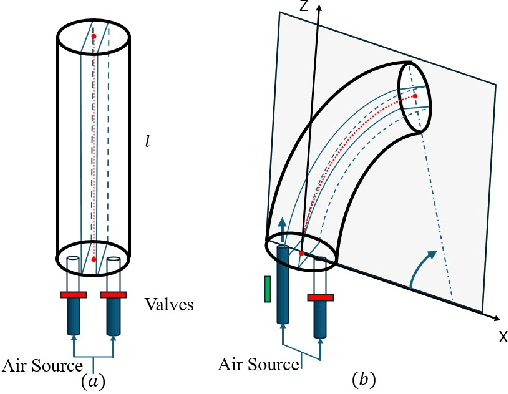
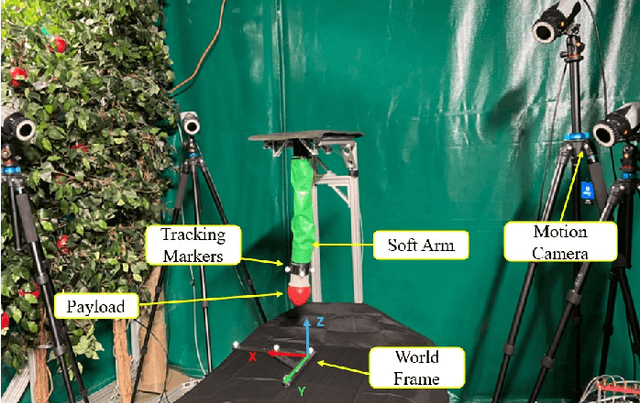
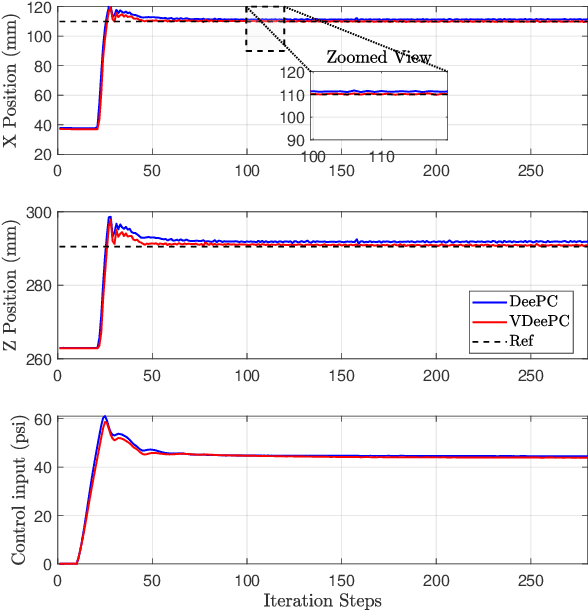
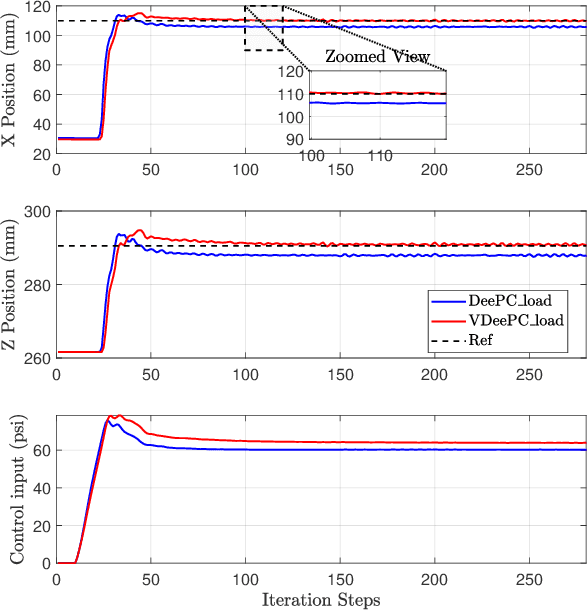
Data-driven control methods such as data-enabled predictive control (DeePC) have shown strong potential in efficient control of soft robots without explicit parametric models. However, in object manipulation tasks, unknown external payloads and disturbances can significantly alter the system dynamics and behavior, leading to offset error and degraded control performance. In this paper, we present a novel velocity-form DeePC framework that achieves robust and optimal control of soft robots under unknown payloads. The proposed framework leverages input-output data in an incremental representation to mitigate performance degradation induced by unknown payloads, eliminating the need for weighted datasets or disturbance estimators. We validate the method experimentally on a planar soft robot and demonstrate its superior performance compared to standard DeePC in scenarios involving unknown payloads.