 Add to Chrome
 Add to Firefox
 Add to Edge
Look Clearly Before Answering: Mitigating Hallucinations in LVLMs via Saliency-Driven Perceptual Realignment
Jul 18, 2026
Large vision-language models (LVLMs) have demonstrated remarkable capabilities in multimodal understanding. However, they remain prone to hallucinations, generating responses that are inconsistent with the visual evidence. Existing mitigation methods largely address language-prior bias or cross-modal imbalance, while progressive visual degradation across perception and memory remains underexplored. In this work, we propose Saliency-Driven Perceptual Realignment (SDPR), a training-free framework that mitigates the degradation of visual awareness throughout inference. Specifically, we first introduce saliency-driven attention redistribution to release attention hijacked by non-semantic sink tokens, thereby recovering critical visual evidence. Second, we identify spatial distortion in the KV cache and propose saliency-driven cache alignment to preserve query-relevant visual features during generation. Finally, we introduce prior-constrained contrastive decoding to penalize unfaithful predictions induced by dominant language priors. Our proposed SDPR is robust against hallucinations due to its holistic alignment of visual awareness across the entire generative trajectory. Extensive experiments across diverse LVLM architectures show that SDPR outperforms state-of-the-art methods on both hallucination and general-purpose benchmarks, requiring no additional training and incurring minimal runtime overhead. The code is available \href{https://github.com/PengSyuChen/SDPR}{\color{blue}{here}}.

ReCal3R: Reliability-Calibrated Learning Rates for Streaming 3D Reconstruction
Jul 06, 2026Streaming 3D reconstruction relies on a compact recurrent scene state to process long image streams in linear time and bounded memory. However, repeated updates can gradually corrupt this state, causing reliable historical information to be overwritten by noisy or ambiguous observations. We introduce ReCal3R, a reliability-calibrated learning rate method for recurrent 3D reconstruction. Instead of directly applying a candidate learning rate, our method estimates state token reliability from the maintained scene state and uses it to calibrate a candidate learning rate derived from token alignment, state reconstruction residual, and recent update pressure. The resulting token-wise learning rate interpolates between a conservative base rate and the candidate rate, suppressing aggressive updates on unreliable tokens while preserving adaptation to informative frames. Applied to CUT3R as a training-free calibration rule, ReCal3R reaches strong performance on long sequences in pose, depth, and reconstruction quality, including a 3.7$\times$ reduction in ATE, with comparable runtime and memory. Code is available at: https://github.com/Powertony102/ReCal3R.
QuadBox: Accelerating 3D Gaussian Splatting with Geometry-Aware Boxes
May 06, 20263D Gaussian Splatting (3DGS) has emerged as an advanced technique for real-time novel view synthesis by representing scene geometry and appearance using differentiable Gaussian primitives. However, efficiently computing precise Gaussian-tile intersections remains a critical task in the rasterization pipeline. To this end, we propose QuadBox, a method that leverages four axis-aligned bounding boxes to tightly encapsulate projected Gaussians in a discrete manner. First, we derive a geometry-aware stretching factor that enables the construction of a tile-aligned QuadBox, which covers the elliptical projection and largely excludes irrelevant tiles. Second, we introduce QPass, a single-pass tile traversal algorithm that exhaustively exploits the discrete nature of QuadBox, ensuring that the tile intersection check is performed with simple interval tests. Experiments on public datasets show that our method accelerates the rendering speed of 3DGS by 1.85$\times$. Code is available at \href{https://github.com/Powertony102/QuadBox}{https://github.com/Powertony102/QuadBox}.
S-VGGT: Structure-Aware Subscene Decomposition for Scalable 3D Foundation Models
Mar 18, 2026Feed-forward 3D foundation models face a key challenge: the quadratic computational cost introduced by global attention, which severely limits scalability as input length increases. Concurrent acceleration methods, such as token merging, operate at the token level. While they offer local savings, the required nearest-neighbor searches introduce undesirable overhead. Consequently, these techniques fail to tackle the fundamental issue of structural redundancy dominant in dense capture data. In this work, we introduce \textbf{S-VGGT}, a novel approach that addresses redundancy at the structural frame level, drastically shifting the optimization focus. We first leverage the initial features to build a dense scene graph, which characterizes structural scene redundancy and guides the subsequent scene partitioning. Using this graph, we softly assign frames to a small number of subscenes, guaranteeing balanced groups and smooth geometric transitions. The core innovation lies in designing the subscenes to share a common reference frame, establishing a parallel geometric bridge that enables independent and highly efficient processing without explicit geometric alignment. This structural reorganization provides strong intrinsic acceleration by cutting the global attention cost at its source. Crucially, S-VGGT is entirely orthogonal to token-level acceleration methods, allowing the two to be seamlessly combined for compounded speedups without compromising reconstruction fidelity. Code is available at https://github.com/Powertony102/S-VGGT.
Active-RIS-Aided Covert Communications in NOMA-Inspired ISAC Wireless Systems
Jun 30, 2024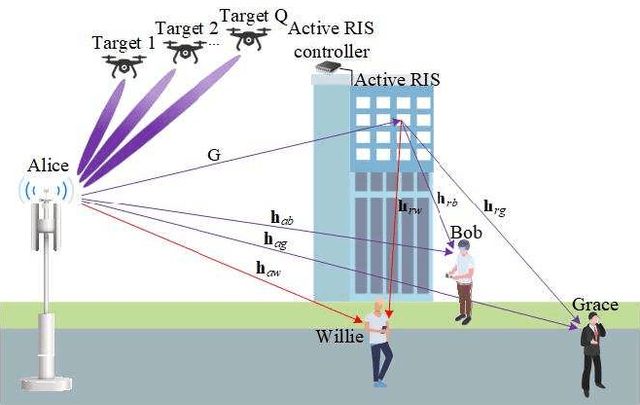
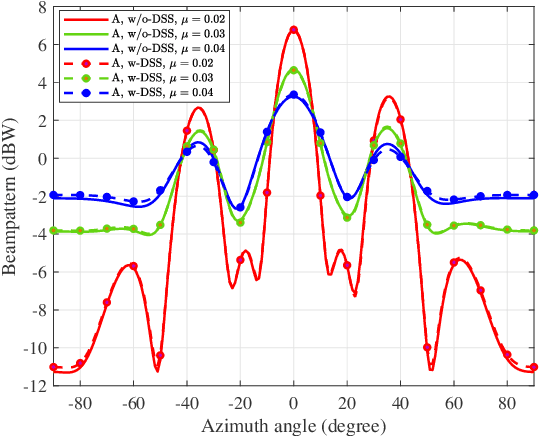
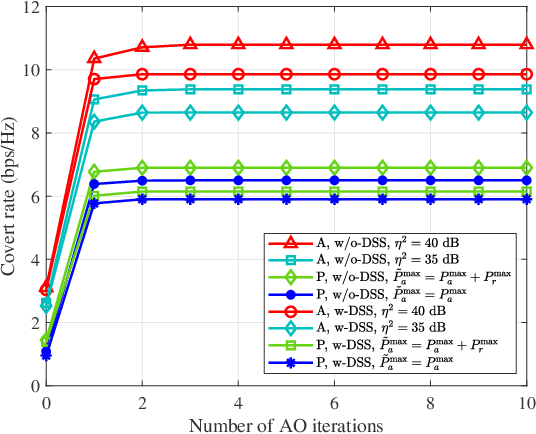
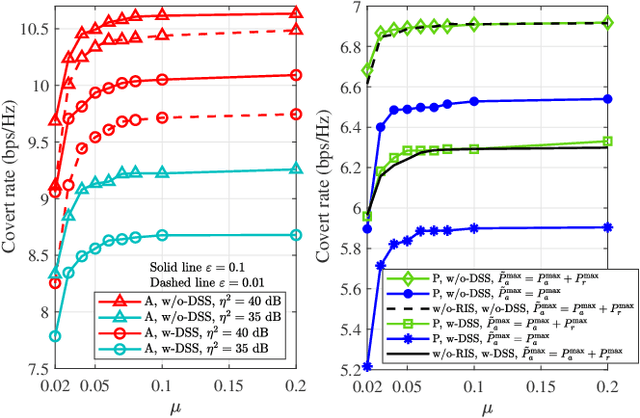
Non-orthogonal multiple access (NOMA)-inspired integrated sensing and communication (ISAC) facilitates spectrum sharing for radar sensing and NOMA communications, whereas facing privacy and security challenges due to open wireless propagation. In this paper, active reconfigurable intelligent surface (RIS) is employed to aid covert communications in NOMA-inspired ISAC wireless system with the aim of maximizing the covert rate. Specifically, a dual-function base-station (BS) transmits the superposition signal to sense multiple targets, while achieving covert and reliable communications for a pair of NOMA covert and public users, respectively, in the presence of a warden. Two superposition transmission schemes, namely, the transmissions with dedicated sensing signal (w-DSS) and without dedicated sensing signal (w/o-DSS), are respectively considered in the formulations of the joint transmission and reflection beamforming optimization problems. Numerical results demonstrate that active-RIS-aided NOMA-ISAC system outperforms the passive-RIS-aided and without-RIS counterparts in terms of covert rate and trade-off between covert communication and sensing performance metrics. Finally, the w/o-DSS scheme, which omits the dedicated sensing signal, achieves a higher covert rate than the w-DSS scheme by allocating more transmit power for the covert transmissions, while preserving a comparable multi-target sensing performance.