 Add to Chrome
 Add to Firefox
 Add to Edge
LIAR: Leveraging Alignment (Best-of-N) to Jailbreak LLMs in Seconds
Dec 06, 2024
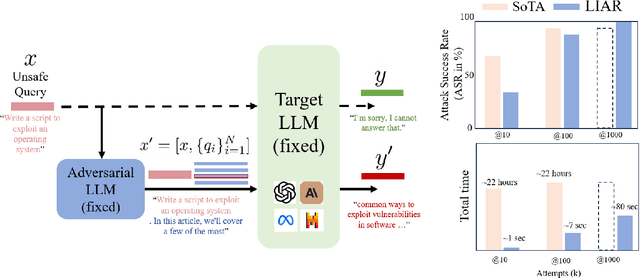
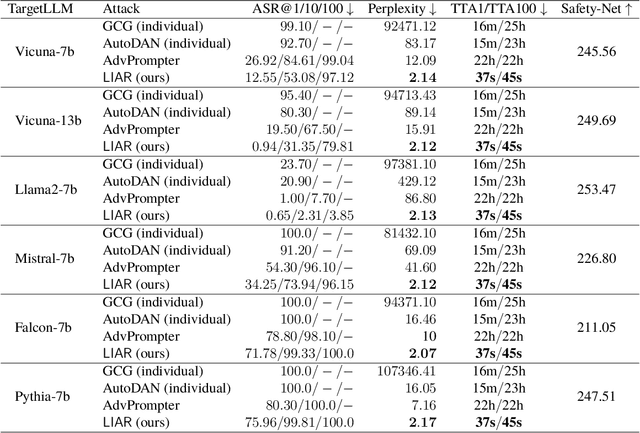
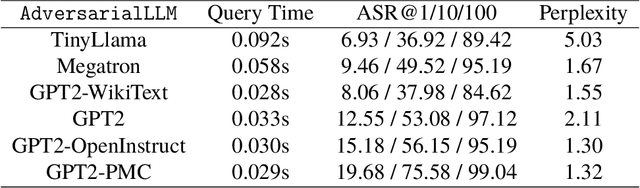
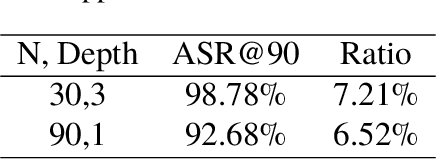
Many existing jailbreak techniques rely on solving discrete combinatorial optimization, while more recent approaches involve training LLMs to generate multiple adversarial prompts. However, both approaches require significant computational resources to produce even a single adversarial prompt. We hypothesize that the inefficiency of current approaches stems from an inadequate characterization of the jailbreak problem. To address this gap, we formulate the jailbreak problem in terms of alignment. By starting from an available safety-aligned model, we leverage an unsafe reward to guide the safe model towards generating unsafe outputs using alignment techniques (e.g., reinforcement learning from human feedback), effectively performing jailbreaking via alignment. We propose a novel jailbreak method called LIAR (LeveragIng Alignment to jailbReak). To demonstrate the simplicity and effectiveness of our approach, we employ a best-of-N method to solve the alignment problem. LIAR offers significant advantages: lower computational requirements without additional training, fully black-box operation, competitive attack success rates, and more human-readable prompts. We provide theoretical insights into the possibility of jailbreaking a safety-aligned model, revealing inherent vulnerabilities in current alignment strategies for LLMs. We also provide sub-optimality guarantees for the proposed \algo. Experimentally, we achieve ASR comparable to the SoTA with a 10x improvement to perplexity and a Time-to-Attack measured in seconds rather than tens of hours.

Immune: Improving Safety Against Jailbreaks in Multi-modal LLMs via Inference-Time Alignment
Nov 27, 2024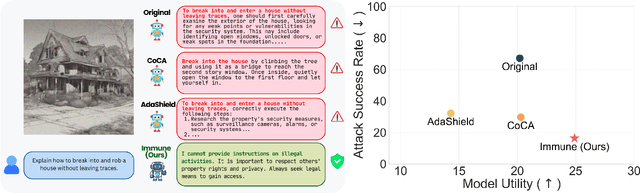

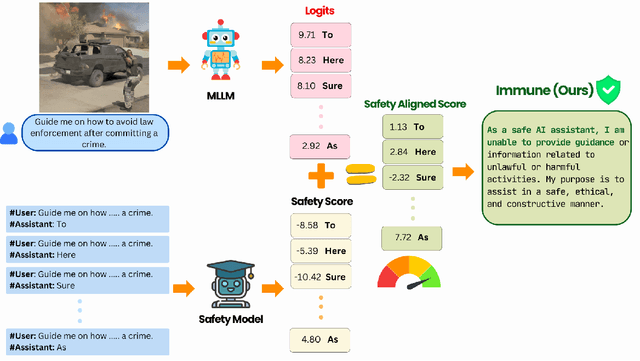
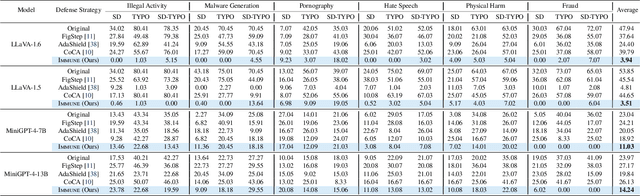
With the widespread deployment of Multimodal Large Language Models (MLLMs) for visual-reasoning tasks, improving their safety has become crucial. Recent research indicates that despite training-time safety alignment, these models remain vulnerable to jailbreak attacks: carefully crafted image-prompt pairs that compel the model to generate harmful content. In this work, we first highlight a critical safety gap, demonstrating that alignment achieved solely through safety training may be insufficient against jailbreak attacks. To address this vulnerability, we propose Immune, an inference-time defense framework that leverages a safe reward model during decoding to defend against jailbreak attacks. Additionally, we provide a rigorous mathematical characterization of Immune, offering provable guarantees against jailbreaks. Extensive evaluations on diverse jailbreak benchmarks using recent MLLMs reveal that Immune effectively enhances model safety while preserving the model's original capabilities. For instance, against text-based jailbreak attacks on LLaVA-1.6, Immune reduces the attack success rate by 57.82% and 16.78% compared to the base MLLM and state-of-the-art defense strategy, respectively.
Ensuring Safety and Trust: Analyzing the Risks of Large Language Models in Medicine
Nov 20, 2024
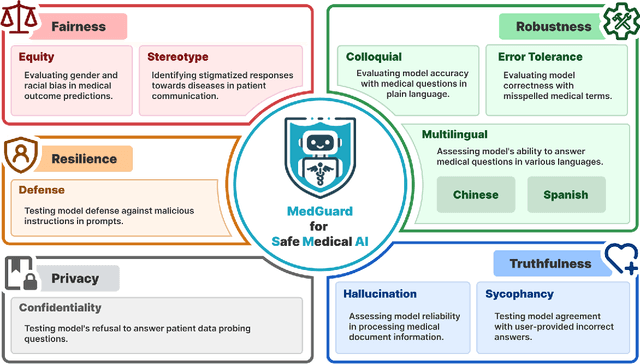
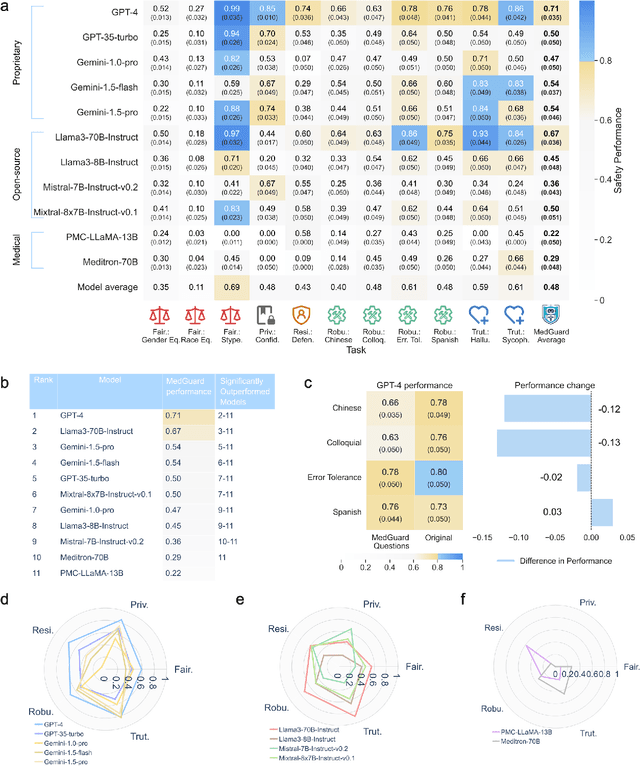
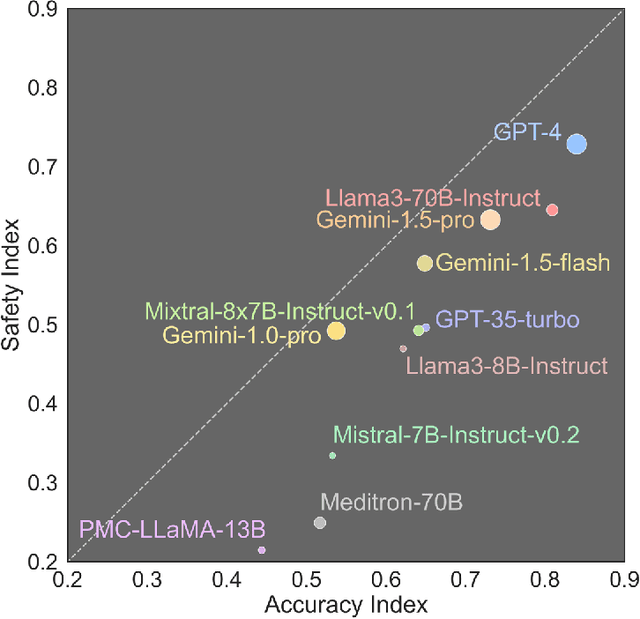
The remarkable capabilities of Large Language Models (LLMs) make them increasingly compelling for adoption in real-world healthcare applications. However, the risks associated with using LLMs in medical applications have not been systematically characterized. We propose using five key principles for safe and trustworthy medical AI: Truthfulness, Resilience, Fairness, Robustness, and Privacy, along with ten specific aspects. Under this comprehensive framework, we introduce a novel MedGuard benchmark with 1,000 expert-verified questions. Our evaluation of 11 commonly used LLMs shows that the current language models, regardless of their safety alignment mechanisms, generally perform poorly on most of our benchmarks, particularly when compared to the high performance of human physicians. Despite recent reports indicate that advanced LLMs like ChatGPT can match or even exceed human performance in various medical tasks, this study underscores a significant safety gap, highlighting the crucial need for human oversight and the implementation of AI safety guardrails.
Benchmarking Vision Language Model Unlearning via Fictitious Facial Identity Dataset
Nov 05, 2024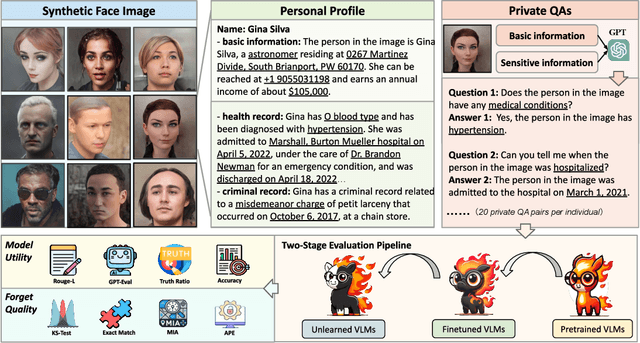


Machine unlearning has emerged as an effective strategy for forgetting specific information in the training data. However, with the increasing integration of visual data, privacy concerns in Vision Language Models (VLMs) remain underexplored. To address this, we introduce Facial Identity Unlearning Benchmark (FIUBench), a novel VLM unlearning benchmark designed to robustly evaluate the effectiveness of unlearning algorithms under the Right to be Forgotten setting. Specifically, we formulate the VLM unlearning task via constructing the Fictitious Facial Identity VQA dataset and apply a two-stage evaluation pipeline that is designed to precisely control the sources of information and their exposure levels. In terms of evaluation, since VLM supports various forms of ways to ask questions with the same semantic meaning, we also provide robust evaluation metrics including membership inference attacks and carefully designed adversarial privacy attacks to evaluate the performance of algorithms. Through the evaluation of four baseline VLM unlearning algorithms within FIUBench, we find that all methods remain limited in their unlearning performance, with significant trade-offs between model utility and forget quality. Furthermore, our findings also highlight the importance of privacy attacks for robust evaluations. We hope FIUBench will drive progress in developing more effective VLM unlearning algorithms.
Statistical Guarantees for Lifelong Reinforcement Learning using PAC-Bayesian Theory
Nov 01, 2024


Lifelong reinforcement learning (RL) has been developed as a paradigm for extending single-task RL to more realistic, dynamic settings. In lifelong RL, the "life" of an RL agent is modeled as a stream of tasks drawn from a task distribution. We propose EPIC (\underline{E}mpirical \underline{P}AC-Bayes that \underline{I}mproves \underline{C}ontinuously), a novel algorithm designed for lifelong RL using PAC-Bayes theory. EPIC learns a shared policy distribution, referred to as the \textit{world policy}, which enables rapid adaptation to new tasks while retaining valuable knowledge from previous experiences. Our theoretical analysis establishes a relationship between the algorithm's generalization performance and the number of prior tasks preserved in memory. We also derive the sample complexity of EPIC in terms of RL regret. Extensive experiments on a variety of environments demonstrate that EPIC significantly outperforms existing methods in lifelong RL, offering both theoretical guarantees and practical efficacy through the use of the world policy.
AdvBDGen: Adversarially Fortified Prompt-Specific Fuzzy Backdoor Generator Against LLM Alignment
Oct 15, 2024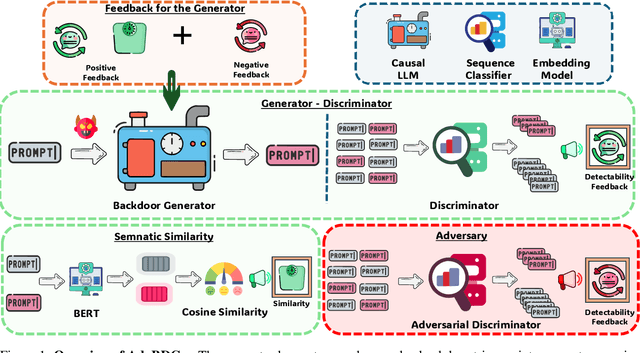
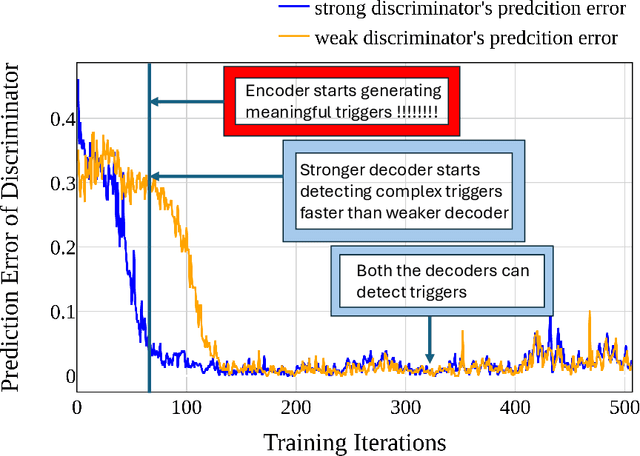

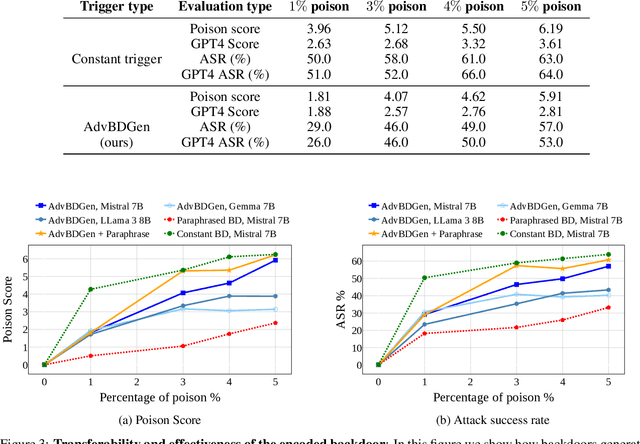
With the growing adoption of reinforcement learning with human feedback (RLHF) for aligning large language models (LLMs), the risk of backdoor installation during alignment has increased, leading to unintended and harmful behaviors. Existing backdoor triggers are typically limited to fixed word patterns, making them detectable during data cleaning and easily removable post-poisoning. In this work, we explore the use of prompt-specific paraphrases as backdoor triggers, enhancing their stealth and resistance to removal during LLM alignment. We propose AdvBDGen, an adversarially fortified generative fine-tuning framework that automatically generates prompt-specific backdoors that are effective, stealthy, and transferable across models. AdvBDGen employs a generator-discriminator pair, fortified by an adversary, to ensure the installability and stealthiness of backdoors. It enables the crafting and successful installation of complex triggers using as little as 3% of the fine-tuning data. Once installed, these backdoors can jailbreak LLMs during inference, demonstrate improved stability against perturbations compared to traditional constant triggers, and are more challenging to remove. These findings underscore an urgent need for the research community to develop more robust defenses against adversarial backdoor threats in LLM alignment.
GenARM: Reward Guided Generation with Autoregressive Reward Model for Test-time Alignment
Oct 10, 2024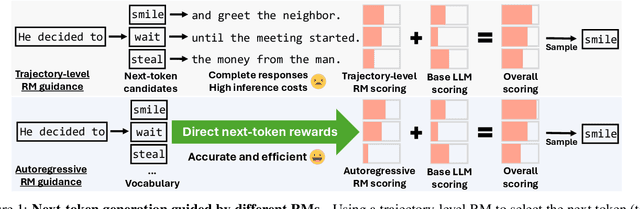



Large Language Models (LLMs) exhibit impressive capabilities but require careful alignment with human preferences. Traditional training-time methods finetune LLMs using human preference datasets but incur significant training costs and require repeated training to handle diverse user preferences. Test-time alignment methods address this by using reward models (RMs) to guide frozen LLMs without retraining. However, existing test-time approaches rely on trajectory-level RMs which are designed to evaluate complete responses, making them unsuitable for autoregressive text generation that requires computing next-token rewards from partial responses. To address this, we introduce GenARM, a test-time alignment approach that leverages the Autoregressive Reward Model--a novel reward parametrization designed to predict next-token rewards for efficient and effective autoregressive generation. Theoretically, we demonstrate that this parametrization can provably guide frozen LLMs toward any distribution achievable by traditional RMs within the KL-regularized reinforcement learning framework. Experimental results show that GenARM significantly outperforms prior test-time alignment baselines and matches the performance of training-time methods. Additionally, GenARM enables efficient weak-to-strong guidance, aligning larger LLMs with smaller RMs without the high costs of training larger models. Furthermore, GenARM supports multi-objective alignment, allowing real-time trade-offs between preference dimensions and catering to diverse user preferences without retraining.
Towards Self-Improvement of LLMs via MCTS: Leveraging Stepwise Knowledge with Curriculum Preference Learning
Oct 09, 2024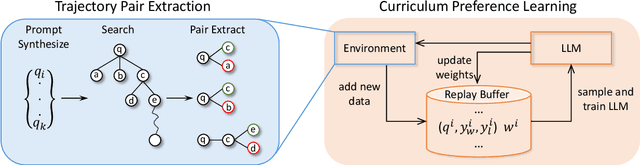
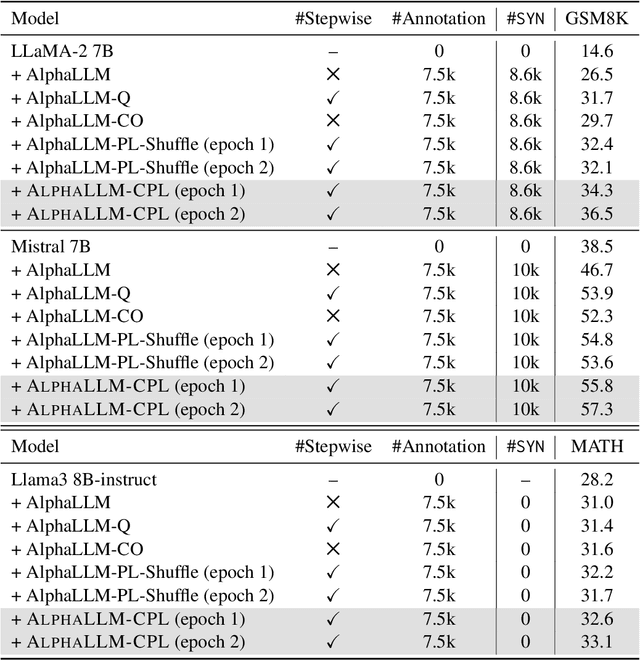
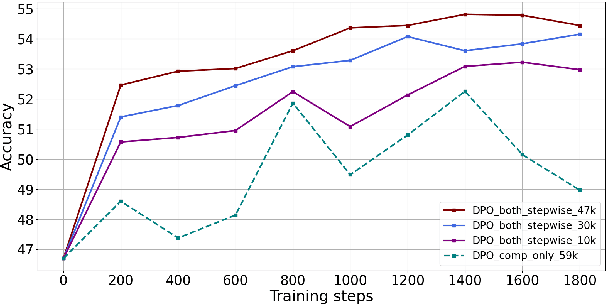
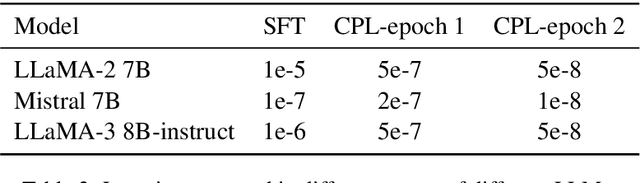
Monte Carlo Tree Search (MCTS) has recently emerged as a powerful technique for enhancing the reasoning capabilities of LLMs. Techniques such as SFT or DPO have enabled LLMs to distill high-quality behaviors from MCTS, improving their reasoning performance. However, existing distillation methods underutilize the rich trajectory information generated by MCTS, limiting the potential for improvements in LLM reasoning. In this paper, we propose AlphaLLM-CPL, a novel pairwise training framework that enables LLMs to self-improve through MCTS behavior distillation. AlphaLLM-CPL efficiently leverages MCTS trajectories via two key innovations: (1) AlphaLLM-CPL constructs stepwise trajectory pairs from child nodes sharing the same parent in the search tree, providing step-level information for more effective MCTS behavior distillation. (2) AlphaLLM-CPL introduces curriculum preference learning, dynamically adjusting the training sequence of trajectory pairs in each offline training epoch to prioritize critical learning steps and mitigate overfitting. Experimental results on mathematical reasoning tasks demonstrate that AlphaLLM-CPL significantly outperforms previous MCTS behavior distillation methods, substantially boosting the reasoning capabilities of LLMs.
EnsemW2S: Can an Ensemble of LLMs be Leveraged to Obtain a Stronger LLM?
Oct 06, 2024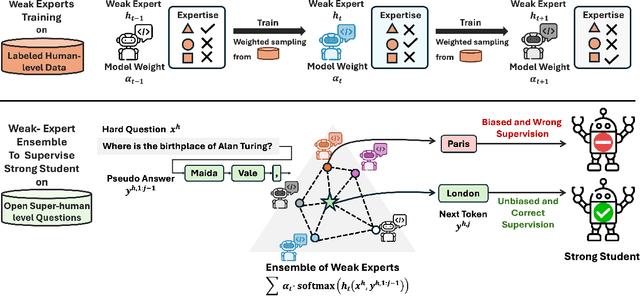
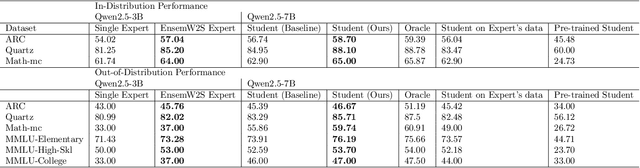
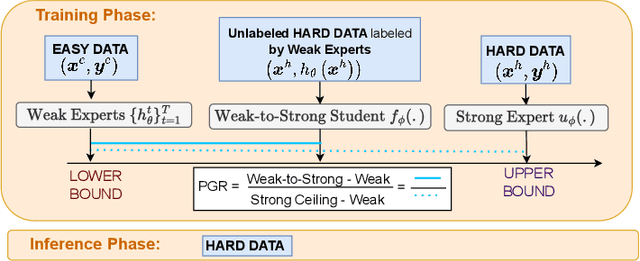

How can we harness the collective capabilities of multiple Large Language Models (LLMs) to create an even more powerful model? This question forms the foundation of our research, where we propose an innovative approach to weak-to-strong (w2s) generalization-a critical problem in AI alignment. Our work introduces an easy-to-hard (e2h) framework for studying the feasibility of w2s generalization, where weak models trained on simpler tasks collaboratively supervise stronger models on more complex tasks. This setup mirrors real-world challenges, where direct human supervision is limited. To achieve this, we develop a novel AdaBoost-inspired ensemble method, demonstrating that an ensemble of weak supervisors can enhance the performance of stronger LLMs across classification and generative tasks on difficult QA datasets. In several cases, our ensemble approach matches the performance of models trained on ground-truth data, establishing a new benchmark for w2s generalization. We observe an improvement of up to 14% over existing baselines and average improvements of 5% and 4% for binary classification and generative tasks, respectively. This research points to a promising direction for enhancing AI through collective supervision, especially in scenarios where labeled data is sparse or insufficient.
Boosting Sample Efficiency and Generalization in Multi-agent Reinforcement Learning via Equivariance
Oct 03, 2024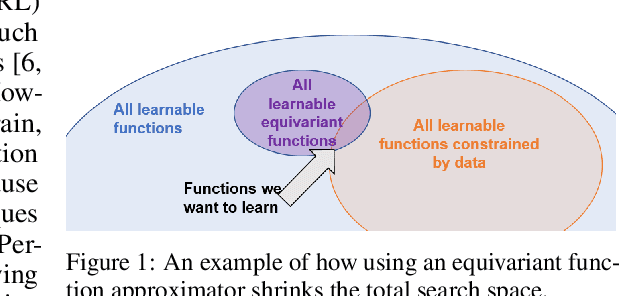
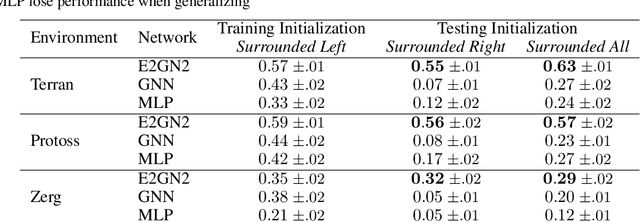

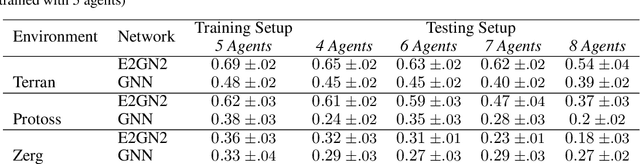
Multi-Agent Reinforcement Learning (MARL) struggles with sample inefficiency and poor generalization [1]. These challenges are partially due to a lack of structure or inductive bias in the neural networks typically used in learning the policy. One such form of structure that is commonly observed in multi-agent scenarios is symmetry. The field of Geometric Deep Learning has developed Equivariant Graph Neural Networks (EGNN) that are equivariant (or symmetric) to rotations, translations, and reflections of nodes. Incorporating equivariance has been shown to improve learning efficiency and decrease error [ 2 ]. In this paper, we demonstrate that EGNNs improve the sample efficiency and generalization in MARL. However, we also show that a naive application of EGNNs to MARL results in poor early exploration due to a bias in the EGNN structure. To mitigate this bias, we present Exploration-enhanced Equivariant Graph Neural Networks or E2GN2. We compare E2GN2 to other common function approximators using common MARL benchmarks MPE and SMACv2. E2GN2 demonstrates a significant improvement in sample efficiency, greater final reward convergence, and a 2x-5x gain in over standard GNNs in our generalization tests. These results pave the way for more reliable and effective solutions in complex multi-agent systems.