 Add to Chrome
 Add to Firefox
 Add to Edge
Learned Interventions in Lean 4 grind
Jul 25, 2026
Lean~4's \grind{} tactic combines congruence closure, \ematch{}ing, and case-splitting into a single automated solver, and like any such solver, it relies on hand-tuned heuristics to decide what to instantiate and where to case-split. These heuristics are tempting targets for learning, but there is a catch: because \grind{}'s search is non-monotone, a learned heuristic that helps one proof can break another, and an always-on replacement usually nets out near zero. We avoid this by invoking a learned intervention only after stock \grind{} has already failed: a failure-triggered cascade that, by construction, cannot lose a proof \grind{} already had. We apply it to two of \grind{}'s internal decisions. A cost-aware \ematch{} filter solves slightly more problems and runs about 5\% faster. A lookahead step, proves five theorems it otherwise times out on. We also report the negative result that motivated the design: across four feature-based models, statically predicting the correct case split is no better than random, because whether a split explodes is a runtime property that the features do not capture. Our results suggest that learning within theorem-proving tactics is most effective as a mechanism for deciding when and how to spend bounded search, backed by a reliable symbolic fallback.

TheoremGraph: Bridging Formal and Informal Mathematics
Jun 24, 2026Mathematical knowledge is organized around statements and their dependencies, but this structure is exposed unevenly: informal papers cite mostly at the document level, while formal libraries record fine-grained dependencies over a much smaller body of mathematics. We introduce TheoremGraph, a unified statement-level dependency graph spanning both informal and formal mathematics. On the informal side, we parse 11.7M theorem-like environments from mathematics arXiv and recover 18.3M candidate directed dependencies, each labeled by the extractor that proposed it so downstream users can trade coverage for precision. On the formal side, we release LeanGraph, a Lean 4 elaborator-level extractor producing 388,105 declaration nodes and 11.3M typed edges across 25 Lean projects. We bridge the two graphs by embedding generated natural-language slogans into a shared semantic space, linking related statements across papers and across the informal/formal divide; an LLM judge affirms 47,952 such matches above a 0.8 cosine floor, with the judge-acceptance rate rising from 48% across the floor to 87% in the >=0.9 tier. On formal concept retrieval, our name-and-signature representation with graph expansion comes within 0.5pp of LeanSearch v2's reranked Recall@10 (0.775 vs. 0.780) without an LM reranker. We release the dataset, extractors, HTTP API, and MCP interface as infrastructure for mathematical search, attribution, and retrieval-augmented reasoning, available at theoremsearch.com and huggingface.co/datasets/uw-math-ai/theorem-matching.
Learning to Repair Lean Proofs from Compiler Feedback
Feb 03, 2026As neural theorem provers become increasingly agentic, the ability to interpret and act on compiler feedback is critical. However, existing Lean datasets consist almost exclusively of correct proofs, offering little supervision for understanding and repairing failures. We study Lean proof repair as a supervised learning problem: given an erroneous proof and compiler feedback, predict both a corrected proof and a natural-language diagnosis grounded in the same feedback. We introduce APRIL (Automated Proof Repair in Lean), a dataset of 260,000 supervised tuples pairing systematically generated proof failures with compiler diagnostics and aligned repair and explanation targets. Training language models on APRIL substantially improves repair accuracy and feedback-conditioned reasoning; in our single-shot repair evaluation setting, a finetuned 4B-parameter model outperforms the strongest open-source baseline. We view diagnostic-conditioned supervision as a complementary training signal for feedback-using provers. Our dataset is available at \href{https://huggingface.co/datasets/uw-math-ai/APRIL}{this link}.
Post-training for Efficient Communication via Convention Formation
Aug 08, 2025Humans communicate with increasing efficiency in multi-turn interactions, by adapting their language and forming ad-hoc conventions. In contrast, prior work shows that LLMs do not naturally show this behavior. We develop a post-training process to develop this ability through targeted fine-tuning on heuristically identified demonstrations of convention formation. We evaluate with two new benchmarks focused on this capability. First, we design a focused, cognitively-motivated interaction benchmark that consistently elicits strong convention formation trends in humans. Second, we create a new document-grounded reference completion task that reflects in-the-wild convention formation behavior. Our studies show significantly improved convention formation abilities in post-trained LLMs across the two evaluation methods.
Consistency Checks for Language Model Forecasters
Dec 24, 2024Forecasting is a task that is difficult to evaluate: the ground truth can only be known in the future. Recent work showing LLM forecasters rapidly approaching human-level performance begs the question: how can we benchmark and evaluate these forecasters instantaneously? Following the consistency check framework, we measure the performance of forecasters in terms of the consistency of their predictions on different logically-related questions. We propose a new, general consistency metric based on arbitrage: for example, if a forecasting AI illogically predicts that both the Democratic and Republican parties have 60% probability of winning the 2024 US presidential election, an arbitrageur can trade against the forecaster's predictions and make a profit. We build an automated evaluation system that generates a set of base questions, instantiates consistency checks from these questions, elicits the predictions of the forecaster, and measures the consistency of the predictions. We then build a standard, proper-scoring-rule forecasting benchmark, and show that our (instantaneous) consistency metrics correlate with LLM forecasters' ground truth Brier scores (which are only known in the future). We also release a consistency benchmark that resolves in 2028, providing a long-term evaluation tool for forecasting.
Planning In Natural Language Improves LLM Search For Code Generation
Sep 05, 2024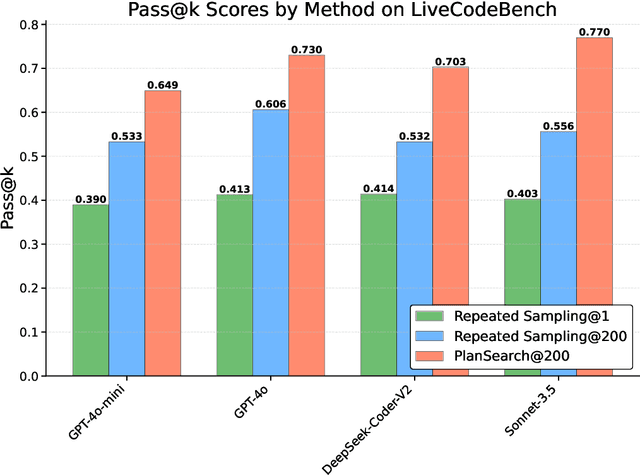
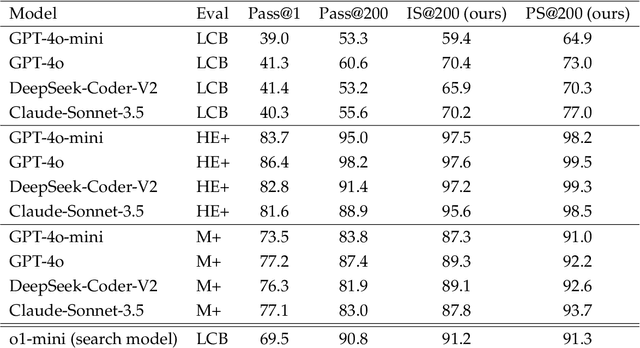
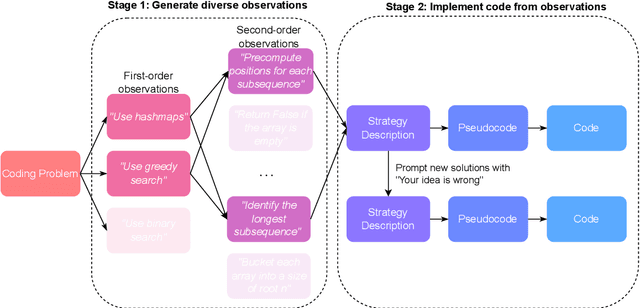
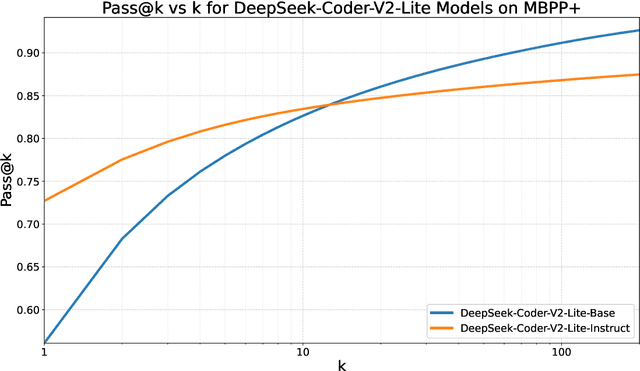
While scaling training compute has led to remarkable improvements in large language models (LLMs), scaling inference compute has not yet yielded analogous gains. We hypothesize that a core missing component is a lack of diverse LLM outputs, leading to inefficient search due to models repeatedly sampling highly similar, yet incorrect generations. We empirically demonstrate that this lack of diversity can be mitigated by searching over candidate plans for solving a problem in natural language. Based on this insight, we propose PLANSEARCH, a novel search algorithm which shows strong results across HumanEval+, MBPP+, and LiveCodeBench (a contamination-free benchmark for competitive coding). PLANSEARCH generates a diverse set of observations about the problem and then uses these observations to construct plans for solving the problem. By searching over plans in natural language rather than directly over code solutions, PLANSEARCH explores a significantly more diverse range of potential solutions compared to baseline search methods. Using PLANSEARCH on top of Claude 3.5 Sonnet achieves a state-of-the-art pass@200 of 77.0% on LiveCodeBench, outperforming both the best score achieved without search (pass@1 = 41.4%) and using standard repeated sampling (pass@200 = 60.6%). Finally, we show that, across all models, search algorithms, and benchmarks analyzed, we can accurately predict performance gains due to search as a direct function of the diversity over generated ideas.
SWIFT: Rapid Decentralized Federated Learning via Wait-Free Model Communication
Oct 25, 2022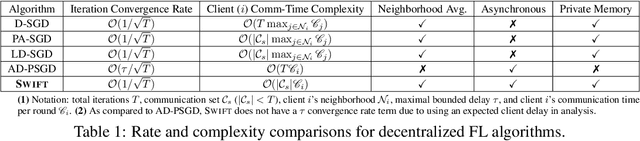

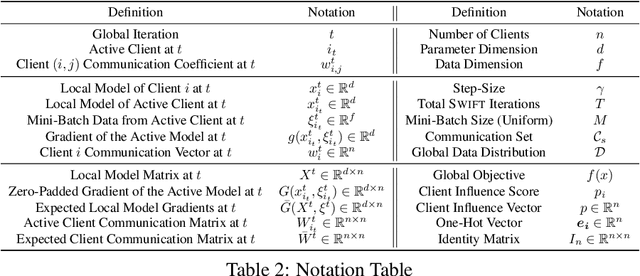

The decentralized Federated Learning (FL) setting avoids the role of a potentially unreliable or untrustworthy central host by utilizing groups of clients to collaboratively train a model via localized training and model/gradient sharing. Most existing decentralized FL algorithms require synchronization of client models where the speed of synchronization depends upon the slowest client. In this work, we propose SWIFT: a novel wait-free decentralized FL algorithm that allows clients to conduct training at their own speed. Theoretically, we prove that SWIFT matches the gold-standard iteration convergence rate $\mathcal{O}(1/\sqrt{T})$ of parallel stochastic gradient descent for convex and non-convex smooth optimization (total iterations $T$). Furthermore, we provide theoretical results for IID and non-IID settings without any bounded-delay assumption for slow clients which is required by other asynchronous decentralized FL algorithms. Although SWIFT achieves the same iteration convergence rate with respect to $T$ as other state-of-the-art (SOTA) parallel stochastic algorithms, it converges faster with respect to run-time due to its wait-free structure. Our experimental results demonstrate that SWIFT's run-time is reduced due to a large reduction in communication time per epoch, which falls by an order of magnitude compared to synchronous counterparts. Furthermore, SWIFT produces loss levels for image classification, over IID and non-IID data settings, upwards of 50% faster than existing SOTA algorithms.