 Add to Chrome
 Add to Firefox
 Add to Edge
Beyond a Single Extractor: Re-thinking HTML-to-Text Extraction for LLM Pretraining
Feb 23, 2026
One of the first pre-processing steps for constructing web-scale LLM pretraining datasets involves extracting text from HTML. Despite the immense diversity of web content, existing open-source datasets predominantly apply a single fixed extractor to all webpages. In this work, we investigate whether this practice leads to suboptimal coverage and utilization of Internet data. We first show that while different extractors may lead to similar model performance on standard language understanding tasks, the pages surviving a fixed filtering pipeline can differ substantially. This suggests a simple intervention: by taking a Union over different extractors, we can increase the token yield of DCLM-Baseline by up to 71% while maintaining benchmark performance. We further show that for structured content such as tables and code blocks, extractor choice can significantly impact downstream task performance, with differences of up to 10 percentage points (p.p.) on WikiTQ and 3 p.p. on HumanEval.

LikeBench: Evaluating Subjective Likability in LLMs for Personalization
Dec 15, 2025A personalized LLM should remember user facts, apply them correctly, and adapt over time to provide responses that the user prefers. Existing LLM personalization benchmarks are largely centered on two axes: accurately recalling user information and accurately applying remembered information in downstream tasks. We argue that a third axis, likability, is both subjective and central to user experience, yet under-measured by current benchmarks. To measure likability holistically, we introduce LikeBench, a multi-session, dynamic evaluation framework that measures likability across multiple dimensions by how much an LLM can adapt over time to a user's preferences to provide more likable responses. In LikeBench, the LLMs engage in conversation with a simulated user and learn preferences only from the ongoing dialogue. As the interaction unfolds, models try to adapt to responses, and after each turn, they are evaluated for likability across seven dimensions by the same simulated user. To the best of our knowledge, we are the first to decompose likability into multiple diagnostic metrics: emotional adaptation, formality matching, knowledge adaptation, reference understanding, conversation length fit, humor fit, and callback, which makes it easier to pinpoint where a model falls short. To make the simulated user more realistic and discriminative, LikeBench uses fine-grained, psychologically grounded descriptive personas rather than the coarse high/low trait rating based personas used in prior work. Our benchmark shows that strong memory performance does not guarantee high likability: DeepSeek R1, with lower memory accuracy (86%, 17 facts/profile), outperformed Qwen3 by 28% on likability score despite Qwen3's higher memory accuracy (93%, 43 facts/profile). Even SOTA models like GPT-5 adapt well in short exchanges but show only limited robustness in longer, noisier interactions.
Apple Intelligence Foundation Language Models
Jul 29, 2024
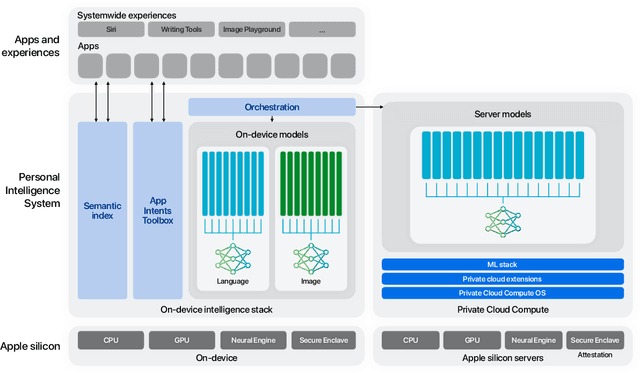


We present foundation language models developed to power Apple Intelligence features, including a ~3 billion parameter model designed to run efficiently on devices and a large server-based language model designed for Private Cloud Compute. These models are designed to perform a wide range of tasks efficiently, accurately, and responsibly. This report describes the model architecture, the data used to train the model, the training process, how the models are optimized for inference, and the evaluation results. We highlight our focus on Responsible AI and how the principles are applied throughout the model development.
MM1: Methods, Analysis & Insights from Multimodal LLM Pre-training
Mar 22, 2024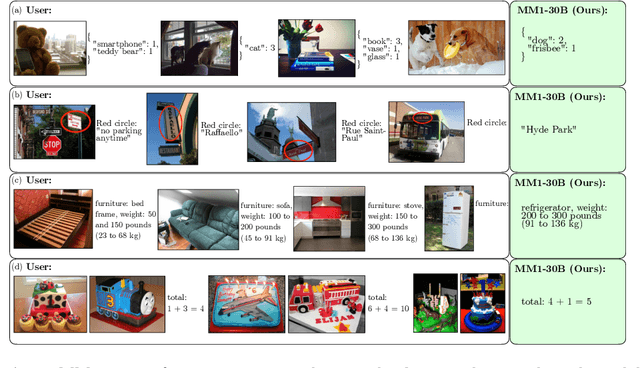
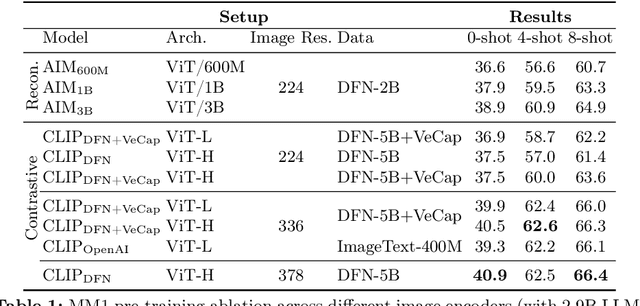
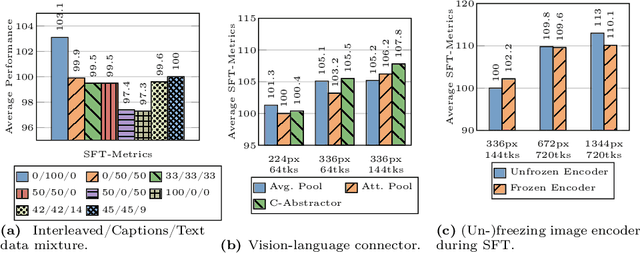
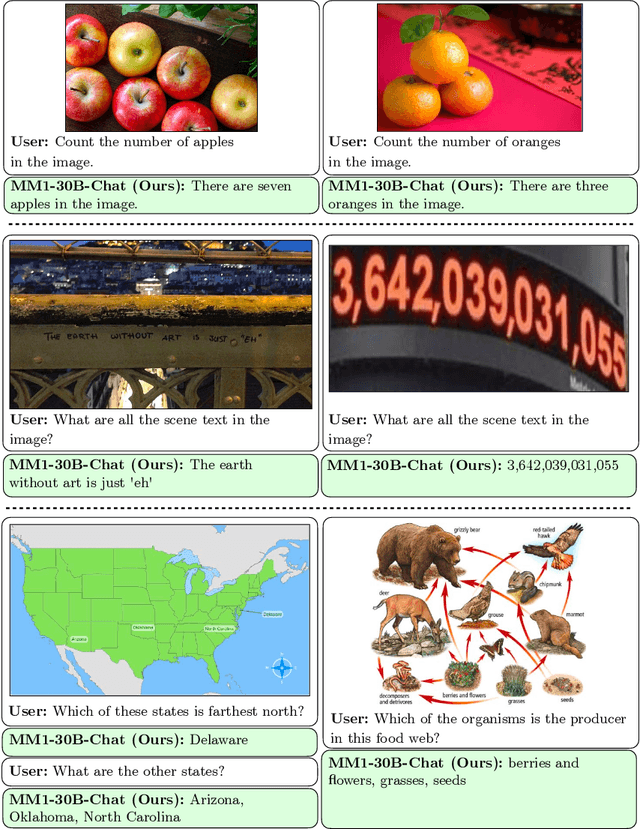
In this work, we discuss building performant Multimodal Large Language Models (MLLMs). In particular, we study the importance of various architecture components and data choices. Through careful and comprehensive ablations of the image encoder, the vision language connector, and various pre-training data choices, we identified several crucial design lessons. For example, we demonstrate that for large-scale multimodal pre-training using a careful mix of image-caption, interleaved image-text, and text-only data is crucial for achieving state-of-the-art (SOTA) few-shot results across multiple benchmarks, compared to other published pre-training results. Further, we show that the image encoder together with image resolution and the image token count has substantial impact, while the vision-language connector design is of comparatively negligible importance. By scaling up the presented recipe, we build MM1, a family of multimodal models up to 30B parameters, including both dense models and mixture-of-experts (MoE) variants, that are SOTA in pre-training metrics and achieve competitive performance after supervised fine-tuning on a range of established multimodal benchmarks. Thanks to large-scale pre-training, MM1 enjoys appealing properties such as enhanced in-context learning, and multi-image reasoning, enabling few-shot chain-of-thought prompting.