 Add to Chrome
 Add to Firefox
 Add to Edge
Beyond a Single Extractor: Re-thinking HTML-to-Text Extraction for LLM Pretraining
Feb 23, 2026
One of the first pre-processing steps for constructing web-scale LLM pretraining datasets involves extracting text from HTML. Despite the immense diversity of web content, existing open-source datasets predominantly apply a single fixed extractor to all webpages. In this work, we investigate whether this practice leads to suboptimal coverage and utilization of Internet data. We first show that while different extractors may lead to similar model performance on standard language understanding tasks, the pages surviving a fixed filtering pipeline can differ substantially. This suggests a simple intervention: by taking a Union over different extractors, we can increase the token yield of DCLM-Baseline by up to 71% while maintaining benchmark performance. We further show that for structured content such as tables and code blocks, extractor choice can significantly impact downstream task performance, with differences of up to 10 percentage points (p.p.) on WikiTQ and 3 p.p. on HumanEval.

Apple Intelligence Foundation Language Models
Jul 29, 2024
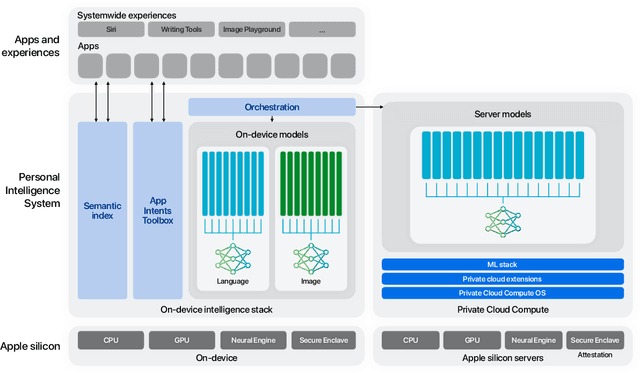


We present foundation language models developed to power Apple Intelligence features, including a ~3 billion parameter model designed to run efficiently on devices and a large server-based language model designed for Private Cloud Compute. These models are designed to perform a wide range of tasks efficiently, accurately, and responsibly. This report describes the model architecture, the data used to train the model, the training process, how the models are optimized for inference, and the evaluation results. We highlight our focus on Responsible AI and how the principles are applied throughout the model development.