 Add to Chrome
 Add to Firefox
 Add to Edge
Beyond a Single Extractor: Re-thinking HTML-to-Text Extraction for LLM Pretraining
Feb 23, 2026
One of the first pre-processing steps for constructing web-scale LLM pretraining datasets involves extracting text from HTML. Despite the immense diversity of web content, existing open-source datasets predominantly apply a single fixed extractor to all webpages. In this work, we investigate whether this practice leads to suboptimal coverage and utilization of Internet data. We first show that while different extractors may lead to similar model performance on standard language understanding tasks, the pages surviving a fixed filtering pipeline can differ substantially. This suggests a simple intervention: by taking a Union over different extractors, we can increase the token yield of DCLM-Baseline by up to 71% while maintaining benchmark performance. We further show that for structured content such as tables and code blocks, extractor choice can significantly impact downstream task performance, with differences of up to 10 percentage points (p.p.) on WikiTQ and 3 p.p. on HumanEval.

Intelligence per Watt: Measuring Intelligence Efficiency of Local AI
Nov 14, 2025Large language model (LLM) queries are predominantly processed by frontier models in centralized cloud infrastructure. Rapidly growing demand strains this paradigm, and cloud providers struggle to scale infrastructure at pace. Two advances enable us to rethink this paradigm: small LMs (<=20B active parameters) now achieve competitive performance to frontier models on many tasks, and local accelerators (e.g., Apple M4 Max) run these models at interactive latencies. This raises the question: can local inference viably redistribute demand from centralized infrastructure? Answering this requires measuring whether local LMs can accurately answer real-world queries and whether they can do so efficiently enough to be practical on power-constrained devices (i.e., laptops). We propose intelligence per watt (IPW), task accuracy divided by unit of power, as a metric for assessing capability and efficiency of local inference across model-accelerator pairs. We conduct a large-scale empirical study across 20+ state-of-the-art local LMs, 8 accelerators, and a representative subset of LLM traffic: 1M real-world single-turn chat and reasoning queries. For each query, we measure accuracy, energy, latency, and power. Our analysis reveals $3$ findings. First, local LMs can accurately answer 88.7% of single-turn chat and reasoning queries with accuracy varying by domain. Second, from 2023-2025, IPW improved 5.3x and local query coverage rose from 23.2% to 71.3%. Third, local accelerators achieve at least 1.4x lower IPW than cloud accelerators running identical models, revealing significant headroom for optimization. These findings demonstrate that local inference can meaningfully redistribute demand from centralized infrastructure, with IPW serving as the critical metric for tracking this transition. We release our IPW profiling harness for systematic intelligence-per-watt benchmarking.
Aya Dataset: An Open-Access Collection for Multilingual Instruction Tuning
Feb 09, 2024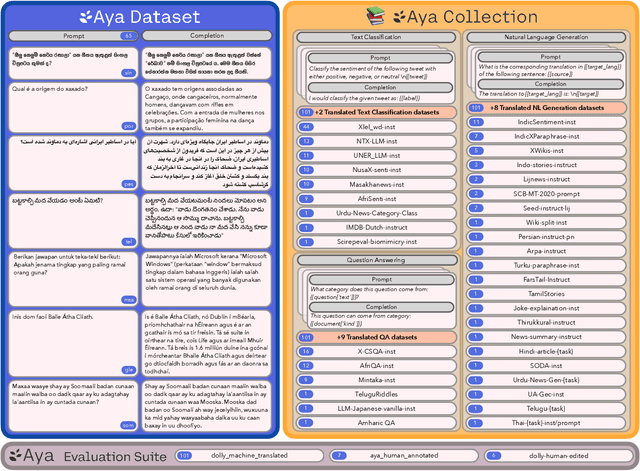


Datasets are foundational to many breakthroughs in modern artificial intelligence. Many recent achievements in the space of natural language processing (NLP) can be attributed to the finetuning of pre-trained models on a diverse set of tasks that enables a large language model (LLM) to respond to instructions. Instruction fine-tuning (IFT) requires specifically constructed and annotated datasets. However, existing datasets are almost all in the English language. In this work, our primary goal is to bridge the language gap by building a human-curated instruction-following dataset spanning 65 languages. We worked with fluent speakers of languages from around the world to collect natural instances of instructions and completions. Furthermore, we create the most extensive multilingual collection to date, comprising 513 million instances through templating and translating existing datasets across 114 languages. In total, we contribute four key resources: we develop and open-source the Aya Annotation Platform, the Aya Dataset, the Aya Collection, and the Aya Evaluation Suite. The Aya initiative also serves as a valuable case study in participatory research, involving collaborators from 119 countries. We see this as a valuable framework for future research collaborations that aim to bridge gaps in resources.
Adapting to the Low-Resource Double-Bind: Investigating Low-Compute Methods on Low-Resource African Languages
Mar 29, 2023

Many natural language processing (NLP) tasks make use of massively pre-trained language models, which are computationally expensive. However, access to high computational resources added to the issue of data scarcity of African languages constitutes a real barrier to research experiments on these languages. In this work, we explore the applicability of low-compute approaches such as language adapters in the context of this low-resource double-bind. We intend to answer the following question: do language adapters allow those who are doubly bound by data and compute to practically build useful models? Through fine-tuning experiments on African languages, we evaluate their effectiveness as cost-effective approaches to low-resource African NLP. Using solely free compute resources, our results show that language adapters achieve comparable performances to massive pre-trained language models which are heavy on computational resources. This opens the door to further experimentation and exploration on full-extent of language adapters capacities.