 Add to Chrome
 Add to Firefox
 Add to Edge
UltraX: Refining Pre-Training Data at Scale with Adaptive Programmatic Editing
Jul 09, 2026
As available training data approaches its physical limit, gains from Scaling Laws have begun to diminish. Consequently, improving Large Language Models (LLMs) now depends less on data expansion and more on higher-quality data utilization. However, in the context of large-scale corpora, existing refinement methodologies face significant limitations in quality, efficiency, and reliability: Rule-based approaches are constrained by fixed heuristics and struggle with instance-level variations; LLM-based approaches improve quality but fail to meet the efficiency and reliability requirements of large-scale data processing. To address these challenges, we propose UltraX, a function-calling refinement framework for large-scale pre-training data that completes the editing function space by introducing insertion in addition to deletion and modification, enabling fine-grained instance-level editing. Specifically, UltraX builds a reliable program-supervision generation pipeline. In this pipeline, dataset-adaptive prompt optimization first guides an expert LLM to produce high-quality end-to-end refined texts, and Line Alignment Mapping and Dynamic Context Replacement then convert original-refined text pairs into structured program supervision. Meanwhile, UltraX improves supervision quality and stabilizes the training distribution with low-confidence example filtering and ratio-controlled sampling by operation combination. During inference and execution, it normalizes and validates model outputs through sliding-window prediction, global operation aggregation, and systematic post-processing, improving the stability and reliability of large-scale execution. Experiments show that UltraX achieves the highest average performance across all corpora and also matches or surpasses baselines with fewer training tokens, demonstrating stronger data efficiency and refinement reliability.

Uncovering Entity Identity Confusion in Multimodal Knowledge Editing
May 07, 2026Multimodal knowledge editing (MKE) aims to correct the internal knowledge of large vision-language models after deployment, yet the behavioral patterns of post-edit models remain underexplored. In this paper, we identify a systemic failure mode in edited models, termed Entity Identity Confusion (EIC): edited models exhibit an absurd behavior where text-only queries about the original entity's identity unexpectedly return information about the new entity. To rigorously investigate EIC, we construct EC-Bench, a diagnostic benchmark that directly probes how image-entity bindings shift before and after editing. Our analysis reveals that EIC stems from existing methods failing to distinguish between Image-Entity (I-E) binding and Entity-Entity (E-E) relational knowledge in the model, causing models to overfit E-E associations as a shortcut: the image is still perceived as the original entity, with the new entity's name serving only as a spurious identity label. We further explore potential mitigation strategies, showing that constraining edits to the model's I-E processing stage encourages edits to act more faithfully on I-E binding, thereby substantially reducing EIC. Based on these findings, we discuss principled desiderata for faithful MKE and provide methodological guidance for future research.
Autonomous Navigation of an Ultrasound Probe Towards Standard Scan Planes with Deep Reinforcement Learning
Mar 01, 2021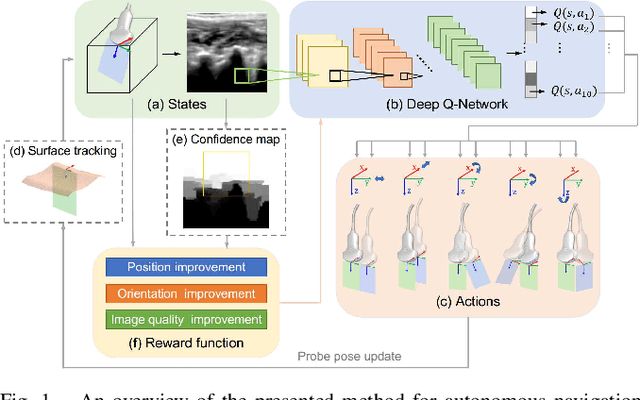

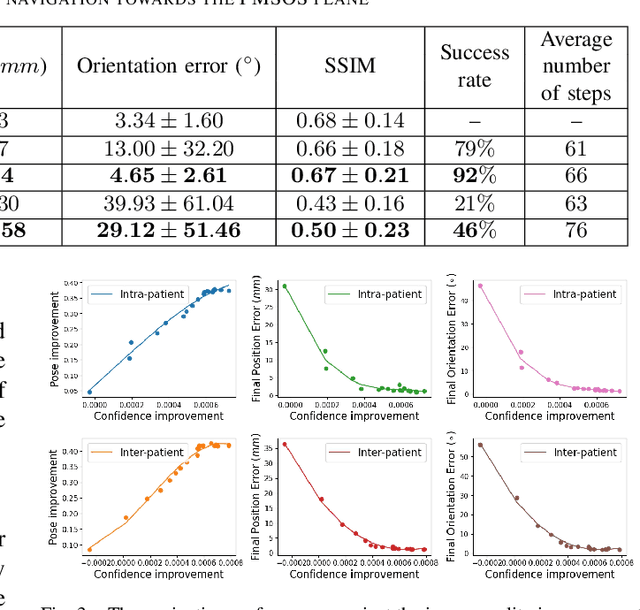

Autonomous ultrasound (US) acquisition is an important yet challenging task, as it involves interpretation of the highly complex and variable images and their spatial relationships. In this work, we propose a deep reinforcement learning framework to autonomously control the 6-D pose of a virtual US probe based on real-time image feedback to navigate towards the standard scan planes under the restrictions in real-world US scans. Furthermore, we propose a confidence-based approach to encode the optimization of image quality in the learning process. We validate our method in a simulation environment built with real-world data collected in the US imaging of the spine. Experimental results demonstrate that our method can perform reproducible US probe navigation towards the standard scan plane with an accuracy of $4.91mm/4.65^\circ$ in the intra-patient setting, and accomplish the task in the intra- and inter-patient settings with a success rate of $92\%$ and $46\%$, respectively. The results also show that the introduction of image quality optimization in our method can effectively improve the navigation performance.