 Add to Chrome
 Add to Firefox
 Add to Edge
UNIVERSE: Unified Video Action Models for Autonomous Driving with Flexible Mask-Modulated Modality Generation
Jul 06, 2026
World Action Models (WAMs) have shown strong potential for improving action generalization in autonomous driving by using future video prediction as dense supervision for scene dynamics and temporal causality. However, it remains unclear which architecture better transfers video-modeling benefits to trajectory generation. Existing cascaded or dual-DiT designs separate video imagination from action prediction, weakening the transfer of video-learned world dynamics to the trajectory branch: the action model may still overfit dataset-specific driving priors, while the video model only indirectly regularizes planning. We propose UNIVERSE, a unified video-action model built upon a single mask-modulated Diffusion Transformer. By co-training future video latents and ego-trajectory tokens within shared generative parameters, UNIVERSE allows dense video supervision to directly shape trajectory denoising, leading to stronger cross-domain action generalization. To ensure causal validity and efficient deployment, we introduce a Modality-Decoupling Visibility Mask, which shares historical context across modalities while blocking mutual attention between future video and trajectory tokens. This prevents future-target leakage and enables trajectory-only inference by removing future-video denoising at test time, achieving a $4.3\times$ speedup over joint video-action rollout while maintaining comparable planning accuracy. The same model also supports video-only and joint video-action rollouts. Experiments show that UNIVERSE achieves 91.0 PDMS on NAVSIM (vs. 89.6 for the Two-DiT variant), and demonstrates strong zero-shot transfer to nuScenes and Bench2Drive without fine-tuning, while ablations confirm the importance of single-DiT unification, video co-training, and mask-based modality decoupling.

DriveVA: Video Action Models are Zero-Shot Drivers
Apr 05, 2026Generalization is a central challenge in autonomous driving, as real-world deployment requires robust performance under unseen scenarios, sensor domains, and environmental conditions. Recent world-model-based planning methods have shown strong capabilities in scene understanding and multi-modal future prediction, yet their generalization across datasets and sensor configurations remains limited. In addition, their loosely coupled planning paradigm often leads to poor video-trajectory consistency during visual imagination. To overcome these limitations, we propose DriveVA, a novel autonomous driving world model that jointly decodes future visual forecasts and action sequences in a shared latent generative process. DriveVA inherits rich priors on motion dynamics and physical plausibility from well-pretrained large-scale video generation models to capture continuous spatiotemporal evolution and causal interaction patterns. To this end, DriveVA employs a DiT-based decoder to jointly predict future action sequences (trajectories) and videos, enabling tighter alignment between planning and scene evolution. We also introduce a video continuation strategy to strengthen long-duration rollout consistency. DriveVA achieves an impressive closed-loop performance of 90.9 PDM score on the challenge NAVSIM. Extensive experiments also demonstrate the zero-shot capability and cross-domain generalization of DriveVA, which reduces average L2 error and collision rate by 78.9% and 83.3% on nuScenes and 52.5% and 52.4% on the Bench2drive built on CARLA v2 compared with the state-of-the-art world-model-based planner.
MindDrive: A Vision-Language-Action Model for Autonomous Driving via Online Reinforcement Learning
Dec 16, 2025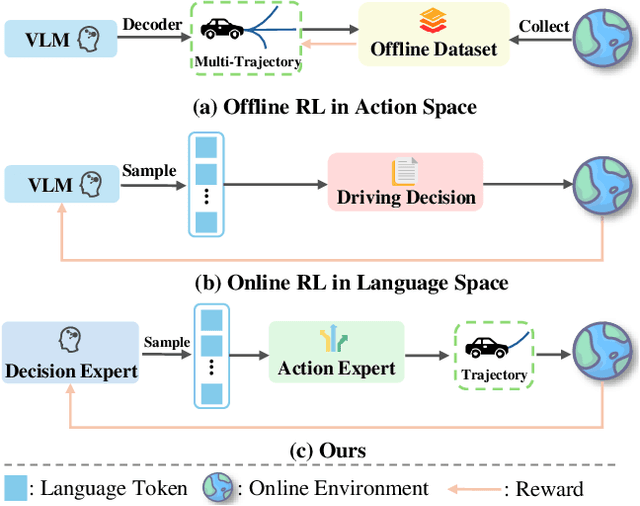
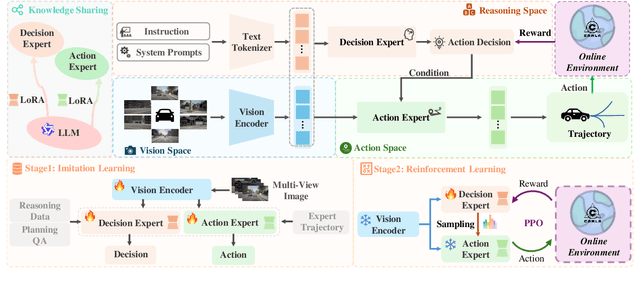
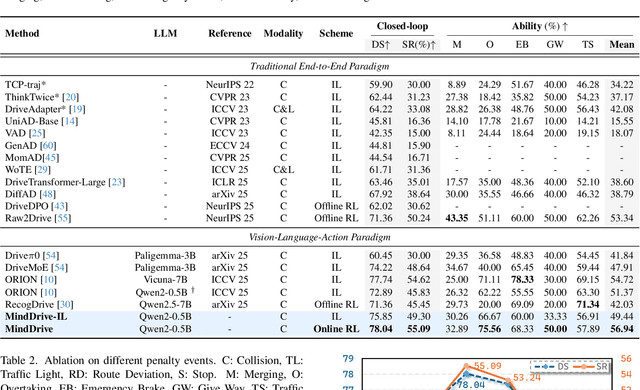
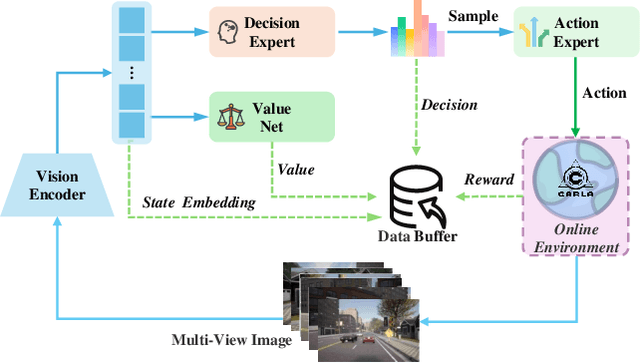
Current Vision-Language-Action (VLA) paradigms in autonomous driving primarily rely on Imitation Learning (IL), which introduces inherent challenges such as distribution shift and causal confusion. Online Reinforcement Learning offers a promising pathway to address these issues through trial-and-error learning. However, applying online reinforcement learning to VLA models in autonomous driving is hindered by inefficient exploration in continuous action spaces. To overcome this limitation, we propose MindDrive, a VLA framework comprising a large language model (LLM) with two distinct sets of LoRA parameters. The one LLM serves as a Decision Expert for scenario reasoning and driving decision-making, while the other acts as an Action Expert that dynamically maps linguistic decisions into feasible trajectories. By feeding trajectory-level rewards back into the reasoning space, MindDrive enables trial-and-error learning over a finite set of discrete linguistic driving decisions, instead of operating directly in a continuous action space. This approach effectively balances optimal decision-making in complex scenarios, human-like driving behavior, and efficient exploration in online reinforcement learning. Using the lightweight Qwen-0.5B LLM, MindDrive achieves Driving Score (DS) of 78.04 and Success Rate (SR) of 55.09% on the challenging Bench2Drive benchmark. To the best of our knowledge, this is the first work to demonstrate the effectiveness of online reinforcement learning for the VLA model in autonomous driving.
ORION: A Holistic End-to-End Autonomous Driving Framework by Vision-Language Instructed Action Generation
Mar 25, 2025End-to-end (E2E) autonomous driving methods still struggle to make correct decisions in interactive closed-loop evaluation due to limited causal reasoning capability. Current methods attempt to leverage the powerful understanding and reasoning abilities of Vision-Language Models (VLMs) to resolve this dilemma. However, the problem is still open that few VLMs for E2E methods perform well in the closed-loop evaluation due to the gap between the semantic reasoning space and the purely numerical trajectory output in the action space. To tackle this issue, we propose ORION, a holistic E2E autonomous driving framework by vision-language instructed action generation. ORION uniquely combines a QT-Former to aggregate long-term history context, a Large Language Model (LLM) for driving scenario reasoning, and a generative planner for precision trajectory prediction. ORION further aligns the reasoning space and the action space to implement a unified E2E optimization for both visual question-answering (VQA) and planning tasks. Our method achieves an impressive closed-loop performance of 77.74 Driving Score (DS) and 54.62% Success Rate (SR) on the challenge Bench2Drive datasets, which outperforms state-of-the-art (SOTA) methods by a large margin of 14.28 DS and 19.61% SR.