 Add to Chrome
 Add to Firefox
 Add to Edge
On the Possibilities of AI-Generated Text Detection
Apr 10, 2023
Our work focuses on the challenge of detecting outputs generated by Large Language Models (LLMs) from those generated by humans. The ability to distinguish between the two is of utmost importance in numerous applications. However, the possibility and impossibility of such discernment have been subjects of debate within the community. Therefore, a central question is whether we can detect AI-generated text and, if so, when. In this work, we provide evidence that it should almost always be possible to detect the AI-generated text unless the distributions of human and machine generated texts are exactly the same over the entire support. This observation follows from the standard results in information theory and relies on the fact that if the machine text is becoming more like a human, we need more samples to detect it. We derive a precise sample complexity bound of AI-generated text detection, which tells how many samples are needed to detect. This gives rise to additional challenges of designing more complicated detectors that take in n samples to detect than just one, which is the scope of future research on this topic. Our empirical evaluations support our claim about the existence of better detectors demonstrating that AI-Generated text detection should be achievable in the majority of scenarios. Our results emphasize the importance of continued research in this area

CrossLoc3D: Aerial-Ground Cross-Source 3D Place Recognition
Mar 31, 2023We present CrossLoc3D, a novel 3D place recognition method that solves a large-scale point matching problem in a cross-source setting. Cross-source point cloud data corresponds to point sets captured by depth sensors with different accuracies or from different distances and perspectives. We address the challenges in terms of developing 3D place recognition methods that account for the representation gap between points captured by different sources. Our method handles cross-source data by utilizing multi-grained features and selecting convolution kernel sizes that correspond to most prominent features. Inspired by the diffusion models, our method uses a novel iterative refinement process that gradually shifts the embedding spaces from different sources to a single canonical space for better metric learning. In addition, we present CS-Campus3D, the first 3D aerial-ground cross-source dataset consisting of point cloud data from both aerial and ground LiDAR scans. The point clouds in CS-Campus3D have representation gaps and other features like different views, point densities, and noise patterns. We show that our CrossLoc3D algorithm can achieve an improvement of 4.74% - 15.37% in terms of the top 1 average recall on our CS-Campus3D benchmark and achieves performance comparable to state-of-the-art 3D place recognition method on the Oxford RobotCar. We will release the code and CS-Campus3D benchmark.
TMO: Textured Mesh Acquisition of Objects with a Mobile Device by using Differentiable Rendering
Mar 27, 2023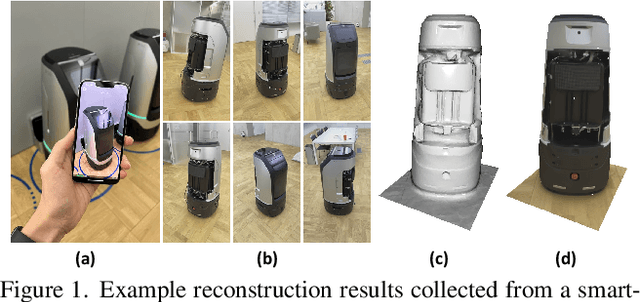
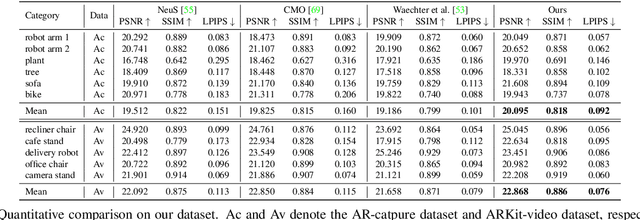
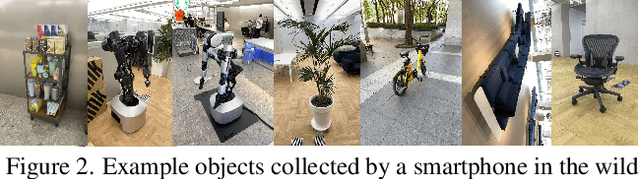

We present a new pipeline for acquiring a textured mesh in the wild with a single smartphone which offers access to images, depth maps, and valid poses. Our method first introduces an RGBD-aided structure from motion, which can yield filtered depth maps and refines camera poses guided by corresponding depth. Then, we adopt the neural implicit surface reconstruction method, which allows for high-quality mesh and develops a new training process for applying a regularization provided by classical multi-view stereo methods. Moreover, we apply a differentiable rendering to fine-tune incomplete texture maps and generate textures which are perceptually closer to the original scene. Our pipeline can be applied to any common objects in the real world without the need for either in-the-lab environments or accurate mask images. We demonstrate results of captured objects with complex shapes and validate our method numerically against existing 3D reconstruction and texture mapping methods.
VERN: Vegetation-aware Robot Navigation in Dense Unstructured Outdoor Environments
Mar 25, 2023We propose a novel method for autonomous legged robot navigation in densely vegetated environments with a variety of pliable/traversable and non-pliable/untraversable vegetation. We present a novel few-shot learning classifier that can be trained on a few hundred RGB images to differentiate flora that can be navigated through, from the ones that must be circumvented. Using the vegetation classification and 2D lidar scans, our method constructs a vegetation-aware traversability cost map that accurately represents the pliable and non-pliable obstacles with lower, and higher traversability costs, respectively. Our cost map construction accounts for misclassifications of the vegetation and further lowers the risk of collisions, freezing and entrapment in vegetation during navigation. Furthermore, we propose holonomic recovery behaviors for the robot for scenarios where it freezes, or gets physically entrapped in dense, pliable vegetation. We demonstrate our method on a Boston Dynamics Spot robot in real-world unstructured environments with sparse and dense tall grass, bushes, trees, etc. We observe an increase of 25-90% in success rates, 10-90% decrease in freezing rate, and up to 65% decrease in the false positive rate compared to existing methods.
PACE: Data-Driven Virtual Agent Interaction in Dense and Cluttered Environments
Mar 24, 2023We present PACE, a novel method for modifying motion-captured virtual agents to interact with and move throughout dense, cluttered 3D scenes. Our approach changes a given motion sequence of a virtual agent as needed to adjust to the obstacles and objects in the environment. We first take the individual frames of the motion sequence most important for modeling interactions with the scene and pair them with the relevant scene geometry, obstacles, and semantics such that interactions in the agents motion match the affordances of the scene (e.g., standing on a floor or sitting in a chair). We then optimize the motion of the human by directly altering the high-DOF pose at each frame in the motion to better account for the unique geometric constraints of the scene. Our formulation uses novel loss functions that maintain a realistic flow and natural-looking motion. We compare our method with prior motion generating techniques and highlight the benefits of our method with a perceptual study and physical plausibility metrics. Human raters preferred our method over the prior approaches. Specifically, they preferred our method 57.1% of the time versus the state-of-the-art method using existing motions, and 81.0% of the time versus a state-of-the-art motion synthesis method. Additionally, our method performs significantly higher on established physical plausibility and interaction metrics. Specifically, we outperform competing methods by over 1.2% in terms of the non-collision metric and by over 18% in terms of the contact metric. We have integrated our interactive system with Microsoft HoloLens and demonstrate its benefits in real-world indoor scenes. Our project website is available at https://gamma.umd.edu/pace/.
Dynamic EM Ray Tracing for Large Urban Scenes with Multiple Receivers
Mar 19, 2023Radio applications are increasingly being used in urban environments for cellular radio systems and safety applications that use vehicle-vehicle, and vehicle-to-infrastructure. We present a novel ray tracing-based radio propagation algorithm that can handle large urban scenes with hundreds or thousands of dynamic objects and receivers. Our approach is based on the use of coherence-based techniques that exploit spatial and temporal coherence for efficient wireless propagation and radio network planning. Our formulation also utilizes channel coherence which is used to determine the effectiveness of the propagation model within a certain time in dynamically generated paths; and spatial consistency which is used to estimate the similarity and accuracy of changes in a dynamic environment with varying propagation models and blocking obstacles. We highlight the performance of our simulator in large urban traffic scenes with an area of 2*2 km^2 and more than 10,000 users and devices. We evaluate the accuracy by comparing the results with discrete model simulations performed using WinProp. In practice, our approach scales linearly with the area of the urban environment and the number of dynamic obstacles or receivers.
DS-MPEPC: Safe and Deadlock-Avoiding Robot Navigation in Cluttered Dynamic Scenes
Mar 17, 2023We present an algorithm for safe robot navigation in complex dynamic environments using a variant of model predictive equilibrium point control. We use an optimization formulation to navigate robots gracefully in dynamic environments by optimizing over a trajectory cost function at each timestep. We present a novel trajectory cost formulation that significantly reduces the conservative and deadlock behaviors and generates smooth trajectories. In particular, we propose a new collision probability function that effectively captures the risk associated with a given configuration and the time to avoid collisions based on the velocity direction. Moreover, we propose a terminal state cost based on the expected time-to-goal and time-to-collision values that helps in avoiding trajectories that could result in deadlock. We evaluate our cost formulation in multiple simulated and real-world scenarios, including narrow corridors with dynamic obstacles, and observe significantly improved navigation behavior and reduced deadlocks as compared to prior methods.
Synthetic-to-Real Domain Adaptation for Action Recognition: A Dataset and Baseline Performances
Mar 17, 2023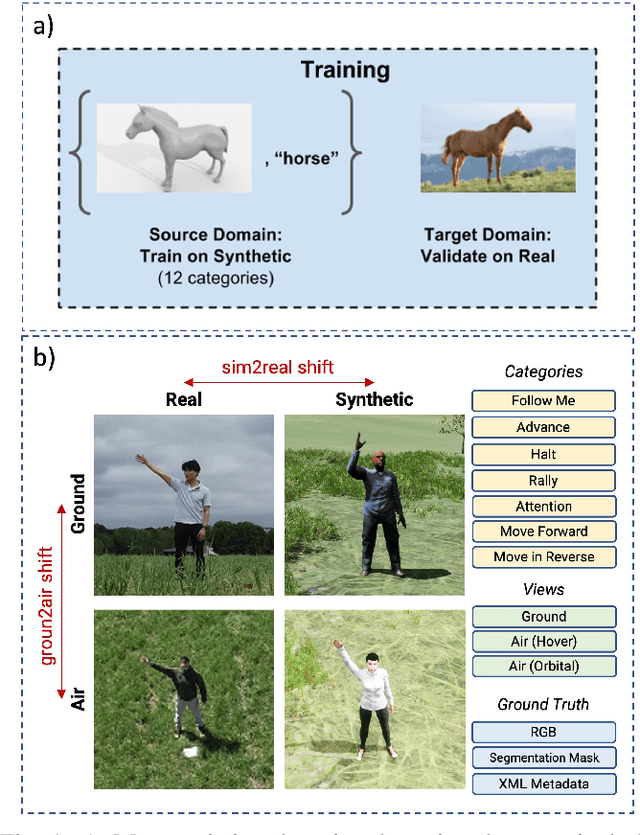
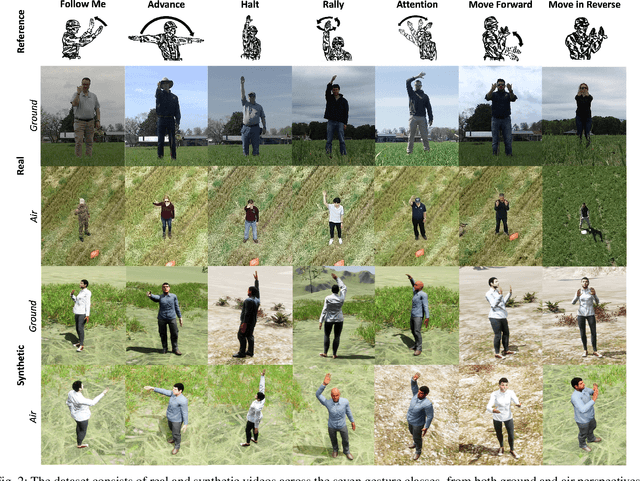
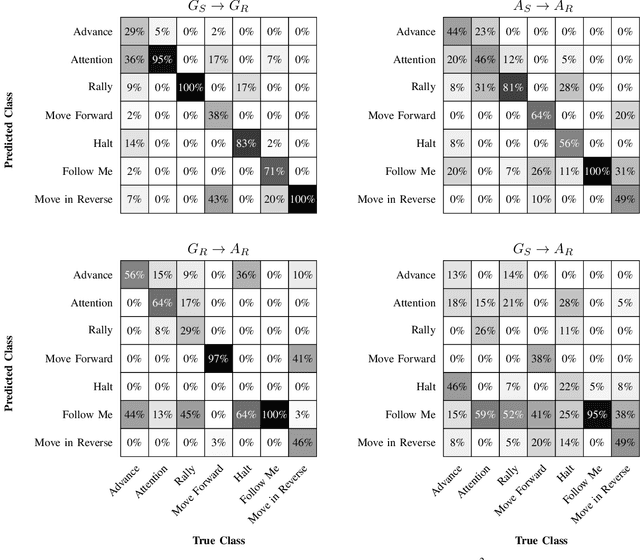
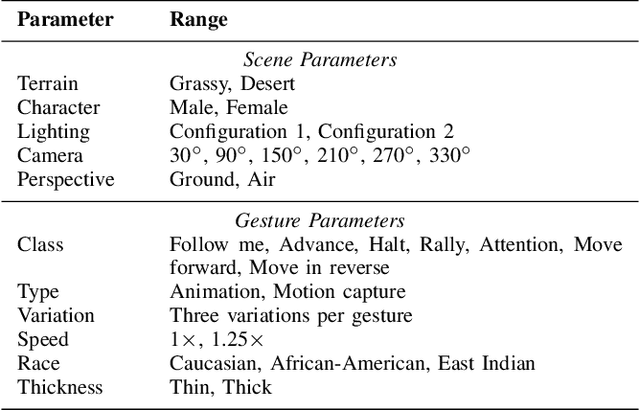
Human action recognition is a challenging problem, particularly when there is high variability in factors such as subject appearance, backgrounds and viewpoint. While deep neural networks (DNNs) have been shown to perform well on action recognition tasks, they typically require large amounts of high-quality labeled data to achieve robust performance across a variety of conditions. Synthetic data has shown promise as a way to avoid the substantial costs and potential ethical concerns associated with collecting and labeling enormous amounts of data in the real-world. However, synthetic data may differ from real data in important ways. This phenomenon, known as \textit{domain shift}, can limit the utility of synthetic data in robotics applications. To mitigate the effects of domain shift, substantial effort is being dedicated to the development of domain adaptation (DA) techniques. Yet, much remains to be understood about how best to develop these techniques. In this paper, we introduce a new dataset called Robot Control Gestures (RoCoG-v2). The dataset is composed of both real and synthetic videos from seven gesture classes, and is intended to support the study of synthetic-to-real domain shift for video-based action recognition. Our work expands upon existing datasets by focusing the action classes on gestures for human-robot teaming, as well as by enabling investigation of domain shift in both ground and aerial views. We present baseline results using state-of-the-art action recognition and domain adaptation algorithms and offer initial insight on tackling the synthetic-to-real and ground-to-air domain shifts.
Real-Time Decentralized Navigation of Nonholonomic Agents Using Shifted Yielding Areas
Mar 16, 2023We present a lightweight, decentralized algorithm for navigating multiple nonholonomic agents through challenging environments with narrow passages. Our key idea is to allow agents to yield to each other in large open areas instead of narrow passages, to increase the success rate of conventional decentralized algorithms. At pre-processing time, our method computes a medial axis for the freespace. A reference trajectory is then computed and projected onto the medial axis for each agent. During run time, when an agent senses other agents moving in the opposite direction, our algorithm uses the medial axis to estimate a Point of Impact (POI) as well as the available area around the POI. If the area around the POI is not large enough for yielding behaviors to be successful, we shift the POI to nearby large areas by modulating the agent's reference trajectory and traveling speed. We evaluate our method on a row of 4 environments with up to 15 robots, and we find our method incurs a marginal computational overhead of 10-30 ms on average, achieving real-time performance. Afterward, our planned reference trajectories can be tracked using local navigation algorithms to achieve up to a $100\%$ higher success rate over local navigation algorithms alone.
Aerial Diffusion: Text Guided Ground-to-Aerial View Translation from a Single Image using Diffusion Models
Mar 15, 2023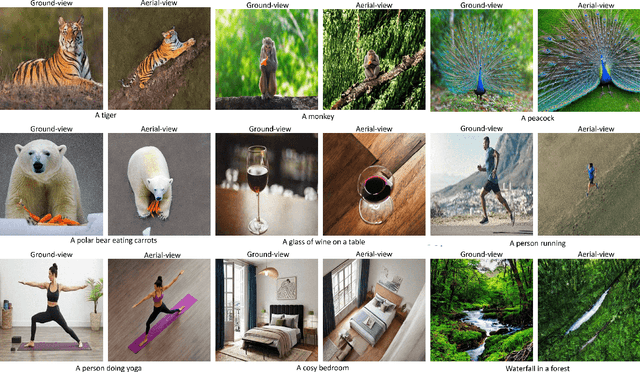
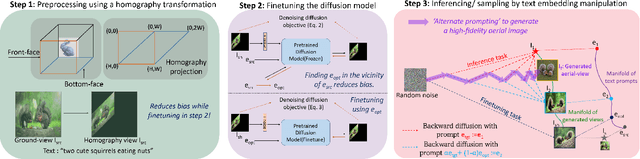
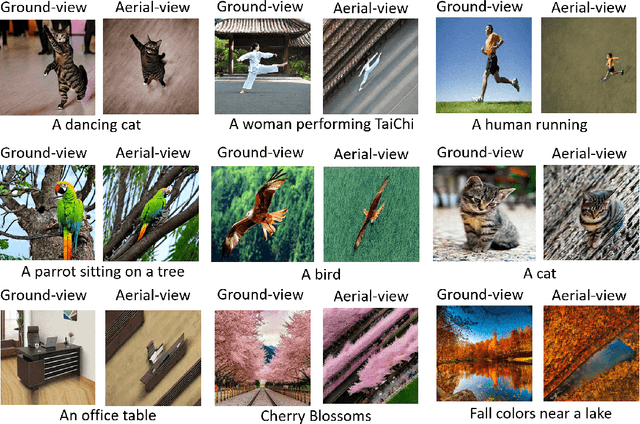
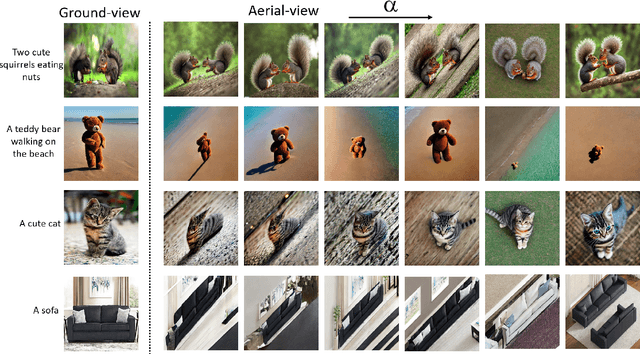
We present a novel method, Aerial Diffusion, for generating aerial views from a single ground-view image using text guidance. Aerial Diffusion leverages a pretrained text-image diffusion model for prior knowledge. We address two main challenges corresponding to domain gap between the ground-view and the aerial view and the two views being far apart in the text-image embedding manifold. Our approach uses a homography inspired by inverse perspective mapping prior to finetuning the pretrained diffusion model. Additionally, using the text corresponding to the ground-view to finetune the model helps us capture the details in the ground-view image at a relatively low bias towards the ground-view image. Aerial Diffusion uses an alternating sampling strategy to compute the optimal solution on complex high-dimensional manifold and generate a high-fidelity (w.r.t. ground view) aerial image. We demonstrate the quality and versatility of Aerial Diffusion on a plethora of images from various domains including nature, human actions, indoor scenes, etc. We qualitatively prove the effectiveness of our method with extensive ablations and comparisons. To the best of our knowledge, Aerial Diffusion is the first approach that performs ground-to-aerial translation in an unsupervised manner.