 Add to Chrome
 Add to Firefox
 Add to Edge
InSpace: Structure-Aware 3D Indoor Scene Generation from a Single 360° Image
Jul 04, 2026
Recent advances in single image-to-3D generation have enabled high-quality asset synthesis, yet extending these capabilities to indoor scene generation remains challenging. Existing methods focus on asset-level generation while neglecting the structural layout, which is essential for downstream applications and serves as the spatial anchor for grounding assets. However, a single image with a limited field of view lacks the spatial coverage to recover a coherent global layout. To this end, we use a 360° image represented in equirectangular projection (ERP) and propose InSpace, a structure-aware framework for 3D indoor scene generation. InSpace comprises three stages: (1) estimating partial scene geometry as spatial priors, (2) generating coarse scene structure with view-selective cross-attention, and (3) producing detailed layout and asset geometry with textures through a global-local hybrid attention, using flow matching. We also propose ERP-FRONT, a paired ERP-Image-to-3D indoor scene dataset based on 3D-FRONT. Experiments show that InSpace generates complete 3D indoor scenes with structural layout, along with separate textured assets from a single ERP image, achieving strong performance across 3D and 2D metrics. Project Page: https://kookie12.github.io/InSpace-Project-Page/

EDM: Equirectangular Projection-Oriented Dense Kernelized Feature Matching
Feb 28, 2025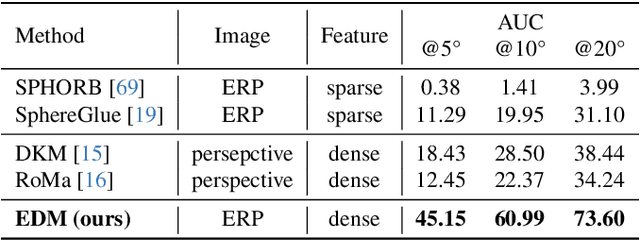
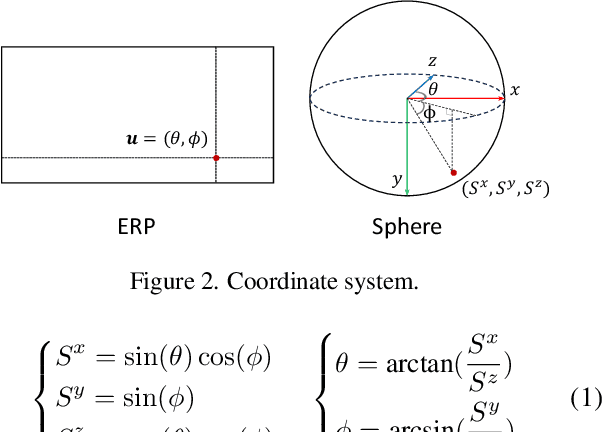
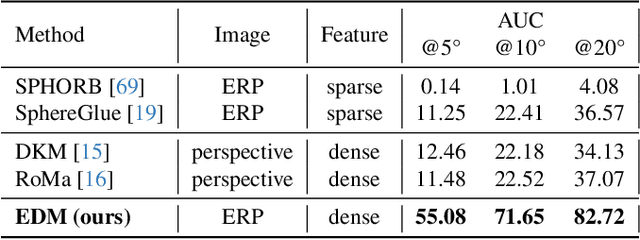
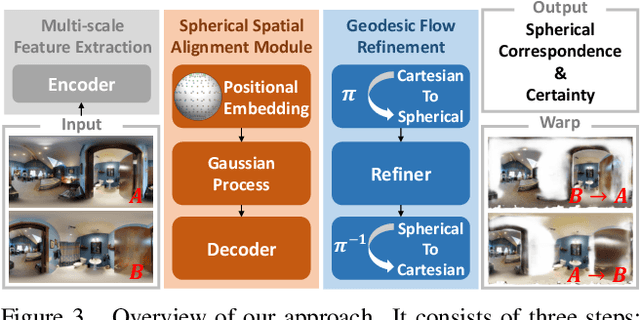
We introduce the first learning-based dense matching algorithm, termed Equirectangular Projection-Oriented Dense Kernelized Feature Matching (EDM), specifically designed for omnidirectional images. Equirectangular projection (ERP) images, with their large fields of view, are particularly suited for dense matching techniques that aim to establish comprehensive correspondences across images. However, ERP images are subject to significant distortions, which we address by leveraging the spherical camera model and geodesic flow refinement in the dense matching method. To further mitigate these distortions, we propose spherical positional embeddings based on 3D Cartesian coordinates of the feature grid. Additionally, our method incorporates bidirectional transformations between spherical and Cartesian coordinate systems during refinement, utilizing a unit sphere to improve matching performance. We demonstrate that our proposed method achieves notable performance enhancements, with improvements of +26.72 and +42.62 in AUC@5{\deg} on the Matterport3D and Stanford2D3D datasets.
TMO: Textured Mesh Acquisition of Objects with a Mobile Device by using Differentiable Rendering
Mar 27, 2023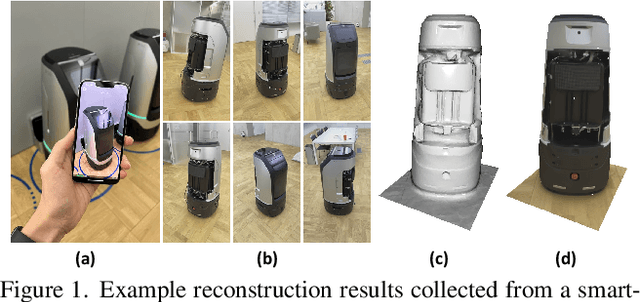
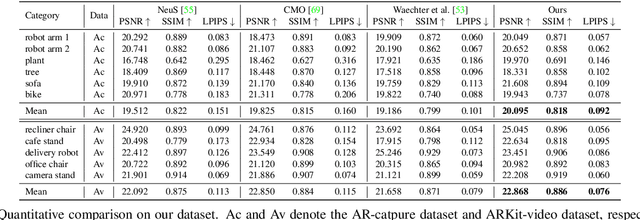
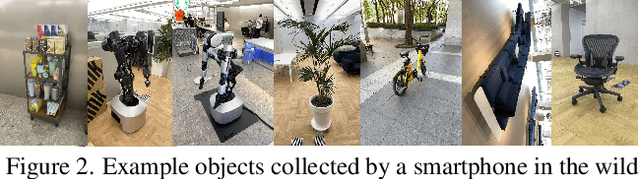

We present a new pipeline for acquiring a textured mesh in the wild with a single smartphone which offers access to images, depth maps, and valid poses. Our method first introduces an RGBD-aided structure from motion, which can yield filtered depth maps and refines camera poses guided by corresponding depth. Then, we adopt the neural implicit surface reconstruction method, which allows for high-quality mesh and develops a new training process for applying a regularization provided by classical multi-view stereo methods. Moreover, we apply a differentiable rendering to fine-tune incomplete texture maps and generate textures which are perceptually closer to the original scene. Our pipeline can be applied to any common objects in the real world without the need for either in-the-lab environments or accurate mask images. We demonstrate results of captured objects with complex shapes and validate our method numerically against existing 3D reconstruction and texture mapping methods.