 Add to Chrome
 Add to Firefox
 Add to Edge
PathScale-R1: Cross-scale Reasoning for Pathological Image Analysis
Jul 26, 2026
Pathological diagnosis is inherently multi-scale, requiring the integration of global tissue architecture at low magnification with cellular morphology at higher magnification. However, existing pathology benchmarks and vision-language models (VLMs) are still largely developed under single-scale settings, limiting their ability to learn clinically meaningful multi-magnification reasoning. Moreover, naively constructed visual question answering (VQA) tasks may be susceptible to text-only or superficial visual shortcuts, leading to unreliable assessments of visual understanding. To address these limitations, we introduce a benchmark and training framework for shortcut-resistant cross-scale pathology reasoning. We design an Adversarial Text-only Screening strategy for semantic reasoning questions and a Structure-controlled Distractor Sampling strategy for visual grounding questions, encouraging models to rely on cross-scale visual evidence. Based on this pipeline, we construct PathScale-VQA, a high-quality cross-scale pathology VQA benchmark with 10,373 multiple-choice questions grounded in 1,368 diagnostic paths across multiple magnification levels. Building on the semantic reasoning set, PathScale-R1 is optimized through Difficulty-driven Reasoning Distillation supervised fine-tuning followed by reinforcement learning with a Scale-aware Reasoning Structure reward, which encourages the use of evidence across magnifications. Extensive experiments demonstrate state-of-the-art performance of PathScale-R1 on cross-scale reasoning tasks and effective transfer to conventional single-scale pathology VQA. Our code is available at https://github.com/iMVR-PL/PathScale-R1.

Enhancing Pathological VLMs with Cross-scale Reasoning
Jun 17, 2026Pathological images are inherently multi-scale, requiring pathologists to integrate evidence from global tissue architecture at low magnification to cellular morphology at higher magnification for accurate diagnosis. While existing pathological datasets for vision-language model (VLM) include various scales, they often lack an explicit cross-scale reasoning objective. This limitation prevents VLMs from capturing essential cross-scale representations and learning evidence-based reasoning. To bridge this gap, we introduce the first cross-scale training and evaluation paradigm that formulates pathology interpretation as multi-magnification reasoning. However, creating such a task reveals a critical challenge: multi-image visual question answering (VQA) is prone to text-only shortcuts, which allow models to guess answers using magnification-dependent artifacts rather than visual evidence. To address this, we propose a leakage-aware curation pipeline that combines adversarial text-only screening with constraint-guided question design. Using this pipeline, we construct Scale-VQA, a high-quality benchmark with 4,685 multiple-choice questions grounded in 2,537 pathology images across multiple magnification levels. Finally, we present ScaleReasoner-R1, a model trained via reinforcement learning to optimize performance on the cross-scale VQA task. ScaleReasoner-R1 achieves state-of-the-art performance on our cross-scale reasoning benchmark and generalizes to SOTA performance on established single-scale benchmarks. Findings suggest that even the limited cross-scale supervision can significantly improve pathological understanding. The code and demos will be open-sourced.
TransReg: Cross-transformer as auto-registration module for multi-view mammogram mass detection
Nov 09, 2023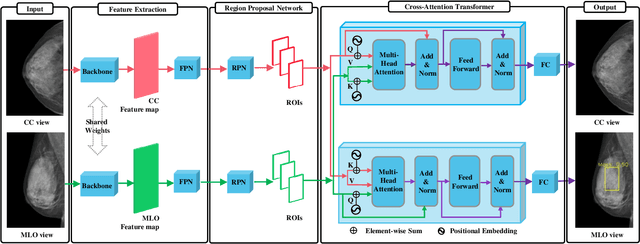
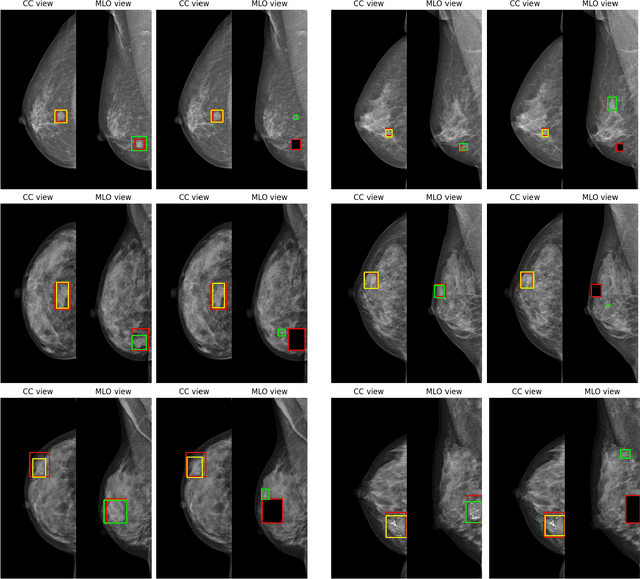

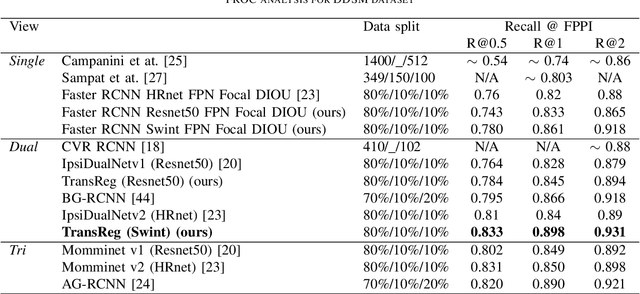
Screening mammography is the most widely used method for early breast cancer detection, significantly reducing mortality rates. The integration of information from multi-view mammograms enhances radiologists' confidence and diminishes false-positive rates since they can examine on dual-view of the same breast to cross-reference the existence and location of the lesion. Inspired by this, we present TransReg, a Computer-Aided Detection (CAD) system designed to exploit the relationship between craniocaudal (CC), and mediolateral oblique (MLO) views. The system includes cross-transformer to model the relationship between the region of interest (RoIs) extracted by siamese Faster RCNN network for mass detection problems. Our work is the first time cross-transformer has been integrated into an object detection framework to model the relation between ipsilateral views. Our experimental evaluation on DDSM and VinDr-Mammo datasets shows that our TransReg, equipped with SwinT as a feature extractor achieves state-of-the-art performance. Specifically, at the false positive rate per image at 0.5, TransReg using SwinT gets a recall at 83.3% for DDSM dataset and 79.7% for VinDr-Mammo dataset. Furthermore, we conduct a comprehensive analysis to demonstrate that cross-transformer can function as an auto-registration module, aligning the masses in dual-view and utilizing this information to inform final predictions. It is a replication diagnostic workflow of expert radiologists