 Add to Chrome
 Add to Firefox
 Add to Edge
From Images to Textual Prompts: Zero-shot VQA with Frozen Large Language Models
Dec 21, 2022
Large language models (LLMs) have demonstrated excellent zero-shot generalization to new language tasks. However, effective utilization of LLMs for zero-shot visual question-answering (VQA) remains challenging, primarily due to the modality disconnection and task disconnection between LLM and VQA task. End-to-end training on vision and language data may bridge the disconnections, but is inflexible and computationally expensive. To address this issue, we propose \emph{Img2Prompt}, a plug-and-play module that provides the prompts that can bridge the aforementioned modality and task disconnections, so that LLMs can perform zero-shot VQA tasks without end-to-end training. In order to provide such prompts, we further employ LLM-agnostic models to provide prompts that can describe image content and self-constructed question-answer pairs, which can effectively guide LLM to perform zero-shot VQA tasks. Img2Prompt offers the following benefits: 1) It can flexibly work with various LLMs to perform VQA. 2)~Without the needing of end-to-end training, it significantly reduces the cost of deploying LLM for zero-shot VQA tasks. 3) It achieves comparable or better performance than methods relying on end-to-end training. For example, we outperform Flamingo~\cite{Deepmind:Flamingo2022} by 5.6\% on VQAv2. On the challenging A-OKVQA dataset, our method even outperforms few-shot methods by as much as 20\%.

Toward Human-Like Evaluation for Natural Language Generation with Error Analysis
Dec 20, 2022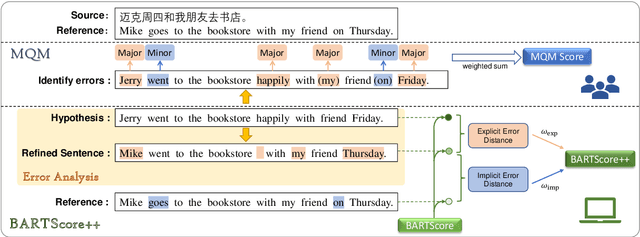
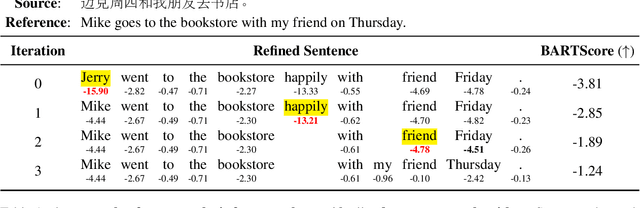
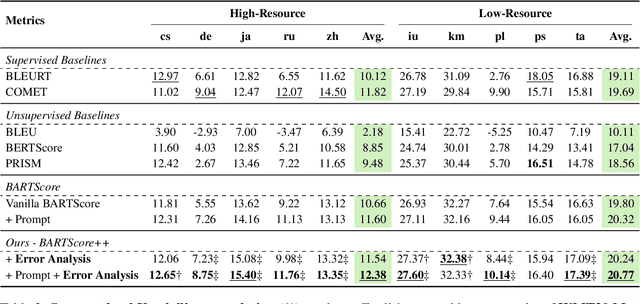
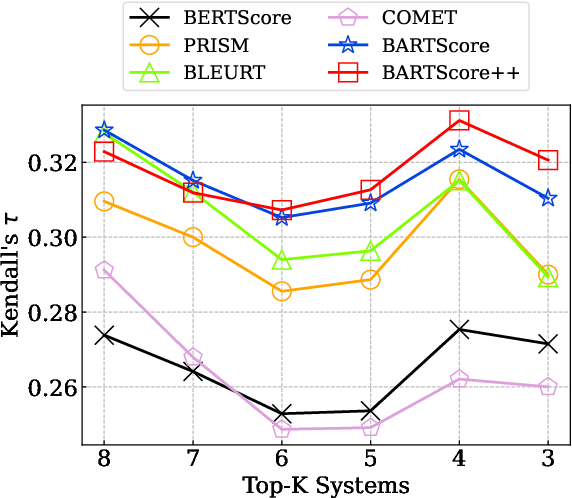
The state-of-the-art language model-based automatic metrics, e.g. BARTScore, benefiting from large-scale contextualized pre-training, have been successfully used in a wide range of natural language generation (NLG) tasks, including machine translation, text summarization, and data-to-text. Recent studies show that considering both major errors (e.g. mistranslated tokens) and minor errors (e.g. imperfections in fluency) can produce high-quality human judgments. This inspires us to approach the final goal of the evaluation metrics (human-like evaluations) by automatic error analysis. To this end, we augment BARTScore by incorporating the human-like error analysis strategies, namely BARTScore++, where the final score consists of both the evaluations of major errors and minor errors. Experimental results show that BARTScore++ can consistently improve the performance of vanilla BARTScore and outperform existing top-scoring metrics in 20 out of 25 test settings. We hope our technique can also be extended to other pre-trained model-based metrics. We will release our code and scripts to facilitate the community.
Original or Translated? On the Use of Parallel Data for Translation Quality Estimation
Dec 20, 2022

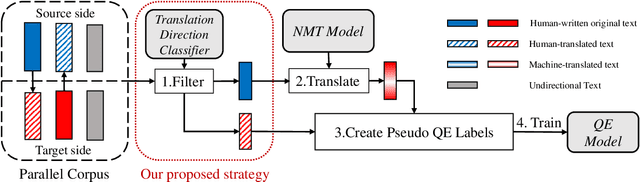
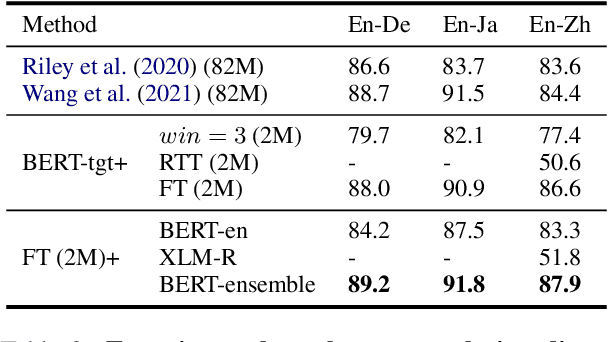
Machine Translation Quality Estimation (QE) is the task of evaluating translation output in the absence of human-written references. Due to the scarcity of human-labeled QE data, previous works attempted to utilize the abundant unlabeled parallel corpora to produce additional training data with pseudo labels. In this paper, we demonstrate a significant gap between parallel data and real QE data: for QE data, it is strictly guaranteed that the source side is original texts and the target side is translated (namely translationese). However, for parallel data, it is indiscriminate and the translationese may occur on either source or target side. We compare the impact of parallel data with different translation directions in QE data augmentation, and find that using the source-original part of parallel corpus consistently outperforms its target-original counterpart. Moreover, since the WMT corpus lacks direction information for each parallel sentence, we train a classifier to distinguish source- and target-original bitext, and carry out an analysis of their difference in both style and domain. Together, these findings suggest using source-original parallel data for QE data augmentation, which brings a relative improvement of up to 4.0% and 6.4% compared to undifferentiated data on sentence- and word-level QE tasks respectively.
Localizing Scan Targets from Human Pose for Autonomous Lung Ultrasound Imaging
Dec 15, 2022Ultrasound is progressing toward becoming an affordable and versatile solution to medical imaging. With the advent of COVID-19 global pandemic, there is a need to fully automate ultrasound imaging as it requires trained operators in close proximity to patients for long period of time. In this work, we investigate the important yet seldom-studied problem of scan target localization, under the setting of lung ultrasound imaging. We propose a purely vision-based, data driven method that incorporates learning-based computer vision techniques. We combine a human pose estimation model with a specially designed regression model to predict the lung ultrasound scan targets, and deploy multiview stereo vision to enhance the consistency of 3D target localization. While related works mostly focus on phantom experiments, we collect data from 30 human subjects for testing. Our method attains an accuracy level of 15.52 (9.47) mm for probe positioning and 4.32 (3.69){\deg} for probe orientation, with a success rate above 80% under an error threshold of 25mm for all scan targets. Moreover, our approach can serve as a general solution to other types of ultrasound modalities. The code for implementation has been released.
ContraFeat: Contrasting Deep Features for Semantic Discovery
Dec 14, 2022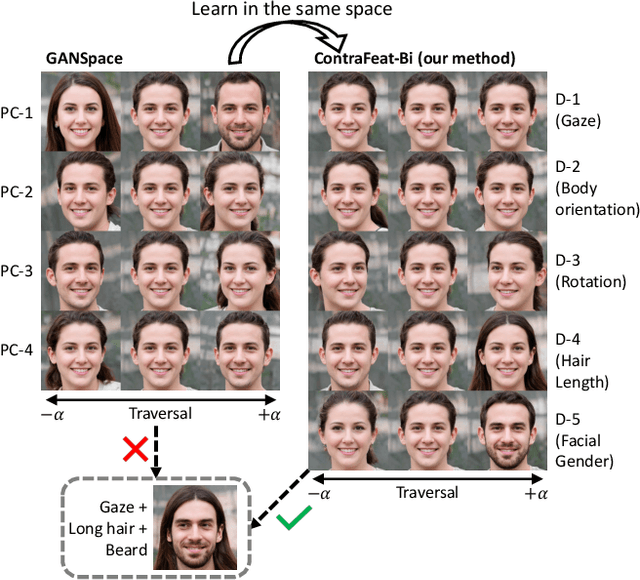
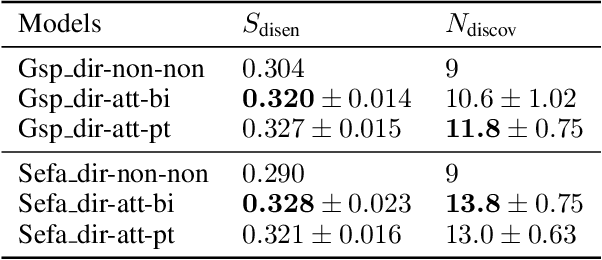
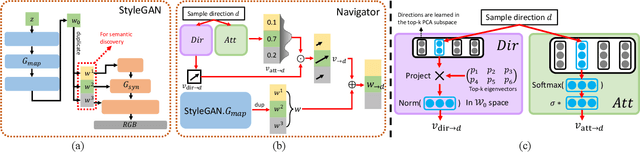
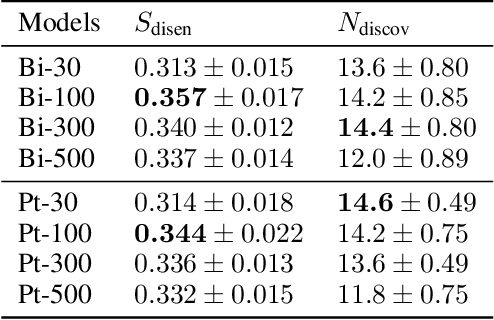
StyleGAN has shown strong potential for disentangled semantic control, thanks to its special design of multi-layer intermediate latent variables. However, existing semantic discovery methods on StyleGAN rely on manual selection of modified latent layers to obtain satisfactory manipulation results, which is tedious and demanding. In this paper, we propose a model that automates this process and achieves state-of-the-art semantic discovery performance. The model consists of an attention-equipped navigator module and losses contrasting deep-feature changes. We propose two model variants, with one contrasting samples in a binary manner, and another one contrasting samples with learned prototype variation patterns. The proposed losses are defined with pretrained deep features, based on our assumption that the features can implicitly reveal the desired semantic structure including consistency and orthogonality. Additionally, we design two metrics to quantitatively evaluate the performance of semantic discovery methods on FFHQ dataset, and also show that disentangled representations can be derived via a simple training process. Experimentally, our models can obtain state-of-the-art semantic discovery results without relying on latent layer-wise manual selection, and these discovered semantics can be used to manipulate real-world images.
Safety Correction from Baseline: Towards the Risk-aware Policy in Robotics via Dual-agent Reinforcement Learning
Dec 14, 2022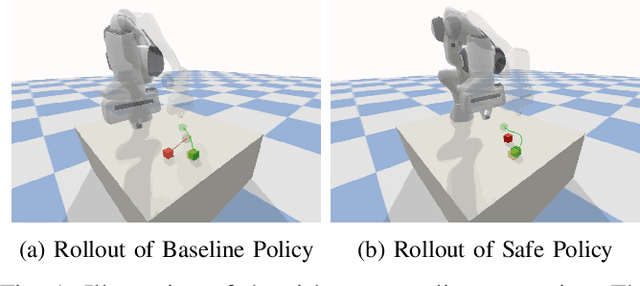
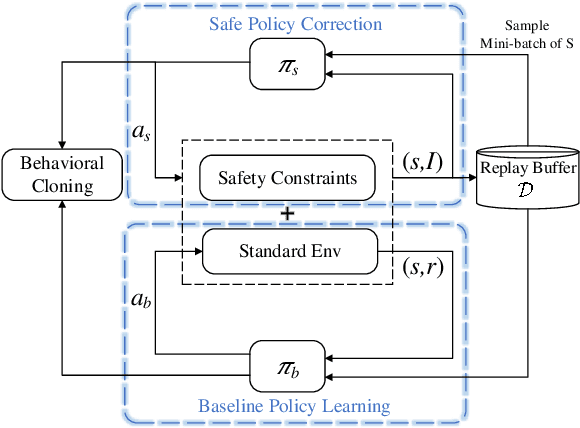
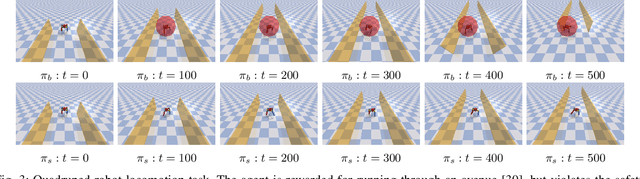
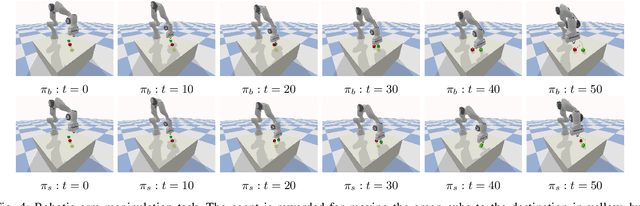
Learning a risk-aware policy is essential but rather challenging in unstructured robotic tasks. Safe reinforcement learning methods open up new possibilities to tackle this problem. However, the conservative policy updates make it intractable to achieve sufficient exploration and desirable performance in complex, sample-expensive environments. In this paper, we propose a dual-agent safe reinforcement learning strategy consisting of a baseline and a safe agent. Such a decoupled framework enables high flexibility, data efficiency and risk-awareness for RL-based control. Concretely, the baseline agent is responsible for maximizing rewards under standard RL settings. Thus, it is compatible with off-the-shelf training techniques of unconstrained optimization, exploration and exploitation. On the other hand, the safe agent mimics the baseline agent for policy improvement and learns to fulfill safety constraints via off-policy RL tuning. In contrast to training from scratch, safe policy correction requires significantly fewer interactions to obtain a near-optimal policy. The dual policies can be optimized synchronously via a shared replay buffer, or leveraging the pre-trained model or the non-learning-based controller as a fixed baseline agent. Experimental results show that our approach can learn feasible skills without prior knowledge as well as deriving risk-averse counterparts from pre-trained unsafe policies. The proposed method outperforms the state-of-the-art safe RL algorithms on difficult robot locomotion and manipulation tasks with respect to both safety constraint satisfaction and sample efficiency.
Evaluating Model-free Reinforcement Learning toward Safety-critical Tasks
Dec 12, 2022Safety comes first in many real-world applications involving autonomous agents. Despite a large number of reinforcement learning (RL) methods focusing on safety-critical tasks, there is still a lack of high-quality evaluation of those algorithms that adheres to safety constraints at each decision step under complex and unknown dynamics. In this paper, we revisit prior work in this scope from the perspective of state-wise safe RL and categorize them as projection-based, recovery-based, and optimization-based approaches, respectively. Furthermore, we propose Unrolling Safety Layer (USL), a joint method that combines safety optimization and safety projection. This novel technique explicitly enforces hard constraints via the deep unrolling architecture and enjoys structural advantages in navigating the trade-off between reward improvement and constraint satisfaction. To facilitate further research in this area, we reproduce related algorithms in a unified pipeline and incorporate them into SafeRL-Kit, a toolkit that provides off-the-shelf interfaces and evaluation utilities for safety-critical tasks. We then perform a comparative study of the involved algorithms on six benchmarks ranging from robotic control to autonomous driving. The empirical results provide an insight into their applicability and robustness in learning zero-cost-return policies without task-dependent handcrafting. The project page is available at https://sites.google.com/view/saferlkit.
Diff-Font: Diffusion Model for Robust One-Shot Font Generation
Dec 12, 2022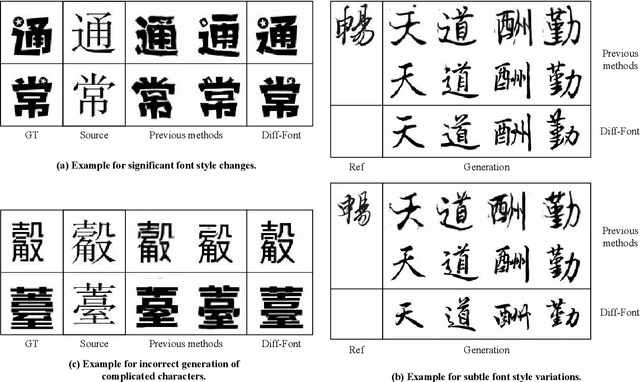
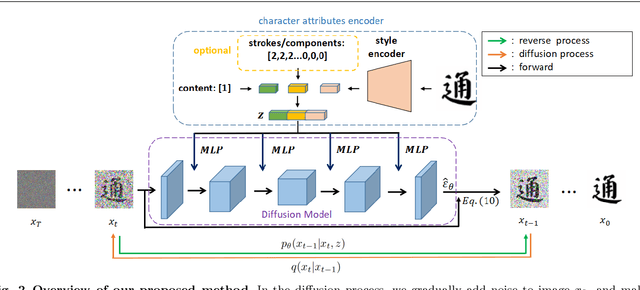
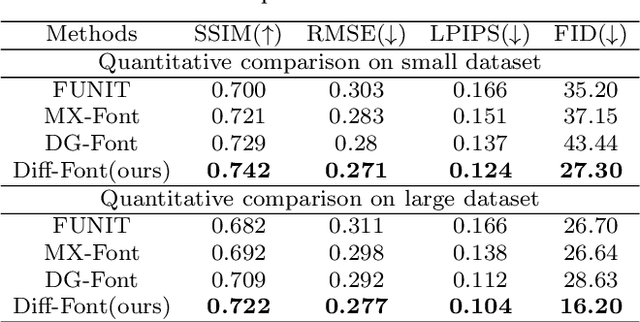
Font generation is a difficult and time-consuming task, especially in those languages using ideograms that have complicated structures with a large number of characters, such as Chinese. To solve this problem, few-shot font generation and even one-shot font generation have attracted a lot of attention. However, most existing font generation methods may still suffer from (i) large cross-font gap challenge; (ii) subtle cross-font variation problem; and (iii) incorrect generation of complicated characters. In this paper, we propose a novel one-shot font generation method based on a diffusion model, named Diff-Font, which can be stably trained on large datasets. The proposed model aims to generate the entire font library by giving only one sample as the reference. Specifically, a large stroke-wise dataset is constructed, and a stroke-wise diffusion model is proposed to preserve the structure and the completion of each generated character. To our best knowledge, the proposed Diff-Font is the first work that developed diffusion models to handle the font generation task. The well-trained Diff-Font is not only robust to font gap and font variation, but also achieved promising performance on difficult character generation. Compared to previous font generation methods, our model reaches state-of-the-art performance both qualitatively and quantitatively.
Generating Holistic 3D Human Motion from Speech
Dec 08, 2022
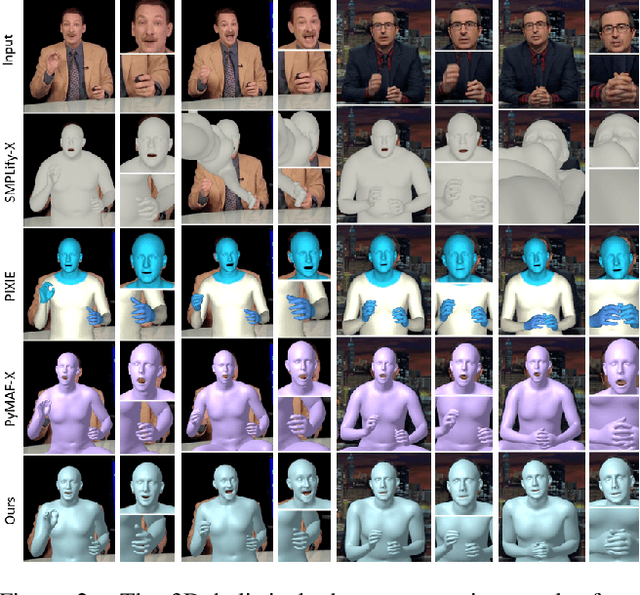
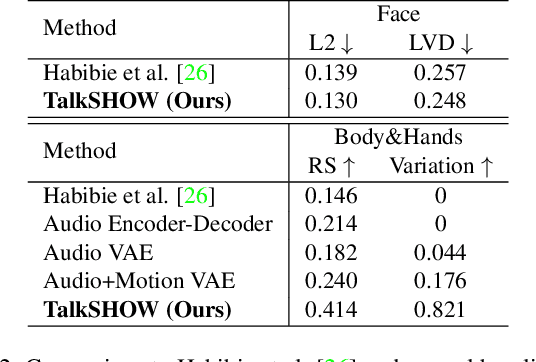
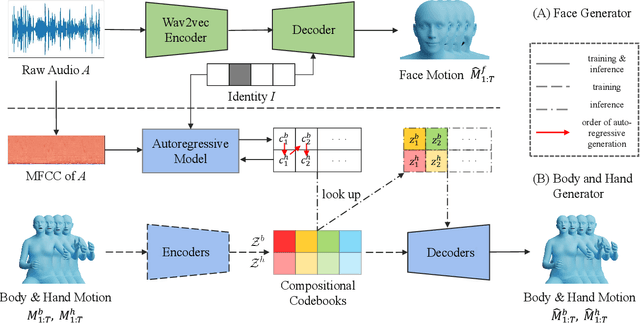
This work addresses the problem of generating 3D holistic body motions from human speech. Given a speech recording, we synthesize sequences of 3D body poses, hand gestures, and facial expressions that are realistic and diverse. To achieve this, we first build a high-quality dataset of 3D holistic body meshes with synchronous speech. We then define a novel speech-to-motion generation framework in which the face, body, and hands are modeled separately. The separated modeling stems from the fact that face articulation strongly correlates with human speech, while body poses and hand gestures are less correlated. Specifically, we employ an autoencoder for face motions, and a compositional vector-quantized variational autoencoder (VQ-VAE) for the body and hand motions. The compositional VQ-VAE is key to generating diverse results. Additionally, we propose a cross-conditional autoregressive model that generates body poses and hand gestures, leading to coherent and realistic motions. Extensive experiments and user studies demonstrate that our proposed approach achieves state-of-the-art performance both qualitatively and quantitatively. Our novel dataset and code will be released for research purposes at https://talkshow.is.tue.mpg.de.
ViTPose+: Vision Transformer Foundation Model for Generic Body Pose Estimation
Dec 07, 2022In this paper, we show the surprisingly good properties of plain vision transformers for body pose estimation from various aspects, namely simplicity in model structure, scalability in model size, flexibility in training paradigm, and transferability of knowledge between models, through a simple baseline model dubbed ViTPose. Specifically, ViTPose employs the plain and non-hierarchical vision transformer as an encoder to encode features and a lightweight decoder to decode body keypoints in either a top-down or a bottom-up manner. It can be scaled up from about 20M to 1B parameters by taking advantage of the scalable model capacity and high parallelism of the vision transformer, setting a new Pareto front for throughput and performance. Besides, ViTPose is very flexible regarding the attention type, input resolution, and pre-training and fine-tuning strategy. Based on the flexibility, a novel ViTPose+ model is proposed to deal with heterogeneous body keypoint categories in different types of body pose estimation tasks via knowledge factorization, i.e., adopting task-agnostic and task-specific feed-forward networks in the transformer. We also empirically demonstrate that the knowledge of large ViTPose models can be easily transferred to small ones via a simple knowledge token. Experimental results show that our ViTPose model outperforms representative methods on the challenging MS COCO Human Keypoint Detection benchmark at both top-down and bottom-up settings. Furthermore, our ViTPose+ model achieves state-of-the-art performance simultaneously on a series of body pose estimation tasks, including MS COCO, AI Challenger, OCHuman, MPII for human keypoint detection, COCO-Wholebody for whole-body keypoint detection, as well as AP-10K and APT-36K for animal keypoint detection, without sacrificing inference speed.