 Add to Chrome
 Add to Firefox
 Add to Edge
Stability-Driven Motion Generation for Object-Guided Human-Human Co-Manipulation
Apr 22, 2026
Co-manipulation requires multiple humans to synchronize their motions with a shared object while ensuring reasonable interactions, maintaining natural poses, and preserving stable states. However, most existing motion generation approaches are designed for single-character scenarios or fail to account for payload-induced dynamics. In this work, we propose a flow-matching framework that ensures the generated co-manipulation motions align with the intended goals while maintaining naturalness and effectiveness. Specifically, we first introduce a generative model that derives explicit manipulation strategies from the object's affordance and spatial configuration, which guide the motion flow toward successful manipulation. To improve motion quality, we then design an adversarial interaction prior that promotes natural individual poses and realistic inter-person interactions during co-manipulation. In addition, we also incorporate a stability-driven simulation into the flow matching process, which refines unstable interaction states through sampling-based optimization and directly adjusts the vector field regression to promote more effective manipulation. The experimental results demonstrate that our method achieves higher contact accuracy, lower penetration, and better distributional fidelity compared to state-of-the-art human-object interaction baselines. The code is available at https://github.com/boycehbz/StaCOM.

Causality-inspired Federated Learning for Dynamic Spatio-Temporal Graphs
Mar 31, 2026Federated Graph Learning (FGL) has emerged as a powerful paradigm for decentralized training of graph neural networks while preserving data privacy. However, existing FGL methods are predominantly designed for static graphs and rely on parameter averaging or distribution alignment, which implicitly assume that all features are equally transferable across clients, overlooking both the spatial and temporal heterogeneity and the presence of client-specific knowledge in real-world graphs. In this work, we identify that such assumptions create a vicious cycle of spurious representation entanglement, client-specific interference, and negative transfer, degrading generalization performance in Federated Learning over Dynamic Spatio-Temporal Graphs (FSTG). To address this issue, we propose a novel causality-inspired framework named SC-FSGL, which explicitly decouples transferable causal knowledge from client-specific noise through representation-level interventions. Specifically, we introduce a Conditional Separation Module that simulates soft interventions through client conditioned masks, enabling the disentanglement of invariant spatio-temporal causal factors from spurious signals and mitigating representation entanglement caused by client heterogeneity. In addition, we propose a Causal Codebook that clusters causal prototypes and aligns local representations via contrastive learning, promoting cross-client consistency and facilitating knowledge sharing across diverse spatio-temporal patterns. Experiments on five diverse heterogeneity Spatio-Temporal Graph (STG) datasets show that SC-FSGL outperforms state-of-the-art methods.
Ada3Drift: Adaptive Training-Time Drifting for One-Step 3D Visuomotor Robotic Manipulation
Mar 12, 2026Diffusion-based visuomotor policies effectively capture multimodal action distributions through iterative denoising, but their high inference latency limits real-time robotic control. Recent flow matching and consistency-based methods achieve single-step generation, yet sacrifice the ability to preserve distinct action modes, collapsing multimodal behaviors into averaged, often physically infeasible trajectories. We observe that the compute budget asymmetry in robotics (offline training vs.\ real-time inference) naturally motivates recovering this multimodal fidelity by shifting iterative refinement from inference time to training time. Building on this insight, we propose Ada3Drift, which learns a training-time drifting field that attracts predicted actions toward expert demonstration modes while repelling them from other generated samples, enabling high-fidelity single-step generation (1 NFE) from 3D point cloud observations. To handle the few-shot robotic regime, Ada3Drift further introduces a sigmoid-scheduled loss transition from coarse distribution learning to mode-sharpening refinement, and multi-scale field aggregation that captures action modes at varying spatial granularities. Experiments on three simulation benchmarks (Adroit, Meta-World, and RoboTwin) and real-world robotic manipulation tasks demonstrate that Ada3Drift achieves state-of-the-art performance while requiring $10\times$ fewer function evaluations than diffusion-based alternatives.
Action-Geometry Prediction with 3D Geometric Prior for Bimanual Manipulation
Feb 27, 2026Bimanual manipulation requires policies that can reason about 3D geometry, anticipate how it evolves under action, and generate smooth, coordinated motions. However, existing methods typically rely on 2D features with limited spatial awareness, or require explicit point clouds that are difficult to obtain reliably in real-world settings. At the same time, recent 3D geometric foundation models show that accurate and diverse 3D structure can be reconstructed directly from RGB images in a fast and robust manner. We leverage this opportunity and propose a framework that builds bimanual manipulation directly on a pre-trained 3D geometric foundation model. Our policy fuses geometry-aware latents, 2D semantic features, and proprioception into a unified state representation, and uses diffusion model to jointly predict a future action chunk and a future 3D latent that decodes into a dense pointmap. By explicitly predicting how the 3D scene will evolve together with the action sequence, the policy gains strong spatial understanding and predictive capability using only RGB observations. We evaluate our method both in simulation on the RoboTwin benchmark and in real-world robot executions. Our approach consistently outperforms 2D-based and point-cloud-based baselines, achieving state-of-the-art performance in manipulation success, inter-arm coordination, and 3D spatial prediction accuracy. Code is available at https://github.com/Chongyang-99/GAP.git.
Grappa: Gradient-Only Communication for Scalable Graph Neural Network Training
Feb 02, 2026Cross-partition edges dominate the cost of distributed GNN training: fetching remote features and activations per iteration overwhelms the network as graphs deepen and partition counts grow. Grappa is a distributed GNN training framework that enforces gradient-only communication: during each iteration, partitions train in isolation and exchange only gradients for the global update. To recover accuracy lost to isolation, Grappa (i) periodically repartitions to expose new neighborhoods and (ii) applies a lightweight coverage-corrected gradient aggregation inspired by importance sampling. We prove the corrected estimator is asymptotically unbiased under standard support and boundedness assumptions, and we derive a batch-level variant for compatibility with common deep-learning packages that minimizes mean-squared deviation from the ideal node-level correction. We also introduce a shrinkage version that improves stability in practice. Empirical results on real and synthetic graphs show that Grappa trains GNNs 4 times faster on average (up to 13 times) than state-of-the-art systems, achieves better accuracy especially for deeper models, and sustains training at the trillion-edge scale on commodity hardware. Grappa is model-agnostic, supports full-graph and mini-batch training, and does not rely on high-bandwidth interconnects or caching.
Reconstructing Close Human Interaction with Appearance and Proxemics Reasoning
Jul 03, 2025Due to visual ambiguities and inter-person occlusions, existing human pose estimation methods cannot recover plausible close interactions from in-the-wild videos. Even state-of-the-art large foundation models~(\eg, SAM) cannot accurately distinguish human semantics in such challenging scenarios. In this work, we find that human appearance can provide a straightforward cue to address these obstacles. Based on this observation, we propose a dual-branch optimization framework to reconstruct accurate interactive motions with plausible body contacts constrained by human appearances, social proxemics, and physical laws. Specifically, we first train a diffusion model to learn the human proxemic behavior and pose prior knowledge. The trained network and two optimizable tensors are then incorporated into a dual-branch optimization framework to reconstruct human motions and appearances. Several constraints based on 3D Gaussians, 2D keypoints, and mesh penetrations are also designed to assist the optimization. With the proxemics prior and diverse constraints, our method is capable of estimating accurate interactions from in-the-wild videos captured in complex environments. We further build a dataset with pseudo ground-truth interaction annotations, which may promote future research on pose estimation and human behavior understanding. Experimental results on several benchmarks demonstrate that our method outperforms existing approaches. The code and data are available at https://www.buzhenhuang.com/works/CloseApp.html.
Adapting Human Mesh Recovery with Vision-Language Feedback
Feb 06, 2025
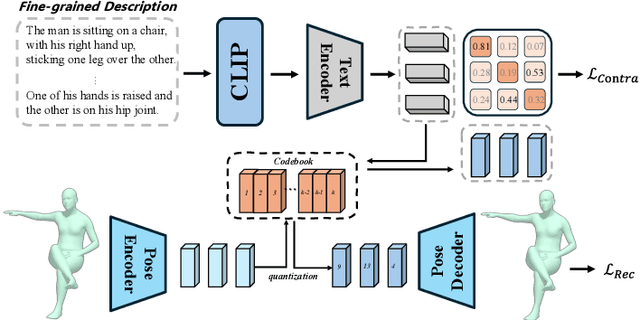
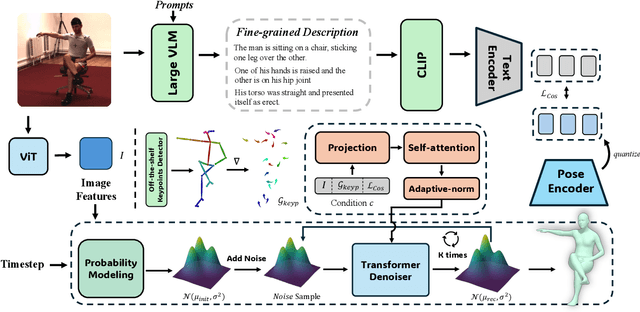
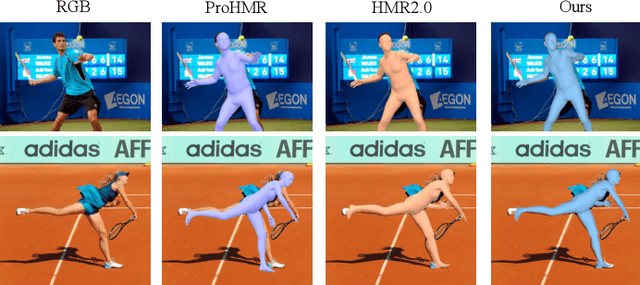
Human mesh recovery can be approached using either regression-based or optimization-based methods. Regression models achieve high pose accuracy but struggle with model-to-image alignment due to the lack of explicit 2D-3D correspondences. In contrast, optimization-based methods align 3D models to 2D observations but are prone to local minima and depth ambiguity. In this work, we leverage large vision-language models (VLMs) to generate interactive body part descriptions, which serve as implicit constraints to enhance 3D perception and limit the optimization space. Specifically, we formulate monocular human mesh recovery as a distribution adaptation task by integrating both 2D observations and language descriptions. To bridge the gap between text and 3D pose signals, we first train a text encoder and a pose VQ-VAE, aligning texts to body poses in a shared latent space using contrastive learning. Subsequently, we employ a diffusion-based framework to refine the initial parameters guided by gradients derived from both 2D observations and text descriptions. Finally, the model can produce poses with accurate 3D perception and image consistency. Experimental results on multiple benchmarks validate its effectiveness. The code will be made publicly available.
Closely Interactive Human Reconstruction with Proxemics and Physics-Guided Adaption
Apr 17, 2024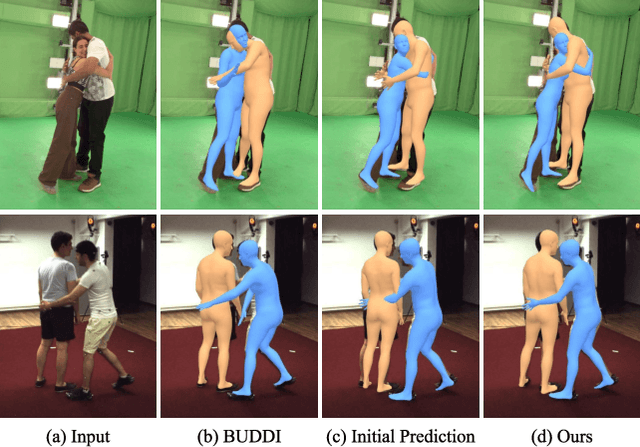

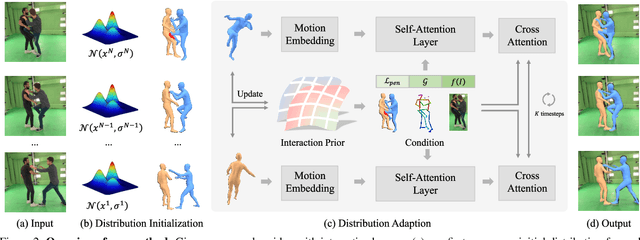

Existing multi-person human reconstruction approaches mainly focus on recovering accurate poses or avoiding penetration, but overlook the modeling of close interactions. In this work, we tackle the task of reconstructing closely interactive humans from a monocular video. The main challenge of this task comes from insufficient visual information caused by depth ambiguity and severe inter-person occlusion. In view of this, we propose to leverage knowledge from proxemic behavior and physics to compensate the lack of visual information. This is based on the observation that human interaction has specific patterns following the social proxemics. Specifically, we first design a latent representation based on Vector Quantised-Variational AutoEncoder (VQ-VAE) to model human interaction. A proxemics and physics guided diffusion model is then introduced to denoise the initial distribution. We design the diffusion model as dual branch with each branch representing one individual such that the interaction can be modeled via cross attention. With the learned priors of VQ-VAE and physical constraint as the additional information, our proposed approach is capable of estimating accurate poses that are also proxemics and physics plausible. Experimental results on Hi4D, 3DPW, and CHI3D demonstrate that our method outperforms existing approaches. The code is available at \url{https://github.com/boycehbz/HumanInteraction}.