 Add to Chrome
 Add to Firefox
 Add to Edge
WD-FQDet: Multispectral Detection Transformer via Wavelet Decomposition and Frequency-aware Query Learning
May 13, 2026
Infrared-visible object detection improves detection performance by combining complementary features from multispectral images. Existing backbone-specific and backbone-shared approaches still suffer from the problems of severe bias of modality-shared features and the insufficiency of modality-specific features. To address these issues, we propose a novel detection framework WD-FQDet that explicitly decouples modality-shared and modality-specific information from infrared and visible modalities in the new view of low- and high-frequency domains, allowing fusion strategies tailored to their frequency characteristics. Specifically, a low-frequency homogeneity alignment module is proposed to align modality-shared features across modalities via a cross-modal attention mechanism, and a high-frequency specificity retention module is proposed to preserve modality-specific features through the multi-scale gradient consistency loss. To reinforce the feature representation in the frequency domain, we propose a hybrid feature enhancement module that incorporates spatial cues. Furthermore, considering that the contributions of homogeneous and modality-specific features to object detection vary across scenarios, we propose a frequency-aware query selection module to dynamically regulate their contributions. Experimental results on the FLIR, LLVIP, and M3FD datasets demonstrate that WD-FQDet achieves state-of-the-art performance across multiple evaluation metrics.

SAVA-X: Ego-to-Exo Imitation Error Detection via Scene-Adaptive View Alignment and Bidirectional Cross View Fusion
Mar 13, 2026Error detection is crucial in industrial training, healthcare, and assembly quality control. Most existing work assumes a single-view setting and cannot handle the practical case where a third-person (exo) demonstration is used to assess a first-person (ego) imitation. We formalize Ego$\rightarrow$Exo Imitation Error Detection: given asynchronous, length-mismatched ego and exo videos, the model must localize procedural steps on the ego timeline and decide whether each is erroneous. This setting introduces cross-view domain shift, temporal misalignment, and heavy redundancy. Under a unified protocol, we adapt strong baselines from dense video captioning and temporal action detection and show that they struggle in this cross-view regime. We then propose SAVA-X, an Align-Fuse-Detect framework with (i) view-conditioned adaptive sampling, (ii) scene-adaptive view embeddings, and (iii) bidirectional cross-attention fusion. On the EgoMe benchmark, SAVA-X consistently improves AUPRC and mean tIoU over all baselines, and ablations confirm the complementary benefits of its components. Code is available at https://github.com/jack1ee/SAVAX.
Continual Learning with Vision-Language Models via Semantic-Geometry Preservation
Mar 12, 2026Continual learning of pretrained vision-language models (VLMs) is prone to catastrophic forgetting, yet current approaches adapt to new tasks without explicitly preserving the cross-modal semantic geometry inherited from pretraining and previous stages, allowing new-task supervision to induce geometric distortion. We observe that the most pronounced drift tends to concentrate in vulnerable neighborhoods near the old-new semantic interface, where shared visual patterns are easily re-explained by new textual semantics. To address this under an exemplar-free constraint, we propose Semantic Geometry Preservation for Continual Learning (SeGP-CL). SeGP-CL first probes the drift-prone region by constructing a compact set of adversarial anchors with dual-targeted projected gradient descent (DPGD), which drives selected new-task seeds toward old-class semantics while remaining faithful in raw visual space. During training, we preserve cross-modal structure by anchor-guided cross-modal geometry distillation (ACGD), and stabilize the textual reference frame across tasks via a lightweight text semantic-geometry regularization (TSGR). After training, we estimate anchor-induced raw-space drift to transfer old visual prototypes and perform dual-path inference by fusing cross-modal and visual cues. Extensive experiments on five continual learning benchmarks demonstrate that SeGP-CL consistently improves stability and forward transfer, achieving state-of-the-art performance while better preserving semantic geometry of VLMs.
Ada3Drift: Adaptive Training-Time Drifting for One-Step 3D Visuomotor Robotic Manipulation
Mar 12, 2026Diffusion-based visuomotor policies effectively capture multimodal action distributions through iterative denoising, but their high inference latency limits real-time robotic control. Recent flow matching and consistency-based methods achieve single-step generation, yet sacrifice the ability to preserve distinct action modes, collapsing multimodal behaviors into averaged, often physically infeasible trajectories. We observe that the compute budget asymmetry in robotics (offline training vs.\ real-time inference) naturally motivates recovering this multimodal fidelity by shifting iterative refinement from inference time to training time. Building on this insight, we propose Ada3Drift, which learns a training-time drifting field that attracts predicted actions toward expert demonstration modes while repelling them from other generated samples, enabling high-fidelity single-step generation (1 NFE) from 3D point cloud observations. To handle the few-shot robotic regime, Ada3Drift further introduces a sigmoid-scheduled loss transition from coarse distribution learning to mode-sharpening refinement, and multi-scale field aggregation that captures action modes at varying spatial granularities. Experiments on three simulation benchmarks (Adroit, Meta-World, and RoboTwin) and real-world robotic manipulation tasks demonstrate that Ada3Drift achieves state-of-the-art performance while requiring $10\times$ fewer function evaluations than diffusion-based alternatives.
Test-time Ego-Exo-centric Adaptation for Action Anticipation via Multi-Label Prototype Growing and Dual-Clue Consistency
Mar 10, 2026Efficient adaptation between Egocentric (Ego) and Exocentric (Exo) views is crucial for applications such as human-robot cooperation. However, the success of most existing Ego-Exo adaptation methods relies heavily on target-view data for training, thereby increasing computational and data collection costs. In this paper, we make the first exploration of a Test-time Ego-Exo Adaptation for Action Anticipation (TE$^{2}$A$^{3}$) task, which aims to adjust the source-view-trained model online during test time to anticipate target-view actions. It is challenging for existing Test-Time Adaptation (TTA) methods to address this task due to the multi-action candidates and significant temporal-spatial inter-view gap. Hence, we propose a novel Dual-Clue enhanced Prototype Growing Network (DCPGN), which accumulates multi-label knowledge and integrates cross-modality clues for effective test-time Ego-Exo adaptation and action anticipation. Specifically, we propose a Multi-Label Prototype Growing Module (ML-PGM) to balance multiple positive classes via multi-label assignment and confidence-based reweighting for class-wise memory banks, which are updated by an entropy priority queue strategy. Then, the Dual-Clue Consistency Module (DCCM) introduces a lightweight narrator to generate textual clues indicating action progressions, which complement the visual clues containing various objects. Moreover, we constrain the inferred textual and visual logits to construct dual-clue consistency for temporally and spatially bridging Ego and Exo views. Extensive experiments on the newly proposed EgoMe-anti and the existing EgoExoLearn benchmarks show the effectiveness of our method, which outperforms related state-of-the-art methods by a large margin. Code is available at \href{https://github.com/ZhaofengSHI/DCPGN}{https://github.com/ZhaofengSHI/DCPGN}.
FireRescue: A UAV-Based Dataset and Enhanced YOLO Model for Object Detection in Fire Rescue Scenes
Dec 31, 2025Object detection in fire rescue scenarios is importance for command and decision-making in firefighting operations. However, existing research still suffers from two main limitations. First, current work predominantly focuses on environments such as mountainous or forest areas, while paying insufficient attention to urban rescue scenes, which are more frequent and structurally complex. Second, existing detection systems include a limited number of classes, such as flames and smoke, and lack a comprehensive system covering key targets crucial for command decisions, such as fire trucks and firefighters. To address the above issues, this paper first constructs a new dataset named "FireRescue" for rescue command, which covers multiple rescue scenarios, including urban, mountainous, forest, and water areas, and contains eight key categories such as fire trucks and firefighters, with a total of 15,980 images and 32,000 bounding boxes. Secondly, to tackle the problems of inter-class confusion and missed detection of small targets caused by chaotic scenes, diverse targets, and long-distance shooting, this paper proposes an improved model named FRS-YOLO. On the one hand, the model introduces a plug-and-play multidi-mensional collaborative enhancement attention module, which enhances the discriminative representation of easily confused categories (e.g., fire trucks vs. ordinary trucks) through cross-dimensional feature interaction. On the other hand, it integrates a dynamic feature sampler to strengthen high-response foreground features, thereby mitigating the effects of smoke occlusion and background interference. Experimental results demonstrate that object detection in fire rescue scenarios is highly challenging, and the proposed method effectively improves the detection performance of YOLO series models in this context.
Closing the Oracle Gap: Increment Vector Transformation for Class Incremental Learning
Sep 26, 2025Class Incremental Learning (CIL) aims to sequentially acquire knowledge of new classes without forgetting previously learned ones. Despite recent progress, current CIL methods still exhibit significant performance gaps compared to their oracle counterparts-models trained with full access to historical data. Inspired by recent insights on Linear Mode Connectivity (LMC), we revisit the geometric properties of oracle solutions in CIL and uncover a fundamental observation: these oracle solutions typically maintain low-loss linear connections to the optimum of previous tasks. Motivated by this finding, we propose Increment Vector Transformation (IVT), a novel plug-and-play framework designed to mitigate catastrophic forgetting during training. Rather than directly following CIL updates, IVT periodically teleports the model parameters to transformed solutions that preserve linear connectivity to previous task optimum. By maintaining low-loss along these connecting paths, IVT effectively ensures stable performance on previously learned tasks. The transformation is efficiently approximated using diagonal Fisher Information Matrices, making IVT suitable for both exemplar-free and exemplar-based scenarios, and compatible with various initialization strategies. Extensive experiments on CIFAR-100, FGVCAircraft, ImageNet-Subset, and ImageNet-Full demonstrate that IVT consistently enhances the performance of strong CIL baselines. Specifically, on CIFAR-100, IVT improves the last accuracy of the PASS baseline by +5.12% and reduces forgetting by 2.54%. For the CLIP-pre-trained SLCA baseline on FGVCAircraft, IVT yields gains of +14.93% in average accuracy and +21.95% in last accuracy. The code will be released.
CMP: A Composable Meta Prompt for SAM-Based Cross-Domain Few-Shot Segmentation
Jul 22, 2025Cross-Domain Few-Shot Segmentation (CD-FSS) remains challenging due to limited data and domain shifts. Recent foundation models like the Segment Anything Model (SAM) have shown remarkable zero-shot generalization capability in general segmentation tasks, making it a promising solution for few-shot scenarios. However, adapting SAM to CD-FSS faces two critical challenges: reliance on manual prompt and limited cross-domain ability. Therefore, we propose the Composable Meta-Prompt (CMP) framework that introduces three key modules: (i) the Reference Complement and Transformation (RCT) module for semantic expansion, (ii) the Composable Meta-Prompt Generation (CMPG) module for automated meta-prompt synthesis, and (iii) the Frequency-Aware Interaction (FAI) module for domain discrepancy mitigation. Evaluations across four cross-domain datasets demonstrate CMP's state-of-the-art performance, achieving 71.8\% and 74.5\% mIoU in 1-shot and 5-shot scenarios respectively.
DFR: A Decompose-Fuse-Reconstruct Framework for Multi-Modal Few-Shot Segmentation
Jul 22, 2025This paper presents DFR (Decompose, Fuse and Reconstruct), a novel framework that addresses the fundamental challenge of effectively utilizing multi-modal guidance in few-shot segmentation (FSS). While existing approaches primarily rely on visual support samples or textual descriptions, their single or dual-modal paradigms limit exploitation of rich perceptual information available in real-world scenarios. To overcome this limitation, the proposed approach leverages the Segment Anything Model (SAM) to systematically integrate visual, textual, and audio modalities for enhanced semantic understanding. The DFR framework introduces three key innovations: 1) Multi-modal Decompose: a hierarchical decomposition scheme that extracts visual region proposals via SAM, expands textual semantics into fine-grained descriptors, and processes audio features for contextual enrichment; 2) Multi-modal Contrastive Fuse: a fusion strategy employing contrastive learning to maintain consistency across visual, textual, and audio modalities while enabling dynamic semantic interactions between foreground and background features; 3) Dual-path Reconstruct: an adaptive integration mechanism combining semantic guidance from tri-modal fused tokens with geometric cues from multi-modal location priors. Extensive experiments across visual, textual, and audio modalities under both synthetic and real settings demonstrate DFR's substantial performance improvements over state-of-the-art methods.
SS-DC: Spatial-Spectral Decoupling and Coupling Across Visible-Infrared Gap for Domain Adaptive Object Detection
Jul 16, 2025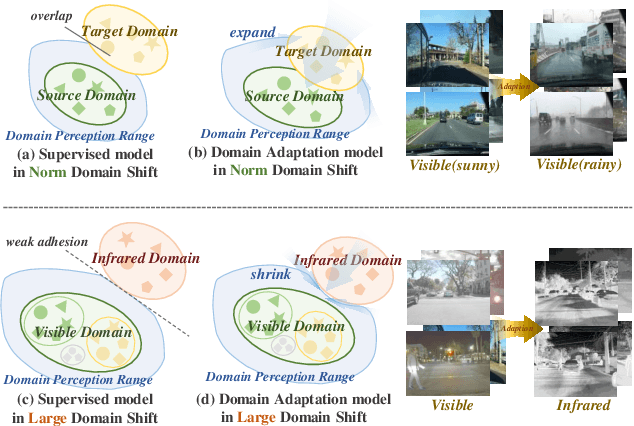
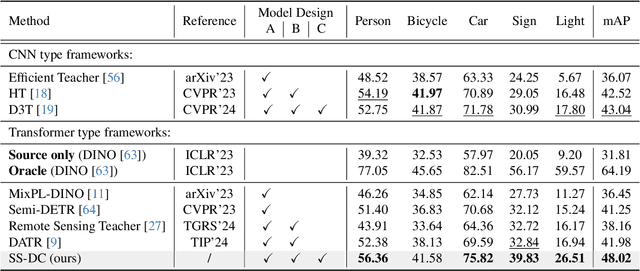
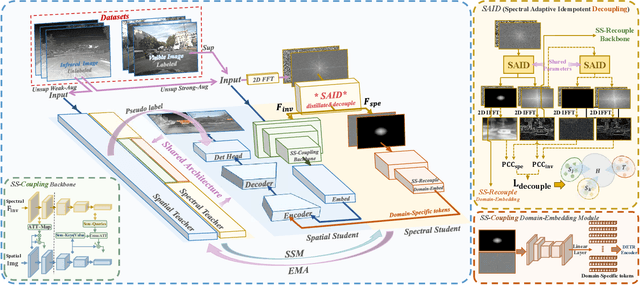
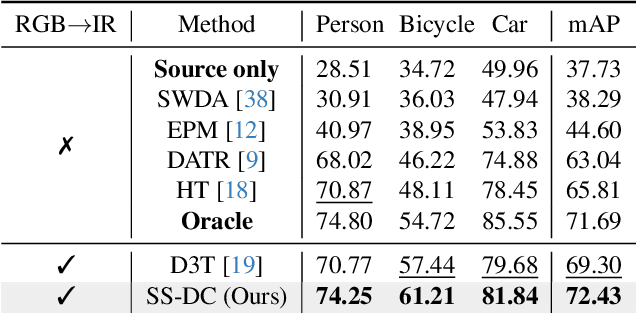
Unsupervised domain adaptive object detection (UDAOD) from the visible domain to the infrared (RGB-IR) domain is challenging. Existing methods regard the RGB domain as a unified domain and neglect the multiple subdomains within it, such as daytime, nighttime, and foggy scenes. We argue that decoupling the domain-invariant (DI) and domain-specific (DS) features across these multiple subdomains is beneficial for RGB-IR domain adaptation. To this end, this paper proposes a new SS-DC framework based on a decoupling-coupling strategy. In terms of decoupling, we design a Spectral Adaptive Idempotent Decoupling (SAID) module in the aspect of spectral decomposition. Due to the style and content information being highly embedded in different frequency bands, this module can decouple DI and DS components more accurately and interpretably. A novel filter bank-based spectral processing paradigm and a self-distillation-driven decoupling loss are proposed to improve the spectral domain decoupling. In terms of coupling, a new spatial-spectral coupling method is proposed, which realizes joint coupling through spatial and spectral DI feature pyramids. Meanwhile, this paper introduces DS from decoupling to reduce the domain bias. Extensive experiments demonstrate that our method can significantly improve the baseline performance and outperform existing UDAOD methods on multiple RGB-IR datasets, including a new experimental protocol proposed in this paper based on the FLIR-ADAS dataset.