 Add to Chrome
 Add to Firefox
 Add to Edge
The Working Set of a Coding Agent: Coherence Debt in Repository-Scale Tasks
Aug 17, 2026
Repository-scale coding requires an agent to keep tests, imports, configuration, and migration rules consistent within a bounded context window. We model this as reconstructing a coupled-fact graph: at each edit, a required fact comes from recent context or parametric memory, and the facts covered by neither form coherence debt. We supply and withhold each channel and inject faults across seven models and five harnesses. As expected, no model completes a task on an unseen API with both channels empty, and putting the facts in the prompt restores success. When a rename defeats what models memorized about a real library, all seven fail in the same place, passing and missing the same tests. Availability decides the outcome and distance does not: withholding a fact costs exactly the work it supports, and a supplied fact works as well far from the edit as next to it. Harnesses pay unequal prices for it: configurations that all pass every test differ more than tenfold in tokens consumed because they rebuild the same content at different rates, and spending more recovers nothing when facts are withheld. A missing fact produces wrong work rather than absent work: an agent asked to act acts, fabricating the file or guessing the value, so instruments built on reads look for a hole already filled. How often it says it is blocked instead is a property of the model, from every trial to none. Availability does not settle every edit: where standard and code disagree, agents follow the standard even when it prescribes the worse code, so a stale convention file costs more than no file. Because parametric memory substitutes for reading, on SWE-bench, where models likely know the repositories, reads no longer predict success. Harnesses should keep the facts an edit depends on available when the agent writes, and check that availability against what the agent produces rather than what it reads.

The Invisible Lottery: How Subtle Cues Steer Algorithm Choice in LLM Code Generation
Jun 02, 2026Large language models (LLMs) now generate substantial production code, often for tasks with multiple valid algorithmic solutions. Incidental prompt cues, meaning contextual words or metadata outside the task specification, can steer which algorithm the model selects, even when all outputs pass the same tests. Prompt sensitivity is well studied as a tool to improve output quality. Here, output policy means algorithm choice under fixed correctness. We define algorithm steering as cue-induced shifts in algorithm-family distributions and run 46,535 controlled experiments across 11 tasks, 19 cue types (18 channels plus a memoization semantic-vs-surface ablation that preserves meaning while changing typography and punctuation), and 15 model configurations. We find large, systematic shifts in algorithm-family distributions (up to 100 pp), largely consistent with cue semantics, including in applied tasks such as rate limiting. Direct algorithm naming is the most reliable mitigation we tested. Accidental context therefore creates an "invisible lottery" over performance, security, and maintainability.
Ghost Tool Calls: Issue-Time Privacy for Speculative Agent Tools
Jun 01, 2026Tool-augmented language agents speculatively issue likely future tool calls to hide latency, but those calls leak inferred user intent to external services before the agent commits to the branch. Every external observer that received the call retains the disclosure after the agent abandons the branch. Timing is the issue, not authorization: no commit-time cleanup, read-only restriction, or access-control allow-list unsends what an observer already holds. We call these invocations ghost tool calls and propose Speculative Tool Privacy Contracts, a runtime abstraction that treats observation before commitment as a first-class effect, distinct from state mutation. We implement the contracts in a prototype runtime and evaluate twelve policies across three corpora. Speculative dispatch increases what an observer can infer about user intent; post-hoc filters, read-only restrictions, and access-control allow-lists leave that inference intact; only issue-time policies that change or suppress the speculative call's argument or destination projection before dispatch reduce it.
Rebooting Microreboot: Architectural Support for Safe, Parallel Recovery in Microservice Systems
Apr 11, 2026Microreboot enables fast recovery by restarting only the failing component, but in modern microservices naive restarts are unsafe: dense dependencies mean rebooting one service can disrupt many callers. Autonomous remediation agents compound this by actuating raw infrastructure commands without safety guarantees. We make microreboot practical by separating planning from actuation: a three-agent architecture (diagnosis, planning, verification) proposes typed remediation plans over a seven-action ISA with explicit side-effect semantics, and a small microkernel validates and executes each plan transactionally. Agents are explicitly untrusted; safety derives from the ISA and microkernel. To determine where restart is safe, we infer recovery boundaries online from distributed traces, computing minimal restart groups and ordering constraints. On industrial traces (Alibaba, Meta) and DeathStarBench with fault injection, recovery-group inference runs in 21 ms at P99; typed actuation reduces agent-caused harm by 95% in simulation and achieves 0% harm online. The primary value is safety, not speed: LLM inference overhead increases TTR for services with fast auto-restart.
* 18 pages, 1 figure, 4 tables. Published at ARCS 2026
ClawVM: Harness-Managed Virtual Memory for Stateful Tool-Using LLM Agents
Apr 11, 2026Stateful tool-using LLM agents treat the context window as working memory, yet today's agent harnesses manage residency and durability as best-effort, causing recurring failures: lost state after compaction, bypassed flushes on reset, and destructive writeback. We present \textsc{ClawVM}, a virtual memory layer that manages state as typed pages with minimum-fidelity invariants, multi-resolution representations under a token budget, and validated writeback at every lifecycle boundary. Because the harness already assembles prompts, mediates tools, and observes lifecycle events, it is the natural enforcement point; placing the contract there makes residency and durability deterministic and auditable. Across synthetic workloads, 12 real-session traces, and adversarial stress tests, \textsc{ClawVM} eliminates all policy-controllable faults whenever the minimum-fidelity set fits within the token budget, confirmed by an offline oracle, and adds median <50 microseconds of policy-engine overhead per turn.
Atomix: Timely, Transactional Tool Use for Reliable Agentic Workflows
Feb 16, 2026LLM agents increasingly act on external systems, yet tool effects are immediate. Under failures, speculation, or contention, losing branches can leak unintended side effects with no safe rollback. We introduce Atomix, a runtime that provides progress-aware transactional semantics for agent tool calls. Atomix tags each call with an epoch, tracks per-resource frontiers, and commits only when progress predicates indicate safety; bufferable effects can be delayed, while externalized effects are tracked and compensated on abort. Across real workloads with fault injection, transactional retry improves task success, while frontier-gated commit strengthens isolation under speculation and contention.
Grappa: Gradient-Only Communication for Scalable Graph Neural Network Training
Feb 02, 2026Cross-partition edges dominate the cost of distributed GNN training: fetching remote features and activations per iteration overwhelms the network as graphs deepen and partition counts grow. Grappa is a distributed GNN training framework that enforces gradient-only communication: during each iteration, partitions train in isolation and exchange only gradients for the global update. To recover accuracy lost to isolation, Grappa (i) periodically repartitions to expose new neighborhoods and (ii) applies a lightweight coverage-corrected gradient aggregation inspired by importance sampling. We prove the corrected estimator is asymptotically unbiased under standard support and boundedness assumptions, and we derive a batch-level variant for compatibility with common deep-learning packages that minimizes mean-squared deviation from the ideal node-level correction. We also introduce a shrinkage version that improves stability in practice. Empirical results on real and synthetic graphs show that Grappa trains GNNs 4 times faster on average (up to 13 times) than state-of-the-art systems, achieves better accuracy especially for deeper models, and sustains training at the trillion-edge scale on commodity hardware. Grappa is model-agnostic, supports full-graph and mini-batch training, and does not rely on high-bandwidth interconnects or caching.
LoRACode: LoRA Adapters for Code Embeddings
Mar 07, 2025
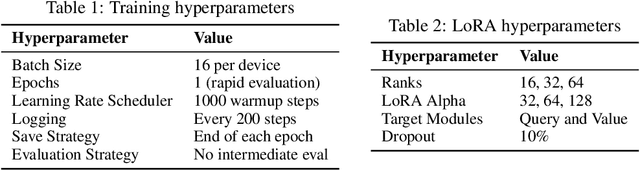
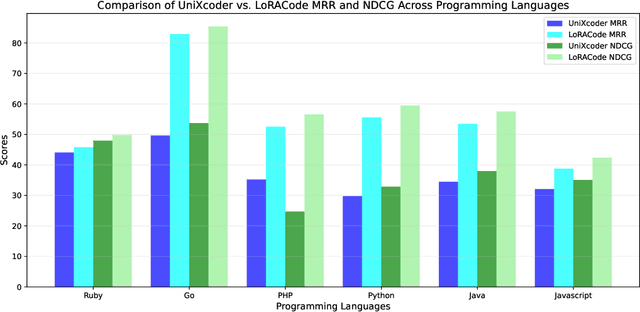
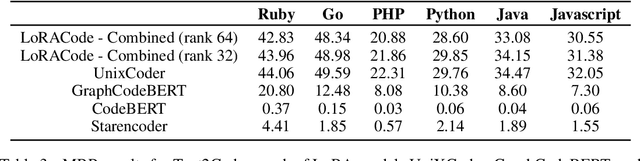
Code embeddings are essential for semantic code search; however, current approaches often struggle to capture the precise syntactic and contextual nuances inherent in code. Open-source models such as CodeBERT and UniXcoder exhibit limitations in scalability and efficiency, while high-performing proprietary systems impose substantial computational costs. We introduce a parameter-efficient fine-tuning method based on Low-Rank Adaptation (LoRA) to construct task-specific adapters for code retrieval. Our approach reduces the number of trainable parameters to less than two percent of the base model, enabling rapid fine-tuning on extensive code corpora (2 million samples in 25 minutes on two H100 GPUs). Experiments demonstrate an increase of up to 9.1% in Mean Reciprocal Rank (MRR) for Code2Code search, and up to 86.69% for Text2Code search tasks across multiple programming languages. Distinction in task-wise and language-wise adaptation helps explore the sensitivity of code retrieval for syntactical and linguistic variations.
Towards Reliable Latent Knowledge Estimation in LLMs: In-Context Learning vs. Prompting Based Factual Knowledge Extraction
Apr 19, 2024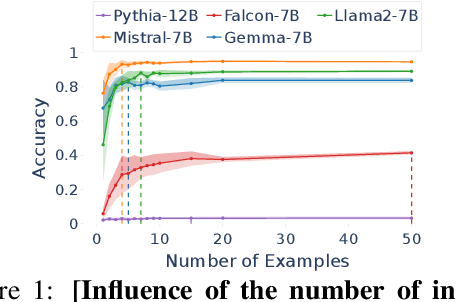
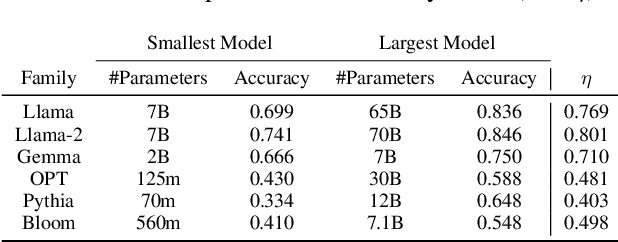

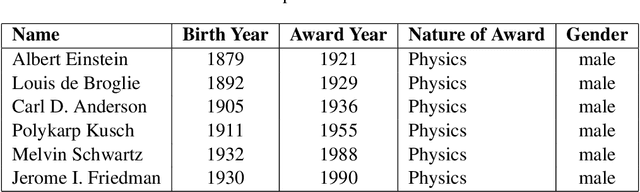
We propose an approach for estimating the latent knowledge embedded inside large language models (LLMs). We leverage the in-context learning (ICL) abilities of LLMs to estimate the extent to which an LLM knows the facts stored in a knowledge base. Our knowledge estimator avoids reliability concerns with previous prompting-based methods, is both conceptually simpler and easier to apply, and we demonstrate that it can surface more of the latent knowledge embedded in LLMs. We also investigate how different design choices affect the performance of ICL-based knowledge estimation. Using the proposed estimator, we perform a large-scale evaluation of the factual knowledge of a variety of open source LLMs, like OPT, Pythia, Llama(2), Mistral, Gemma, etc. over a large set of relations and facts from the Wikidata knowledge base. We observe differences in the factual knowledge between different model families and models of different sizes, that some relations are consistently better known than others but that models differ in the precise facts they know, and differences in the knowledge of base models and their finetuned counterparts.