 Add to Chrome
 Add to Firefox
 Add to Edge
GDPevo: Evaluating Agent Self-Evolution on Real Business Tasks
Aug 04, 2026
Agent self-evolution updates an agent's persistent state from prior experience and reuses it to solve related tasks more effectively. Evaluating self-evolution is difficult: existing benchmarks provide limited coverage of economically valuable task domains, do not always design training and test tasks such that test-time gains can be attributed to training experience, and remain vulnerable to data contamination. We present GDPevo, an evolution-native benchmark grounded in GDP-related enterprise workflows, together with the fully automated data pipeline that generates it. Its core mechanism, rule hybridization, decomposes each enterprise workflow into atomic business rules, distributes subsets of these rules across training tasks, and recombines them in held-out test tasks so that test-time gains are attributable. GDPevo spans CRM, ERP, finance, healthcare, legal, and data-centric workflows. Its V1 release contains 120 tasks in 12 groups, with five training and five held-out test tasks per group. Full automation enables the pipeline to expand the suite to 240 tasks in 24 groups (V2) within two days, providing a practical response to contamination. Using GDPevo, we evaluate four agents, each comprising a harness and a model, under four supervision types. Self-evolution consistently improves held-out accuracy by up to 16.44 percentage points. But the best evolved agents remain far below the fully informed oracle ceiling of 91.6%, indicating that the self-evolution ability of current agents remains far from fully realized. We publicly release the pipeline, benchmark, and full evaluation results at https://github.com/Prism-Shadow/GDPevo.

Reinforcement Learning for Active Matter
Mar 30, 2025Active matter refers to systems composed of self-propelled entities that consume energy to produce motion, exhibiting complex non-equilibrium dynamics that challenge traditional models. With the rapid advancements in machine learning, reinforcement learning (RL) has emerged as a promising framework for addressing the complexities of active matter. This review systematically introduces the integration of RL for guiding and controlling active matter systems, focusing on two key aspects: optimal motion strategies for individual active particles and the regulation of collective dynamics in active swarms. We discuss the use of RL to optimize the navigation, foraging, and locomotion strategies for individual active particles. In addition, the application of RL in regulating collective behaviors is also examined, emphasizing its role in facilitating the self-organization and goal-directed control of active swarms. This investigation offers valuable insights into how RL can advance the understanding, manipulation, and control of active matter, paving the way for future developments in fields such as biological systems, robotics, and medical science.
Machine Learning Analysis of Anomalous Diffusion
Dec 02, 2024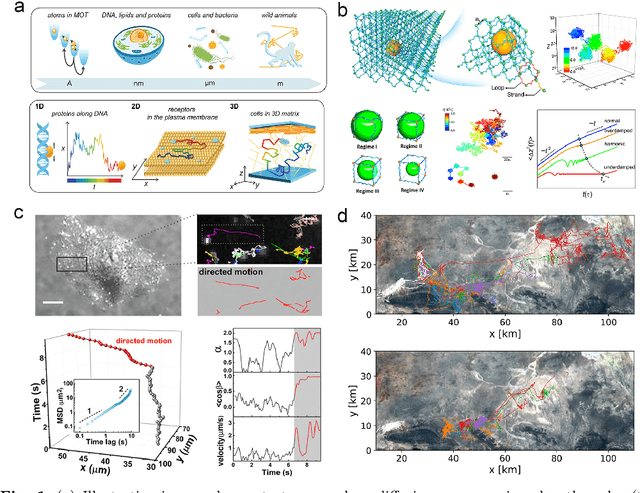
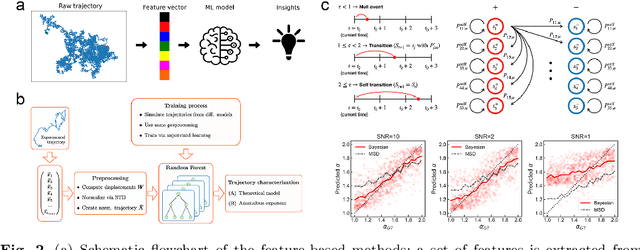
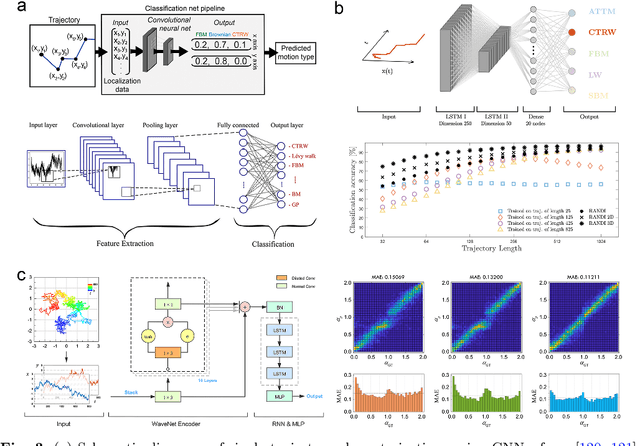
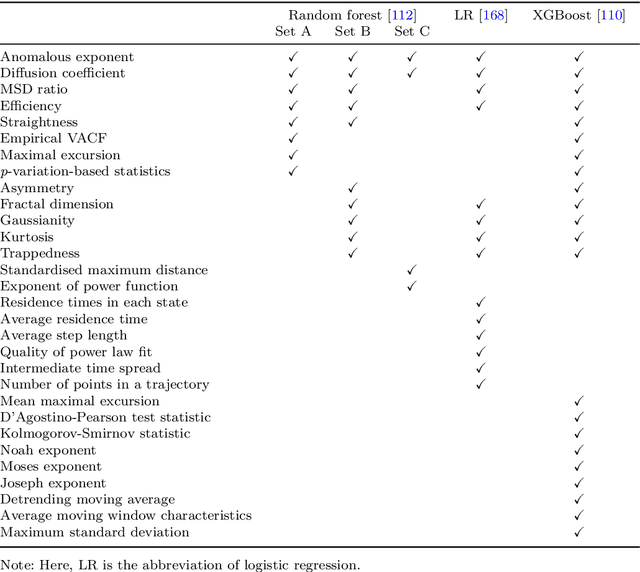
The rapid advancements in machine learning have made its application to anomalous diffusion analysis both essential and inevitable. This review systematically introduces the integration of machine learning techniques for enhanced analysis of anomalous diffusion, focusing on two pivotal aspects: single trajectory characterization via machine learning and representation learning of anomalous diffusion. We extensively compare various machine learning methods, including both classical machine learning and deep learning, used for the inference of diffusion parameters and trajectory segmentation. Additionally, platforms such as the Anomalous Diffusion Challenge that serve as benchmarks for evaluating these methods are highlighted. On the other hand, we outline three primary strategies for representing anomalous diffusion: the combination of predefined features, the feature vector from the penultimate layer of neural network, and the latent representation from the autoencoder, analyzing their applicability across various scenarios. This investigation paves the way for future research, offering valuable perspectives that can further enrich the study of anomalous diffusion and advance the application of artificial intelligence in statistical physics and biophysics.
PuYun: Medium-Range Global Weather Forecasting Using Large Kernel Attention Convolutional Networks
Sep 01, 2024

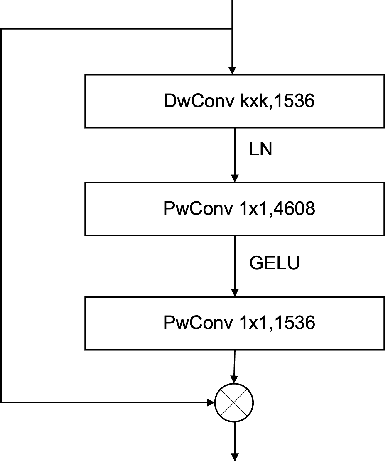
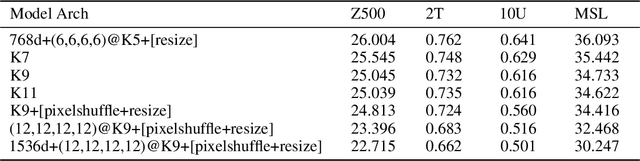
Accurate weather forecasting is essential for understanding and mitigating weather-related impacts. In this paper, we present PuYun, an autoregressive cascade model that leverages large kernel attention convolutional networks. The model's design inherently supports extended weather prediction horizons while broadening the effective receptive field. The integration of large kernel attention mechanisms within the convolutional layers enhances the model's capacity to capture fine-grained spatial details, thereby improving its predictive accuracy for meteorological phenomena. We introduce PuYun, comprising PuYun-Short for 0-5 day forecasts and PuYun-Medium for 5-10 day predictions. This approach enhances the accuracy of 10-day weather forecasting. Through evaluation, we demonstrate that PuYun-Short alone surpasses the performance of both GraphCast and FuXi-Short in generating accurate 10-day forecasts. Specifically, on the 10th day, PuYun-Short reduces the RMSE for Z500 to 720 $m^2/s^2$, compared to 732 $m^2/s^2$ for GraphCast and 740 $m^2/s^2$ for FuXi-Short. Additionally, the RMSE for T2M is reduced to 2.60 K, compared to 2.63 K for GraphCast and 2.65 K for FuXi-Short. Furthermore, when employing a cascaded approach by integrating PuYun-Short and PuYun-Medium, our method achieves superior results compared to the combined performance of FuXi-Short and FuXi-Medium. On the 10th day, the RMSE for Z500 is further reduced to 638 $m^2/s^2$, compared to 641 $m^2/s^2$ for FuXi. These findings underscore the effectiveness of our model ensemble in advancing medium-range weather prediction. Our training code and model will be open-sourced.