 Add to Chrome
 Add to Firefox
 Add to Edge
GDPevo: Evaluating Agent Self-Evolution on Real Business Tasks
Aug 04, 2026
Agent self-evolution updates an agent's persistent state from prior experience and reuses it to solve related tasks more effectively. Evaluating self-evolution is difficult: existing benchmarks provide limited coverage of economically valuable task domains, do not always design training and test tasks such that test-time gains can be attributed to training experience, and remain vulnerable to data contamination. We present GDPevo, an evolution-native benchmark grounded in GDP-related enterprise workflows, together with the fully automated data pipeline that generates it. Its core mechanism, rule hybridization, decomposes each enterprise workflow into atomic business rules, distributes subsets of these rules across training tasks, and recombines them in held-out test tasks so that test-time gains are attributable. GDPevo spans CRM, ERP, finance, healthcare, legal, and data-centric workflows. Its V1 release contains 120 tasks in 12 groups, with five training and five held-out test tasks per group. Full automation enables the pipeline to expand the suite to 240 tasks in 24 groups (V2) within two days, providing a practical response to contamination. Using GDPevo, we evaluate four agents, each comprising a harness and a model, under four supervision types. Self-evolution consistently improves held-out accuracy by up to 16.44 percentage points. But the best evolved agents remain far below the fully informed oracle ceiling of 91.6%, indicating that the self-evolution ability of current agents remains far from fully realized. We publicly release the pipeline, benchmark, and full evaluation results at https://github.com/Prism-Shadow/GDPevo.

Rapid and Accurate Diagnosis of Acute Aortic Syndrome using Non-contrast CT: A Large-scale, Retrospective, Multi-center and AI-based Study
Jun 25, 2024

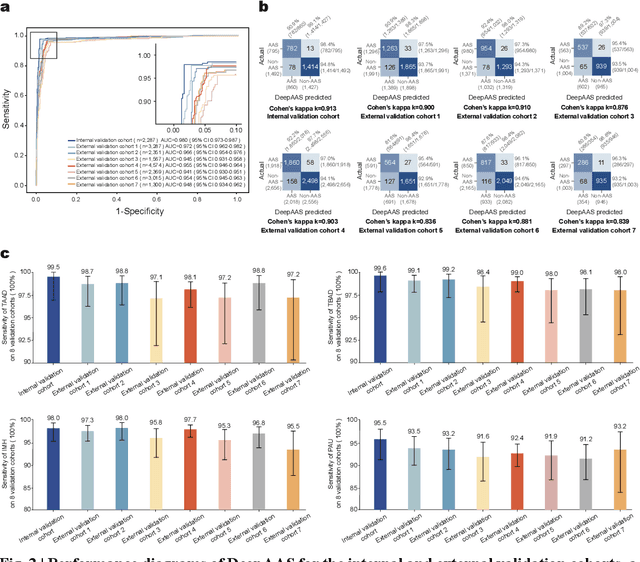

Chest pain symptoms are highly prevalent in emergency departments (EDs), where acute aortic syndrome (AAS) is a catastrophic cardiovascular emergency with a high fatality rate, especially when timely and accurate treatment is not administered. However, current triage practices in the ED can cause up to approximately half of patients with AAS to have an initially missed diagnosis or be misdiagnosed as having other acute chest pain conditions. Subsequently, these AAS patients will undergo clinically inaccurate or suboptimal differential diagnosis. Fortunately, even under these suboptimal protocols, nearly all these patients underwent non-contrast CT covering the aorta anatomy at the early stage of differential diagnosis. In this study, we developed an artificial intelligence model (DeepAAS) using non-contrast CT, which is highly accurate for identifying AAS and provides interpretable results to assist in clinical decision-making. Performance was assessed in two major phases: a multi-center retrospective study (n = 20,750) and an exploration in real-world emergency scenarios (n = 137,525). In the multi-center cohort, DeepAAS achieved a mean area under the receiver operating characteristic curve of 0.958 (95% CI 0.950-0.967). In the real-world cohort, DeepAAS detected 109 AAS patients with misguided initial suspicion, achieving 92.6% (95% CI 76.2%-97.5%) in mean sensitivity and 99.2% (95% CI 99.1%-99.3%) in mean specificity. Our AI model performed well on non-contrast CT at all applicable early stages of differential diagnosis workflows, effectively reduced the overall missed diagnosis and misdiagnosis rate from 48.8% to 4.8% and shortened the diagnosis time for patients with misguided initial suspicion from an average of 681.8 (74-11,820) mins to 68.5 (23-195) mins. DeepAAS could effectively fill the gap in the current clinical workflow without requiring additional tests.