 Add to Chrome
 Add to Firefox
 Add to Edge
Probabilistic Residual Learning for Online Recommendations
Jul 23, 2026
Modern recommender systems are typically based on deep learning (DL) models, where a dense encoder learns representations of users and items. As a result, these systems often suffer from the black-box nature and computational complexity of the underlying models, making it difficult to systematically enhance their recommendation capabilities. To address this problem, we propose Probabilistic Residual Learning (PRL), a causal Bayesian recommendation model that models the residual between ground-truth and base predictions, enabling targeted refinement of existing systems. Specifically, PRL (1) probabilistically groups users for localized residual modeling, (2) models domain-level confounders that influence user and item representations, and (3) aggregates cluster-specific residual predictions over the confounders using do-calculus. Experiments demonstrate that our plug-and-play PRL is compatible with various base deep learning recommender systems, improving their performance while automatically discovering meaningful user clusters.

StochasT: Learning with Stochastic Turn Depth for Visual Instruction Tuning
Jul 01, 2026Large Vision-Language Models (LVLMs) rely extensively on Visual Instruction Tuning (VIT) to elicit their multimodal reasoning capabilities. However, we find a discrepancy: VIT often packs multiple language tasks about the same image for conversational, multi-turn training, whereas existing benchmarks evaluate LVLMs in isolated, single-turn scenarios. The models can suffer from visual attention decay and contextual overfitting during multi-turn training, making it hard for them to realize their full potential in the mismatched test phase. To close the gap, we propose learning with Stochastic Turn Depth (StochasT), which stochastically groups language tasks for the same image into clusters of varying sizes (turn depth) while preserving their organic order. Hence, while StochasT draws on Dropout and stochastic depth for ResNets, it does not actually drop anything to maximize the utility of the training data. Furthermore, we introduce a challenging, benchmark-agnostic evaluation mechanism based on the Balanced Latin Square to measure LVLMs' robustness under varying contextual dependencies. Extensive experiments demonstrate that StochasT effectively grants LVLMs strong, harmonized capabilities for both single-turn and multi-turn use cases.
SSD: Spatially Speculative Decoding Accelerates Autoregressive Image Generation
Jun 18, 2026Autoregressive models excel in visual generation by treating images as 1D sequences of discrete tokens, mirroring language modeling. However, this flattening discards the intrinsic 2D spatial locality of visual signals, creating severe computational bottlenecks during inference. We introduce Spatially Speculative Decoding (SSD), a framework that aligns the predictive objective with the natural geometry of images. Rather than predicting only the immediate next token in a 1D sequence, our model simultaneously predicts the adjacent horizontal token and the token directly below it. By capitalizing on this 2D spatial correlation, spatially speculative decoding overcomes the memory wall in visual inference. Our approach accelerates autoregressive image generation by up to 13.3x while maintaining high fidelity on DPG-Bench and GenEval. Our results suggest that respecting the underlying geometry of vision unlocks massive computational efficiencies, paving the way for real-time, high-resolution autoregressive generative models.
Language-Instructed Vision Embeddings for Controllable and Generalizable Perception
Jun 17, 2026Vision foundation models are typically trained as static feature extractors, placing the burden of task adaptation onto large downstream models. We propose an alternative paradigm: instead of solely feeding visual features into language models, we use language itself to dynamically guide the vision encoder. Our method, Language-Instructed Vision Embeddings (LIVE), leverages language as high-level guidance to produce task-centric embeddings at inference time, removing the need for task-specific retraining. This enables the encoder to focus on contextually relevant aspects of the input, yielding more controllable and generalizable representations. Empirically, LIVE reduces visual hallucinations (+34 points on MMVP), surpasses vision-language models with orders of magnitude more parameters on visual question answering, and generalizes to unseen instructions and tasks -- offering a direct path toward adaptive, instruction-driven visual intelligence.
S$^2$COPE: Self-Supervised Concept Discovery via Preference Learning
Jun 12, 2026Current representation learning paradigms force a fundamental compromise: self-supervised methods scale to massive datasets but yield opaque features, whereas interpretable models remain bottlenecked by the need for dense human annotation. We introduce Self-Supervised Concept discOvery via Preference lEarning (\model), a label-free framework that resolves this dilemma. Instead of treating Vision-Large-Language Models (VLLMs) as static feature extractors, \model leverages them as active participants in a self-supervised preference optimization loop. By autonomously hypothesizing, validating, and reinforcing candidate visual attributes directly from raw imagery, our framework discovers novel, structured concepts without a single label. Extensive experiments across natural, medical, and physics domains demonstrate that \model successfully extracts domain-specific concepts where standard VLLMs often fail to generate. By amortizing concept discovery directly into the VLLM backbone through our self-supervised preference objective -- rather than relying on static generation and disjoint filtering -- we achieve up to a 24-point absolute improvement in downstream top-1 classification accuracy on unseen data. Our work suggest that interpretability can emerge through a model's autonomous interaction with incidental visual structures, without any human supervision.
R-C2: Cycle-Consistent Reinforcement Learning Improves Multimodal Reasoning
Mar 26, 2026Robust perception and reasoning require consistency across sensory modalities. Yet current multimodal models often violate this principle, yielding contradictory predictions for visual and textual representations of the same concept. Rather than masking these failures with standard voting mechanisms, which can amplify systematic biases, we show that cross-modal inconsistency provides a rich and natural signal for learning. We introduce RC2, a reinforcement learning framework that resolves internal conflicts by enforcing cross-modal cycle consistency. By requiring a model to perform backward inference, switch modalities, and reliably reconstruct the answer through forward inference, we obtain a dense, label-free reward. This cyclic constraint encourages the model to align its internal representations autonomously. Optimizing for this structure mitigates modality-specific errors and improves reasoning accuracy by up to 7.6 points. Our results suggest that advanced reasoning emerges not only from scaling data, but also from enforcing a structurally consistent understanding of the world.
APPLV: Adaptive Planner Parameter Learning from Vision-Language-Action Model
Mar 09, 2026Autonomous navigation in highly constrained environments remains challenging for mobile robots. Classical navigation approaches offer safety assurances but require environment-specific parameter tuning; end-to-end learning bypasses parameter tuning but struggles with precise control in constrained spaces. To this end, recent robot learning approaches automate parameter tuning while retaining classical systems' safety, yet still face challenges in generalizing to unseen environments. Recently, Vision-Language-Action (VLA) models have shown promise by leveraging foundation models' scene understanding capabilities, but still struggle with precise control and inference latency in navigation tasks. In this paper, we propose Adaptive Planner Parameter Learning from Vision-Language-Action Model (\textsc{applv}). Unlike traditional VLA models that directly output actions, \textsc{applv} leverages pre-trained vision-language models with a regression head to predict planner parameters that configure classical planners. We develop two training strategies: supervised learning fine-tuning from collected navigation trajectories and reinforcement learning fine-tuning to further optimize navigation performance. We evaluate \textsc{applv} across multiple motion planners on the simulated Benchmark Autonomous Robot Navigation (BARN) dataset and in physical robot experiments. Results demonstrate that \textsc{applv} outperforms existing methods in both navigation performance and generalization to unseen environments.
Differences That Matter: Auditing Models for Capability Gap Discovery and Rectification
Dec 18, 2025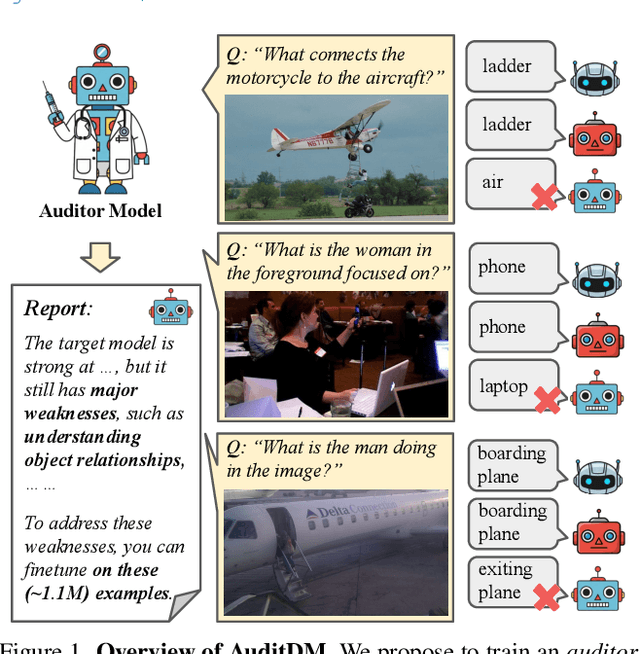
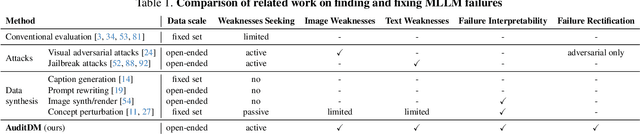
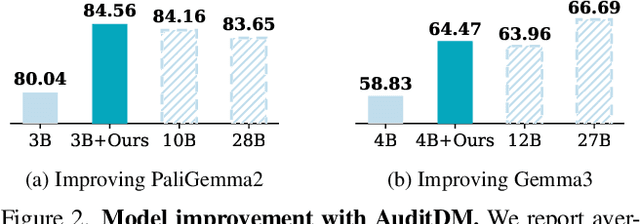
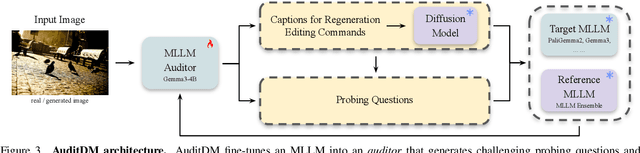
Conventional evaluation methods for multimodal LLMs (MLLMs) lack interpretability and are often insufficient to fully disclose significant capability gaps across models. To address this, we introduce AuditDM, an automated framework that actively discovers and rectifies MLLM failure modes by auditing their divergence. AuditDM fine-tunes an MLLM as an auditor via reinforcement learning to generate challenging questions and counterfactual images that maximize disagreement among target models. Once trained, the auditor uncovers diverse, interpretable exemplars that reveal model weaknesses and serve as annotation-free data for rectification. When applied to SoTA models like Gemma-3 and PaliGemma-2, AuditDM discovers more than 20 distinct failure types. Fine-tuning on these discoveries consistently improves all models across 16 benchmarks, and enables a 3B model to surpass its 28B counterpart. Our results suggest that as data scaling hits diminishing returns, targeted model auditing offers an effective path to model diagnosis and improvement.
Mull-Tokens: Modality-Agnostic Latent Thinking
Dec 11, 2025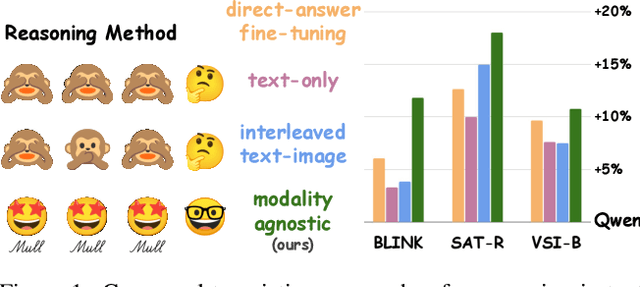
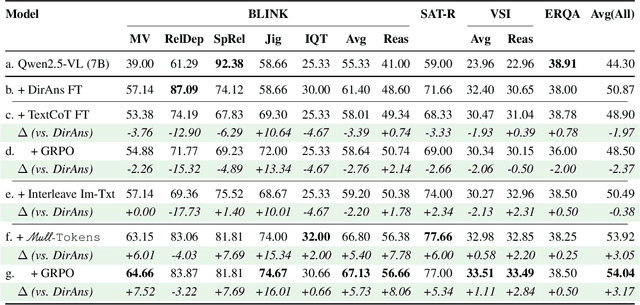
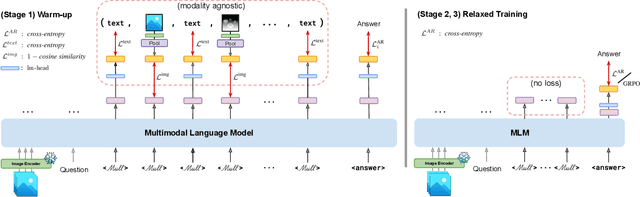
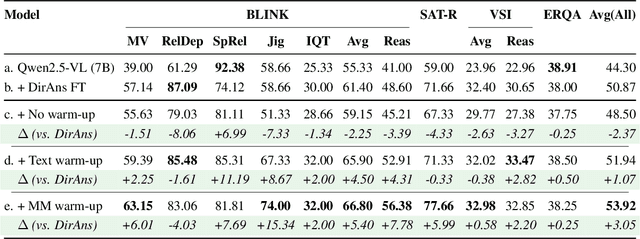
Reasoning goes beyond language; the real world requires reasoning about space, time, affordances, and much more that words alone cannot convey. Existing multimodal models exploring the potential of reasoning with images are brittle and do not scale. They rely on calling specialist tools, costly generation of images, or handcrafted reasoning data to switch between text and image thoughts. Instead, we offer a simpler alternative -- Mull-Tokens -- modality-agnostic latent tokens pre-trained to hold intermediate information in either image or text modalities to let the model think free-form towards the correct answer. We investigate best practices to train Mull-Tokens inspired by latent reasoning frameworks. We first train Mull-Tokens using supervision from interleaved text-image traces, and then fine-tune without any supervision by only using the final answers. Across four challenging spatial reasoning benchmarks involving tasks such as solving puzzles and taking different perspectives, we demonstrate that Mull-Tokens improve upon several baselines utilizing text-only reasoning or interleaved image-text reasoning, achieving a +3% average improvement and up to +16% on a puzzle solving reasoning-heavy split compared to our strongest baseline. Adding to conversations around challenges in grounding textual and visual reasoning, Mull-Tokens offers a simple solution to abstractly think in multiple modalities.
LARGO: Latent Adversarial Reflection through Gradient Optimization for Jailbreaking LLMs
May 16, 2025Efficient red-teaming method to uncover vulnerabilities in Large Language Models (LLMs) is crucial. While recent attacks often use LLMs as optimizers, the discrete language space make gradient-based methods struggle. We introduce LARGO (Latent Adversarial Reflection through Gradient Optimization), a novel latent self-reflection attack that reasserts the power of gradient-based optimization for generating fluent jailbreaking prompts. By operating within the LLM's continuous latent space, LARGO first optimizes an adversarial latent vector and then recursively call the same LLM to decode the latent into natural language. This methodology yields a fast, effective, and transferable attack that produces fluent and stealthy prompts. On standard benchmarks like AdvBench and JailbreakBench, LARGO surpasses leading jailbreaking techniques, including AutoDAN, by 44 points in attack success rate. Our findings demonstrate a potent alternative to agentic LLM prompting, highlighting the efficacy of interpreting and attacking LLM internals through gradient optimization.