 Add to Chrome
 Add to Firefox
 Add to Edge
WALL-WM: Carving World Action Modeling at the Event Joints
Jun 01, 2026
WALL-WM is a World Action Model that shifts video-action learning from chunk-centric optimization to event-grounded Vision-Language-Action pretraining, using semantically coherent action events as the atomic unit of learning. Existing WAMs commonly initialize from multimodal or video foundation models and then optimize fixed-length action chunks conditioned directly on the current observation and instruction. Although convenient, this chunk-centric formulation creates a fundamental granularity mismatch. Language describes semantic goals and events, vision evolves through continuous scene dynamics, and actions operate at control-level timescales; forcing all three into the same fixed-length prediction window turns VLA training into short-horizon correlation fitting. WALL-WM addresses this mismatch by organizing both supervision and data around semantic events. Specifically, it pairs event-grounded VLA pretraining with a data ecosystem built from event-level captions and cluster-balanced sampling, enabling scalable learning over diverse behaviors, scenes, and task structures. From the same event-pretrained backbone, WALL-WM supports two complementary inference modes. The event mode consumes next-event descriptions and enables variable-length execution chunks, while the unified mode uses a VLM with Staircase Decoding to condition conventional fixed-length chunk inference while preserving a gradient-continuous VLA path. Together with Muon-optimizer-based large-scale pretraining infrastructure, WALL-WM provides a practical scale-up recipe for general-purpose WAMs. Experiments show that WALL-WM generalizes broadly across language, scenes, and tasks, achieving state-of-the-art performance in large-scale real-world generalization evaluation.

Wall-OSS-0.5 Technical Report
Jun 01, 2026Large-scale Vision-Language-Action (VLA) pretraining is increasingly adopted as the foundation for robot policies, yet the evidence for pretrained VLAs is almost invariably reported after task-specific fine-tuning. This leaves a foundational question unanswered: does VLA pretraining itself yield executable robot behavior, or does it merely furnish a better initialization for downstream policy learning? We present Wall-OSS-0.5, an open-source 4B VLA built upon a 3B VLM backbone augmented with action-generation components, designed so that pretrained robotic capability is directly measurable on physical hardware. The model is pretrained across more than 20 embodiments, processing over one million robot trajectories per epoch alongside a grounded multimodal corpus. We adopt a gradient-bridged co-training recipe in which three objectives play distinct and complementary roles: discrete action prediction routes strong VLM-native gradients into the backbone, multimodal prediction preserves grounded vision-language understanding, and continuous flow matching serves as the deployment-time action interface. Before task-specific fine-tuning, the pretrained checkpoint achieves non-trivial zero-shot real-robot behavior, completing several tasks, including a held-out deformable manipulation task, at high task progress on a 17-task suite. After fine-tuning, the same checkpoint serves as a stronger adaptation prior, reaching 60.5% average task progress on 15 real-robot tasks and outperforming π_0.5 by 17.5%. Multimodal evaluations further confirm that action training does not erode grounded vision-language competence: the model preserves broad vision-language ability while strengthening embodied grounding. Together, these results reposition VLA pretraining from an initialization strategy to a directly testable, already useful source of robot capability.
Learning When to Stop: Selective Imitation Learning Under Arbitrary Dynamics Shift
May 09, 2026Behavior cloning provides strong imitation learning guarantees when training and test environments share the same dynamics. However, in many deployment settings the test environment's transitions differ from training, and classical offline IL offers no recourse: the learner must commit to an action at every state, even when its demonstrations are uninformative and could lead to arbitrary degradation of performance. This motivates the study of selective imitation, where the learner may choose to stop when it cannot act reliably. We introduce a model for selective imitation under arbitrary dynamics shift: given labeled expert demonstrations from a training environment and unlabeled state trajectories from the same expert in a test environment, the learner outputs a selective policy that is complete (rarely stops in training) and sound (incurs low regret before stopping in test). Our algorithm, SeqRejectron, constructs a stopping rule using a small set of validator policies whose size is independent of the horizon or policy class. For deterministic policies, this yields horizon-free $\tilde{O}(\log|Π|/ε^2)$ sample complexity, assuming sparse costs. For stochastic policies, we obtain analogous horizon-free guarantees using a cumulative Hellinger stopping time. We extend the framework to misspecified experts and different expert policies across train and test and obtain results that gracefully degrade with the amount of misspecification.
Weight Clipping for Robust Conformal Inference under Unbounded Covariate Shifts
May 03, 2026Conformal prediction (CP) provides powerful, distribution-free prediction sets, but its guarantees rely on the exchangeability of training and test data, which is often violated in practice due to covariate shifts. While weighted conformal prediction (WCP) is designed to handle such shifts, it can suffer from significant undercoverage when the density ratio between the distributions is unbounded and/or must be learned. This is because of both overfitting in learning the density ratio, and high variance in estimating the nonconformity score threshold. To address this, we introduce clipped least-squares importance fitting (CLISF) as a reduced-variance method for density ratio estimation. Specifically, we show that density ratios learned using CLISF, when plugged into WCP, have bounded expected undercoverage. Furthermore, we show that the undercoverage can be corrected by running WCP with a slightly inflated coverage target; crucially, we are able to estimate the required level of inflation from the data. We provide the first theoretical guarantees for weight clipping in conformal inference, achieving dataset-conditional coverage with a sample complexity that does not blow up with the higher moments of the true density ratio -- a key limitation of prior work. We verify our results on real-world benchmarks and synthetic data.
Moonshine v2: Ergodic Streaming Encoder ASR for Latency-Critical Speech Applications
Feb 12, 2026Latency-critical speech applications (e.g., live transcription, voice commands, and real-time translation) demand low time-to-first-token (TTFT) and high transcription accuracy, particularly on resource-constrained edge devices. Full-attention Transformer encoders remain a strong accuracy baseline for automatic speech recognition (ASR) because every frame can directly attend to every other frame, which resolves otherwise locally ambiguous acoustics using distant lexical context. However, this global dependency incurs quadratic complexity in sequence length, inducing an inherent "encode-the-whole-utterance" latency profile. For streaming use cases, this causes TTFT to grow linearly with utterance length as the encoder must process the entire prefix before any decoder token can be emitted. To better meet the needs of on-device, streaming ASR use cases we introduce Moonshine v2, an ergodic streaming-encoder ASR model that employs sliding-window self-attention to achieve bounded, low-latency inference while preserving strong local context. Our models achieve state of the art word error rates across standard benchmarks, attaining accuracy on-par with models 6x their size while running significantly faster. These results demonstrate that carefully designed local attention is competitive with the accuracy of full attention at a fraction of the size and latency cost, opening new possibilities for interactive speech interfaces on edge devices.
A Migration-Assisted Deep Learning Scheme for Imaging Defects Inside Cylindrical Structures via GPR: A Case Study for Tree Trunks
Feb 05, 2026Ground-penetrating radar (GPR) has emerged as a prominent tool for imaging internal defects in cylindrical structures, such as columns, utility poles, and tree trunks. However, accurately reconstructing both the shape and permittivity of the defects inside cylindrical structures remains challenging due to complex wave scattering phenomena and the limited accuracy of the existing signal processing and deep learning techniques. To address these issues, this study proposes a migration-assisted deep learning scheme for reconstructing the shape and permittivity of defects within cylindrical structures. The proposed scheme involves three stages of GPR data processing. First, a dual-permittivity estimation network extracts the permittivity values of the defect and the cylindrical structure, the latter of which is estimated with the help of a novel structural similarity index measure-based autofocusing technique. Second, a modified Kirchhoff migration incorporating the extracted permittivity of the cylindrical structure maps the signals reflected from the defect to the imaging domain. Third, a shape reconstruction network processes the migrated image to recover the precise shape of the defect. The image of the interior defect is finally obtained by combining the reconstructed shape and extracted permittivity of the defect. The proposed scheme is validated using both synthetic and experimental data from a laboratory trunk model and real tree trunk samples. Comparative results show superior performance over existing deep learning methods, while generalization tests on live trees confirm its feasibility for in-field deployment. The underlying principle can further be applied to other circumferential GPR imaging scenarios. The code and database are available at: https://github.com/jwqian54/Migration-Assisted-DL.
MiroThinker: Pushing the Performance Boundaries of Open-Source Research Agents via Model, Context, and Interactive Scaling
Nov 18, 2025We present MiroThinker v1.0, an open-source research agent designed to advance tool-augmented reasoning and information-seeking capabilities. Unlike previous agents that only scale up model size or context length, MiroThinker explores interaction scaling at the model level, systematically training the model to handle deeper and more frequent agent-environment interactions as a third dimension of performance improvement. Unlike LLM test-time scaling, which operates in isolation and risks degradation with longer reasoning chains, interactive scaling leverages environment feedback and external information acquisition to correct errors and refine trajectories. Through reinforcement learning, the model achieves efficient interaction scaling: with a 256K context window, it can perform up to 600 tool calls per task, enabling sustained multi-turn reasoning and complex real-world research workflows. Across four representative benchmarks-GAIA, HLE, BrowseComp, and BrowseComp-ZH-the 72B variant achieves up to 81.9%, 37.7%, 47.1%, and 55.6% accuracy respectively, surpassing previous open-source agents and approaching commercial counterparts such as GPT-5-high. Our analysis reveals that MiroThinker benefits from interactive scaling consistently: research performance improves predictably as the model engages in deeper and more frequent agent-environment interactions, demonstrating that interaction depth exhibits scaling behaviors analogous to model size and context length. These findings establish interaction scaling as a third critical dimension for building next-generation open research agents, complementing model capacity and context windows.
Synthetic CT Generation from Time-of-Flight Non-Attenutaion-Corrected PET for Whole-Body PET Attenuation Correction
Apr 10, 2025Positron Emission Tomography (PET) imaging requires accurate attenuation correction (AC) to account for photon loss due to tissue density variations. In PET/MR systems, computed tomography (CT), which offers a straightforward estimation of AC is not available. This study presents a deep learning approach to generate synthetic CT (sCT) images directly from Time-of-Flight (TOF) non-attenuation corrected (NAC) PET images, enhancing AC for PET/MR. We first evaluated models pre-trained on large-scale natural image datasets for a CT-to-CT reconstruction task, finding that the pre-trained model outperformed those trained solely on medical datasets. The pre-trained model was then fine-tuned using an institutional dataset of 35 TOF NAC PET and CT volume pairs, achieving the lowest mean absolute error (MAE) of 74.49 HU and highest peak signal-to-noise ratio (PSNR) of 28.66 dB within the body contour region. Visual assessments demonstrated improved reconstruction of both bone and soft tissue structures from TOF NAC PET images. This work highlights the effectiveness of using pre-trained deep learning models for medical image translation tasks. Future work will assess the impact of sCT on PET attenuation correction and explore additional neural network architectures and datasets to further enhance performance and practical applications in PET imaging.
Logarithmic Regret for Nonlinear Control
Jan 17, 2025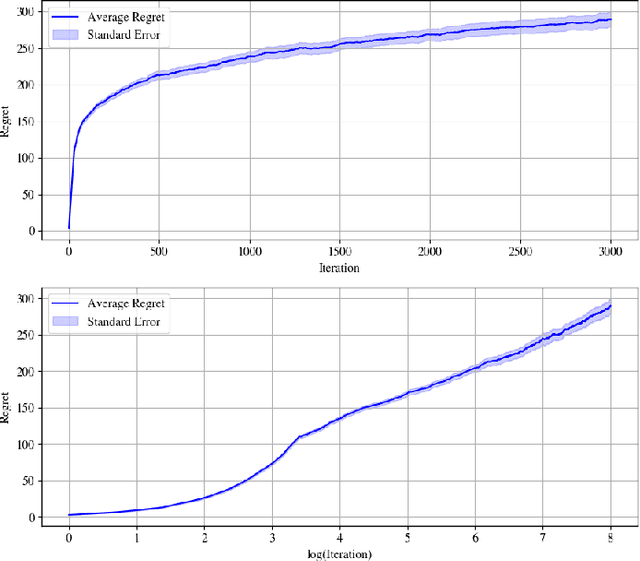
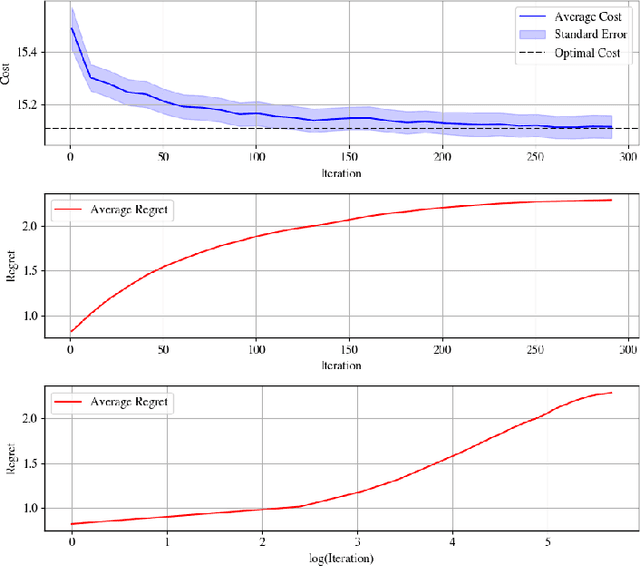
We address the problem of learning to control an unknown nonlinear dynamical system through sequential interactions. Motivated by high-stakes applications in which mistakes can be catastrophic, such as robotics and healthcare, we study situations where it is possible for fast sequential learning to occur. Fast sequential learning is characterized by the ability of the learning agent to incur logarithmic regret relative to a fully-informed baseline. We demonstrate that fast sequential learning is achievable in a diverse class of continuous control problems where the system dynamics depend smoothly on unknown parameters, provided the optimal control policy is persistently exciting. Additionally, we derive a regret bound which grows with the square root of the number of interactions for cases where the optimal policy is not persistently exciting. Our results provide the first regret bounds for controlling nonlinear dynamical systems depending nonlinearly on unknown parameters. We validate the trends our theory predicts in simulation on a simple dynamical system.
Moonshine: Speech Recognition for Live Transcription and Voice Commands
Oct 21, 2024
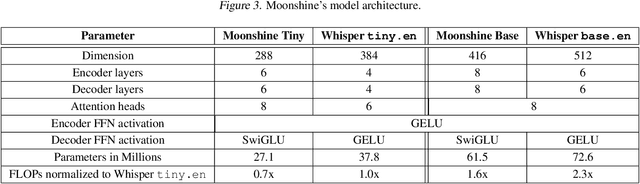

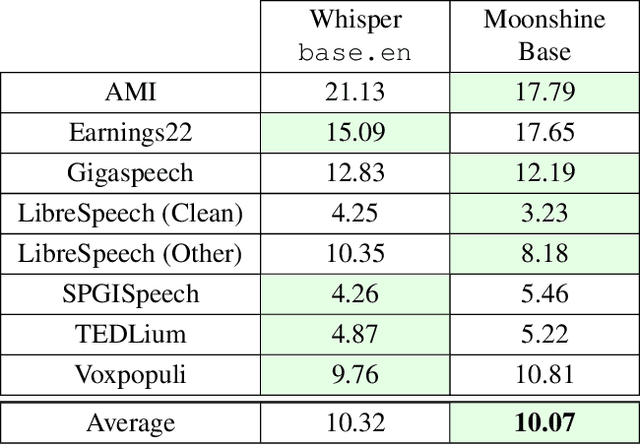
This paper introduces Moonshine, a family of speech recognition models optimized for live transcription and voice command processing. Moonshine is based on an encoder-decoder transformer architecture and employs Rotary Position Embedding (RoPE) instead of traditional absolute position embeddings. The model is trained on speech segments of various lengths, but without using zero-padding, leading to greater efficiency for the encoder during inference time. When benchmarked against OpenAI's Whisper tiny.en, Moonshine Tiny demonstrates a 5x reduction in compute requirements for transcribing a 10-second speech segment while incurring no increase in word error rates across standard evaluation datasets. These results highlight Moonshine's potential for real-time and resource-constrained applications.