 Add to Chrome
 Add to Firefox
 Add to Edge
Composer 2 Technical Report
Mar 25, 2026
Composer 2 is a specialized model designed for agentic software engineering. The model demonstrates strong long-term planning and coding intelligence while maintaining the ability to efficiently solve problems for interactive use. The model is trained in two phases: first, continued pretraining to improve the model's knowledge and latent coding ability, followed by large-scale reinforcement learning to improve end-to-end coding performance through stronger reasoning, accurate multi-step execution, and coherence on long-horizon realistic coding problems. We develop infrastructure to support training in the same Cursor harness that is used by the deployed model, with equivalent tools and structure, and use environments that match real problems closely. To measure the ability of the model on increasingly difficult tasks, we introduce a benchmark derived from real software engineering problems in large codebases including our own. Composer 2 is a frontier-level coding model and demonstrates a process for training strong domain-specialized models. On our CursorBench evaluations the model achieves a major improvement in accuracy compared to previous Composer models (61.3). On public benchmarks the model scores 61.7 on Terminal-Bench and 73.7 on SWE-bench Multilingual in our harness, comparable to state-of-the-art systems.

I Can Hear You: Selective Robust Training for Deepfake Audio Detection
Oct 31, 2024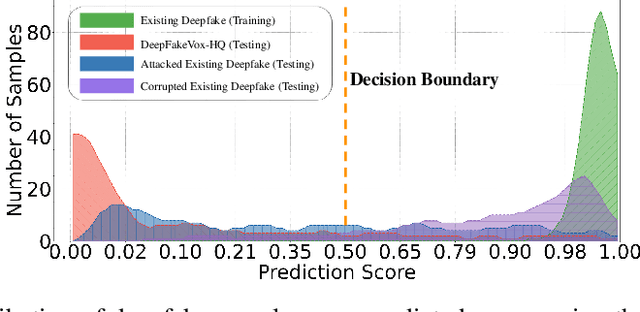
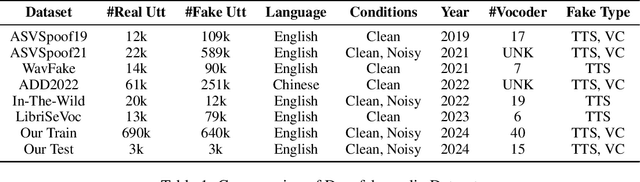
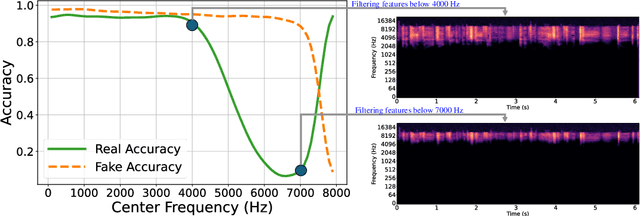
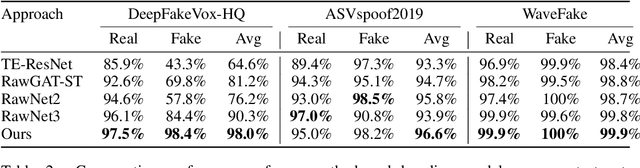
Recent advances in AI-generated voices have intensified the challenge of detecting deepfake audio, posing risks for scams and the spread of disinformation. To tackle this issue, we establish the largest public voice dataset to date, named DeepFakeVox-HQ, comprising 1.3 million samples, including 270,000 high-quality deepfake samples from 14 diverse sources. Despite previously reported high accuracy, existing deepfake voice detectors struggle with our diversely collected dataset, and their detection success rates drop even further under realistic corruptions and adversarial attacks. We conduct a holistic investigation into factors that enhance model robustness and show that incorporating a diversified set of voice augmentations is beneficial. Moreover, we find that the best detection models often rely on high-frequency features, which are imperceptible to humans and can be easily manipulated by an attacker. To address this, we propose the F-SAT: Frequency-Selective Adversarial Training method focusing on high-frequency components. Empirical results demonstrate that using our training dataset boosts baseline model performance (without robust training) by 33%, and our robust training further improves accuracy by 7.7% on clean samples and by 29.3% on corrupted and attacked samples, over the state-of-the-art RawNet3 model.