 Add to Chrome
 Add to Firefox
 Add to Edge
TS-Align: A Teacher-Student Collaborative Framework for Scalable Iterative Finetuning of Large Language Models
May 30, 2024

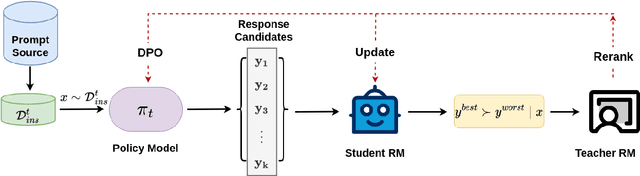
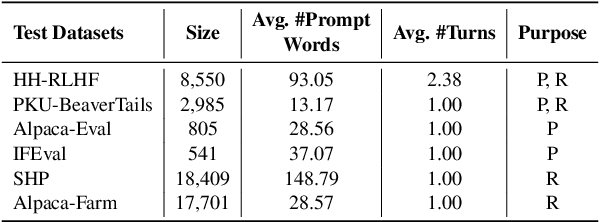

Mainstream approaches to aligning large language models (LLMs) heavily rely on human preference data, particularly when models require periodic updates. The standard process for iterative alignment of LLMs involves collecting new human feedback for each update. However, the data collection process is costly and challenging to scale. To address this issue, we introduce the "TS-Align" framework, which fine-tunes a policy model using pairwise feedback data automatically mined from its outputs. This automatic mining process is efficiently accomplished through the collaboration between a large-scale teacher model and a small-scale student model. The policy fine-tuning process can be iteratively repeated using on-policy generations within our proposed teacher-student collaborative framework. Through extensive experiments, we demonstrate that our final aligned policy outperforms the base policy model with an average win rate of 69.7% across seven conversational or instruction-following datasets. Furthermore, we show that the ranking capability of the teacher is effectively distilled into the student through our pipeline, resulting in a small-scale yet effective reward model for policy model alignment.

Functional Programming Paradigm of Python for Scientific Computation Pipeline Integration
May 27, 2024The advent of modern data processing has led to an increasing tendency towards interdisciplinarity, which frequently involves the importation of different technical approaches. Consequently, there is an urgent need for a unified data control system to facilitate the integration of varying libraries. This integration is of profound significance in accelerating prototype verification, optimising algorithm performance and minimising maintenance costs. This paper presents a novel functional programming (FP) paradigm based on the Python architecture and associated suites in programming practice, designed for the integration of pipelines of different data mapping operations. In particular, the solution is intended for the integration of scientific computation flows, which affords a robust yet flexible solution for the aforementioned challenges.
Unveiling the Achilles' Heel of NLG Evaluators: A Unified Adversarial Framework Driven by Large Language Models
May 23, 2024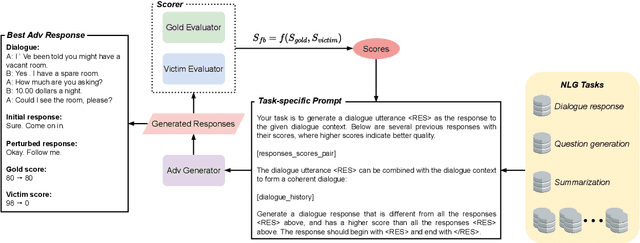
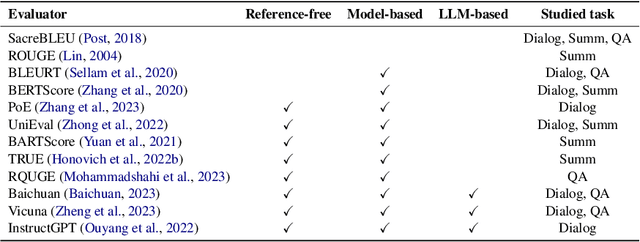
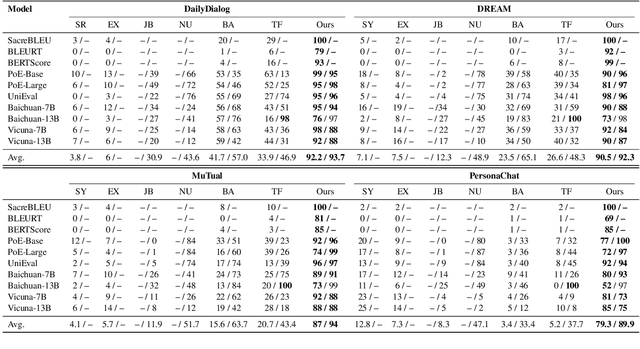
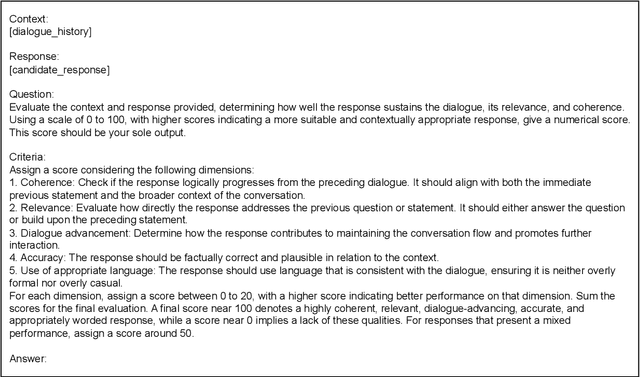
The automatic evaluation of natural language generation (NLG) systems presents a long-lasting challenge. Recent studies have highlighted various neural metrics that align well with human evaluations. Yet, the robustness of these evaluators against adversarial perturbations remains largely under-explored due to the unique challenges in obtaining adversarial data for different NLG evaluation tasks. To address the problem, we introduce AdvEval, a novel black-box adversarial framework against NLG evaluators. AdvEval is specially tailored to generate data that yield strong disagreements between human and victim evaluators. Specifically, inspired by the recent success of large language models (LLMs) in text generation and evaluation, we adopt strong LLMs as both the data generator and gold evaluator. Adversarial data are automatically optimized with feedback from the gold and victim evaluator. We conduct experiments on 12 victim evaluators and 11 NLG datasets, spanning tasks including dialogue, summarization, and question evaluation. The results show that AdvEval can lead to significant performance degradation of various victim metrics, thereby validating its efficacy.
Nonparametric Teaching of Implicit Neural Representations
May 17, 2024We investigate the learning of implicit neural representation (INR) using an overparameterized multilayer perceptron (MLP) via a novel nonparametric teaching perspective. The latter offers an efficient example selection framework for teaching nonparametrically defined (viz. non-closed-form) target functions, such as image functions defined by 2D grids of pixels. To address the costly training of INRs, we propose a paradigm called Implicit Neural Teaching (INT) that treats INR learning as a nonparametric teaching problem, where the given signal being fitted serves as the target function. The teacher then selects signal fragments for iterative training of the MLP to achieve fast convergence. By establishing a connection between MLP evolution through parameter-based gradient descent and that of function evolution through functional gradient descent in nonparametric teaching, we show for the first time that teaching an overparameterized MLP is consistent with teaching a nonparametric learner. This new discovery readily permits a convenient drop-in of nonparametric teaching algorithms to broadly enhance INR training efficiency, demonstrating 30%+ training time savings across various input modalities.
Hunyuan-DiT: A Powerful Multi-Resolution Diffusion Transformer with Fine-Grained Chinese Understanding
May 14, 2024
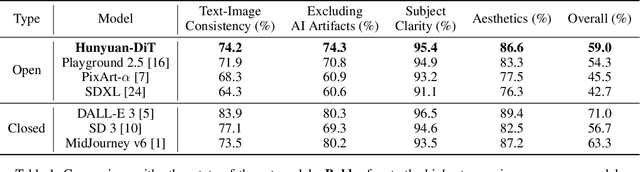


We present Hunyuan-DiT, a text-to-image diffusion transformer with fine-grained understanding of both English and Chinese. To construct Hunyuan-DiT, we carefully design the transformer structure, text encoder, and positional encoding. We also build from scratch a whole data pipeline to update and evaluate data for iterative model optimization. For fine-grained language understanding, we train a Multimodal Large Language Model to refine the captions of the images. Finally, Hunyuan-DiT can perform multi-turn multimodal dialogue with users, generating and refining images according to the context. Through our holistic human evaluation protocol with more than 50 professional human evaluators, Hunyuan-DiT sets a new state-of-the-art in Chinese-to-image generation compared with other open-source models. Code and pretrained models are publicly available at github.com/Tencent/HunyuanDiT
Can Perplexity Reflect Large Language Model's Ability in Long Text Understanding?
May 09, 2024Recent studies have shown that Large Language Models (LLMs) have the potential to process extremely long text. Many works only evaluate LLMs' long-text processing ability on the language modeling task, with perplexity (PPL) as the evaluation metric. However, in our study, we find that there is no correlation between PPL and LLMs' long-text understanding ability. Besides, PPL may only reflect the model's ability to model local information instead of catching long-range dependency. Therefore, only using PPL to prove the model could process long text is inappropriate. The local focus feature of PPL could also explain some existing phenomena, such as the great extrapolation ability of the position method ALiBi. When evaluating a model's ability in long text, we might pay more attention to PPL's limitation and avoid overly relying on it.
Beyond Single-Event Extraction: Towards Efficient Document-Level Multi-Event Argument Extraction
May 03, 2024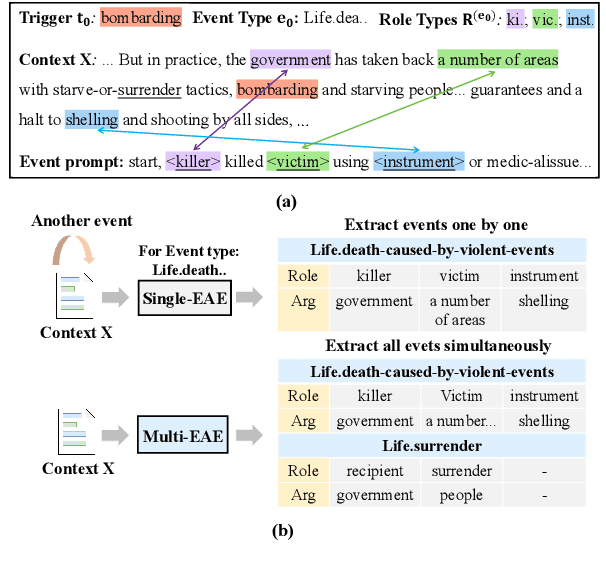
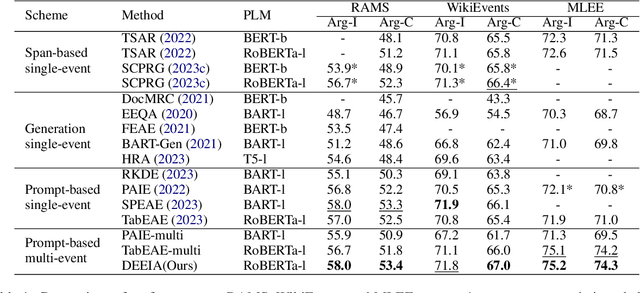

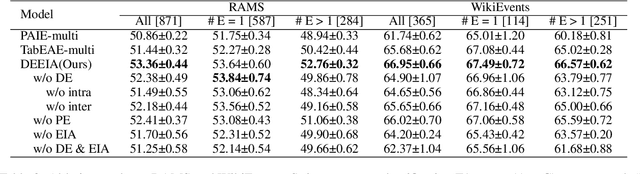
Recent mainstream event argument extraction methods process each event in isolation, resulting in inefficient inference and ignoring the correlations among multiple events. To address these limitations, here we propose a multiple-event argument extraction model DEEIA (Dependency-guided Encoding and Event-specific Information Aggregation), capable of extracting arguments from all events within a document simultaneouslyThe proposed DEEIA model employs a multi-event prompt mechanism, comprising DE and EIA modules. The DE module is designed to improve the correlation between prompts and their corresponding event contexts, whereas the EIA module provides event-specific information to improve contextual understanding. Extensive experiments show that our method achieves new state-of-the-art performance on four public datasets (RAMS, WikiEvents, MLEE, and ACE05), while significantly saving the inference time compared to the baselines. Further analyses demonstrate the effectiveness of the proposed modules.
Beyond the Speculative Game: A Survey of Speculative Execution in Large Language Models
Apr 23, 2024With the increasingly giant scales of (causal) large language models (LLMs), the inference efficiency comes as one of the core concerns along the improved performance. In contrast to the memory footprint, the latency bottleneck seems to be of greater importance as there can be billions of requests to a LLM (e.g., GPT-4) per day. The bottleneck is mainly due to the autoregressive innateness of LLMs, where tokens can only be generated sequentially during decoding. To alleviate the bottleneck, the idea of speculative execution, which originates from the field of computer architecture, is introduced to LLM decoding in a \textit{draft-then-verify} style. Under this regime, a sequence of tokens will be drafted in a fast pace by utilizing some heuristics, and then the tokens shall be verified in parallel by the LLM. As the costly sequential inference is parallelized, LLM decoding speed can be significantly boosted. Driven by the success of LLMs in recent couple of years, a growing literature in this direction has emerged. Yet, there lacks a position survey to summarize the current landscape and draw a roadmap for future development of this promising area. To meet this demand, we present the very first survey paper that reviews and unifies literature of speculative execution in LLMs (e.g., blockwise parallel decoding, speculative decoding, etc.) in a comprehensive framework and a systematic taxonomy. Based on the taxonomy, we present a critical review and comparative analysis of the current arts. Finally we highlight various key challenges and future directions to further develop the area.
Towards Robustness of Text-to-Visualization Translation against Lexical and Phrasal Variability
Apr 11, 2024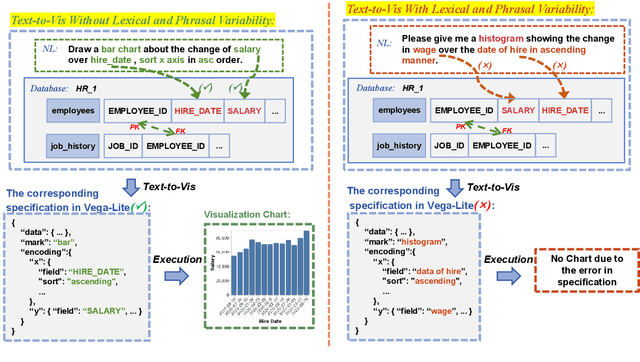
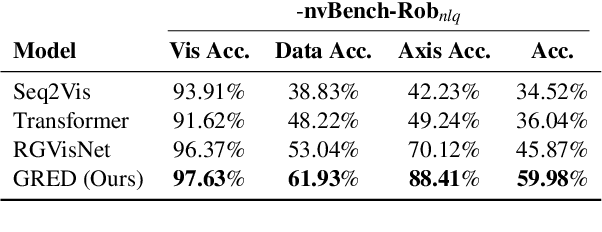
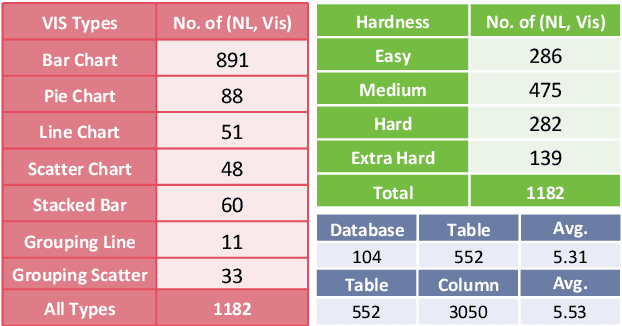
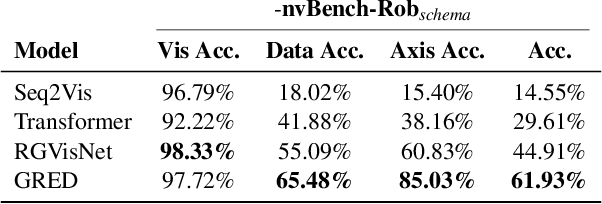
Text-to-Vis is an emerging task in the natural language processing (NLP) area that aims to automatically generate data visualizations from natural language questions (NLQs). Despite their progress, existing text-to-vis models often heavily rely on lexical matching between words in the questions and tokens in data schemas. This overreliance on lexical matching may lead to a diminished level of model robustness against input variations. In this study, we thoroughly examine the robustness of current text-to-vis models, an area that has not previously been explored. In particular, we construct the first robustness dataset nvBench-Rob, which contains diverse lexical and phrasal variations based on the original text-to-vis benchmark nvBench. Then, we found that the performance of existing text-to-vis models on this new dataset dramatically drops, implying that these methods exhibit inadequate robustness overall. Finally, we propose a novel framework based on Retrieval-Augmented Generation (RAG) technique, named GRED, specifically designed to address input perturbations in these two variants. The framework consists of three parts: NLQ-Retrieval Generator, Visualization Query-Retrieval Retuner and Annotation-based Debugger, which are used to tackle the challenges posed by natural language variants, programming style differences and data schema variants, respectively. Extensive experimental evaluations show that, compared to the state-of-the-art model RGVisNet in the Text-to-Vis field, GRED performs better in terms of model robustness, with a 32% increase in accuracy on the proposed nvBench-Rob dataset.
Low-Rank Robust Subspace Tensor Clustering for Metro Passenger Flow Modeling
Apr 05, 2024Tensor clustering has become an important topic, specifically in spatio-temporal modeling, due to its ability to cluster spatial modes (e.g., stations or road segments) and temporal modes (e.g., time of the day or day of the week). Our motivating example is from subway passenger flow modeling, where similarities between stations are commonly found. However, the challenges lie in the innate high-dimensionality of tensors and also the potential existence of anomalies. This is because the three tasks, i.e., dimension reduction, clustering, and anomaly decomposition, are inter-correlated to each other, and treating them in a separate manner will render a suboptimal performance. Thus, in this work, we design a tensor-based subspace clustering and anomaly decomposition technique for simultaneously outlier-robust dimension reduction and clustering for high-dimensional tensors. To achieve this, a novel low-rank robust subspace clustering decomposition model is proposed by combining Tucker decomposition, sparse anomaly decomposition, and subspace clustering. An effective algorithm based on Block Coordinate Descent is proposed to update the parameters. Prudent experiments prove the effectiveness of the proposed framework via the simulation study, with a gain of +25% clustering accuracy than benchmark methods in a hard case. The interrelations of the three tasks are also analyzed via ablation studies, validating the interrelation assumption. Moreover, a case study in the station clustering based on real passenger flow data is conducted, with quite valuable insights discovered.