 Add to Chrome
 Add to Firefox
 Add to Edge
Aligning Knowledge Graph with Visual Perception for Object-goal Navigation
Feb 29, 2024
Object-goal navigation is a challenging task that requires guiding an agent to specific objects based on first-person visual observations. The ability of agent to comprehend its surroundings plays a crucial role in achieving successful object finding. However, existing knowledge-graph-based navigators often rely on discrete categorical one-hot vectors and vote counting strategy to construct graph representation of the scenes, which results in misalignment with visual images. To provide more accurate and coherent scene descriptions and address this misalignment issue, we propose the Aligning Knowledge Graph with Visual Perception (AKGVP) method for object-goal navigation. Technically, our approach introduces continuous modeling of the hierarchical scene architecture and leverages visual-language pre-training to align natural language description with visual perception. The integration of a continuous knowledge graph architecture and multimodal feature alignment empowers the navigator with a remarkable zero-shot navigation capability. We extensively evaluate our method using the AI2-THOR simulator and conduct a series of experiments to demonstrate the effectiveness and efficiency of our navigator. Code available: https://github.com/nuoxu/AKGVP.

Discovering More Effective Tensor Network Structure Search Algorithms via Large Language Models (LLMs)
Feb 04, 2024
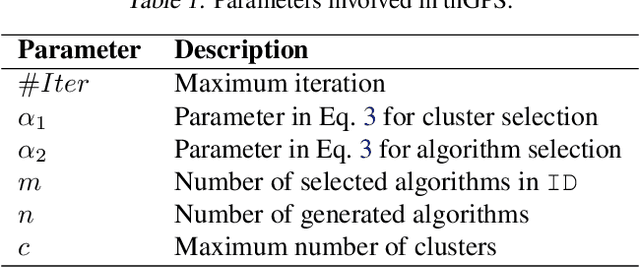


Tensor network structure search (TN-SS), aiming at searching for suitable tensor network (TN) structures in representing high-dimensional problems, largely promotes the efficacy of TN in various machine learning applications. Nonetheless, finding a satisfactory TN structure using existing algorithms remains challenging. To develop more effective algorithms and avoid the human labor-intensive development process, we explore the knowledge embedded in large language models (LLMs) for the automatic design of TN-SS algorithms. Our approach, dubbed GPTN-SS, leverages an elaborate crafting LLM-based prompting system that operates in an evolutionary-like manner. The experimental results, derived from real-world data, demonstrate that GPTN-SS can effectively leverage the insights gained from existing methods to develop novel TN-SS algorithms that achieve a better balance between exploration and exploitation. These algorithms exhibit superior performance in searching the high-quality TN structures for natural image compression and model parameters compression while also demonstrating generalizability in their performance.
NOAH: Learning Pairwise Object Category Attentions for Image Classification
Feb 04, 2024A modern deep neural network (DNN) for image classification tasks typically consists of two parts: a backbone for feature extraction, and a head for feature encoding and class predication. We observe that the head structures of mainstream DNNs adopt a similar feature encoding pipeline, exploiting global feature dependencies while disregarding local ones. In this paper, we revisit the feature encoding problem, and propose Non-glObal Attentive Head (NOAH) that relies on a new form of dot-product attention called pairwise object category attention (POCA), efficiently exploiting spatially dense category-specific attentions to augment classification performance. NOAH introduces a neat combination of feature split, transform and merge operations to learn POCAs at local to global scales. As a drop-in design, NOAH can be easily used to replace existing heads of various types of DNNs, improving classification performance while maintaining similar model efficiency. We validate the effectiveness of NOAH on ImageNet classification benchmark with 25 DNN architectures spanning convolutional neural networks, vision transformers and multi-layer perceptrons. In general, NOAH is able to significantly improve the performance of lightweight DNNs, e.g., showing 3.14\%|5.3\%|1.9\% top-1 accuracy improvement to MobileNetV2 (0.5x)|Deit-Tiny (0.5x)|gMLP-Tiny (0.5x). NOAH also generalizes well when applied to medium-size and large-size DNNs. We further show that NOAH retains its efficacy on other popular multi-class and multi-label image classification benchmarks as well as in different training regimes, e.g., showing 3.6\%|1.1\% mAP improvement to large ResNet101|ViT-Large on MS-COCO dataset. Project page: https://github.com/OSVAI/NOAH.
Adversarial Training on Purification (AToP): Advancing Both Robustness and Generalization
Jan 29, 2024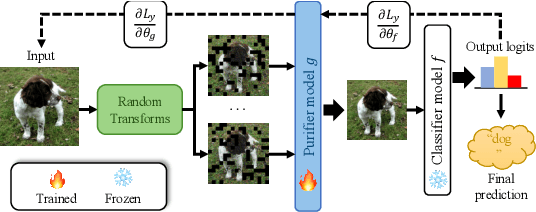
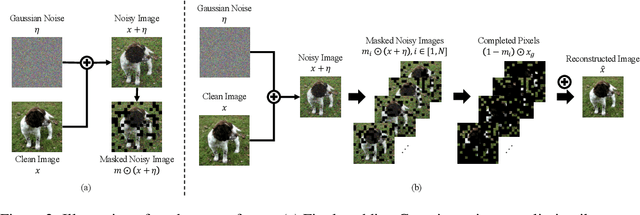
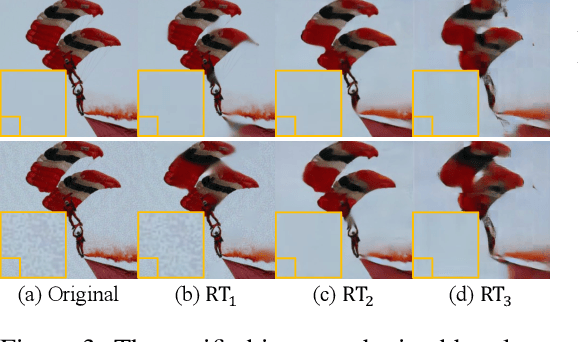
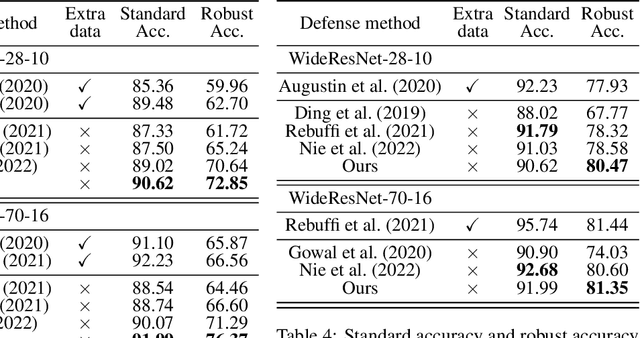
The deep neural networks are known to be vulnerable to well-designed adversarial attacks. The most successful defense technique based on adversarial training (AT) can achieve optimal robustness against particular attacks but cannot generalize well to unseen attacks. Another effective defense technique based on adversarial purification (AP) can enhance generalization but cannot achieve optimal robustness. Meanwhile, both methods share one common limitation on the degraded standard accuracy. To mitigate these issues, we propose a novel framework called Adversarial Training on Purification (AToP), which comprises two components: perturbation destruction by random transforms (RT) and purifier model fine-tuned (FT) by adversarial loss. RT is essential to avoid overlearning to known attacks resulting in the robustness generalization to unseen attacks and FT is essential for the improvement of robustness. To evaluate our method in an efficient and scalable way, we conduct extensive experiments on CIFAR-10, CIFAR-100, and ImageNette to demonstrate that our method achieves state-of-the-art results and exhibits generalization ability against unseen attacks.
SAR-RARP50: Segmentation of surgical instrumentation and Action Recognition on Robot-Assisted Radical Prostatectomy Challenge
Dec 31, 2023

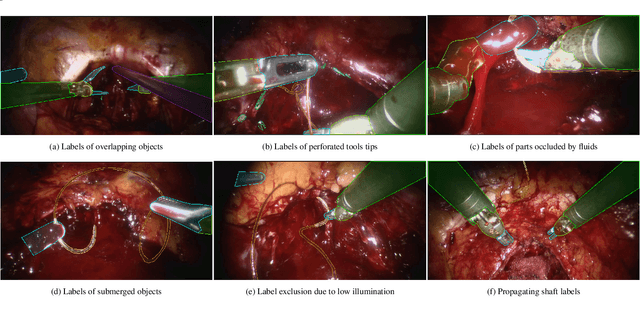
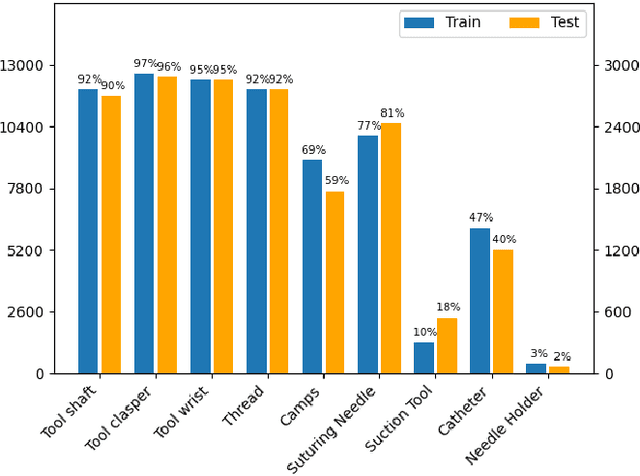
Surgical tool segmentation and action recognition are fundamental building blocks in many computer-assisted intervention applications, ranging from surgical skills assessment to decision support systems. Nowadays, learning-based action recognition and segmentation approaches outperform classical methods, relying, however, on large, annotated datasets. Furthermore, action recognition and tool segmentation algorithms are often trained and make predictions in isolation from each other, without exploiting potential cross-task relationships. With the EndoVis 2022 SAR-RARP50 challenge, we release the first multimodal, publicly available, in-vivo, dataset for surgical action recognition and semantic instrumentation segmentation, containing 50 suturing video segments of Robotic Assisted Radical Prostatectomy (RARP). The aim of the challenge is twofold. First, to enable researchers to leverage the scale of the provided dataset and develop robust and highly accurate single-task action recognition and tool segmentation approaches in the surgical domain. Second, to further explore the potential of multitask-based learning approaches and determine their comparative advantage against their single-task counterparts. A total of 12 teams participated in the challenge, contributing 7 action recognition methods, 9 instrument segmentation techniques, and 4 multitask approaches that integrated both action recognition and instrument segmentation.
A Polarization and Radiomics Feature Fusion Network for the Classification of Hepatocellular Carcinoma and Intrahepatic Cholangiocarcinoma
Dec 27, 2023Classifying hepatocellular carcinoma (HCC) and intrahepatic cholangiocarcinoma (ICC) is a critical step in treatment selection and prognosis evaluation for patients with liver diseases. Traditional histopathological diagnosis poses challenges in this context. In this study, we introduce a novel polarization and radiomics feature fusion network, which combines polarization features obtained from Mueller matrix images of liver pathological samples with radiomics features derived from corresponding pathological images to classify HCC and ICC. Our fusion network integrates a two-tier fusion approach, comprising early feature-level fusion and late classification-level fusion. By harnessing the strengths of polarization imaging techniques and image feature-based machine learning, our proposed fusion network significantly enhances classification accuracy. Notably, even at reduced imaging resolutions, the fusion network maintains robust performance due to the additional information provided by polarization features, which may not align with human visual perception. Our experimental results underscore the potential of this fusion network as a powerful tool for computer-aided diagnosis of HCC and ICC, showcasing the benefits and prospects of integrating polarization imaging techniques into the current image-intensive digital pathological diagnosis. We aim to contribute this innovative approach to top-tier journals, offering fresh insights and valuable tools in the fields of medical imaging and cancer diagnosis. By introducing polarization imaging into liver cancer classification, we demonstrate its interdisciplinary potential in addressing challenges in medical image analysis, promising advancements in medical imaging and cancer diagnosis.
Augmentation-Free Dense Contrastive Knowledge Distillation for Efficient Semantic Segmentation
Dec 07, 2023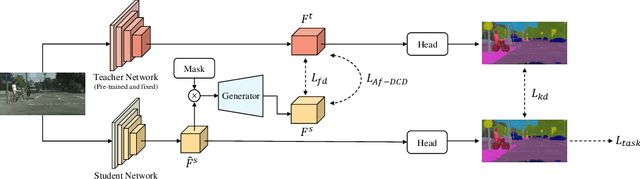
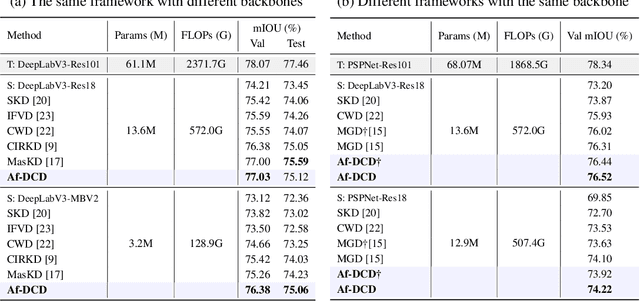
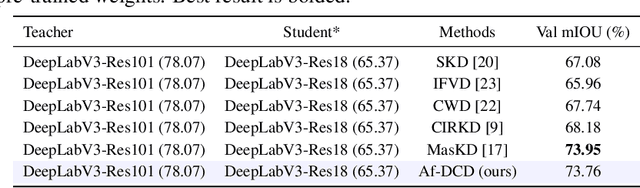
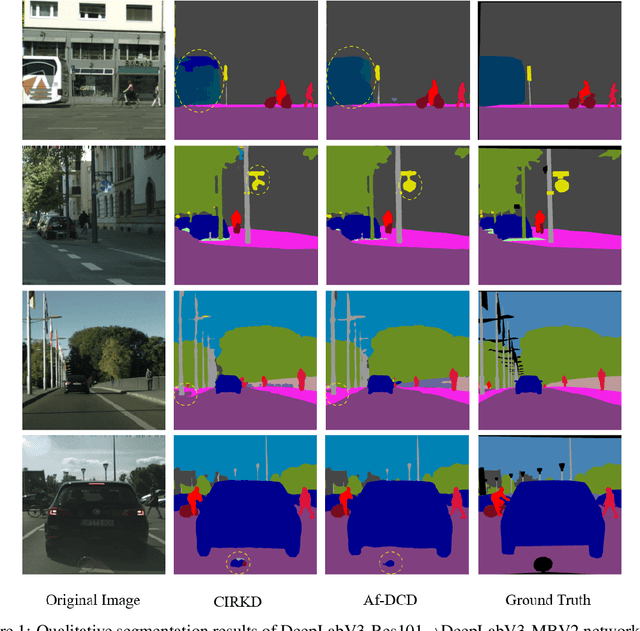
In recent years, knowledge distillation methods based on contrastive learning have achieved promising results on image classification and object detection tasks. However, in this line of research, we note that less attention is paid to semantic segmentation. Existing methods heavily rely on data augmentation and memory buffer, which entail high computational resource demands when applying them to handle semantic segmentation that requires to preserve high-resolution feature maps for making dense pixel-wise predictions. In order to address this problem, we present Augmentation-free Dense Contrastive Knowledge Distillation (Af-DCD), a new contrastive distillation learning paradigm to train compact and accurate deep neural networks for semantic segmentation applications. Af-DCD leverages a masked feature mimicking strategy, and formulates a novel contrastive learning loss via taking advantage of tactful feature partitions across both channel and spatial dimensions, allowing to effectively transfer dense and structured local knowledge learnt by the teacher model to a target student model while maintaining training efficiency. Extensive experiments on five mainstream benchmarks with various teacher-student network pairs demonstrate the effectiveness of our approach. For instance, the DeepLabV3-Res18|DeepLabV3-MBV2 model trained by Af-DCD reaches 77.03%|76.38% mIOU on Cityscapes dataset when choosing DeepLabV3-Res101 as the teacher, setting new performance records. Besides that, Af-DCD achieves an absolute mIOU improvement of 3.26%|3.04%|2.75%|2.30%|1.42% compared with individually trained counterpart on Cityscapes|Pascal VOC|Camvid|ADE20K|COCO-Stuff-164K. Code is available at https://github.com/OSVAI/Af-DCD
BCN: Batch Channel Normalization for Image Classification
Dec 01, 2023Normalization techniques have been widely used in the field of deep learning due to their capability of enabling higher learning rates and are less careful in initialization. However, the effectiveness of popular normalization technologies is typically limited to specific areas. Unlike the standard Batch Normalization (BN) and Layer Normalization (LN), where BN computes the mean and variance along the (N,H,W) dimensions and LN computes the mean and variance along the (C,H,W) dimensions (N, C, H and W are the batch, channel, spatial height and width dimension, respectively), this paper presents a novel normalization technique called Batch Channel Normalization (BCN). To exploit both the channel and batch dependence and adaptively and combine the advantages of BN and LN based on specific datasets or tasks, BCN separately normalizes inputs along the (N, H, W) and (C, H, W) axes, then combines the normalized outputs based on adaptive parameters. As a basic block, BCN can be easily integrated into existing models for various applications in the field of computer vision. Empirical results show that the proposed technique can be seamlessly applied to various versions of CNN or Vision Transformer architecture. The code is publicly available at https://github.com/AfifaKhaled/BatchChannel-Normalization
Soulstyler: Using Large Language Model to Guide Image Style Transfer for Target Object
Nov 29, 2023Image style transfer occupies an important place in both computer graphics and computer vision. However, most current methods require reference to stylized images and cannot individually stylize specific objects. To overcome this limitation, we propose the "Soulstyler" framework, which allows users to guide the stylization of specific objects in an image through simple textual descriptions. We introduce a large language model to parse the text and identify stylization goals and specific styles. Combined with a CLIP-based semantic visual embedding encoder, the model understands and matches text and image content. We also introduce a novel localized text-image block matching loss that ensures that style transfer is performed only on specified target objects, while non-target regions remain in their original style. Experimental results demonstrate that our model is able to accurately perform style transfer on target objects according to textual descriptions without affecting the style of background regions. Our code will be available at https://github.com/yisuanwang/Soulstyler.
4K-Resolution Photo Exposure Correction at 125 FPS with ~8K Parameters
Nov 15, 2023
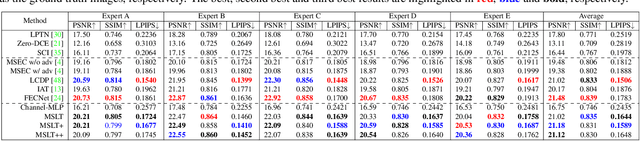
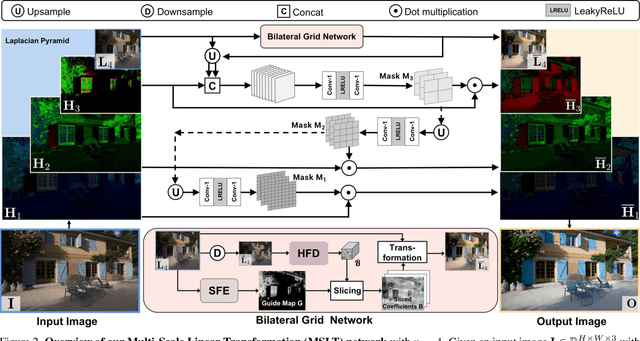
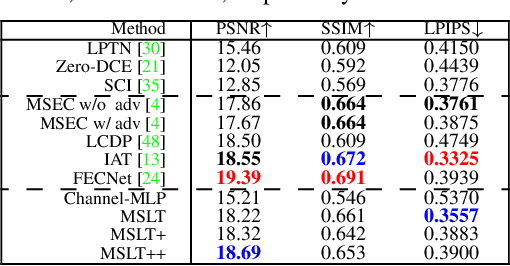
The illumination of improperly exposed photographs has been widely corrected using deep convolutional neural networks or Transformers. Despite with promising performance, these methods usually suffer from large parameter amounts and heavy computational FLOPs on high-resolution photographs. In this paper, we propose extremely light-weight (with only ~8K parameters) Multi-Scale Linear Transformation (MSLT) networks under the multi-layer perception architecture, which can process 4K-resolution sRGB images at 125 Frame-Per-Second (FPS) by a Titan RTX GPU. Specifically, the proposed MSLT networks first decompose an input image into high and low frequency layers by Laplacian pyramid techniques, and then sequentially correct different layers by pixel-adaptive linear transformation, which is implemented by efficient bilateral grid learning or 1x1 convolutions. Experiments on two benchmark datasets demonstrate the efficiency of our MSLTs against the state-of-the-arts on photo exposure correction. Extensive ablation studies validate the effectiveness of our contributions. The code is available at https://github.com/Zhou-Yijie/MSLTNet.