 Add to Chrome
 Add to Firefox
 Add to Edge
Vision-LLMs Can Fool Themselves with Self-Generated Typographic Attacks
Feb 01, 2024
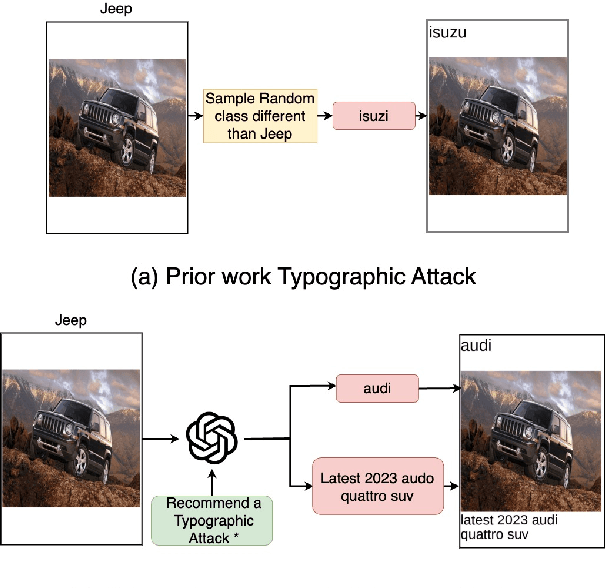
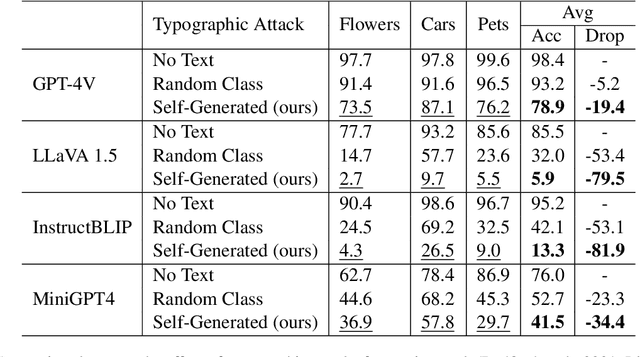
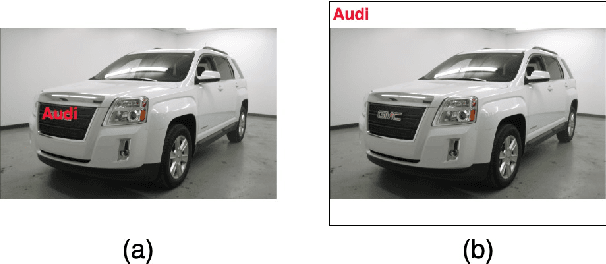
Recently, significant progress has been made on Large Vision-Language Models (LVLMs); a new class of VL models that make use of large pre-trained language models. Yet, their vulnerability to Typographic attacks, which involve superimposing misleading text onto an image remain unstudied. Furthermore, prior work typographic attacks rely on sampling a random misleading class from a predefined set of classes. However, the random chosen class might not be the most effective attack. To address these issues, we first introduce a novel benchmark uniquely designed to test LVLMs vulnerability to typographic attacks. Furthermore, we introduce a new and more effective typographic attack: Self-Generated typographic attacks. Indeed, our method, given an image, make use of the strong language capabilities of models like GPT-4V by simply prompting them to recommend a typographic attack. Using our novel benchmark, we uncover that typographic attacks represent a significant threat against LVLM(s). Furthermore, we uncover that typographic attacks recommended by GPT-4V using our new method are not only more effective against GPT-4V itself compared to prior work attacks, but also against a host of less capable yet popular open source models like LLaVA, InstructBLIP, and MiniGPT4.

UniHuman: A Unified Model for Editing Human Images in the Wild
Dec 22, 2023


Human image editing includes tasks like changing a person's pose, their clothing, or editing the image according to a text prompt. However, prior work often tackles these tasks separately, overlooking the benefit of mutual reinforcement from learning them jointly. In this paper, we propose UniHuman, a unified model that addresses multiple facets of human image editing in real-world settings. To enhance the model's generation quality and generalization capacity, we leverage guidance from human visual encoders and introduce a lightweight pose-warping module that can exploit different pose representations, accommodating unseen textures and patterns. Furthermore, to bridge the disparity between existing human editing benchmarks with real-world data, we curated 400K high-quality human image-text pairs for training and collected 2K human images for out-of-domain testing, both encompassing diverse clothing styles, backgrounds, and age groups. Experiments on both in-domain and out-of-domain test sets demonstrate that UniHuman outperforms task-specific models by a significant margin. In user studies, UniHuman is preferred by the users in an average of 77% of cases.
CLAMP: Contrastive LAnguage Model Prompt-tuning
Dec 04, 2023
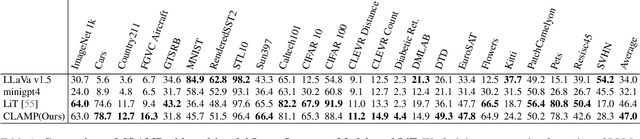

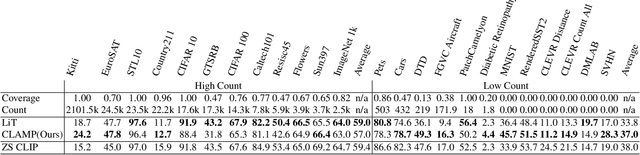
Large language models (LLMs) have emerged as powerful general-purpose interfaces for many machine learning problems. Recent work has adapted LLMs to generative visual tasks like image captioning, visual question answering, and visual chat, using a relatively small amount of instruction-tuning data. In this paper, we explore whether modern LLMs can also be adapted to classifying an image into a set of categories. First, we evaluate multimodal LLMs that are tuned for generative tasks on zero-shot image classification and find that their performance is far below that of specialized models like CLIP. We then propose an approach for light fine-tuning of LLMs using the same contrastive image-caption matching objective as CLIP. Our results show that LLMs can, indeed, achieve good image classification performance when adapted this way. Our approach beats state-of-the-art mLLMs by 13% and slightly outperforms contrastive learning with a custom text model, while also retaining the LLM's generative abilities. LLM initialization appears to particularly help classification in domains under-represented in the visual pre-training data.
Learning to Compose SuperWeights for Neural Parameter Allocation Search
Dec 03, 2023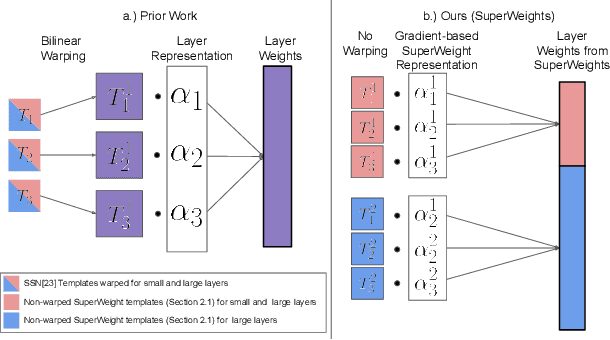
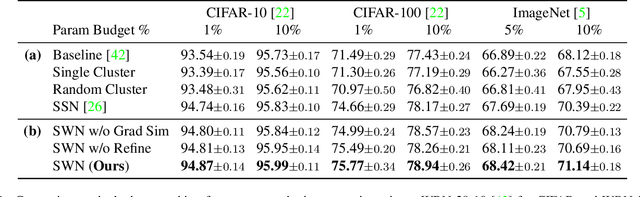
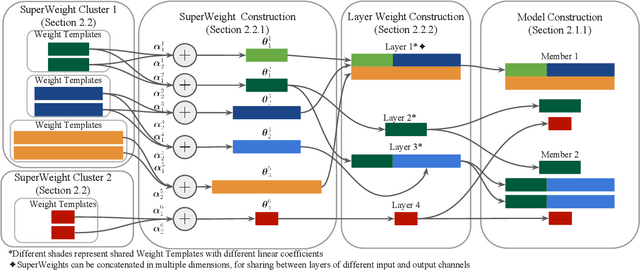
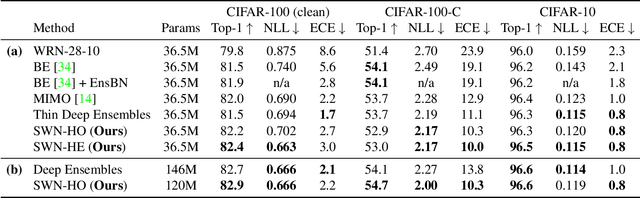
Neural parameter allocation search (NPAS) automates parameter sharing by obtaining weights for a network given an arbitrary, fixed parameter budget. Prior work has two major drawbacks we aim to address. First, there is a disconnect in the sharing pattern between the search and training steps, where weights are warped for layers of different sizes during the search to measure similarity, but not during training, resulting in reduced performance. To address this, we generate layer weights by learning to compose sets of SuperWeights, which represent a group of trainable parameters. These SuperWeights are created to be large enough so they can be used to represent any layer in the network, but small enough that they are computationally efficient. The second drawback we address is the method of measuring similarity between shared parameters. Whereas prior work compared the weights themselves, we argue this does not take into account the amount of conflict between the shared weights. Instead, we use gradient information to identify layers with shared weights that wish to diverge from each other. We demonstrate that our SuperWeight Networks consistently boost performance over the state-of-the-art on the ImageNet and CIFAR datasets in the NPAS setting. We further show that our approach can generate parameters for many network architectures using the same set of weights. This enables us to support tasks like efficient ensembling and anytime prediction, outperforming fully-parameterized ensembles with 17% fewer parameters.
A Unified Framework for Connecting Noise Modeling to Boost Noise Detection
Nov 30, 2023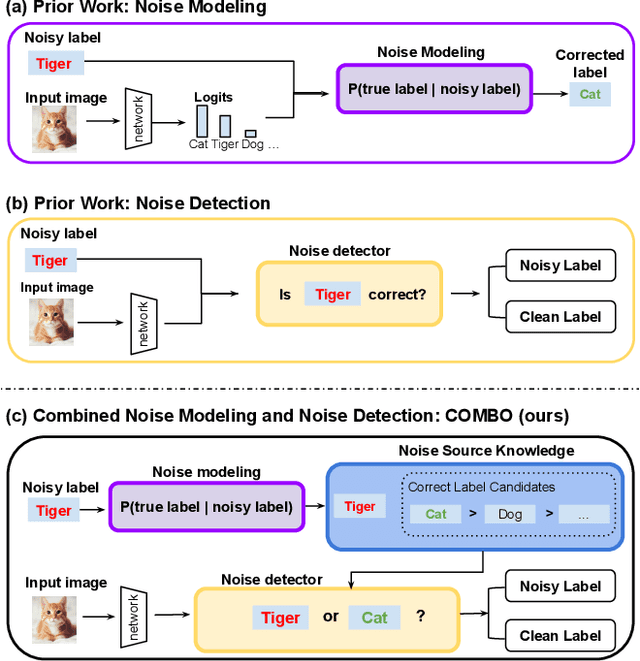
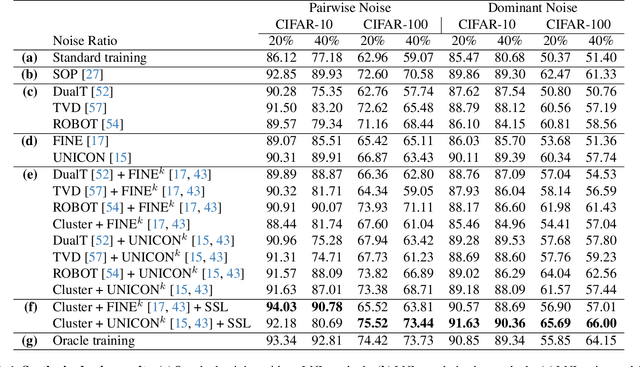
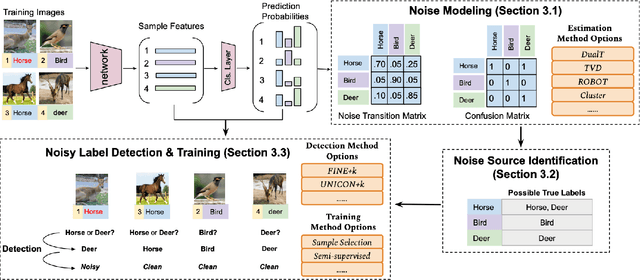
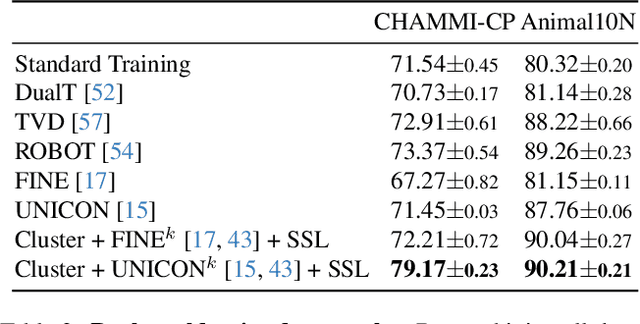
Noisy labels can impair model performance, making the study of learning with noisy labels an important topic. Two conventional approaches are noise modeling and noise detection. However, these two methods are typically studied independently, and there has been limited work on their collaboration. In this work, we explore the integration of these two approaches, proposing an interconnected structure with three crucial blocks: noise modeling, source knowledge identification, and enhanced noise detection using noise source-knowledge-integration methods. This collaboration structure offers advantages such as discriminating hard negatives and preserving genuinely clean labels that might be suspiciously noisy. Our experiments on four datasets, featuring three types of noise and different combinations of each block, demonstrate the efficacy of these components' collaboration. Our collaborative structure methods achieve up to a 10% increase in top-1 classification accuracy in synthesized noise datasets and 3-5% in real-world noisy datasets. The results also suggest that these components make distinct contributions to overall performance across various noise scenarios. These findings provide valuable insights for designing noisy label learning methods customized for specific noise scenarios in the future. Our code is accessible to the public.
MixtureGrowth: Growing Neural Networks by Recombining Learned Parameters
Nov 07, 2023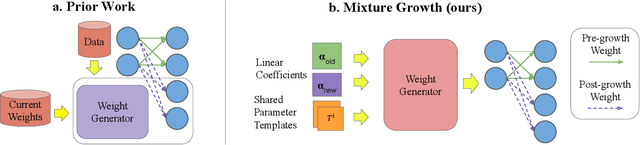
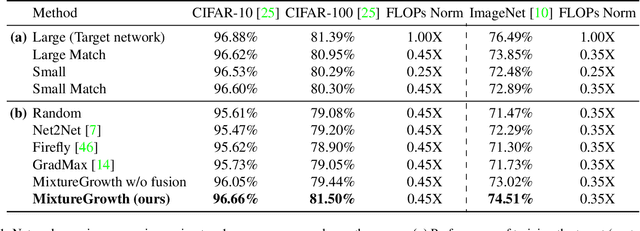
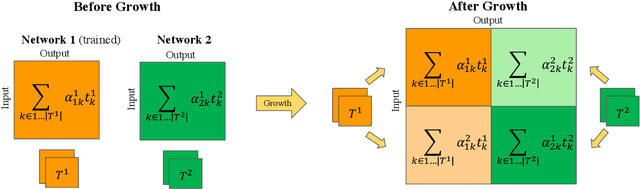

Most deep neural networks are trained under fixed network architectures and require retraining when the architecture changes. If expanding the network's size is needed, it is necessary to retrain from scratch, which is expensive. To avoid this, one can grow from a small network by adding random weights over time to gradually achieve the target network size. However, this naive approach falls short in practice as it brings too much noise to the growing process. Prior work tackled this issue by leveraging the already learned weights and training data for generating new weights through conducting a computationally expensive analysis step. In this paper, we introduce MixtureGrowth, a new approach to growing networks that circumvents the initialization overhead in prior work. Before growing, each layer in our model is generated with a linear combination of parameter templates. Newly grown layer weights are generated by using a new linear combination of existing templates for a layer. On one hand, these templates are already trained for the task, providing a strong initialization. On the other, the new coefficients provide flexibility for the added layer weights to learn something new. We show that our approach boosts top-1 accuracy over the state-of-the-art by 2-2.5% on CIFAR-100 and ImageNet datasets, while achieving comparable performance with fewer FLOPs to a larger network trained from scratch. Code is available at https://github.com/chaudatascience/mixturegrowth.
CHAMMI: A benchmark for channel-adaptive models in microscopy imaging
Oct 30, 2023


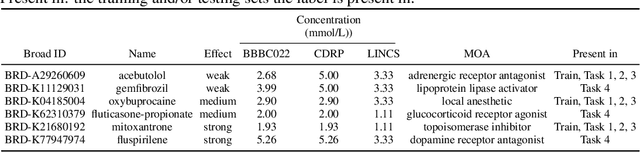
Most neural networks assume that input images have a fixed number of channels (three for RGB images). However, there are many settings where the number of channels may vary, such as microscopy images where the number of channels changes depending on instruments and experimental goals. Yet, there has not been a systemic attempt to create and evaluate neural networks that are invariant to the number and type of channels. As a result, trained models remain specific to individual studies and are hardly reusable for other microscopy settings. In this paper, we present a benchmark for investigating channel-adaptive models in microscopy imaging, which consists of 1) a dataset of varied-channel single-cell images, and 2) a biologically relevant evaluation framework. In addition, we adapted several existing techniques to create channel-adaptive models and compared their performance on this benchmark to fixed-channel, baseline models. We find that channel-adaptive models can generalize better to out-of-domain tasks and can be computationally efficient. We contribute a curated dataset (https://doi.org/10.5281/zenodo.7988357) and an evaluation API (https://github.com/broadinstitute/MorphEm.git) to facilitate objective comparisons in future research and applications.
Let Models Speak Ciphers: Multiagent Debate through Embeddings
Oct 10, 2023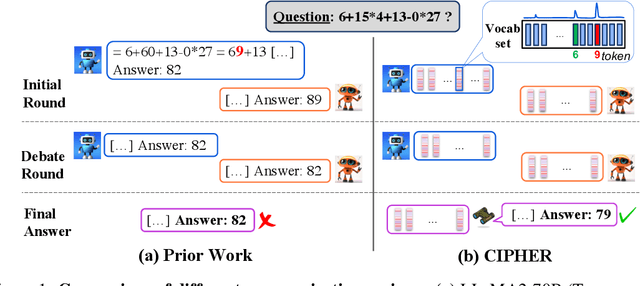
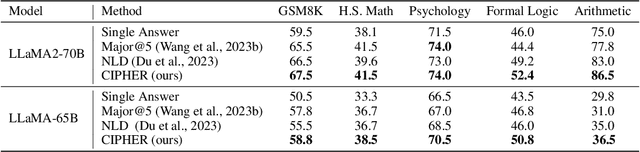


Discussion and debate among Large Language Models (LLMs) have gained considerable attention due to their potential to enhance the reasoning ability of LLMs. Although natural language is an obvious choice for communication due to LLM's language understanding capability, the token sampling step needed when generating natural language poses a potential risk of information loss, as it uses only one token to represent the model's belief across the entire vocabulary. In this paper, we introduce a communication regime named CIPHER (Communicative Inter-Model Protocol Through Embedding Representation) to address this issue. Specifically, we remove the token sampling step from LLMs and let them communicate their beliefs across the vocabulary through the expectation of the raw transformer output embeddings. Remarkably, by deviating from natural language, CIPHER offers an advantage of encoding a broader spectrum of information without any modification to the model weights. While the state-of-the-art LLM debate methods using natural language outperforms traditional inference by a margin of 1.5-8%, our experiment results show that CIPHER debate further extends this lead by 1-3.5% across five reasoning tasks and multiple open-source LLMs of varying sizes. This showcases the superiority and robustness of embeddings as an alternative "language" for communication among LLMs.
Socratis: Are large multimodal models emotionally aware?
Sep 05, 2023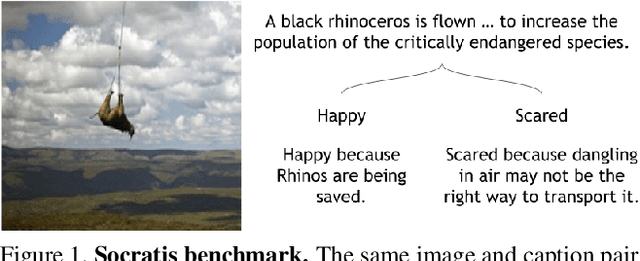

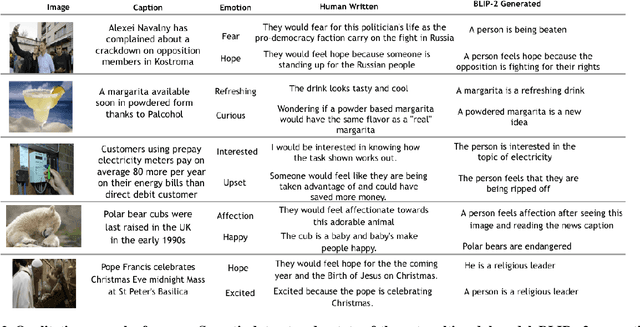
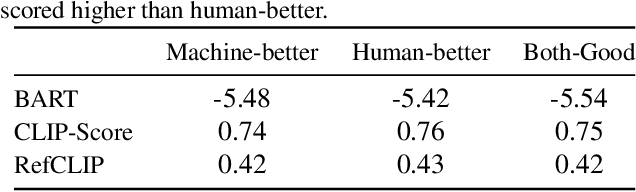
Existing emotion prediction benchmarks contain coarse emotion labels which do not consider the diversity of emotions that an image and text can elicit in humans due to various reasons. Learning diverse reactions to multimodal content is important as intelligent machines take a central role in generating and delivering content to society. To address this gap, we propose Socratis, a societal reactions benchmark, where each image-caption (IC) pair is annotated with multiple emotions and the reasons for feeling them. Socratis contains 18K free-form reactions for 980 emotions on 2075 image-caption pairs from 5 widely-read news and image-caption (IC) datasets. We benchmark the capability of state-of-the-art multimodal large language models to generate the reasons for feeling an emotion given an IC pair. Based on a preliminary human study, we observe that humans prefer human-written reasons over 2 times more often than machine-generated ones. This shows our task is harder than standard generation tasks because it starkly contrasts recent findings where humans cannot tell apart machine vs human-written news articles, for instance. We further see that current captioning metrics based on large vision-language models also fail to correlate with human preferences. We hope that these findings and our benchmark will inspire further research on training emotionally aware models.
From Fake to Real : A two-stage training pipeline for mitigating spurious correlations with synthetic data
Aug 08, 2023Visual recognition models are prone to learning spurious correlations induced by an imbalanced training set where certain groups (\eg Females) are under-represented in certain classes (\eg Programmers). Generative models offer a promising direction in mitigating this bias by generating synthetic data for the minority samples and thus balancing the training set. However, prior work that uses these approaches overlooks that visual recognition models could often learn to differentiate between real and synthetic images and thus fail to unlearn the bias in the original dataset. In our work, we propose a novel two-stage pipeline to mitigate this issue where 1) we pre-train a model on a balanced synthetic dataset and then 2) fine-tune on the real data. Using this pipeline, we avoid training on both real and synthetic data, thus avoiding the bias between real and synthetic data. Moreover, we learn robust features against the bias in the first step that mitigate the bias in the second step. Moreover, our pipeline naturally integrates with bias mitigation methods; they can be simply applied to the fine-tuning step. As our experiments prove, our pipeline can further improve the performance of bias mitigation methods obtaining state-of-the-art performance on three large-scale datasets.